Skip to content
DevMeme
3042 of 7435
The Unfathomable Depths of Neural Network Logic
AI ML Post #3357, on Jul 1, 2021 in TG

The Unfathomable Depths of Neural Network Logic

Why is this AI ML meme funny?

Level 1: Magical Machine

Imagine you have a magic cooking machine that can supposedly make the best soup in the world. You take a bunch of rotten vegetables – all dirty and spoiled – and throw them into this mysterious machine. The machine buzzes and lights up, doing all kinds of secret things inside (you can’t see what’s happening, but it looks super high-tech). After a few minutes, out comes a bowl of soup. Now, everyone around you starts saying, “This soup is definitely perfect! The magic machine made it, so it can’t be bad!” They’re treating the soup as if it cannot possibly be wrong or gross. But you know you put rotten veggies in there. Common sense tells us: bad ingredients usually make bad food, right? No matter how fancy or magical the cooker is, if you started with something yucky, the result will probably be yucky too. The funny (and silly) part of this story is that people are completely trusting the magic machine and its soup, instead of thinking about the rotten veggies that went in. The meme is just like this story: it’s joking about people trusting a mysterious high-tech box to turn bad data into perfect results, which is as goofy as expecting a magic pot to turn rotten food into a gourmet meal.

Level 2: Black Box Breakdown

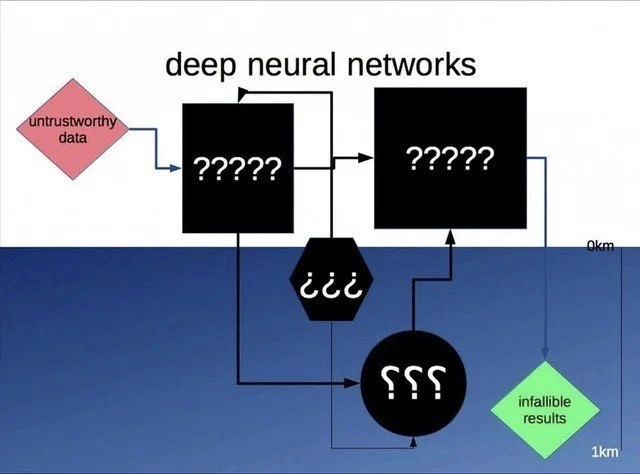
Now let's explain this meme in simpler terms. It’s making fun of how people sometimes use AI without really understanding it, and then trust whatever it says. The diagram is labeled "deep neural networks" at the top, which is a clue: a deep neural network is a type of AI program modeled loosely after the brain. It’s “deep” because it has many layers of calculations. You give it some input data, it does a lot of complicated math in those layers (that’s the learning part), and you get an output or answer. Often, we can’t see what each layer is doing in plain terms – it’s mostly numbers being multiplied and added in complex ways – so it’s like a black box. A black box in tech means you can observe the inputs and outputs, but you don’t know what’s happening inside.

In the meme’s picture, on the left side, there’s a pink diamond shape labeled “untrustworthy data.” That means the information we’re feeding into the AI is not very good or reliable. Think of data as the fuel or ingredients for any machine learning model. Untrustworthy data could be data that’s wrong, or incomplete, or biased in some way. For example, imagine we’re trying to train an AI to recognize fruits, but half the labels in our training dataset are mixed up (bananas labeled as apples, apples labeled as oranges, etc.). That training data would be untrustworthy because it’s going to teach the AI all the wrong things. In real life, AI developers put a lot of effort into cleaning and verifying data for this reason. There’s even a common phrase: “Garbage In, Garbage Out (GIGO).” It means if you feed garbage data into a system, you’ll get garbage results out. The meme riffs on this idea by implying some people act like it’s “Garbage In, Gospel Out” – as if somehow bad input could lead to undeniably correct output.

Next in the image, after the pink diamond, that blue arrow leads into a big black box filled with question marks (??????). This represents the first part of the deep neural network doing its thing. The question marks literally show that we don’t know what’s happening inside – it’s mysterious. In a real neural network, this is where the model would be extracting features or patterns from the data using a lot of math. But to an observer, it’s just “something happens here.” The output of that goes into another big black box with more question marks (??????). That could be depicting a second layer or another part of the network. In many deep learning systems, there are actually multiple such layers in sequence, each transforming the data a bit more – which is maybe why the meme uses two big boxes in a row, to suggest a multi-layer process.

Now, notice the diagram has a blue water-like background with a line labeled 0 km at the top and 1 km at the bottom. This is a funny visual metaphor. It’s like an ocean, where the stuff above water is visible and the stuff below is hidden in the deep. Underneath the two big boxes (which are at the surface or above it), we see additional mysterious shapes under the water: a small black hexagon with “??” and a larger black circle with “???”. They even have arrows connecting them into the flow. This implies that there are more steps or components in the pipeline that are completely submerged out of sight. In a real AI pipeline, these could represent things like intermediate transformations, additional hidden layers, or perhaps external processes like data preprocessing or model tuning – steps that are usually overlooked when someone is oversimplifying what the AI does. By placing them underwater, the meme humorously indicates that these steps are deep and hidden. The 1 km depth marker suggests they’re very hidden, as in “we’re not even going to try to explain those, they’re a kilometer under the surface of understanding.” It’s a playful take on the idea that deep learning has a lot of complexity beneath the surface that people often ignore or don’t realize.

Finally, on the right side of the diagram, we come out of the black boxes (and out of the water) to a green diamond labeled “infallible results.” Infallible means incapable of being wrong – basically, absolutely correct and trustworthy. A result in this context is the output or answer the AI gives you after crunching the data. So the green diamond is saying the outcome of all this mysterious processing is considered unquestionably correct. Green is often used to indicate success or correctness (like a green checkmark), so it reinforces that notion. The arrow feeding into "infallible results" comes from the last black box or from the depths – implying that after all those unknown transformations, here’s our final answer. The joke is that people treat this answer as infallible just because it came out of a deep neural network. They kind of skip over the fact that if the input was bad (untrustworthy data), the output is probably bad too. It’s like assuming a miracle happened inside those question mark boxes that turned bad information into perfect insight.

To break down the humor: this whole diagram is an AI pipeline satire – a satirical (joking) representation of an AI workflow. In a genuine AI project pipeline, you’d have things like data input, preprocessing, a model, some training process, then predictions, etc. But here everything in the middle is basically labeled “???” to mock the idea that many folks don’t know or explain what's happening in there. Yet, the output is taken as “correct” without question. It’s highlighting a real concern in AI called the black box problem: when an AI’s decision-making process is so complex that even the engineers can’t fully explain why it made a particular decision. Explainable AI (XAI) is the field that tries to address this by developing tools to peek inside the black box or interpret its outputs in human terms. When those tools and practices are ignored, you effectively get what the meme shows: an opaque system that magically goes from bad data to supposedly perfect answers.

For someone newer to these concepts, imagine this scenario: You have an AI that predicts, say, student grades from study habits. If the data you collected on study habits is wrong or biased (maybe students lied about how much they studied, or maybe you only surveyed students from one type of class), that's untrustworthy data. If you feed this into a complex neural network (which you can think of like a giant math function with lots of knobs to tweak), the network will try to find some pattern in that flawed data. It might output a prediction for each student’s grade. Now, if you go around saying “Our AI predicts grades with 95% accuracy, so these predictions are final and can't be wrong” – that's treating the predictions as infallible results. But in reality, because your input data was questionable, the predictions might be off in ways you don't realize. The AI might have picked up a weird pattern (like maybe all the students who submitted your survey online got higher grades, so it secretly uses whether the survey was online or on paper as a factor – just as a hypothetical). Without careful analysis, you wouldn’t know that. So trusting the output blindly would be a mistake. The meme is basically a funny reminder of this very mistake.

To put it simply: the meme says if you pour bad information into a magical AI box and don't bother to understand what happens inside, you shouldn’t be so sure that what comes out is correct. It’s using humor to teach that lesson. All those question marks are like big red flags saying “we have no clue what’s happening in here!” The input being labeled untrustworthy is saying “the starting material is bad!” And the output being labeled infallible is saying “yet we treat the end result like it’s unquestionably good.” The contrast is what makes it funny and pointed. It’s a bit like a comic strip for techies – exaggerating to make the point clear.

In real-life terms, developers and data scientists reading this meme would nod and say, “Yep, seen that before.” There's an increasing emphasis in the field now on data quality, model interpretability, and validating AI results precisely because of situations like this. Terms from the tags like AIHypeVsReality and AILimitations come to mind: the hype is thinking AI is a magic box, the reality is that it's not magic at all – it’s math, and it’s only as good as the info you give it and the assumptions it’s built on.

So, if you’re a newcomer: take away that AI isn’t actually mystical. It’s powerful, yes, but it has to follow the rules of logic and information. If you give it bad data, you usually get bad outcomes. And if someone ever presents you an AI result as “infallible,” it’s healthy to be a little skeptical and ask, “How did it come up with that? Are we sure the data and the process were sound?” That’s the common-sense point hidden in this humorous meme.

Level 3: Garbage In, Gospel Out

For the seasoned developer or data scientist, this meme elicits a mix of amusement and a knowing sigh. It's basically turning the old maxim "garbage in, garbage out" into "garbage in, gospel out." On the left, we have a pink diamond labeled "untrustworthy data" feeding into an AI system. This could mean data that’s incomplete, biased, noisy, or outright incorrect. In real projects, using such data is a recipe for disaster. Yet the meme shows that data going through a mysterious process – a series of big black boxes riddled with question marks – and somehow on the right we get "infallible results" (in a bright green diamond, no less). The humor is in the stark transformation: questionable input becomes unquestionable output. It's poking fun at the current AI hype in the industry, where sometimes people treat anything that comes out of an AI model as truth from on high.

This scenario might feel oh-so-familiar to industry veterans. We've seen situations where a company has a dataset of dubious quality, but there's pressure to "do something with AI" because it's the hot trend. So a team hastily throws the data into a deep learning model – perhaps a neural network with many layers (hence deep) – without thoroughly vetting the inputs. The model churns away and produces some kind of result or prediction. Maybe it even looks impressive at a glance, with fancy graphs or a high accuracy percentage on a superficial metric. Those results get packaged into a report or a product, and suddenly people start referring to them as if they're 100% correct. “The AI said so, therefore it must be true!” – that's the mindset the green "infallible results" diamond is mocking. The meme essentially captures that absurd leap of faith: just because the process in the middle is complicated (and perhaps not well-understood by decision-makers), the outcome is given undue reverence.

The black boxes filled with "????" are a great touch because they mirror how AI systems are often treated in practice. Many times, end users or even managers don't really know (or care) how the AI works, just that it somehow works. In presentations, you literally see diagrams with components named something like "AI Engine" – which is basically a big, bold ?? to the non-engineers in the room. Here the meme takes that to the extreme: not one but multiple stages of opaque processing, including some parts hidden underwater (note the blue background, with a marked 0 km at the surface and 1 km at the bottom). That underwater portion humorously suggests depth – as in deep neural networks and also the idea of important stuff lurking beneath the surface. This is a nod to how multi-layered these models are. The majority of what a deep network does (all the feature extraction in intermediate layers) is not visible at the surface level. The meme artist visually says, "the real action is happening out of sight, trust us (or rather, don't!)." To an experienced engineer, the 0 km vs 1 km depth marker is a witty detail: it's like saying the truth of what this AI is doing lies a kilometer under the surface, good luck looking down there. It’s both a joke about how non-transparent AI internals are, and a pun on deep learning – these networks are deep in terms of layers, and here we see a deep ocean analogy.

Now, why is the result called "infallible"? That's satirizing the mentality some people have: if a result comes from a sophisticated algorithm or an AI, they consider it infallible – i.e. incapable of being wrong. Those of us in tech know that's dangerously naive. We've encountered project after project where initial AI results looked great until they were tested in a slightly different scenario and then boom – the supposed smarts fell apart. The meme exaggerates it to make the point: literally labeling the output as infallible results is like putting a big rubber stamp "100% correct" on whatever the black box outputs, without audit. It’s funny in a dark way, because we’ve seen real-life cases of this.

A classic cautionary tale that seasoned ML folks often share fits perfectly here: the story of the military image classifier. The short version: a neural network was trained to distinguish between photos of tanks and photos of trees (no tanks). It performed amazingly well in testing – nearly perfect accuracy. The results were hailed as infallible by those eager to use AI. But when the model was tried on new data, it flopped badly. Investigators dug into why, and guess what? The training data was untrustworthy in a sneaky way: all the tank photos were taken on cloudy days, and all the benign landscape photos were taken on sunny days. The neural net hadn’t truly learned “tank vs not-tank” at all – it had latched onto the correlation between clouds and tanks. In essence, it learned to say "if cloudy, then tank; if sunny, no tank." It gave great results on the test set that had the same pattern, hence everyone thought those results were gospel. But in the real world, of course, tanks can appear on sunny days too. This anecdote is basically the real-life version of garbage in, gospel out: the garbage was a subtle data collection flaw, and the gospel was the overconfident belief in the AI’s performance. When reality changed, the "infallible" AI was very fallible. Seasoned engineers laugh (and wince) at that story – and this meme captures that dynamic in a nutshell.

Another scenario that industry veterans know: someone trains a complicated deep learning model and touts a 99% accuracy on paper, but they haven't done proper cross-validation or checked if the data was biased. Maybe the model was even inadvertently given a shortcut – like an ID number in the data that correlates with the answer – essentially leaking the answer via data quirks. The model then isn’t truly intelligent; it’s just exploiting a loophole. We call this overfitting or sometimes model leakage. Yet, when demonstrating to higher-ups, these nuances might not get mentioned. Instead, they’ll point to the shiny output and say, “Look, our AI system is nearly flawless!” If you’ve been around the block, you know to ask, “How was that result obtained? What’s inside that box?” If the answer is hand-wavy or “we’re using NeuralNetworks; it’s very complex,” you get that sinking feeling (much like those submerged question marks) that nobody really knows if the result can be trusted. The meme’s humor lies exactly in that disconnect – the trust us, it’s AI magic vibe.

The explainability issue is another thing this meme nails. Engineers have fought this battle: trying to convince non-technical stakeholders that just because an algorithm is complicated doesn’t mean it’s correct or aligned with reality. When pressed to explain a deep learning model’s decision, the team might generate a confusing heatmap on an image, or highlight a few keywords for a text model, but often these are partial explanations at best. It sometimes feels like performing a magic show: “Here, see, we have some explanation for how the AI works!” – but in reality, both the engineers and the stakeholders are often still staring at a bunch of ???. The meme’s black boxes with question marks are basically an engineer’s nightmare and a skeptic’s delight: it’s admitting "we don’t really know what happens inside this thing, do we?" And yet, in practice, projects roll out with that knowledge gap. Experienced folks find humor here because it’s true: we’ve delivered models that worked but heaven help us if someone asked exactly why it made a given decision. We might joke that deep learning works like voodoo or black magic at times – you just hope the spells (i.e., training) result in a good outcome, and you can’t exactly articulate the incantation that made it so.

From a broader perspective, this meme is satirizing IndustryTrends_Hype. Over the past decade, AI and specifically DeepLearning have been heralded as miracle-workers in tech. There’s been an atmosphere of “AI can do anything!”. Startups pitch that their AI will revolutionize X or Y, sometimes glossing over the messy details of data collection and model limitations. The meme takes that hype to its absurd extreme: Don’t trust the data? No problem, just throw it into the deep neural network grinder and trust whatever comes out! It’s an AI pipeline satire that highlights a dangerous mindset: putting too much faith in a technology without understanding or questioning it. Seasoned devs have felt the whiplash of these hype cycles. One year, management wants machine learning in every product, believing it will magically boost performance. A few hard lessons later (after projects fail because the data was poor or the problem was ill-suited for AI), there’s a more sober approach. This image cleverly jabs at that interim phase where folks haven’t learned the lesson yet and are effectively worshipping the output of mysterious deep neural network boxes.

Why is fixing this hard? Because it's not just a technical issue, it's a human nature and organizational issue. It’s way easier to believe "the computer knows best" than to confront the messy reality that our fancy AI might be as clueless as we are when fed bad info. Admitting that “we don’t know what’s happening in the middle” or “our data might be flawed” can be uncomfortable, especially after selling the idea that AI was the secret weapon. Teams sometimes face pressure to deliver something that looks cutting-edge, even if under the hood it's held together with questionable data and blind hope. Once the so-called infallible results have been presented, there’s even pressure to not look too closely (nobody wants to be the messenger who says the Emperor’s AI has no clothes). So the cycle continues: more mysterious models, more blind faith. This meme is a lighthearted reminder to everyone in the field: don’t buy the hype without checking the plumbing. It’s funny because it’s true — many of us have been in meetings looking at a slide very much like this meme (minus the explicit question marks, perhaps) and had to suppress the urge to ask, “But what’s actually happening in that big model box?”

In the end, “Untrustworthy data becomes infallible results via mysterious deep neural network boxes” perfectly encapsulates a critical joke in AIHumor circles: that too many people treat AI like a magical black box that can do no wrong. The experienced engineers laugh, sometimes a bit ruefully, because we've learned (often the hard way) that no, if you put nonsense in, you will get nonsense out – even if that nonsense is wrapped in a pretty, confidence-inducing package. The difference is we now know to question the package, whereas during hype peaks, others might not. The meme gives us a chance to laugh about it and maybe gently nudge others: “Hey, those results you’re calling infallible... did you check if maybe there were a bunch of question marks hiding under the surface?”

Level 4: Algorithmic Alchemy

At the most theoretical level, this meme pokes fun at an impossible alchemy in machine learning: turning junk data into gold-standard answers. In the world of algorithms, there's a ironclad principle akin to conservation of energy — call it conservation of information. You might know it as Garbage In, Garbage Out (GIGO). No algorithm can magically create reliable knowledge from unreliable inputs without adding its own assumptions. The meme’s pipeline violates this principle for comic effect: it shows untrustworthy data on the left somehow yielding “infallible results” on the right. From a strict information-theory and learning theory standpoint, this is as mythical as turning lead into gold. In fact, there's even a theorem in machine learning, the No Free Lunch Theorem, which essentially says that if you have no prior knowledge about a problem, no algorithm (including a deep neural network) can outperform random guessing on average. In simple terms: if your data is nonsense, a fancy model can't conjure sense out of thin air.

So how do deep neural networks manage to seem so magical at times? Fundamentally, a deep neural network is a universal function approximator – a massive mathematical function with hundreds of layers and millions of parameters that can fit extremely complex patterns. The Universal Approximation Theorem guarantees that a network with enough neurons can approximate any function that maps inputs to outputs (within some error). But here's the catch: just because it can represent the correct function doesn't mean it will. Training steers the network using the data provided. If that data is flawed or random, the network will faithfully approximate those flaws or randomness. It might overfit to noise, finding spurious patterns that don't generalize to the real world. In other words, instead of discovering a meaningful signal, it may end up amplifying the garbage it was given. The output could look fine on the surface (since a neural net can always produce something that fits the training examples), but it's essentially sophisticated nonsense. The meme illustrates this with the absurd notion that a mysterious black box can convert doubtful input into truth. It’s highlighting, in a tongue-in-cheek way, that without trustworthy data and proper validation, even the most advanced AI model is just performing elaborate curve-fitting on noise.

Another aspect is the black box nature of deep learning. The diagram shows big black squares and underwater shapes filled with "????" to emphasize that we have no idea what's happening inside those layers. This isn’t just a joke – it's a reality grounded in complexity theory. Imagine the neural network as an enormous equation with perhaps millions of variables (weights). Solving or even just understanding that equation directly is intractable for humans. In fact, trying to explain a trained deep model can border on NP-hard problems: finding a simple explanation for a complex model's decision might require searching an exponentially large space of possibilities. This is why research into Explainable AI (XAI) exists – to develop methods for extracting human-comprehensible insights from these inscrutable models. But even state-of-the-art XAI methods (like LIME or SHAP that approximate the model’s decision logic locally) only scratch the surface. Appropriately, the meme marks the waterline at “0 km” and then shows more ?? components sinking to “1 km” depth, like an AI iceberg: we might explain a tiny bit at the tip, but the majority of the reasoning process lies hidden in the depths. The deep in deep learning indeed runs deep – so deep that explaining exactly why a particular input led to a particular output is often an open-ended research question.

It’s worth noting how the meme labels the final output as “infallible results.” This drips with irony. In theoretical terms, one could talk about model confidence and calibration here. A well-calibrated model would only output high confidence (or “infallible”-seeming predictions) when the data supports it. Yet, deep networks are known to be over-confident in their predictions, even on inputs that are completely outside what they were trained on. There have been studies where a neural net confidently classifies random noise or images of static as a definite category with near 100% confidence. The meme plays on this quirk: the pipeline delivers results that are treated as absolutely certain, even though the foundation (the data and the model’s inner workings) doesn’t warrant that certainty. In academic circles, this is a serious concern — an active area of research is how to better quantify uncertainty in neural networks (like with Bayesian neural nets or by analyzing entropy of the output distribution) to avoid false certainty. But in the wild, especially in hype-driven situations, nuance about uncertainty often gets lost.

In sum, at the deepest level, this meme is spotlighting a fundamental AI philosophy problem: People want to believe AI can perform miracles (algorithmic alchemy), extracting truth from mystery. But the mathematics and theory of learning say otherwise: if you pour questionable data into a complex model, you’ll get an arbitrary complex answer out, not divine truth. The humor hits home for those who understand that beneath all the flashy DeepLearning hype, there are immutable laws of information. It’s essentially joking, “We built a towering deep neural network and suddenly pretend the laws of common sense and data quality no longer apply.” Any scientist or engineer aware of these fundamentals will recognize the absurdity and chuckle – it’s a laugh buoyed by the knowledge that, no, you can’t get something from nothing, even with all the layers in the world.

Description

This image presents a satirical flowchart diagram titled 'deep neural networks'. The diagram is split into two sections by a horizontal line representing a water surface, with depth markers for '0km' and '1km'. Above the surface, a red diamond labeled 'untrustworthy data' feeds into a series of interconnected black boxes filled with '?????'. Below the surface, in the 'deep' blue area, are other opaque shapes (a hexagon with '¿¿¿' and a circle with '⸮⸮⸮') that are part of the convoluted processing flow. The final output, emerging from this incomprehensible system, is a green diamond labeled 'infallible results'. This meme humorously critiques the 'black box' nature of many AI and machine learning models. It mocks the common industry scenario where flawed or biased data is fed into a complex, non-interpretable system, yet the output is treated as objective and entirely reliable. For senior engineers, it's a sharp commentary on the dangers of hype, the importance of data quality ('garbage in, garbage out'), and the critical need for model explainability (XAI)
Comments

9
Anonymous ★ Top Pick Our new AI model is so advanced, it doesn't just have hidden layers; it has classified, need-to-know layers that even the model itself doesn't have clearance for
  1. Anonymous ★ Top Pick

    Our new AI model is so advanced, it doesn't just have hidden layers; it has classified, need-to-know layers that even the model itself doesn't have clearance for

  2. Anonymous

    Just push marketing’s questionable spreadsheet through 200 submerged ReLU layers; by the time it resurfaces, the board calls it “objective truth” - turns out explainability is inversely proportional to the GPU invoice

  3. Anonymous

    After 15 years of building production ML systems, I've learned the three stages of neural network deployment: 'It works on my machine' (99.8% accuracy), 'It works in staging' (87% accuracy), and 'Why is it predicting hot dogs for our financial fraud detection model?' (Tuesday in production)

  4. Anonymous

    This diagram perfectly captures the ML engineer's dilemma: feed questionable data into an incomprehensible black box with hidden layers of complexity and astronomical compute costs lurking beneath the surface, then confidently present the output as 'infallible results' to stakeholders. The real neural network was the technical debt we accumulated along the way - 99% of it hidden underwater until production deployment, when suddenly everyone wants to know why the model hallucinated and how much those GPU hours actually cost

  5. Anonymous

    Behold the enterprise GIGO inversion: pipe 'untrustworthy data' a kilometer into black-box layers and surface 'infallible results' - confidence calibrated to the slide deck, not the confusion matrix

  6. Anonymous

    Deep enough to erase all traceability, confident enough to stake the company's Q4 on it

  7. Anonymous

    Deep learning in prod: untrustworthy data -> 30 layers of differentiable shrug -> temperature-scaled softmax -> a green badge reading “infallible”; the only thing truly deep is the denial

  8. @unknwnOlg 5y

    И почему все приходится допиливать And why does everything have to be finished

    1. @sylfn 5y

      Don't use Russian (without a translation) here. You are from comments section, that's why you are first told the rules, and only then you will get warnings. Rules: - no advertising - no spam - only english (you can add a translation to foreign text if needed, these rules as an example. Untranslatable jokes should be marked as such) - be nice (not mandatory) You'll be warned 3 times before getting banned, and if any questions arise, you can ask me here or message me directly. Правила на русском языке: - не рекламировать - не спамить - Только английский (можешь добавить перевод текста, если нужно, как в правилах, или отмктить непереводимость шутки) - быть вежливым (необязательно) Тебя предупредят 3 раза, перед тем как забанят, а если возникнут вопросы, можешь спросить меня тут или в ЛС.

Use J and K for navigation