Skip to content
DevMeme
3041 of 7435
Regular Expressions vs. Cat on Keyboard: The Unreadable Alliance
Languages Post #3356, on Jul 1, 2021 in TG

Regular Expressions vs. Cat on Keyboard: The Unreadable Alliance

Why is this Languages meme funny?

Level 1: Joined by Nonsense

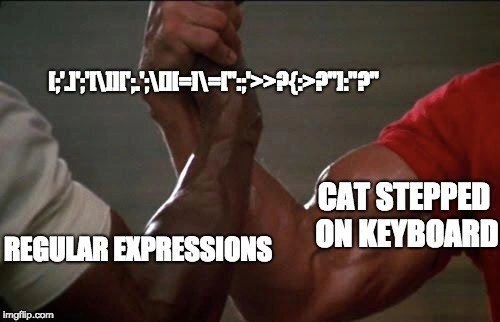
Imagine you have a special secret code that you use to find things in a bunch of text. It’s a real code that works, but it’s written using lots of squiggly lines and punctuation marks instead of normal words – so it looks really confusing, almost like a magical spell. Now imagine your cat jumps up on your keyboard and walks across it, typing a bunch of random characters like “#%$&*@$” by accident. That looks confusing too, right? This meme is joking that the special code (called a regex, used by computer programmers) and the cat’s random typing look so similar that you could mix them up! In the picture, two strong arms are clasping hands, meaning they are in agreement or friendship. One arm represents the regex code and the other represents the cat’s keyboard mash. They’re bonding over the fact that no one can read what they’ve written. It’s funny because one of those things is supposed to be a serious, clever tool and the other is complete nonsense – but to most people, they both just look like a jumbled mess of symbols. In simple terms, the meme is saying: “Wow, that complicated computer pattern looks as crazy as if a cat just banged on the keys!”. It makes us laugh because we realize even our “smart” solutions in coding can seem totally absurd, just like kitty gibberish, when you step back and look at them.

Level 2: Decoding the Gibberish

Let’s break down why this meme is funny in simpler terms. On the left side, we have Regular Expressions (regex): a tool used in many programming languages to match patterns in text. Think of regex as a mini-language made up of lots of symbols that have special meanings. For example, in regex syntax:

  • . (a dot) means “match any single character.”
  • * means “repeat the previous thing any number of times.”
  • ^ means “the start of a line,” and $ means “end of a line.”
  • Characters in square brackets like [A-Z] mean “any one letter from A to Z.”

When you put these symbols together, you can make very precise search patterns. A regex could do something like: find all email addresses in a document, or check if a string is in the format of a phone number. It’s a powerful way to validate or find text without writing a lot of code. The catch? All those symbols crammed together can look insanely confusing to a human reader. A real-life regex pattern might look like this:

^(?:(?:\+?1\s*(?:[.-]\s*)?)?(?:\([2-9]\d{2}\)|[2-9]\d{2})\s*(?:[.-]\s*)?[\d]{3}\s*(?:[.-]\s*)?[\d]{4})$

To a computer, that regex is perfectly logical – it’s a set of instructions to match a US phone number with optional country code. But to most people, including many programmers, it looks like line noise or cartoon cursing! If you’re not familiar with regex syntax, a string like that (or like the meme’s example ";[:}?\N!?;\^\0=-^=;>>?<>&>?*!?") appears to be pure nonsense. This is why regex is a common subject of CodingHumor and SyntaxHumor. Developers often joke that reading a dense regex feels like deciphering hieroglyphics or a secret code. The meme leans into that joke by comparing regex to something universally recognized as random gibberish: a cat walking across a keyboard.

Now, the right side of the meme literally says “CAT STEPPED ON KEYBOARD.” We’ve all seen what happens if a pet walks on a keyboard: you might get a line of random characters like jkl;;;p;;09u splattered on your screen. It’s a classic example of accidental gibberish. In internet slang, people might even post a jumbled string of letters and quip, “Sorry, my cat walked over the keyboard.” It’s an easy, funny way to explain away meaningless text. Here, the meme jokes that regular expressions and cat keyboard mash produce the same looking result – essentially unreadable patterns of symbols. The two muscular arms in the image (from a popular movie meme format) are joining in agreement about that shared result.

To give more context on the image: it’s referencing the Predator handshake meme. In that 1987 action movie, two characters with muscular arms clasp hands in a very bro-like handshake. Meme creators label each arm as different things, and the clasped hands as their point of agreement. In this case, one arm is labeled “Regular Expressions” and the other “Cat stepped on keyboard,” and the handshake in the middle is effectively the string of gibberish symbols they have in common. The text ;[:}?\N!?;\^\0=-^=;>>?<>&>?*!? floating above the handshake is meant to represent a nonsensical string that could either be a real regex or just random keystrokes – and humorously, you can’t tell which!

For a junior developer or someone new to coding, here’s why that’s relatable and funny: The first time you see a complex regex, you probably feel lost. You might think, “This looks like my cat typed it!” You’re not alone – even experienced devs often have to slow down and carefully decode a regex one symbol at a time. It’s a known language quirk that regex trades human readability for compact power. And from a code quality viewpoint, we’re taught that code should be clear and easy to understand. Regexes kind of break that rule because they prioritize brevity and symbolic precision over readability. It’s a bit of a guilty pleasure in programming – you can solve a problem in one line with regex, but that one line might confuse everyone else.

So the meme is essentially doing a funny comparison: “Regex and random cat typing – haha, they look the same to me!”. It’s a light-hearted jab at how cryptic regex syntax can be. If you’ve ever struggled to read a fellow developer’s regex or had to explain one of your own, this meme instantly makes sense. It’s saying even a cat could have produced that string of symbols, given how chaotic it appears. And for anyone who’s felt that confusion, it’s a perfectly relatable humor moment.

Level 3: Unified by Gibberish

For seasoned developers, this meme hits home because it captures a very real coding experience: encountering a regular expression in someone’s code and thinking it looks like random punctuation soup. The iconic Predator-era handshake symbolizes two very different sources of text — one from a serious coder, one from a mischievous cat — finding common ground in utter illegibility. The left arm labeled “REGULAR EXPRESSIONS” and the right arm labeled “CAT STEPPED ON KEYBOARD” are clasping hands because, as the meme jokes, both produce strings that look equally unintelligible. It’s a classic bit of developer humor: equating a powerful coding tool with complete random chaos.

Why is that funny (and a little painful)? In day-to-day programming, regexes are a double-edged sword. They’re unbelievably handy for tasks like validating input formats or searching through logs. But the trade-off for this power is readability and maintainability. A complex regex is often described as “line noise” – a term veteran developers use to describe code full of symbols that looks more like a modem transmission or comic strip swearing (@$%#!) than self-documenting logic. In the software industry, there’s a famous saying:

“Some people, when confronted with a problem, think ‘I know, I’ll use regular expressions.’ Now they have two problems.”

This tongue-in-cheek quote (often attributed to programmer Jamie Zawinski) encapsulates the situation. The first problem was whatever text-processing issue you were trying to solve. The second problem is the regex itself – specifically, that cryptic regex you wrote might work today, but when someone (maybe Future You) tries to read or modify it, they’ll be scratching their head as if trying to decode an alien language. In terms of CodeQuality, a regex can become a tiny piece of technical debt: it solves the immediate issue but introduces a maintainability headache. The meme dramatizes that headache by implying a cat randomly stomping on keys could produce something of similar comprehensibility.

Every experienced developer has stories of regex gone wrong or being impossibly hard to debug. Maybe you’ve had a 100-character regex in your codebase that no one dared to touch, or you copied a Stack Overflow regex answer that did the job but looked like pure scrambled eggs. During a code review, a colleague might quip, “Did your cat help write this regex?” – exactly the scenario the meme jokes about. We laugh (perhaps a bit ruefully) because we’ve been on both sides: writing a quick regex to save time, and later being the person utterly baffled by that same regex. It’s relatable humor born of shared pain: even though RegularExpressions are a formal part of many programming languages, they can feel as capricious and opaque as if someone just mashed the keyboard at random.

The Predator handshake format adds an extra layer of camaraderie to the joke. In the original movie scene, two tough characters lock hands in a show of respect and shared strength. Here, the “strength” shared by regex and a cat’s keyboard smash is the ability to generate gibberish that’s impenetrable to humans. It’s a satire of the fact that regex syntax is so symbol-heavy that it accidentally overlaps with random junk text. The visual of muscular arms also humorously implies that both the senior developer wielding regex and the oblivious cat have some kind of superhuman power — the power to create a string that nobody else can understand. It underscores a common pattern in coding culture: we sometimes achieve powerful results in absurd ways. A regex can perform feats of text parsing in one line that would otherwise take dozens of lines of code, but the cost is that that one-liner looks like gibberish. As a result, those in the know often approach large regexes with a mix of awe and dread.

In summary, at the senior developer perspective, this meme is poking fun at a well-known language quirk: regex’s terse syntax. It highlights an industry in-joke about code readability. Both a carefully crafted regex and a cat’s accidental key smash produce strings that can make a programmer mutter “What the $%^& does this do?” under their breath. By uniting these two in a handshake, the meme perfectly captures that grim, comedic moment of solidarity: Powerful code and pure nonsense sometimes look exactly the same.

Level 4: Infinite Cat Theorem

On a theoretical level, regular expressions aren’t actually random at all – they’re rooted in formal language theory and automata. A complex regex pattern belongs to the class of regular languages in the Chomsky hierarchy (Type-3 grammars). In fact, the algebra of regex was first described by mathematician Stephen Kleene in the 1950s (hence the term Kleene star for the * operator). Under the hood, a regex like the one in this meme’s handshake is processed by a regex engine that builds a state machine (often a finite automaton or a backtracking parser) to systematically match text. Each symbol in a regex has a precise semantic meaning: for example, ^ anchors to the start of a line, * means “repeat the previous element zero or more times,” ? can denote optional elements or non-greedy qualifiers, and \d would mean “any digit.” In other words, a well-formed regex encodes a deterministic set of rules for matching strings, not unlike a concise programming language specialized for pattern matching.

Yet the humor arises because, to human eyes, these tiny rule encodings appear as gibberish. From an information theory perspective, the string ;[:}?\N!?;\^\0=-^=;>>?<>&>?*!? has extremely high entropy — it looks like a statistically random sequence of ASCII characters. The cat-on-keyboard scenario, on the other hand, is literally random input. The meme cheekily posits a theoretical convergence: given enough time (think of the infinite monkey theorem 🐒, but with cats 🐈 on keyboards), one could eventually produce a string of symbols that happens to be a valid regex. In probability terms, the space of all possible keyboard smash strings is enormous, but it does include every valid regex pattern. So with infinite feline keystrokes, the chance exists that one random smash will coincidentally form a working regex that, say, matches an email or a date. This absurd scenario highlights a kernel of truth: regex patterns and random noise occupy the same universe of strings, separated only by the hidden order that the regex’s formal syntax carries.

It’s a delightful irony from a theoretical standpoint. The handshake meme’s unification of “formal” and “chaos” winks at the idea that what appears random might actually be following strict rules – rules only a machine (or a theoretical computer scientist) could love. In complexity terms, a dense regex is often described as “write-only code” because its Kolmogorov complexity (intuitively, the difficulty of describing it succinctly) is high for humans. The pattern might be only 30 characters long, but without knowledge of regex syntax, you essentially need those same 30 characters to describe it – it’s as incompressible to a reader as pure noise. Thus, on Level 4 we recognize the cosmic joke: Regex leverages elegant formal underpinnings, but to the uninitiated (or the weary programmer at 3 AM), it might as well be line noise generated by a pet walking on the keyboard.

Description

This meme uses the 'Epic Handshake' template from the 1987 film Predator, which shows a close-up of two muscular arms clasping hands in a powerful arm-wrestle-like grip. The arm on the left, belonging to a character in a white shirt, is labeled 'REGULAR EXPRESSIONS'. The arm on the right, from a character in a red shirt, is labeled 'CAT STEPPED ON KEYBOARD'. Above their clasped hands, a string of cryptic characters reads: '[';]';\r//[';\][]!=\[';>>?{;>?']:"?"]'. The bottom left corner contains a watermark for 'imgflip.com'. The humor comes from the visual similarity between a complex, syntactically dense regular expression and the random string of characters produced when a cat walks across a keyboard. For developers, especially experienced ones, this is a highly relatable joke about the notorious difficulty of reading and deciphering regex patterns. It highlights a shared pain point in software development where a tool's power is matched only by its inscrutability, making it a common source of frustration and jokes within the community
Comments

8
Anonymous ★ Top Pick The Turing test for a senior engineer is showing them a string and asking if it's a regex, a Perl script, or a keyboard smash. They know the correct answer is 'yes'
  1. Anonymous ★ Top Pick

    The Turing test for a senior engineer is showing them a string and asking if it's a regex, a Perl script, or a keyboard smash. They know the correct answer is 'yes'

  2. Anonymous

    Regex is the only PR where “sorry, my cat ran across the keyboard” still gets LGTM - no one wants to be on call when that incantation goes feral at 3 AM

  3. Anonymous

    After 20 years in the industry, I've concluded that the only difference between a senior engineer's regex and a cat walking across the keyboard is that the cat's version has better test coverage - at least someone witnessed it being created

  4. Anonymous

    The real joke is that the cat's output might actually compile and somehow pass code review with a comment like 'legacy regex pattern, do not touch' - because nobody, including the original author from 2008, has any idea what it does, but production depends on it and all 47 unit tests still pass

  5. Anonymous

    Regex: the only code where “cat stepped on keyboard” gets merged, and one greedy .* turns your input validation into a self‑inflicted DoS

  6. Anonymous

    Regex is the only DSL where a cat can ship a hotfix that passes sample tests yet pins CPUs in prod via catastrophic backtracking

  7. Anonymous

    Regex: the one escape sequence cats naturally master without Stack Overflow

  8. @NIK1357master 5y

    Minecraft enchanting language

Use J and K for navigation