Skip to content
DevMeme
3043 of 7435
GPU Evolution: From Floppa to Big Floppa Performance
Hardware Post #3358, on Jul 1, 2021 in TG

GPU Evolution: From Floppa to Big Floppa Performance

Why is this Hardware meme funny?

Level 1: Serious Chart, Silly Cat

Imagine your teacher is really proud because the new calculator in class is way faster than the old one. They show you a bar chart: one small bar for the old calculator, and a much taller bar for the new calculator, to prove how much better it is. Normally, that chart would be pretty boring, right? Just numbers and bars. Now picture the teacher decided to use a funny cat sticker on the bars to make it more entertaining. The small bar just has the cat’s face, and the tall bar has the cat’s whole body because it’s so tall. And instead of labeling the chart “speed in calculations per second,” they made a goofy unit like “cat-power per second.” It’s as if they said the new calculator can do 19 Mega-Cats of work vs the old one’s 8 Mega-Cats.

That’s essentially what’s going on in this meme. It’s a very serious performance chart (comparing how fast two advanced computer chips can do math), but someone replaced the dry technical labels with a silly cat theme. The result is funny because of the contrast: a factual “2.4× faster” achievement presented with a big goofy cat picture. Even if you don’t understand the tech, you can laugh at the idea of measuring computing power in “Big Floppas” (the cat’s name) instead of boring old numbers. It’s like seeing a scientific graph in a lab report that suddenly has kittens all over it – unexpected and charming. The new GPU is faster, that’s the point, but celebrating it with a meme cat makes the news a lot more fun!

Level 2: Counting FLOPs with Floppa

Let’s break down what’s happening in this image for someone newer to GPUs or these terms. We have a bar chart comparing two powerful graphics processing units: the Nvidia V100 and A100. These are not your everyday gaming GPUs; they’re used in deep learning labs and supercomputers for heavy math. The chart title “Third Generation Tensor Core – DGEMM Performance using FP64 Tensor Core” sounds dense, so here’s what it means:

  • Tensor Cores are special hardware units inside these GPUs that do matrix math really fast. “Third generation” refers to the version in the A100 (since the A100 is a newer generation than the V100).
  • FP64 means 64-bit floating-point numbers (also called “double precision”). It’s a format for numbers that is very precise and often used in scientific calculations. (By contrast, FP32 is 32-bit, single precision, which is common in graphics and some ML, and FP16 is 16-bit, used in deep learning for faster, less precise calculations.)
  • DGEMM stands for Double-precision General Matrix Multiply – basically a standard way to measure how fast a computer can multiply large matrices using 64-bit numbers. It’s a common benchmark because matrix multiplication is a core operation in both scientific computing and machine learning (think of multiplying huge grids of numbers, which is what you do in neural networks and simulations).

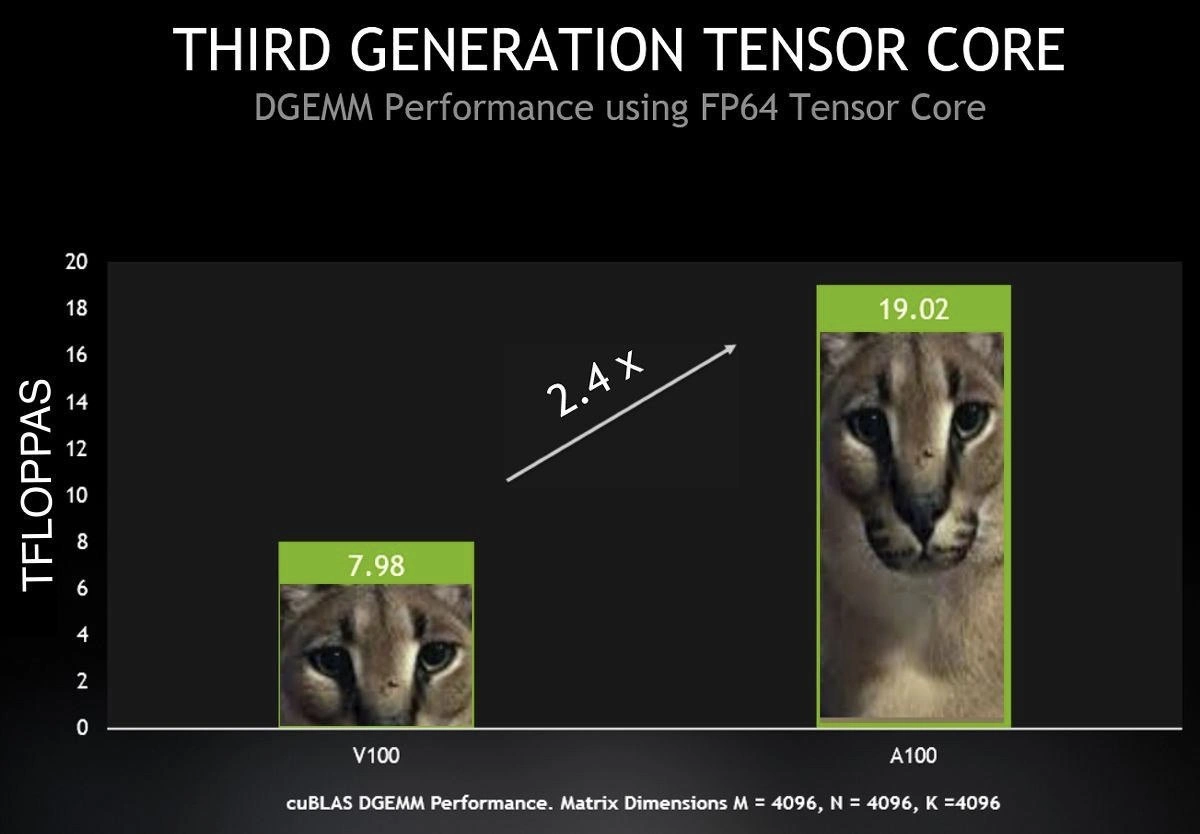
Now, TFLOPS: this is short for “Tera FLOPS,” which is a trillion floating-point operations per second. It’s a unit to measure a computer’s speed at math. The V100 bar has “7.98” on top – meaning ~7.98 TFLOPS, and the A100 bar has “19.02”, meaning ~19.02 TFLOPS. So the A100 can do about 19 trillion math operations a second in this test, compared to about 8 trillion for the V100. The white diagonal arrow saying “2.4×” emphasizes that the A100 is roughly 2.4 times faster than the V100 for this task.

The funny part is calling these units “TFLOPPAS” instead of TFLOPS and decorating the bars with pictures of a cat called Big Floppa. Big Floppa is an internet-famous cat (a caracal with tufted ears) often used in memes. The creators of this meme replaced the usual stern graphics on a GPU chart with Floppa’s face. So effectively, one bar shows a small portion of Floppa’s face (for the slower V100, ~8 TFLOPPAS) and the other shows a big, full Floppa (for the faster A100, ~19 TFLOPPAS). It’s a pun: “FLOPS” sounds like “Floppa,” so they made a fake unit TFLOPPA as if the cat is a measurement of compute power. The Y-axis on the left actually says “TFLOPPAS” with numbers up to 20 – implying this chart measures “how many Big Floppas worth of computation” each GPU can do. It’s silly, but you can still read the actual improvement: from about 8 to 19 in whatever units, which is the real performance jump.

The footnote at the bottom (“cuBLAS DGEMM Performance. Matrix Dimensions M=4096, N=4096, K=4096.”) is basically informing us how the test was run. cuBLAS is a CUDA library (from NVIDIA) for very fast linear algebra operations on the GPU. They used it to multiply two 4096×4096 matrices (M, N, K are the dimensions, typical notation in matrix multiply). This detail is usually there to assure technical folks that the comparison was done fairly and with optimized code. For someone new, the key takeaway is: they made the GPUs multiply a lot of numbers (4096×4096 matrices have over 16 million entries!) and measured how fast each one did it.

So in simpler terms: The A100 is a newer GPU that can do double-precision math about 2.4 times faster than the older V100. That’s a huge leap in raw number-crunching ability. Researchers or engineers care about that because it means tasks like training AI models or running physics simulations could go much faster. But instead of just presenting that with boring numbers, the meme dresses it up with a big cat joke. It’s mixing serious tech with a bit of fun – the kind of thing you’d share in an AI/ML lab Slack channel for a laugh.

Level 3: FLOPS vs Floppas

Seasoned developers and machine learning engineers recognize this immediately as a parody of NVIDIA’s marketing slides. Typically, such a slide would brag about FP64 performance gains of the new A100 GPU over the older V100 using a bar chart. The left bar shows V100’s number of teraFLOPs (7.98), and the right bar shows A100’s much higher number (19.02), with an arrow trumpeting a “2.4×” improvement. That’s a genuine performance ratio one might see at a GPU technology conference. The twist? The y-axis is labeled in “TFLOPPAS” instead of TFLOPS, and each bar has a picture of Big Floppa the cat. This mashup is classic AIHumor: blending an inside joke from internet culture with dry technical data. It’s funny because it catches us off-guard – a serious GPU performance chart suddenly invaded by a meme cat as if it were an official unit of measure.

For those in the know, the meme operates on multiple levels. First, FLOPS (Floating Point Operations Per Second) is a very real metric that GPU engineers and HPC scientists obsess over – more FLOPS means more raw computation for things like neural network training or physics simulations. Here, turning FLOPS into FLOPPAS is wordplay: Big Floppa is a popular meme cat, so it’s as if the GPU’s power is measured in “cat units.” The bar for V100 only shows Floppa’s face peeking (7.98 TFLOPPAS), while the A100’s bar is tall enough to show Floppa’s full majestic visage (19.02 TFLOPPAS). It’s a visual gag implying the A100 has “full Big Floppa power.” That 2.4× arrow is exactly how marketers highlight generational improvements, but pairing it with a cat picture makes it delightfully absurd.

Experienced folks also catch the specific context: FP64 Tensor Core implies double-precision capability on A100’s tensor cores. This was a big deal for both deep learning researchers and traditional HPC users. NVIDIA’s earlier Volta V100 had tensor cores mainly for FP16/FP32 (good for AI), but its FP64 performance, while decent, wasn’t boosted by those tensor cores. The A100 changed that by allowing tensor cores to accelerate FP64 (via new hardware or data paths), hence the dramatic leap in the DGEMM throughput. So this slide isn’t just random numbers – it’s poking fun at a real technical improvement that GPU-savvy people were excited about. It targets the overlap of AI_ML and scientific computing: imagine someone at NVIDIA saying, “Our new GPU is so fast, it’s off the charts – we need a bigger cat!”

The BenchmarkingTools reference (cuBLAS DGEMM) in the footer adds to the authenticity. cuBLAS is NVIDIA’s CUDA Basic Linear Algebra Subprograms library – essentially the go-to for running matrix multiplication on GPUs efficiently. Including “Matrix Dimensions M=4096, N=4096, K=4096” mimics the fine-print detail on real performance slides, telling experts that this was a big matrix multiply test case. Engineers reading this chuckle because it’s a spot-on impersonation of official slides, marketing_slide_parody at its finest, down to the exactness of the numbers. We all remember tech keynotes where the presenter shows a bar chart proclaiming their new chip is X times faster. Here, the meme lovingly mocks that ritual. It’s the contrast between the seriousness of HPC performance bragging and the silliness of internet meme culture that makes it so amusing. For a senior dev who has sat through dry presentations, seeing a goofy cat metric is a breath of fresh air. It says: “Yes, we achieved incredible performance – but let’s not take ourselves too seriously.”

Level 4: Feline-Accelerated Floating-Point

At the cutting edge of GPU design, performance metrics like TFLOPS (tera–floating-point operations per second) are king. Here we see a twist: the slide labels the y-axis as TFLOPPAS, blending a serious technical metric with the Big Floppa cat meme. Under the hood, this meme references real high-end computing concepts. The NVIDIA V100 GPU (based on Volta architecture) and the newer A100 GPU (Ampere architecture) are compared on FP64 Tensor Core throughput — essentially how many 64-bit floating-point multiplications and additions (the kind used in scientific computing and deep learning) they can do per second. The footnote reveals a DGEMM benchmark (double-precision general matrix multiply) using cuBLAS, with large 4096×4096 matrices. In HPC (High-Performance Computing) and deep learning, DGEMM is a standard stress test, as matrix multiplication workloads push GPUs to their limits.

The Third Generation Tensor Core in A100 is a hardware marvel: it can accelerate FP64 calculations by leveraging specialized units that perform matrix math incredibly fast. On Volta (V100), double-precision relied on standard CUDA cores with FMA (fused multiply-add) units, topping out around 7.8 TFLOPS of FP64 throughput. Ampere’s third-gen tensor cores introduce double-precision matrix math capability — a big architectural leap. Each tensor core in A100 can perform multiple fused multiply-add operations in parallel on 64-bit values, dramatically boosting throughput. The result? The A100 achieves ~19.02 TFLOPS of FP64 in this benchmark, versus the V100’s ~7.98 TFLOPS. That’s the 2.4× speedup indicated by the diagonal arrow. In other words, A100 can crank through roughly 19 trillion 64-bit operations per second on a dense matrix multiply – an insane number reflecting massive parallelism across thousands of cores and many SMs (Streaming Multiprocessors) on the chip.

By cheekily renaming TFLOPS to TFLOPPAS, the slide merges cat meme culture with hardcore computing. Big Floppa is an internet-famous caracal cat, and “flop” is conveniently part of FLOPS terminology, so it’s a perfect pun. It’s rare to see AI/ML engineers and HPC folks chuckle over a performance chart, but here the absurdity works because the data itself is legitimate. The humor lies in treating a benchmarking victory (A100’s leap in FP64 compute) with meme-driven silliness. Under that humor, however, are serious implications: for scientists and ML researchers, a 2.4× compute boost means larger models, faster training, or heavier simulations now feasible on the same hardware. It’s a celebration of technological progress – with a cat cameo – showing that even dry performance metrics can inspire a laugh when presented through a creative lens.

Description

This image is a technical bar chart presented as a meme, comparing the performance of two generations of NVIDIA GPUs. The title reads 'THIRD GENERATION TENSOR CORE' with a subtitle 'DGEMM Performance using FP64 Tensor Core'. The chart shows two vertical bars against a dark background. The first, labeled 'V100', reaches 7.98 on the 'TFLOPPAS' Y-axis (a likely intentional typo for TFLOPS) and is filled with a picture of a small caracal, a cat known in meme culture as 'Floppa'. The second, much taller bar, labeled 'A100', reaches 19.02 and is filled with an image of a larger, more imposing caracal, or 'Big Floppa'. An arrow between them indicates a '2.4 x' performance increase. The technical context, provided at the bottom, is 'cuBLAS DGEMM Performance. Matrix Dimensions M = 4096, N = 4096, K = 4096'. The meme humorously leverages the 'Floppa' meme to represent a significant generational leap in hardware performance, a joke that would be highly appreciated by those in the AI/ML and High-Performance Computing fields who are familiar with both the hardware and the specific internet subculture


Comments

8
Anonymous ★ Top Pick The A100's performance jump is so significant, your model now overfits in half the time, giving you twice as many opportunities to question your life choices
  1. Anonymous ★ Top Pick

    The A100's performance jump is so significant, your model now overfits in half the time, giving you twice as many opportunities to question your life choices

  2. Anonymous

    Sure, the A100 hits 19 TFLOPPAS on 4K³ DGEMM - now if only my PCIe bus could move tensors 2.4× faster instead of just streaming larger cat pics

  3. Anonymous

    When your infrastructure budget meeting turns into explaining why the new GPUs cost as much as a Tesla, but you just show them the longcat chart and say 'Look, the performance scales linearly with the cat's spine!' - suddenly everyone understands why FP64 tensor cores are worth stretching the budget for

  4. Anonymous

    When your GPU upgrade delivers 2.4x performance gains and you realize the real 'Big Floppa' was the 19 teraflops of double-precision matrix multiplication we computed along the way. Nothing says 'we've made it' in HPC quite like watching your cuBLAS DGEMM benchmarks scale linearly with Tensor Core generations - though explaining to finance why you need A100s for 'critical cat image processing workloads' remains the hardest problem in computer science

  5. Anonymous

    Love that A100 hits 19.02 TFLOPPAS; Amdahl's Law converts it to 1.1x once dataloaders, NVLink topology, and checkpoint I/O show up

  6. Anonymous

    V100's FP64 purr at 7.98 TFLOPS meets A100's third-gen Tensor Core roar - because in HPC, 2.4x isn't evolution, it's extinction event for old iron

  7. Anonymous

    2.4x more TFLOPPAS on 4096^3 DGEMM - great; shame the rest of the pipeline is PCIe, I/O, and one Python thread politely queueing cuBLAS

  8. @ZgGPuo8dZef58K6hxxGVj3Z2 5y

    Next year they will be able to remder the balls too

Use J and K for navigation