Skip to content
DevMeme
409 of 7435
The Evolution of a Developer: From Idealist to Jaded Parent
Production Post #476, on Jul 11, 2019 in TG

The Evolution of a Developer: From Idealist to Jaded Parent

Why is this Production meme funny?

Level 1: New Toy vs Old Toy

Imagine you have a brand new toy that you really love. The day you get it, you’re super careful with it. You make sure not to drop it, you might even tell your friends or siblings, “Be gentle, don’t break it!” You perhaps even keep it in a special place when you’re not playing with it. You treat it like a treasure because it’s new and you don’t want anything bad to happen to it.

Now think about that same toy a couple of years later. By then, it’s not as shiny and new. You’ve played with it a lot; maybe it has a few scratches or it’s missing a piece, but it still basically works. At this point, if the toy accidentally falls off the table and hits the floor, you’re likely to just pick it up and go “Oh well!” or even laugh if it fell in a funny way. You’re not as worried about it because you’ve gotten used to it and maybe you have other toys now. It’s not that you want it to break, but you’re just not treating it like a fragile glass ornament anymore. It’s an old toy – if it gets a little banged up, no big deal.

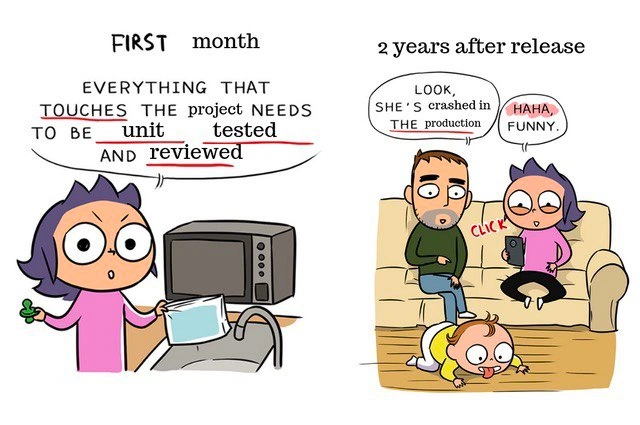
This meme is joking about that kind of change in attitude, but with a software project instead of a toy. At the start (when the project is new), the developer was treating it very carefully – like that new toy. She wanted everything perfect: every little part of the project had to be tested and reviewed. It’s like she didn’t want even a scratch on her creation.

Later, once the project is a couple of years old, it’s as if the project has been “played with” a lot – lots of changes, some parts wearing out (in code terms, some bugs or rough edges). At that point, the developer isn’t as alarmed when something goes wrong. In the comic, something goes wrong in the live product (represented by the baby falling down) and she just laughs a bit, kind of how you might chuckle if that old toy fell in a goofy way. It’s the “old toy” mentality – she’s thinking, “Yeah, these things happen, it’s not the end of the world.”

The funny part is mostly about how big the change is. We don’t expect someone who was so strict and careful at first to become so relaxed about a serious issue later. It’s like if a very strict teacher who gave tons of homework on the first day suddenly, two years later, is throwing paper airplanes in class. That contrast makes us laugh because it’s unexpected and a bit silly.

Another simple way to see it: Remember the first time you learned to do something new, like riding a bike or baking cookies. At first, you might have been extremely careful – checking every detail, worrying about every wobble or every measurement. After you’ve done it for a couple of years, you probably don’t sweat the small stuff – if the bike hits a small bump you don’t panic, or if a little eggshell gets in the cookie batter you just fish it out and keep going. You’ve become confident and maybe a touch careless because it’s familiar now. There’s a saying, “Familiarity breeds contempt,” which means once you’re used to something, you might not respect it as much as when it was new. In this comic, familiarity bred a sort of funny carelessness in the developer.

So, the meme uses a baby falling (a minor accident) in real life as a playful symbol for a program crashing (a serious accident) in tech life. Early on, that developer would have treated any “accident” as a big deal to fix immediately. Later on, she reacts to an accident with a laugh, almost like it’s a funny everyday occurrence. We find it humorous because it’s true that people often start off very cautious and then loosen up over time – and seeing that illustrated with a baby and a couch just makes it extra clear and comical.

In the end, even if you don’t know anything about coding, you can relate: it’s showing how someone went from perfectionist to so relaxed they’re almost ignoring a problem. It’s poking fun at that journey, and anyone who’s ever tried super hard at first and then chilled out later (like many of us do with various hobbies or projects) can smile at this. The developer’s initial rule “everything must be perfect” turned into her later saying “haha, look at that” when something went wrong. That big change is the joke – and it reminds us that as time passes, people change how they handle things, sometimes in pretty funny ways!

Level 2: Production vs Perfection

Let’s break down what’s happening in each panel in simpler terms, and why it’s ironic:

Panel 1 – “FIRST month”: We see a very alert, almost intense developer declaring that “everything that touches the project needs to be unit tested and reviewed.” This basically means in the first month of the project, she wants every bit of code that’s part of the project to go through two strict processes:

  • Unit tested: This refers to unit tests, which are small, focused tests written by developers to check that each “unit” of the code (usually a function or module) works correctly. For example, if there’s a function calculateTotal(), a unit test would call calculateTotal() with some sample inputs and assert (verify) that the output is what’s expected. Unit tests are like little yes/no questions you ask your code: “For this input, do I get the right output?” Writing a lot of unit tests helps catch bugs early because you run them whenever you change the code to ensure nothing broke. When she says “everything that touches the project needs to be unit tested,” she’s insisting on very high test coverage (coverage = how much of the code is exercised by tests). Essentially, she doesn’t want any part of the codebase to be untested. This is a hallmark of someone who really cares about code quality – they likely believe in the mantra “if it’s not tested, it’s broken.”

  • Reviewed: This means code review. Code review is a practice where whenever a developer makes changes or adds new code, another developer (or several teammates) look at the code changes before they are merged into the main project. The idea is to have a second pair of eyes catch mistakes, suggest improvements, and ensure the code meets the team’s standards. It’s like proofreading an essay – except here it’s reviewing code for bugs, style, performance issues, etc. When she demands everything be reviewed, she’s making sure no “unseen” code goes into the product. It’s another safety net to maintain quality.

So, in the first month, this developer is extremely vigilant. She might be doing things by the book, maybe following all the best practices one learns in school or from mentors about testing and reviewing. The fact that the cartoon emphasizes certain words (they’re underlined in red in the speech bubble) shows how strongly she’s emphasizing this. She’s practically scolding: “EVERYTHING that touches the project MUST be unit tested AND reviewed!” – you can imagine her pointing at a tiny change and saying “Did you write a test for that? Did someone review it? No? Then it’s not going in!” It’s almost militant quality control. This is often how projects start when the team is either very quality-conscious or maybe a bit anxious because it’s a new project and they want it to succeed with zero issues.

Panel 2 – “2 years after release”: Now the scenario is quite different. It literally looks like a home setting – the developer is on a sofa with her phone, looking very relaxed. A bearded colleague or perhaps her partner is sitting next to her casually with a laptop. And there’s a little toddler on the floor in front of them. The toddler has just fallen flat on her face (we see the baby sprawled with arms out – a classic kiddie faceplant). We see a “CLICK” sound effect, indicating the bearded guy took a photo of the funny scene. He says: “Look, she’s crashed in the production.” And our once-zealous developer responds with a laugh: “HAHA. Funny.” She’s completely unfazed.

Let’s unpack the language and context here:

  • “She’s crashed in the production.” This is a play on words. In everyday terms, the baby crashed in the sense that she fell down (like “crashed onto the floor”). But in software terms, a “crash in production” is a serious event where the software (website, app, service, etc.) encounters an error so bad that it stops working for users. Production (or “prod” for short) refers to the live environment where real users interact with the software – as opposed to a development or testing environment. So if something crashes in production, it’s like saying “the website went down” or “the app crashed for the users.” It usually triggers urgency: alarms might go off in a company’s monitoring system, on-call developers get paged, and it becomes all-hands-on-deck to fix the issue because it’s affecting customers.

    By saying “she’s crashed in the production,” the character is jokingly treating the family living room as “the production environment” for the baby. The baby is like an application that has just crashed (fallen). It’s a clever analogy blending tech speak with a real-life event. Developers often inject tech humor into daily life like this – here he’s basically making a dad-joke but in developer language.

  • The developer’s reaction: She just laughs and says “Funny.” This is shockingly casual given what “crash in production” implies. If we take it in the software sense, imagine hearing your product just crashed and instead of jumping up to fix it, you just chuckle. That would be considered highly unprofessional or a sign you’re really desensitized. And that’s exactly the joke – she’s become indifferent to something that used to be a big deal to her. Two years ago, if anything even minor went wrong, she’d probably freak out and say “Did we write tests? How did this happen? Let’s rollback the deployment!” Now, a full-on crash elicits a “haha” from her.

So the humor is coming from the contrast between these two states of mind. It’s early vs. late attitude: at first, perfectionism; later, nonchalance.

Now, why would a developer change like this over two years? There are common reasons in the software world:

  • Burnout & Alert Fatigue: In the beginning, you have energy to catch every bug, write all the tests, do long reviews. After a couple of years, especially if the project had many issues or you had to firefight a lot of production issues, you might get tired. If she was on call (meaning if something broke in production, she had to wake up and fix it), after many late-night emergencies you ironically start to care less about each one – it becomes routine. It’s like hearing the same fire alarm every day; eventually, you might casually walk instead of run because it’s probably a false alarm or something small. This is sometimes called alert fatigue in ops: when you get too many alerts, you start ignoring them. Her laughing at the “crash” is like a depiction of alert fatigue – she’s not shocked because, been there, done that.

  • Technical Debt & Lowered Standards: Over two years of rushing to release features or quick fixes, the team might have incurred technical debt. Let’s explain that term: technical debt is like when you do something the quick way instead of the right way – it’s faster now but causes problems later. For example, not writing tests for a new feature because you needed to release it by Friday is incurring technical debt; later, that untested code might break and you’ll have to fix it (with interest, meaning it might be a bigger mess by then). After a lot of this debt, the project can become messy. Perhaps their test suite now fails often or gives false alarms because it wasn’t maintained – so the team starts ignoring test results. Perhaps code reviews got lax because the team trusts each other or they’re just too busy to comb through every line. All this means the strict rules of month one have eroded. It’s like at first you enforce a curfew, but after enough battles, you stop enforcing it strictly.

  • Experience and Realism: Sometimes becoming more experienced can ironically make a developer a bit more relaxed about certain things. Maybe in month one, she truly believed she could prevent all crashes with enough testing. Two years in, she knows that no matter what, some bugs will slip by – maybe an odd user behavior, or a strange device, or a one-in-a-million scenario. So she’s not as surprised or upset when a crash happens. This could be seen as maturity (she’s focusing energy only on really important issues and not freaking out over every fall) or as apathy (she’s stopped caring). The truth is probably in between: she cares, but she’s learned not to overreact to every single incident, especially if it’s minor. The comic makes it look like she doesn’t care at all, which is the joke.

  • Priorities shift: In the panel, she’s possibly at home, relaxing. Maybe it’s after work hours. If you think about it, in the first month, she might have been working late and obsessing over quality. Two years later, maybe she has a kid (the toddler might even be hers in this scenario) and she values her downtime. So when her colleague/friend points out a production issue, she might deliberately choose to laugh it off because she’s not going to ruin her evening over it if it’s not a critical problem. This ties into a healthy work-life balance (or just lost passion, depending on how you read it).

Now, about the parenting metaphor: The comic literally shows a parenting moment (baby falling) described in tech terms. This works as a metaphor for how projects are “babies” that grow up:

  • In the early stage of a project (like a newborn baby), everyone is very careful. Just like new parents sanitize every bottle and fret over every little sneeze, the dev in month one didn’t let a single line of code through without tests and reviews. The project was her “baby” and she protected it from any possible harm (bugs).

  • By the later stage (project is a toddler, a couple of years old), the team might treat it more casually. Just like parents of a toddler know the kid will stumble and it’s usually fine – they don’t helicopter as much – the dev has seen the project survive some crashes and maybe become resilient. She might think, “the system has fallen before and it’s still alive, no need to panic.” She’s basically treating the project like a second kid who’ll “walk it off” after a fall.

It’s actually common in tech jokes to compare software projects to children (we even call them “our baby” sometimes) and to compare production incidents to things like a child throwing a tantrum or, in this case, literally crashing to the floor.

Let’s clarify some key terms mentioned:

  • TestingHumor: This meme falls into a category of humor about software testing. It’s funny to developers because of the testing angle – the absurdity of someone who insisted on tests for everything ending up ignoring a failure. If you’re familiar with writing tests, you know that feeling of “I covered everything… how is it still failing?!” which can eventually turn into a cynical joke like this.

  • UnitTesting: As explained, that’s writing tests for individual units of code. The first panel is basically a meme-able representation of a unit testing zealot (which many of us are at the start of a project or after we read a testing best-practices blog).

  • ProductionIssues: This refers to problems (bugs, crashes, errors) that occur in the production environment (the live system). They’re usually the most stressful, because they affect real users or customers. The second panel is literally showing a “production issue” (the crash) being handled in the least stressful way imaginable – with a laugh. That’s what makes it a joke, because in reality a production issue is serious.

  • TechnicalDebt: This is when you have accumulated “unfinished work” or quick fixes in your code that you eventually need to address. Over two years, if the team shortcut on testing or didn’t refactor messy code, they accumulated technical debt. It’s like actual debt: at first it doesn’t hurt, but the interest (consequences) build up. One consequence is that the code might start crashing more often or be harder to fix when it does crash. The dev might be laughing because maybe by this point, fixing one thing breaks another (a symptom of too much debt in the code), so every crash is almost expected.

  • CodeQuality: This is about how well-written and robust the code is. High code quality usually means the code is easy to understand, has fewer bugs, and is well-tested. In month one, code quality was top priority (they reviewed everything, tested everything). Two years later, the code quality might have dropped (if they stopped those practices, the code might have inconsistencies or known bugs – basically lower quality). The joke is showing this drop in quality focus.

Finally, let’s appreciate why this is relatable: Developers often experience a kind of idealism when starting a new job or project – “this time we’ll do everything right.” Over time, real-world pressures make it harder to sustain perfection. So standards slip a bit, sometimes a lot. It doesn’t mean all developers end up literally ignoring crashes, but many will admit that they’ve written code without tests as time went on, or ignored a minor bug in production because it wasn’t worth the immediate hassle. This comic just uses an extreme scenario (laughing at a crash) to poke fun at that common trajectory. The humor comes from recognition – “Haha, I’ve seen this happen” or “Oh no, I might become like this!” – and from the silly way it’s presented (with a baby and a literal crash).

In short, the first panel represents perfectionism in testing and code quality at the start, and the second panel represents the complacency or fatigue in production support that can happen later. It’s a cautionary and comedic tale about how a developer’s attitude can shift from “We must prevent every bug!” to “Eh, it’s just a bug, no biggie.” For those learning about the field, it’s a reminder that maintaining that first-month rigor is challenging in the long run – but also that going to the opposite extreme is part of why this is funny (because it’s obviously not ideal either!). It’s laughing at a scenario we try to avoid, by showing an exaggerated version of it.

Level 3: Test-Driven Disillusionment

Every seasoned developer can recognize the arc depicted here. In the “FIRST month” panel, the purple-haired dev is basically the poster child of early-project idealism. She’s likely a big fan of Test Driven Development (TDD), demanding every piece of code be covered by unit tests, and nothing goes in without a proper code review. The cartoon even underlines “TOUCHES,” “unit tested,” and “reviewed” in red, emphasizing how emphatic (borderline obsessive) she is about quality. This is the phase where a team might boast about 100% code coverage, refuse any commit that breaks a test, and perhaps run around quoting “no code goes to production untested” like scripture. Seasoned folks smile at this because we’ve been there – bright-eyed, convinced that with enough diligence we can keep the codebase pristine.

Fast forward “2 years after release,” and the tone does a 180. Now we see the same developer slouched on a sofa, casually scrolling her phone, utterly unfazed by what should be a panic-inducing event: a crash in production. Her bearded teammate holds up a laptop, announcing with mild amusement, “Look, she’s crashed in the production,” while a toddler literally face-plants on the carpet accompanied by a camera “CLICK” sound. The dev’s response: “HAHA. Funny.” – as if a production crash is a cute little joke. The contrast is golden: from “STOP EVERYTHING, WRITE TESTS!” to “Eh, crashes happen 😏.” It’s a humorously hyperbolic take on how code quality standards often slip over time.

Why does this slide happen? In real life, around the two-year mark of a project, technical debt and sheer maintenance grind can wear down even the most ardent quality fanatic. Early on, the project is greenfield: low complexity, few features, and enthusiasm is high to “do things right.” But give it a couple of years: requirements change, managers demand new features ASAP, maybe some original team members left (taking their fanaticism with them), and you’ve now got a sprawling codebase with deadlines attached. Those exhaustive unit tests from year one? By year two, half of them are failing because the code changed, but nobody had time to update tests. The once-sacred code review process might have devolved into rubber stamping (“LGTM 👍, let’s ship it”) because who has time to nitpick style when prod has an outage every other week? In other words, process rigor quietly gave way to pragmatism and shortcuts. It’s like a slow cultural shift: skipping tests was unthinkable at first, then it became an occasional guilty exception (“just this once for this hotfix”), and eventually it’s the norm. The comic cranks that to eleven by showing the dev literally ignoring a production crash – something unthinkable in month one – to illustrate how far the standards have fallen.

There’s also the element of shared trauma and coping through humor. The line “Look, she’s crashed in the production” is developer humor masking pain. In a real team, stating “the app crashed in prod” usually sets off alarms: people scrambling, Slack lighting up, on-call engineer gulping caffeine. If someone said it so casually you’d think they’ve either lost it or seen so many crashes that it no longer triggers panic. The latter is often true – after enough 3 AM on-call incidents, devs get a bit numb. They might joke about an outage as a sanity mechanism. Here the teammate even snaps a photo of the “crash” (the baby face-planting) as if it’s a funny sight. It’s dark comedy: instead of jumping to fix the issue, they’re making a joke out of it. This hints at a burnout or resignation underneath – when you can’t fix the systemic issues (or you’re just too exhausted), you start making memes of your own failures. It’s the “we’ve seen it all, might as well laugh” veteran mindset. The Cynical Veteran in me chuckles and winces at the same time.

The parenting metaphor here is brilliant. The toddler in the scene isn’t random – it symbolizes how the project has aged (two years old, toddler stage) and possibly how the developer’s life has evolved. There’s a well-known joke among parents: with the first baby you’re sterilizing pacifiers; by the second or third, you’re like “eh, five-second rule.” New parents are hyper-cautious, experienced parents know which cries are serious and which are just drama. Similarly, the dev was a “new parent” to the code initially – everything was critical. Two years later, she’s an “experienced parent” – a little crash (toddler tumble or minor outage) doesn’t faze her; she knows the system/world isn’t so fragile. She might also literally be a parent now – notice how she’s more interested in her phone than leaping up to grab the falling child, much like she’s not rushing to triage the crash. It’s a tongue-in-cheek way of saying her priorities have shifted; maybe she’s balancing work and life now, whereas in month one she lived for that project’s quality.

From an industry standpoint, this scenario is a commentary on code_quality_decline over a project’s lifecycle. The phrase “technical debt” tagged here is key – as shortcuts accumulate, the cost of maintaining that initial high standard skyrockets. By year two, teams often enter a mode of survival: keeping the product running takes precedence over perfection. If a few non-critical crashes occur, you log them and address them when you can (if ever). There’s an unwritten calibration of seriousness: a crash in production is still bad, but if it only happens once a month and auto-recovers, you might not stop everything to fix it immediately, especially if you’re buried under other work. The comic exaggerates that to the dev outright laughing, which is the humor hook. But any senior dev reading this likely has a memory of a time they saw a production bug report and just sighed and joked, “Of course it did that. Classic.” – because it was a known issue or they were too swamped to react with full panic for the hundredth time.

We should also talk about the phrase “works on my machine” – a classic in DeveloperHumor. It’s not explicitly in the comic text, but the attitude of the second panel reeks of it. That phrase is what developers say when something fails in production or on a colleague’s setup, but they can’t reproduce it on their own computer. It’s basically a faux-innocent way of absolving oneself: “Well, it works on my machine, so the problem must be elsewhere (not my code!)”. Here, by laughing at the production crash, the dev is practically saying “Hah, not my problem right now.” It’s the same energy. The first panel dev – that one-month-in zealot – would never utter “works on my machine” as an excuse; she’d be mortified if anything broke outside her environment. The two-years-later dev, though, likely had to say “works on my machine” one too many times when confronted with bug reports she couldn’t immediately solve, and it evolved into this cavalier posture.

TestingHumor often revolves around the gap between theory and practice. This meme hits that sweet spot. The theoretical best practice: test everything, review everything, keep quality ultra-high. The practical reality over time: you can’t sustain that level, things break anyway, and you loosen up. It’s funny (in a slightly painful way) because it’s relatable – developers who’ve been through a full product lifecycle nod knowingly. We remember being newbies writing ten tests for a trivial function, and we recall later skipping writing tests for a hotfix at 2 AM because “we can’t afford to not patch prod now.” That first panel could even be a senior poking fun at juniors who insist on testing absolutely every scenario (“even the microwave must be unit-tested!” is the vibe, given she’s literally pointing at a kitchen appliance while talking about testing). The second panel is the senior chuckling, “kid, after a couple years in production, you’ll realize some crashes just get a laugh and a log entry.”

The comic strip analogy using the baby also serves to soften the dark truth with a family-friendly visual. Instead of showing a data center on fire and the dev roasting marshmallows over it (an image for utter indifference), it shows a toddler “crashing” and the dev mom giggling. It’s disarming and absurd, which makes us laugh, but the underlying tech message remains pointed. We’re essentially laughing at how our strict standards can slip: it’s a self-deprecating laugh for the dev community. The meme calls out the early_vs_late_release_attitude shift directly: “FIRST month” vs “2 years after release.” It’s a timeline many of us recognize. Release day, we’re sweating every detail. Two years of ProductionIssues later, we’re like, “Did the server just hiccup? Eh, it’ll restart, I’ll check it after my coffee.”

In summary, this panel is a cheeky commentary from a senior perspective on how maintaining extreme diligence is hard. It’s not advocating letting quality slip – it’s warning and mocking how easily it can happen despite our best intentions. And, as a cynical veteran developer might quip, it’s also a bit of “told you so”: you can unit-test your heart out, but just wait until reality throws something at your production that you never saw coming. The journey from “Test all the things!” to “Haha, that crash is kinda funny” is the joke we’re all in on, especially those of us who have been on call at 3 AM enough times to develop a grim sense of humor about it.

Level 4: Entropy Always Wins

In the first month panel, the developer’s uncompromising stance on quality – “EVERYTHING that touches the project needs to be unit tested AND reviewed” – represents an almost idealized state of order. It’s as if the codebase is a pristine system where every part is verified and nothing is left to chance. However, any experienced engineer knows this state is fleeting. Over time, software complexity inexorably increases; new features, quick patches, and environmental changes introduce disorder. In theoretical terms, a codebase tends toward software entropy: without continuous effort to refactor and test, code quality decays much like an untended garden or, more starkly, how physical systems drift toward chaos per the Second Law of Thermodynamics. The phrase “entropy always wins” applies here – unless you constantly invest energy into maintenance, the system will become more chaotic (bugs, inconsistent tests, sloppy hacks) as it grows. This comic exaggerates that principle: the developer’s early red-line insistence on perfection succumbs to the inevitable entropy of a production system after two years.

From a computer science perspective, the shift from religiously writing unit tests to blithely ignoring a crash highlights the limits of testing and the complexity of real software. Initially, the dev aspires to complete test coverage – maybe even believing that if every unit is checked, the program will be bulletproof. Here’s the catch: even if you somehow test 100% of your code’s lines, you can’t realistically test 100% of its states or inputs. The possible combinations of interactions grow combinatorially with each new feature. This is akin to the state explosion problem in testing theory – covering every edge case becomes computationally infeasible as systems scale. In formal terms, verifying a program’s correctness for all possible cases borders on the Halting Problem territory – you can’t write a test for every scenario without infinite time. As the legendary computer scientist Edsger Dijkstra cautioned decades ago:

Program testing can be used to show the presence of bugs, but never to show their absence!” – Edsger W. Dijkstra

This meme illustrates that maxim in a lighthearted way. The dev started out trying to prove the absence of bugs (demanding tests for everything that touches the project, i.e. 100% thoroughness). Two years later, reality has set in: bugs still happen, crashes still occur – the production crash (the baby face-planting) is living proof that even obsessive testing can’t guarantee a bug-free system. In fact, the developer’s nonchalant “HA HA. Funny.” response suggests a kind of fatalism born from discovering that despite all those unit tests, things still went wrong in production. It’s a transition from a formalist approach (almost like attempting formal verification via exhaustive testing) to a pragmatist (or defeatist) approach where they accept that crashes happen. In reliability engineering terms, she’s gone from striving for zero failures to embracing an error budget mindset (albeit taken to a comical extreme where a crash doesn’t even raise an eyebrow).

Another aspect is how technical debt accumulates and erodes initial rigor. In theory, if you don’t continuously pay down this debt (by refactoring, updating tests, improving flaky areas), the “interest” on it compounds. This is reflected in academic laws of software evolution – Lehman’s Second Law (Increasing Complexity) states that as a program evolves, its complexity increases unless work is done to reduce it. In the comic’s world, that first-month zeal was a strong counter-force to complexity (lots of tests, reviews, presumably cleaning up issues immediately). But two years in, maybe that effort waned; tests might have been skipped “just this once” under pressure, code reviews may have become perfunctory. Each lapse is like a tiny broken window, and uncared-for broken windows invite more. Eventually, the system’s complexity debt comes due: the test suite might be full of red underlines failing cases that nobody fixed, the production environment might have quirks that weren’t in the test environment, and the team has accepted a certain level of chaos as normal. In a sense, the heat death of code quality has set in – the point where maintaining perfect order is too costly, so you settle for “good enough” (or in this case, downright neglect).

The parenting metaphor in the second panel actually reinforces a deep truth known in both parenting and software engineering: initial conditions of high order naturally devolve into disorder without sustained energy. Just like new parents sterilize every pacifier (maximum effort to prevent problems) but a couple of years later may shrug when the toddler eats a Cheerio off the floor (acceptance that you can’t control everything), engineering teams often start with rigorous test protocols but later let small issues slide. The end result in the comic is an absurdly jaded developer who has made peace with the chaos – a state of equilibrium where a production crash is just another Tuesday. It’s a cautionary tale wrapped in humor: without constant vigilance, quality assurance processes entropy out, and even the staunchest tester can become the “hah, it crashed” cynic. The meme exaggerates this transformation to highlight an underlying engineering reality: maintaining perfection is an uphill battle against complexity, and given enough time (and unattended technical debt), even the best-laid testing regimes can collapse under the weight of real-world unpredictability. In short, the laws of software physics catch up with everyone – and this dev’s journey from zealot to zen (or perhaps to indifferent burnout) is a witty illustration of that inevitability.

Description

A two-panel comic strip illustrating the change in a developer's mindset over time. The first panel, labeled 'FIRST month', shows a determined-looking cartoon character with purple hair standing by a kitchen sink, holding a pacifier and a container. A speech bubble above them reads, 'EVERYTHING THAT TOUCHES THE project NEEDS TO BE unit tested AND reviewed', with 'unit tested' and 'reviewed' underlined for emphasis. The second panel, labeled '2 years after release', depicts the same character sitting on a couch next to a man, looking at a phone. A baby is crawling on the floor. The man says, 'LOOK, SHE'S crashed in THE production', and the purple-haired character replies, 'HAHA, FUNNY.' This meme uses the analogy of raising a child to comment on the software development lifecycle. It contrasts the initial strict adherence to best practices like comprehensive testing and code reviews with the desensitization and dark humor that often develops after years of maintaining a live system, where production failures become a source of amusement rather than panic

Comments

7
Anonymous ★ Top Pick The project is like a child. At first, you sanitize everything and bubble-wrap the corners. After two years, if it licks the floor and doesn't immediately segfault, you call it a win for resilience engineering
  1. Anonymous ★ Top Pick

    The project is like a child. At first, you sanitize everything and bubble-wrap the corners. After two years, if it licks the floor and doesn't immediately segfault, you call it a win for resilience engineering

  2. Anonymous

    Month 1: Red-Green-Refactor. Month 24: Red screenshot, Green ignore, Refactor the post-mortem template

  3. Anonymous

    The same engineer who insisted on 100% code coverage now has a monitoring dashboard that just says "Usually works" and considers a 15-minute MTTR a personal best because the kids' bedtime is non-negotiable

  4. Anonymous

    The microwave represents the developer's initial commitment to testing everything - even the kitchen appliances. Two years later, production crashes have become so routine they're just background noise to family time. It's the classic arc: from 'we need 100% test coverage and peer review for every semicolon' to 'production's down again? Cool, cool, anyway did you see this TikTok?' The real tragedy isn't the crash - it's how normalized firefighting becomes when technical debt compounds and the team stops caring because management never allocated time to fix the root causes

  5. Anonymous

    First month: every line gets a unit test; two years later: “it crashed in prod” is just our integration suite - users are the load generator and the toddler is the chaos monkey

  6. Anonymous

    Month 1: Test every touchpoint. Year 2: Prod crashes are the real integration tests we all secretly await

  7. Anonymous

    We started with 100% coverage and mandatory reviews; two years later the only thing at 100% is the pager’s mute coverage - because prod is our integration test

Use J and K for navigation