Googling: A Doctor's Sin, a Programmer's Job
Why is this DevCommunities meme funny?
Level 1: Following Instructions
Imagine you have a big LEGO kit to build, but you’re not sure how to put all the pieces together. What do you do? You’d probably grab the instruction booklet or watch a quick how-to video. By following those step-by-step instructions, you eventually build the LEGO spaceship. Using the instructions doesn’t instantly make you a master LEGO designer, but it does help you get the job done. Programmers do something similar. When they’re unsure how to solve a coding problem, they look up instructions or examples on the internet. It’s like having a giant recipe book or manual for building programs.
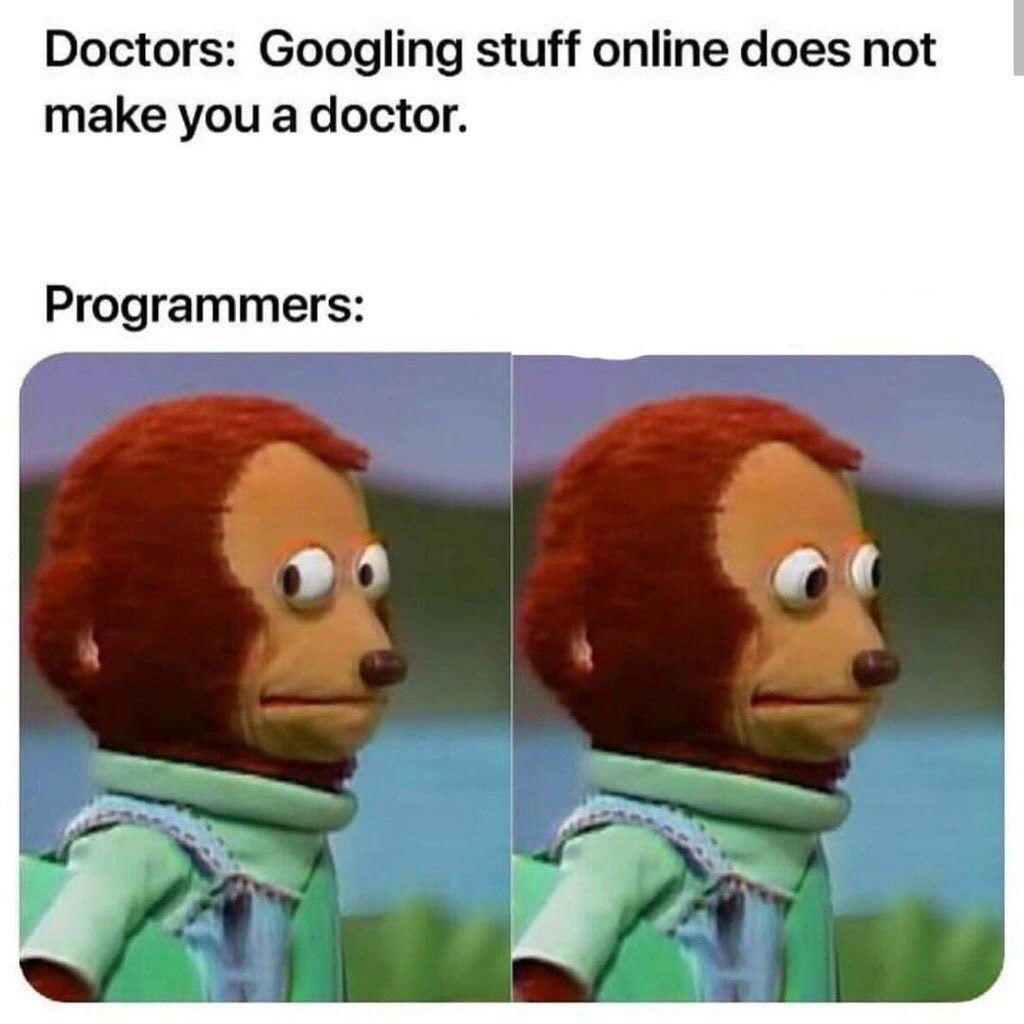
In the meme, the doctors say, “Googling stuff online does not make you a doctor.” That makes sense — you wouldn’t want someone to do surgery on you just because they read about it on Wikipedia! But the meme then shows the word “Programmers:” and uses a picture of a little monkey puppet looking sideways nervously. That puppet’s face is like the expression you’d have if you were caught doing something you feel a bit guilty about. Why? Because almost every programmer does google things while coding. It’s their secret ingredient. The joke is that, unlike a doctor, a programmer actually relies on Googling to help with their job every day.
Think of it this way: following a recipe doesn’t make you a professional chef, but it helps you cook a good meal. In the same way, looking up solutions online doesn’t mean you’re not a "real programmer" — it helps you get your program working. The funny monkey puppet is the programmers shrugging with an embarrassed smile, saying “yeah, I looked up the answer.” In the end, what matters is that the LEGO spaceship gets built or the cake gets baked (i.e. the code runs correctly), even if you used a guide. The meme is funny because it points out something everyone does but doesn’t always talk about. We can all laugh knowing that behind the scenes, every coder, no matter how experienced, sometimes needs to follow the instructions to make things work. And that’s perfectly okay, because the result – a finished project that works – is what counts!
Level 2: Google is My IDE
If you’re newer to programming, let’s break down why this meme hits home for so many developers. First of all, IDE stands for Integrated Development Environment. That’s the application or suite where programmers write and test their code (for example, Visual Studio Code, IntelliJ, or Eclipse). An IDE usually has a code editor, debugger, and other handy tools all in one. When programmers joke that “Google is my IDE,” they mean that having a web browser open with Google search is just as essential to their coding process as the code editor itself. In other words, they constantly switch to Google to search for documentation, error explanations, or examples, as if the internet were part of their development environment.
Now, Google (the search engine) is often the first place we go when something goes wrong. Imagine you hit an error message you’ve never seen before, or you need to use a function and you’re not sure of the correct syntax. The instinctive move is to Google the error or question. For example, if a Python program throws a NullPointerException (a common error type in some languages), a programmer might immediately type that error message into Google to see what it means and how others fixed it. Nine times out of ten, this search will lead to a site called Stack Overflow.
Stack Overflow is a huge question-and-answer website that’s immensely popular in the programming community. It’s basically a giant forum where developers ask questions about coding problems, and other developers post answers. Over the years, it has amassed a vast archive of common (and not-so-common) problems and solutions. So when you search for a programming issue, often an exact or similar question from Stack Overflow will appear in the top results. The format usually shows the question, a bunch of answers, and one answer marked as “accepted” which often contains the solution or an explanation. This site is so central to developer communities that a lot of us treat it as the first stop for troubleshooting.
This habit can become so routine that developers joke about having a Stack Overflow dependency or finding themselves stuck in a loop of constantly searching and copying from Stack Overflow. If you peek over a programmer’s shoulder, you might see a cycle like this:
error occurs → copy the error text → paste it into Google → click a Stack Overflow result → copy a code snippet from an answer → paste it into the code → test to see if the problem is solved.
This search-copy-paste loop might repeat a few times until the bug is fixed. It’s an extremely common part of real-world debugging and learning. Far from being taboo, it’s just how things get done. In fact, knowing how to search effectively is considered a valuable skill. Developers even humorously talk about their "Google-Fu" — basically, how good they are at googling the right keywords to find a solution quickly.
The meme sets up a comparison with doctors to highlight a difference in mindset. You often hear doctors say, “Googling symptoms doesn’t make you a doctor.” And that’s true! You wouldn’t want a surgeon who’s about to operate on you pausing to say, “Hang on, let me Google what this part does.” Medical professionals rely on years of training and controlled knowledge sources, and if someone untrained just reads WebMD and claims to be a doctor, that’s obviously dangerous. However, for programmers, looking up information online is not only accepted, it’s expected. Writing code is more like an open-book exam: you’re allowed (even encouraged) to use references and resources. The field of software changes so quickly and is so broad that even a seasoned programmer will be unfamiliar with portions of it. What makes a good programmer is not memorizing everything, but the ability to problem-solve — and that often involves researching solutions or examples.
This leads to what we jokingly call “copy-paste coding.” That’s when a programmer literally copies a snippet of code from a web page (like Stack Overflow) and pastes it into their project. Now, ideally, you don’t do this blindly. Good developers will test that snippet, make sure they understand what it does, and adjust it to fit their specific case. But the truth is, especially when you’re learning, you might not grasp every line of a solution you find online. That’s okay as long as you’re gradually improving and not copying insecure or incompatible code. Over time, by searching and reading these answers, you learn more and start remembering common solutions. It’s a bit like learning by example.
Let’s talk about that awkward monkey puppet image used in the meme. In internet culture, that two-panel monkey puppet (often called “Awkward Look Monkey”) is a popular meme for moments when someone feels caught or called out. In the first image the puppet’s eyes are looking to the side, and in the second image the puppet is looking forward, often with a funny, frozen expression. It perfectly conveys the feeling of, “Pretend you didn’t see that… oh no, they saw that.” In this meme, the text says:
Doctors: “Googling stuff online does not make you a doctor.”
Programmers: [monkey puppet side-eye face]
The joke here is that programmers are hearing “Googling doesn’t make you an expert” and reacting with that guilty look, because programming is the one field where we kind of do google stuff constantly to do our jobs. It’s a shared funny moment of self-awareness. We know that if we took the doctors’ statement and applied it strictly to ourselves, it would be embarrassing — by that logic, Googling code problems shouldn’t make us programmers! But the reason it works for us and not for doctors is the fundamental difference in the professions. No lives are at stake if we quickly look up how to center a div in CSS or how to fix a compiler error. Using the collective knowledge of the web is just efficient engineering.
For someone just starting out, it’s important to understand that using Google and sites like Stack Overflow is a normal part of the developer experience. New developers sometimes suffer from impostor syndrome — the worry that “I’m not a real programmer because I have to look up so many things.” This meme gently points out that everyone from the novice to the veteran does this. Even the rock-star engineers with 20 years of experience find themselves searching for the correct usage of a function or the solution to a weird error. They might not announce it, but they’re doing it. So if you find yourself on Google half a dozen times a day while coding, you’re not alone — you’re doing exactly what programmers do.
In summary, saying “Google is my IDE” is a humorous way to admit that a web browser is as vital a tool for coding as the code editor itself. Developers rely on the vast developer communities and resources online (documentation, forums, Q&A sites) just like a student relies on textbooks and class notes. The meme playfully acknowledges this reality by showing our embarrassed little monkey friend when faced with the doctors’ no-Googling rule. What might seem like “cheating” in another field is just everyday problem-solving in software development. The result? Code gets written and bugs get fixed, thanks in part to that quick Google search. The awkward puppet’s face captures the mix of slight embarrassment and acceptance we feel about this truth: Yes, we Google a lot — and that’s okay!
Level 3: Stack Overflow Driven Development
In software engineering, there's an awkward truth that even the most senior developers quietly embrace: coding often means searching for answers online. The meme’s comparison highlights a humorous paradox – “Googling medical symptoms doesn’t make you a doctor” vs. “Googling programming problems kinda does make you a programmer.” That side-eye monkey puppet in the image is basically every experienced developer when someone implies that using Google is "cheating." We give that same guilty look because our daily workflow is practically Google-driven development. It’s an open secret in tech that Stack Overflow and similar sites are part of the unofficial toolkit for developers. We sometimes jokingly call this Stack Overflow–driven development (SDD) or copy-paste coding. Instead of memorizing every API or reading documentation cover-to-cover (because who really has time for a 500-page manual for each library?), we rely on the collective wisdom of the internet. A seasoned coder might have deep knowledge, but they also have deep bookmarks. 😏
Why is this funny to veterans? Consider the contrast with other professions. In medicine or law, leaning on random online info signals inexperience. But in programming, the technology landscape evolves so quickly that not using online resources would be impractical. One month you’re working with React, the next you’re dealing with a brand-new framework — no one can keep all that in their head. So experienced devs have perfected their Google-Fu (search skills) and see it as a strength, not a weakness. It’s much faster to search and find a solution from someone who’s already solved a similar problem than to reinvent the wheel. The meme nails that guilty pleasure: we all chuckle because we’ve had that exact moment of “Oh no, I basically got this fix from Stack Overflow… hope no one asks how I figured it out.” The humor comes from exposing something we all do but don’t usually admit.
From a senior perspective, being a good developer isn’t about knowing everything by heart — it’s about knowing how to find information quickly and accurately. Think of Google and Stack Overflow as an extension of a programmer’s brain, a sort of external memory. We might not brag about it on our resumes, but using search engines effectively is absolutely part of the job. In fact, many of us have war stories about critical production bugs being solved thanks to an obscure blog post or a seven-year-old Stack Overflow answer found at 3 AM. There’s a running joke that if Stack Overflow ever went down, half the world’s code would suddenly stop compiling.
To illustrate how ingrained this is, here’s a tongue-in-cheek pseudocode for a typical debugging session in real life:
while bug_not_fixed:
query = "Stack Overflow " + error_message # form query with error text
solution = google_search(query) # search the web for answers
if solution:
apply(solution) # copy-paste the fix from the web
run_program_again()
This loop continues until the program works. It’s a playful algorithm for real-world troubleshooting: encounter error, search the error, copy the fix, and repeat. Every veteran developer recognizes this pattern. We often refine and learn from the code we find online, but initially we lean on Google like it’s part of our IDE.
Interestingly, the developer ecosystem has started to officially embrace this reality. Modern IDEs and editors sometimes have built-in web search, and tools like GitHub Copilot even auto-suggest code based on knowledge scraped from documentation and forums. It’s as if the industry collectively admitted, “Yes, searching online is part of coding, so let’s streamline it.” The meme’s humor lies in plainly stating this awkward truth. A room full of senior engineers will smirk and nod at that puppet’s guilty side glance, each remembering the last time they secretly pasted an error message into Google during a meeting. We laugh because we’ve lived it. We know that behind many “expert solutions” is a well-crafted search query and a copied snippet from Stack Overflow (tweaked just enough to fit our case). It’s a shared secret of the trade — one we usually don’t speak of out loud, but here the meme broadcasts it for all to see, leaving us programmers to do the sideways monkey look and chuckle in agreement.
Description
A two-part meme that contrasts medical and programming professions. The top text reads, 'Doctors: Googling stuff online does not make you a doctor.' Below this, it says, 'Programmers:'. The bottom half of the meme consists of two adjacent images of the 'Awkward Look Monkey Puppet'. The puppet, with large, expressive eyes, looks forward in the first frame and then nervously darts its eyes to the side in the second. This meme format is used to express guilt, anxiety, or being caught in an awkward situation. The joke hinges on the fact that while self-diagnosing medical issues via Google is frowned upon, for programmers, searching for code snippets, error solutions, and documentation online (especially on sites like Stack Overflow) is an absolutely fundamental, necessary, and universally accepted part of the job. The monkey puppet's reaction humorously represents the entire programming profession's collective 'uh oh' moment when their core workflow is called out
Comments
7Comment deleted
The difference is, when a doctor Googles your symptoms, it's malpractice. When a developer Googles an error message, it's called 'researching the optimal solution for stakeholder value alignment'
Sure, Googling won’t grant an M.D., but after 20 years of harvesting snippets from page-two Stack Overflow answers I feel qualified to perform open-heart surgery on a live production cluster
The difference is doctors Google symptoms while we Google error messages that are actually unique enough to return useful results
The fundamental difference between medicine and software engineering: doctors spend 8+ years learning before they practice, while we spend 8+ hours Googling before we ship to production. Both save lives, but only one profession has accepted that 'I'll just search for it' is a valid methodology. At least when our Stack Overflow goes down, patients don't die - they just get really, really nervous PRs
Senior devs don't recall APIs; they craft SO queries that summon fixes faster than rubber duck debugging
Senior engineering is 10% architecture, 90% knowing which stack trace to paste into Google - and which accepted Stack Overflow answer to ignore in production
After two decades, my edge isn’t knowing answers - it’s knowing the exact five-word search that returns the 2013 Stack Overflow snippet I can paste behind a feature flag and call ‘risk mitigation’