Skip to content
DevMeme
927 of 7435
Debugging Until The Career Pivot
Debugging Troubleshooting Post #1047, on Feb 24, 2020 in TG

Debugging Until The Career Pivot

Why is this Debugging Troubleshooting meme funny?

Level 1: The Stuck Puzzle

This is like refusing to stop working on a puzzle even though you are tired and angry. Someone says, "Take a break," but you keep staring at the same piece until you either find where it goes or decide puzzles are not your life anymore.

Level 2: Take the Break

Debugging means finding and fixing a problem in software. A bug might be a crash, a wrong calculation, a broken button, a race condition, or anything else that makes the program behave differently from what was intended. Bug fixing often involves reading error messages, adding logs, writing tests, checking recent changes, and trying to reproduce the problem reliably.

The tweet shows a common beginner and expert mistake: refusing to pause. The brain suggests a break because stepping away can reset your attention. When you return, you may notice the typo, wrong assumption, missing import, stale cache, bad environment variable, or off-by-one error that was invisible while you were frustrated.

For newer developers, this is an important lesson. Struggling does not automatically mean learning, and suffering does not automatically mean progress. A better debugging loop is: state the hypothesis, test one thing, record the result, then change direction if the evidence says to. If you cannot explain what you are testing anymore, the break is not laziness. It is part of the method.

Level 3: While Not Fixed

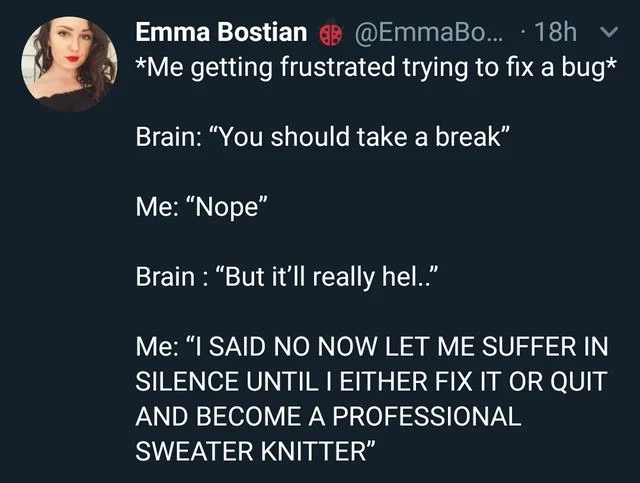
The tweet frames debugging as an argument between reason and obsession. The visible setup is *Me getting frustrated trying to fix a bug*, followed by the brain offering the correct advice: You should take a break. The developer refuses with Nope, then escalates into the all-caps vow to suffer until the bug is fixed or a new life as a "professional sweater knitter" begins. It is funny because every experienced developer has watched their own brain file a perfectly valid incident report and then ignored it.

The senior pain here is debugging fatigue. Bugs often reward persistence, so developers learn to stay with a problem through discomfort. That habit works right up until it does not. After enough failed hypotheses, the mind starts narrowing instead of exploring: you reread the same stack trace, rerun the same test, tweak the same line, and convince yourself the fix is one more attempt away. At that point, dedication has quietly become a while (!fixed) suffer(); loop.

The meme lands because good debugging is not only technical skill. It is managing cognition under uncertainty. A nasty bug forces you to maintain a mental model of program state, inputs, timing, environment, dependencies, and prior attempts. Fatigue corrupts that model. You forget what you already tested. You stop naming hypotheses clearly. You mistake motion for progress. The rational move is to step away, explain the problem to someone else, make a smaller reproduction, or sleep. The emotional move is to glare at the code until the code confesses.

The sweater-knitter punchline matters because it exaggerates the career-threat feeling of a stubborn bug. A local defect becomes an identity crisis: maybe I am not a developer, maybe computers were a mistake, maybe yarn has better documentation. The joke is not that knitting is bad; the post even says it sounds nice. The joke is that one bug can temporarily make any other profession look like a stable architecture.

Description

The image is a dark-mode Twitter screenshot from Emma Bostian, with the handle truncated as "@EmmaBo..." and a timestamp of "18h". The tweet reads: "*Me getting frustrated trying to fix a bug* Brain: \"You should take a break\" Me: \"Nope\" Brain : \"But it'll really hel..\" Me: \"I SAID NO NOW LET ME SUFFER IN SILENCE UNTIL I EITHER FIX IT OR QUIT AND BECOME A PROFESSIONAL SWEATER KNITTER\"". The humor is the familiar debugging spiral where the rational move is to step away, but the developer doubles down out of pride, sunk cost, and proximity to a maybe-fix. Technically, it captures the human failure mode behind long debugging sessions: degraded cognition masquerading as dedication.

Comments

1
Anonymous ★ Top Pick Every senior engineer knows exponential backoff works, then proceeds to implement `while (!fixed) suffer();` on themselves.
  1. Anonymous ★ Top Pick

    Every senior engineer knows exponential backoff works, then proceeds to implement `while (!fixed) suffer();` on themselves.

Use J and K for navigation