When a Programmer's Debugging Mindset Enters Surgery
Why is this Bugs meme funny?
Level 1: Oops, Wrong Tool
Imagine you're trying to do something simple and delicate, like build a little sandcastle with a toy shovel. But instead of using the shovel, you accidentally grab a big bulldozer and drive it over your sandcastle! Sand flies everywhere, the castle is ruined – it's a huge mistake. Now, normally you would be really upset or scared if this happened. But instead, you just shrug and say calmly, "Oops, I was supposed to use my little shovel. I'll fix that."
That contrast is what makes this scene funny. Something really bad and ridiculous happened (using a giant tool when a tiny one was needed), but the person reacts very calmly as if it's only a small hiccup. We expect the surgeon to panic when he sees a chainsaw in his hand during surgery (yikes!), but instead he treats it like it's just a minor mix-up he'll sort out. It's like watching someone use a hammer to crack open an egg and then coolly saying, "I'll use a spoon next time." The humor comes from that silly calmness in a moment that deserves a big "Oh no!" reaction. Even if you’re not a programmer, it’s easy to giggle at how absurd that is: a giant mistake met with an almost casual "I'll fix it" response.
Level 2: Wrong Tool for the Job
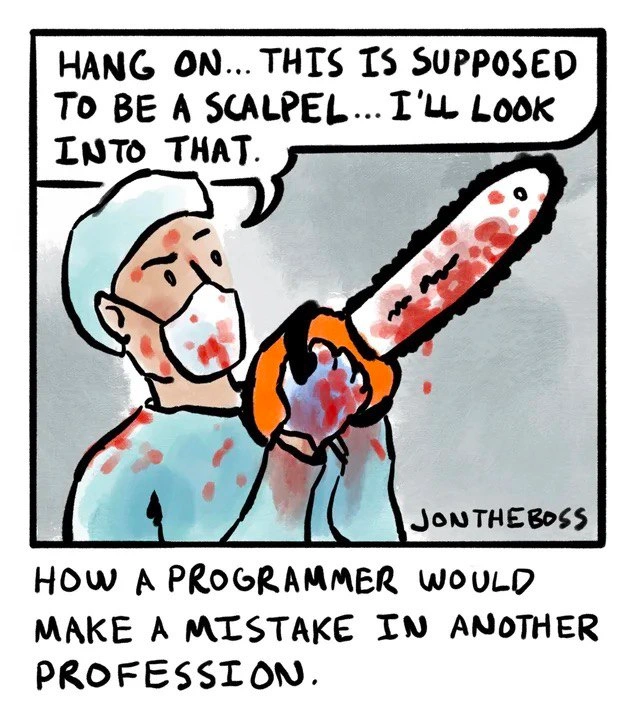
Let's break down the joke in simpler terms. We have a surgeon in an operating room who intended to use a scalpel, which is a small, precise knife for surgery. Instead, somehow he's holding a chainsaw – a huge power tool that's obviously not meant for delicate surgery. This is a ridiculous example of using the wrong tool for the job. The surgeon quickly realizes the mix-up mid-operation and says, "Hang on... this is supposed to be a scalpel... I'll look into that."
Why is this funny to programmers? Because it perfectly mirrors how developers deal with bugs in software. A "bug" is a mistake or error in a program that makes it do something it shouldn't. For example, maybe a coder accidentally used a piece of code that was way too destructive or heavy for the task – kind of like grabbing a chainsaw when a scalpel was needed. Imagine a simple script:
# Intended behavior: delete one file
delete_file("important.txt")
But due to a bug, it actually ran:
# Buggy behavior: delete an entire folder (major oops!)
delete_directory("important_documents/")
That's a chainsaw-level mistake when you only wanted a scalpel action!
When a programmer finds out they've made a mistake like that (often while the program is already running), they don't usually scream or panic. Instead, the typical response is something along the lines of, "Oh, that's not right. I'll look into it." This phrase basically means "I'll investigate the problem" – it's programmer-speak for "I'll debug it." Debugging (and troubleshooting) is what developers do to figure out why something went wrong and fix it. Just like the surgeon says he'll find out why there's a chainsaw present, a developer would dive into the code to see why the wrong function ran or why the output is all messed up.
The humor here comes from putting a programmer's calm, methodical attitude into a situation that is clearly NOT okay. In real life, if a surgeon ever pulled out the wrong instrument – especially something as crazy as a chainsaw – it would be an immediate crisis. But programmers are used to big mix-ups happening in a virtual environment (their mistakes usually don't physically hurt anyone). So we treat even serious issues as normal problems to solve. It's part of software developer culture: no matter how bad the bug is, you stay cool and methodically work through it. This is often called being in "debug mode" – you set aside panic and logically troubleshoot step by step.
The caption under the comic says, "How a programmer would make a mistake in another profession." It's highlighting that developers have a very analytical, almost casual approach to errors. We tend to see even a serious error as just another problem to fix. That calm "I'll look into it" response is something many people in tech have said or heard when a bug appears. It's part of the relatable developer experience – if you've written code, you've probably had a moment where something went horribly wrong and you had to calmly dig in to fix it, even if you were freaking out inside.
Finally, let's touch on Code Quality. Code quality means writing code in a way that avoids bugs or catches them early. In a well-run software project, you have practices like code reviews and automatic tests to prevent wild mistakes from making it into the final product. A mix-up as big as "chainsaw instead of scalpel" suggests that those safety nets failed. In the comic, clearly some hospital protocol failed if a chainsaw made it onto the surgeon's tray. In coding terms, it's like a deployment to production (the live system) that somehow passed all checks despite having a huge error. Beginners learn that you should test your code (like double-checking your tools) before letting it run in production (real-world use). This comic exaggerates what can happen if a colossal bug slips through unchecked: you end up in a mess and have to fix it on the fly. The joke sticks the programmer's normal behavior (calm debugging of a bug) into a context where it absolutely doesn't belong, which is why it's both funny and eye-opening.
Level 3: Operating in Production
Every seasoned developer can recognize the nightmare scenario being spoofed here (cue nervous laughter from anyone who's deployed the wrong code before). It's essentially a production bug playing out in a life-and-death context. In the comic, the surgeon is smack in the middle of an operation (the equivalent of running code in production on a live system) when he discovers a grotesque error: the instrument in hand is massively the wrong tool. This is the surgical equivalent of deploying software with a disastrously wrong dependency or configuration. The humor comes from the surgeon's unnervingly calm response: "Hang on... this is supposed to be a scalpel... I'll look into that." That's exactly how developers speak when a critical bug pops up. Server on fire? Users screaming? The dev checks the logs and, in deadpan fashion, says something like, "Hmm, that's not right. I'll debug this." It's the panic_free_debugging mindset, ingrained after surviving countless 3 AM outages on call.
The absurdity is obvious: in any normal world, realizing you're holding a bloody chainsaw instead of a scalpel would trigger full-on panic. But the joke is that a programmer's reflex is to treat even a catastrophic bug as a routine glitch, not a reason to freak out. We approach a severed database table or a site outage with the same analytical demeanor: identify the issue, trace the cause, apply a fix. Here, the surgeon behaves exactly like a dev who found a bug in production code. He's basically logging a bug report in real-time:
Expected: Scalpel
Actual: Chainsaw
Status: Investigating...
The caption spells it out: "How a programmer would make a mistake in another profession." In other words, if you took a coder’s mindset and pasted it onto a surgeon, you’d get this ridiculous, inappropriate level of calm in the face of a mortal screw-up. For those of us in software, this scenario is hilarious and horrifyingly familiar (the old "fixing the plane while it's flying" feeling). We've all been taught to stay cool under pressure. Part of being good at debugging is not letting the severity of an issue cloud your problem-solving. You might deploy a new update only to discover it’s the wrong build running – akin to grabbing a chainsaw for a delicate incision – but you don't scream, you mutter "let me look into that" while beads of sweat form. It's that mix of internal debugging frustration and external stoicism that the meme nails perfectly.
This comic is poking fun at our sometimes blasé attitude toward serious mistakes. In coding culture, using the wrong tool or crashing a program is all in a day's work; we often downplay it as "just another bug." We even throw around the joke "it's not a bug, it's a feature" to cope. But in an operating room, there's no cheeky rebranding of a chainsaw-as-scalpel error – it's a disaster, period. The meme wittily reminds us that what we consider a normal Tuesday in software development (a deploy gone horribly wrong, followed by a calm debug session) would be utter insanity elsewhere. It also has an implicit Code Quality lesson: this situation is like a code review that failed spectacularly. How did a chainsaw even get into the surgeon's toolkit? That hints that all the safeguards (double-checking tools, following checklists – the analogs of tests and code reviews) failed. It's a lighthearted warning that if you slack off on quality control, you might end up with a chainsaw-grade bug and find yourself coolly saying "Oops, I'll fix it" when it's far too late.
Level 4: Type Safety Malpractice
Deep beneath the humor is a commentary on software reliability vs. real-world safety. In programming terms, swapping a scalpel for a chainsaw is an extreme type mismatch or a major misconfiguration that somehow escaped all checks (shockingly, not one test caught it). A robust system with strict code quality gates (static type checking, unit tests, integration tests) would catch such a glaring discrepancy before "runtime" (if only OR protocols acted like a compiler!). For instance, a strongly-typed language or formal specification would never let a Chainsaw object be used where a Scalpel is required – the compiler or static analyzer would flag an error long before any real operation happens. The cartoon scenario implies either a highly dynamic/untyped context or simply a total breakdown of quality control – hey, we’ve all seen that happen in production.
In high-stakes fields (medical software, aerospace, etc.), you often see formal verification and exhaustive testing to ensure a wrong "tool" can't be used by accident. There's an entire discipline of writing proofs or using static analysis to guarantee correctness and prevent catastrophic outcomes. If a surgical robot or life-critical system had a "chainsaw vs scalpel" bug, it would spark a massive investigation into what spec or safety net failed. This is essentially the coding equivalent of malpractice. The phrase "I'll look into that" hints at the blameless postmortem culture in software: after something goes horribly wrong, engineers calmly sift through logs and stack traces to pinpoint the root cause. In software, that methodical retrospective is normal (nobody dies from a NullPointerException), but in an operating room a "postmortem" isn't just a meeting – it's a literal autopsy. The meme is darkly highlighting that what counts as a mere bug to a programmer would be an unthinkable, disastrous oversight in surgery.
From a theoretical perspective, this humor underscores the gap between how software engineering tolerates on-the-fly fixes versus how traditional engineering demands upfront correctness. Programming can afford a "deploy now, patch later" attitude because mistakes are reversible or at worst cause system downtime. But if physical reality had an equivalent of a compiler, it would never "link" a chainsaw into a surgical kit – or if it did, the system design has fundamentally failed. This absurd mismatch serves as a cautionary tale: robust design by contract, strong type safety, and thorough testing are supposed to prevent exactly this sort of nightmare scenario, whether in code or on an operating table.
Description
A single-panel comic by 'JONTHEBOSS' titled 'HOW A PROGRAMMER WOULD MAKE A MISTAKE IN ANOTHER PROFESSION.' The illustration depicts a surgeon in a light blue scrub cap and gown, splattered with blood. He is holding a large, bloody chainsaw and has a worried expression. A speech bubble from the surgeon says, 'HANG ON... THIS IS SUPPOSED TO BE A SCALPEL... I'LL LOOK INTO THAT.' The humor arises from the absurdly calm and analytical response, typical of a programmer discovering a bug, applied to a horrifying and life-threatening surgical error. It satirizes the detached, problem-solving approach of developers, contrasting the often abstract nature of software bugs with the immediate, visceral consequences of mistakes in the physical world
Comments
8Comment deleted
That's not a bug, it's an undocumented feature for rapid, bulk tissue removal. He just needs to add a feature flag and update the release notes
Apparently the surgical team let Spring autowire ScalpelInterface and got ChainsawImpl - another reminder that prod is just staging with higher blood pressure
This is exactly how we handle production incidents: "Interesting, we deployed a DELETE * instead of a SELECT. Let me create a JIRA ticket and we'll discuss it in the next sprint retrospective."
Severity: critical. Status: acknowledged. ETA: after standup. The patient has been moved to the backlog
This perfectly captures the programmer's instinct to treat every catastrophic production failure as just another ticket to investigate. 'Critical data loss affecting 10,000 users? Yeah, I'll look into that after lunch.' The chainsaw-for-scalpel swap is the equivalent of using a regex to parse HTML, or deploying directly to prod on a Friday afternoon - technically you *can* do it, but the blood splatter should've been your first code smell. The real horror isn't the wrong tool; it's the calm, methodical 'I'll investigate' response when the patient is already on the table. Every senior engineer has been that surgeon at 3 AM, staring at a Datadog alert, thinking 'Huh, that's not supposed to be a chainsaw' while the on-call pager screams
This is what happens when your DI container resolves IScalpel to ChainsawImpl because the default profile was “performance” and nobody wrote a contract test
When the DI container resolves IScalpel to Chainsaw in prod - “I’ll look into it” is engineer‑speak for “see you at the blameless Sev1 postmortem.”
error: scalpel not found; substituting chainsaw. Proceeding with incision