Kubernetes: The Right Helm for the Wrong Vehicle
Why is this Containerization meme funny?
Level 1: Boat Wheel in a Car
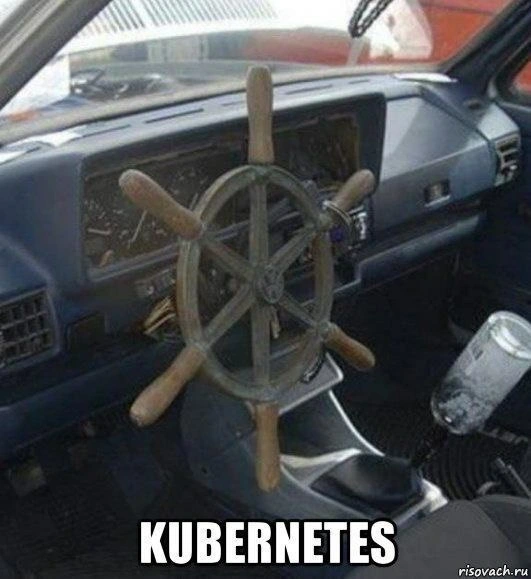
Imagine you have a little car, and someone decides to put a huge pirate ship’s steering wheel in it instead of the regular steering wheel. Pretty silly, right? The big wooden wheel might look cool for a moment (you might feel like a pirate captain in a tiny car!), but it doesn’t actually help – it just makes driving the car awkward and hard. You don’t need such a giant, fancy wheel to drive a small car down the street. In fact, it probably makes things worse because it’s so unwieldy. This meme is funny for the same reason: it’s showing how ridiculous it is to use something super big and complicated where a simple thing would do. It’s like using a rocket launch control panel to turn on your kitchen toaster – overkill and completely out of place, which makes us laugh. The car with the boat wheel is a goofy way to say, “Don’t use a giant ship’s steering wheel when all you need is a normal steering wheel,” or in tech terms, don’t use an ultra-complex tool for a simple job. Even a kid can see that a boat’s wheel belongs on a boat, not in a car, and that obvious mismatch is what makes it so humorous. The picture just makes you giggle and think, “Wow, that’s doing way too much for such a small car!”
Level 2: Bolting on the Helm
Let’s break down the joke for those newer to DevOps and containerization. In the image, we have an old car where the normal steering wheel has been replaced by a big wooden ship’s wheel (the kind a captain uses to steer a boat). It looks totally out of place! Below that picture is the caption “KUBERNETES” in bold letters. This is a reference to the Kubernetes logo and icon, which is also a ship’s wheel (a stylized helm). Kubernetes’ very name actually comes from a Greek word meaning “helmsman” or pilot – someone who steers a ship. So the meme takes that literally: someone bolted a ship’s helm onto a car’s steering column.
Now, Kubernetes (K8s) is a popular technology in the software world. It’s an open-source platform for container orchestration. Let’s unpack that: containers are a way to package applications so they run the same everywhere. Think of a container like a little shipping container holding an app with everything it needs (code, libraries, settings). Tools like Docker made containers easy to use – you “containerize” an app so it’s portable and isolated, much like how a real shipping container lets you move goods easily between trucks, trains, and ships. Kubernetes builds on that shipping analogy: if Docker gives you containers (and Docker’s logo is a whale carrying containers), then Kubernetes is like the harbor master or ship’s helmsman coordinating a whole port full of container ships. Kubernetes can deploy, start, stop, and manage containers across many computers (a cluster) automatically. It keeps apps running, scales them up or down, and handles networking between them. In essence, Kubernetes is great for large, complex applications or lots of services that need to be managed reliably.
DevOps (Development & Operations) culture often embraces Kubernetes because it helps automate releasing and running code in production. It has features to self-heal (if something fails, Kubernetes can restart it), load-balance user requests, and roll out updates with minimal downtime. That’s why Kubernetes has become a standard in modern cloud infrastructure – it’s very powerful for deploying microservices and cloud-native applications. It has a strong nautical theme (even the name of its package manager is Helm, continuing the ship metaphor). By 2019, Kubernetes was the cool new thing – an industry trend almost to the point of hype. Many engineers were excited about it (it’s often considered “the next big thing” after virtual machines and cloud) and there was a push to use Kubernetes for all sorts of projects. This led to some cases of overkill tool choice: teams choosing Kubernetes even when their app was small or simple enough to run without it, just because it was trendy or because “that’s what everyone is doing now.”
This meme is calling out that overkill. Replacing a car’s steering wheel with a ship’s wheel is a comedic visual metaphor for “using Kubernetes for everything.” A car is a much smaller, simpler vehicle than a ship — just like a tiny app or a simple service is much simpler than the huge distributed systems Kubernetes is meant to run. The car doesn’t need a ship’s navigation system, and in fact, trying to use one makes driving awkward and silly. Likewise, not every software project needs Kubernetes. Sometimes a simple approach (even just running the app directly, or using a single Docker container without all the orchestration) would work better. When people force Kubernetes into projects that don’t need that scale, it can feel as clumsy and unnecessary as trying to drive a compact car with a giant wooden helm.
Let’s decode some terms and elements here:
- Kubernetes (K8s): A platform that automates running and managing containers (packaged applications) across multiple computers. It’s symbolized by a ship’s wheel. It’s great for complex, large-scale systems but introduces a lot of moving parts.
- Ship’s wheel in the car: This is literally the Kubernetes logo brought to life. It represents putting Kubernetes into a place it isn’t meant for. It’s a punny sight gag: the car now has a “Kubernetes steering wheel.”
- Overengineering: This means designing a solution that's far more complicated or powerful than what’s actually needed. In tech, we say something is overengineered when people use an extremely complex tool or architecture to solve a simple problem. Here, using Kubernetes for a small or non-critical app is seen as overengineering – akin to using a rocket engine to power a bicycle.
- DevOps hype: Around the time of this meme, Kubernetes was a buzzword. “Everyone” in tech was talking about containers, microservices, and K8s. This sometimes led to a bandwagon effect: using a technology because it’s popular, not because it’s the right fit. The meme jokes about that mindset. If you imagine the conversation in a development team: “We have a simple app, do we really need Kubernetes?” “Of course, Kubernetes is the future – we have to use it!” – that’s the kind of hype-driven decision the image is parodying.
- Nautical theme in tech: Both Docker and Kubernetes use a lot of shipping and naval imagery (containers, whales, helms, etc.). This meme leans into that by making the car’s steering literally nautical. It’s a playful way to connect the tech symbolism to a real object.
Overall, to a junior developer or someone new to this area, the meme is saying: “Kubernetes is cool and powerful, but be careful about using such a heavyweight tool everywhere.” If you put a tool in a context where it doesn’t fit, you’ll end up with something that’s funny to look at but not very practical (like our car with the boat wheel). Many people in tech find this funny because they’ve seen real-life versions of this scenario – where a simple project becomes overly complicated by using the latest DevOps tools or cloud technologies without a real need. The image exaggerates it to make the point clear. It’s a lighthearted reminder not to let hype dictate your engineering choices: just because Kubernetes is the “in” thing, it doesn’t mean you should weld it onto every project (just like you wouldn’t literally put a ship’s wheel on your car!). Sometimes, using a simpler solution is okay – your car can keep its normal steering wheel, and your small app can run without a massive orchestration system.
Level 3: Orchestrating Overkill
This meme lands close to home for many senior developers and DevOps folks because it captures a real-world pattern: overengineering due to tech hype. Kubernetes became a buzzword synonymous with modern infrastructure, to the point that some teams deploy it without a clear need — essentially using a sledgehammer to crack a nut. Seeing a ship’s wheel crudely mounted in a car is hilariously on-point: Kubernetes’s logo is a ship’s wheel (a helm), and here someone literally put one in a place it absolutely doesn’t belong. The humor is in the absurd overkill. It’s as if a small-town mechanic decided their 20-year-old compact car should be controlled like a container ship, just because container ships are the hot new thing.
In practice, we’ve all encountered the scenario being mocked. For instance, a simple web app that could run on one server with a single database ends up “modernized” into a full microservices architecture on a Kubernetes cluster. The developers promise benefits like easy scaling and resilience, but suddenly the project’s complexity explodes. Now you have to manage pods, nodes, services, and ingress controllers for what used to be a straightforward stack. The dashboard ripped open in the image — wires hanging out — resembles the chaotic DevOps aftermath of such an unnecessary Kubernetes integration. Things that once “just worked” might break in weird ways: database connections time out because of misconfigured cluster DNS, deploys fail due to mis-scheduled pods, or the whole app goes down because the cluster’s helmsperson (the control plane) fell asleep at the wheel. It’s a perfectly relatable dev experience: that sinking feeling when a deployment pipeline becomes an order of magnitude more complicated than the app itself.
The text “KUBERNETES” plastered below the photo is both the label and the punchline. It implies, “Yes, we really did Kubernetes-ify this ordinary thing.” It’s poking fun at the industry trend: Kubernetes-all-the-things. In meetings, this might look like:
Dev 1: “Our app runs fine on a single server, do we really need containers and Kubernetes?”
Dev 2: “But…but everyone is using Kubernetes now. We’ll be cloud-native! Ship it!”
Dev 1: sigh “Alright, set sail I guess…”
The meme’s caption, “When you bolt Kubernetes onto everything, even the steering feels nautical,” says it all. After shoehorning Kubernetes into the mix, you suddenly find your project steering in an entirely different way — nautical, as in overly complex and built for high seas that you aren’t actually sailing. The car (your project) now handles differently (harder to steer, more to maintain) because it’s burdened with the apparatus of a much larger vessel. Seasoned engineers chuckle (or groan) at this because they’ve lived through it: the on-call nights dealing with a surprise cluster failure for an app that used to run on one machine, or the hours lost debugging a yamling (YAML wrestling) issue for a service that could have been a simple script.
Why do teams do this? Often, it’s a mix of “because we can” and FOMO. There’s a joke about resume-driven development: choosing a buzzworthy tool like Kubernetes so you can brag about it later, regardless of whether it’s the right fit. Kubernetes is an amazing piece of technology — for the right context. But the meme spotlights the folly of using it indiscriminately. It’s the tech equivalent of fitting a Honda Civic with controls from a Navy battleship. Sure, it’s innovative in a twisted way and might impress your peers at a meetup, but driving to the grocery store has become an adventure in all the wrong ways. The car’s owner in the photo even left a plastic bottle rolling around the floor and the dash half-disassembled, which feels true to form — when you’re rushing to implement the Next Big Thing, some basic cleanliness and sanity often get left behind.
In summary, the humor here comes from engineering absurdity and irony. Kubernetes is meant to orchestrate large fleets of application containers, keeping them sailing smoothly. But when someone treats a tiny application (the little car) like it needs a full container ship’s bridge to drive, the result is laughably cumbersome. Experienced devs laugh (and maybe wince) because it reminds them of all the over-built solutions they’ve seen. It’s a gentle jab at the DevOps zeitgeist: just because something is a best practice at Google scale doesn’t mean it makes sense in your side project or small business app. The meme holds up a mirror to our tendency to grab the shiny new hammer (K8s) and start swinging at every problem — even when the problem is a thumbtack. The image is ridiculous, and that ridiculousness is exactly what makes the joke so on-point about DevOps overcomplication.
Expectation: “This will make our app infinitely scalable and robust.”
Reality: Your one tiny app now drags around a whole container cluster with it. It’s like expecting a car to turn into a rocket ship, but instead you got a car towing a rocket’s launchpad — overkill with a performance penalty.Expectation: “Automated resilience! If something crashes, Kubernetes will restart it.”
Reality: Yes, Kubernetes will try to keep your app running — but you’ve also added new ways for things to crash. (Service mesh misconfigurations? Node communication errors? Ingress TLS secret not found? Welcome to a new world of obscure outages at 3 AM.)Expectation: “Using Kubernetes is modern and standard – it future-proofs our deployment.”
Reality: It standardizes some things at the cost of uber-complexity for small projects. You spend more time writing YAML and managing the orchestrator than developing the app. Future-proofing? More like present-proofing your patience.
In the end, the senior-perspective takeaway is clear: Just because you can do something doesn’t mean you should. Kubernetes is a powerful tool, but as this meme deftly shows, slapping a powerful tool onto everything leads to comically poor fit. It’s a cautionary laugh, reminding us to match our tools to our actual needs — or risk steering our simple projects with an unwieldy nautical wheel and wondering why the ride got so bumpy.
Level 4: Overboard with Kubernetes
At the highest technical tier, this meme highlights the accidental complexity introduced by applying a distributed container orchestration platform to a problem far smaller than it was meant to solve. Kubernetes was originally designed to coordinate hundreds or thousands of containers across clusters of machines — essentially acting as the helmsman for a fleet of server ships. It tackles hard computer science problems: scheduling workloads (a multi-dimensional bin-packing problem that’s NP-hard in theory), maintaining cluster state via distributed consensus (the Kubernetes control plane relies on etcd, which uses the Raft consensus algorithm to keep data consistent across nodes), and handling network abstraction and service discovery across ephemeral containers. These features are brilliant when you actually have a fleet. But here, our “fleet” is one old beat-up car (a single node or a small app), so all that sophisticated machinery becomes overhead rather than benefit.
Fundamentally, distributed systems like Kubernetes trade additional complexity for scalability and reliability across many machines. They have to consider the CAP theorem (balancing Consistency, Availability, and Partition tolerance) and implement controllers that reconcile desired state with reality. In a huge production environment, this complexity is justified — you need robust algorithms to handle node failures, network partitions, and scaling requirements. However, bolting those mechanisms onto a tiny system is like installing a ship’s autopilot and radar on a rowboat. The car-turned-boat in the meme inherits the distributed overhead without any of the scale that made it worthwhile. There’s now a whole “cluster” to manage where a single process would do: a Kubernetes control plane (API server, controller manager, scheduler, etcd) humming along just to steer one little application. Each turn of that massive ship’s wheel introduces needless indirection: a command might go through layers of API calls and scheduling decisions as if provisioning across an ocean of servers, when in reality there’s only one engine under the hood.
This is a case of over-engineering by orchestration. By insisting on Kubernetes in every scenario (“Kubernetes-on-everything” syndrome), engineers can introduce new failure modes that simply don’t exist in a simpler setup. The meme’s absurd car dashboard — wires dangling out — mirrors the brittle state of an over-complex system jammed into a simple environment. For example, a straightforward monolithic app that could be run as a single binary now has multiple microservices in containers, orchestrated by Kubernetes. That means if the cluster’s etcd has a hiccup or the network overlay misroutes, your once-stable app might stop responding even if the code itself is fine. By going “overboard” with Kubernetes, you’ve invited the choppy seas of distributed computing (like consensus failures, network latency, YAML misconfigurations) into a context that never needed to leave the calm harbor of a basic deployment.
In short, the meme is a nerdy critique of hype-driven architecture. It’s showcasing the humorous extreme of “if it moves, containerize it; if it doesn’t move, containerize it anyway.” Seasoned engineers recognize that while Kubernetes is powerful, it comes with a complexity tax. Using it without necessity is like performing delicate surgery with a multitool chainsaw. Yes, it can cut, but the collateral damage (and sheer ridiculousness) is plain to see. The ship’s helm sticking out of the car’s steering column is the perfect visual metaphor for this concept: a literal illustration of how out-of-place an enterprise-grade solution can be when slapped onto a trivial problem space, all in the name of the latest tech trend.
Description
A meme depicting the interior of an older model car where the standard steering wheel has been replaced with a large, wooden ship's helm. The dashboard and surrounding interior appear dated. At the bottom of the image, the word 'KUBERNETES' is written in a bold, white, capitalised font. This image is a clever visual pun on the name 'Kubernetes,' which is Greek for 'helmsman' or 'pilot.' The humor lies in the absurdity of using a complex, heavy-duty steering mechanism (a ship's helm) for a simple vehicle (a car). For experienced developers, this serves as a powerful metaphor for the common anti-pattern of over-engineering, specifically the trend of adopting the complex Kubernetes orchestration platform for small-scale applications that don't justify its operational overhead
Comments
8Comment deleted
That's what happens when the platform team designs the car. Now, turning left requires a quorum of three nodes, a 200-line YAML file, and a service mesh
We replaced the steering wheel with Helm - now every lane change is a rolling update and the car won’t start without etcd quorum
"We spent three sprints implementing K8s for our two-container app, but at least now we can tell investors we're 'cloud-native' while our single EC2 instance runs at 5% capacity."
Sure, the engine hasn't started since 2009, but now it has a control plane
Kubernetes: where 'just deploy the container' somehow requires you to become a certified helmsman, understand YAML indentation at a molecular level, and explain to stakeholders why your 'simple microservice' now needs a 47-node cluster with service meshes, ingress controllers, and a dedicated SRE team - all to replace what used to be a single Docker run command. At least the name is etymologically accurate: you really do need to be a ship's pilot to navigate these waters
Kubernetes: your app is a Corolla, but you bolt a helm to the dashboard - now a right turn is a rolling update and the horn needs RBAC
Enterprise modernization: replaced the steering wheel with a helm - now a left turn requires a CRD, RBAC, and kubectl apply -f lane-change.yaml
Kubernetes: Because parallel parking one sedan needs Helm charts, three replicas, and a rolling update for left turns