Skip to content
DevMeme
299 of 7435
AI Memory: Literal, Not Contextual
AI ML Post #356, on May 2, 2019 in TG

AI Memory: Literal, Not Contextual

Why is this AI ML meme funny?

Level 1: Not What I Meant

Imagine you ask your friend to help you remember where you parked your bike. You point around and say, “remember this spot.” You mean that you want your friend to note the actual place so you can find it again later. Now, picture your friend nodding and replying, “Sure, I’ll remember that.” But when you later ask, “Hey, what spot did I ask you to remember?”, your friend proudly answers, “You told me to remember ‘this spot’!” – and that’s all they say. They literally just repeat the words “this spot” back to you. That wouldn’t help at all, right? You’d probably facepalm or laugh because your friend totally missed the point. They remembered the words “this spot” but not the actual location of your bike.

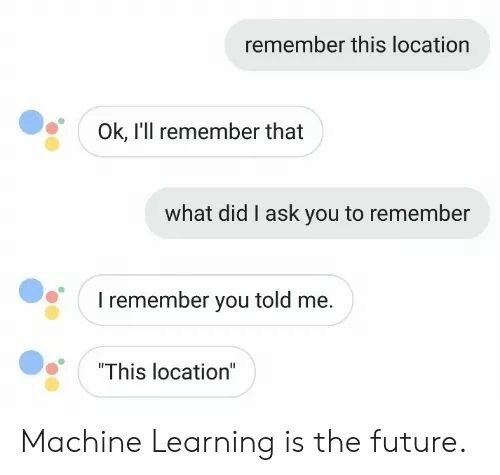
This is exactly what’s happening in the meme. The person told the AI assistant to remember the location, and the assistant only remembered the phrase itself, “This location,” instead of the real place. It’s funny in a silly way: the high-tech gadget acted like a forgetful friend who took the request way too literally. The phrase “Machine Learning is the future.” at the bottom is the meme poking fun – it’s saying, “Look, this is the great AI future we were promised?” It’s a bit like saying, “Wow, some future – the machine can’t even understand such a simple thing!” We laugh because we expected a smart helper, but got a goofy misunderstanding instead. It’s humor that anyone who’s ever been misunderstood can relate to, just with a computer playing the role of the overly literal friend.

Level 2: Context Not Included

Let’s break down what’s happening in the meme in simpler terms. We have a conversation with a voice assistant (think Google Assistant or Alexa). The user says, “remember this location.” In normal language, that means the user wants the assistant to keep track of where they are at that moment (maybe so they can get back there later). In a perfect scenario, the assistant would use the phone’s GPS or a map to save the actual place (like “123 Main Street” or the GPS coordinates). The assistant even replies, “Ok, I’ll remember that,” which sounds promising — as if it understood and will remember the spot.

However, when the user later asks, “what did I ask you to remember?”, the assistant’s answer is completely unhelpful: it says, “I remember you told me ‘This location’.” In other words, the assistant literally memorized the words “this location” instead of remembering the location itself. It’s treating “this location” as just a piece of text, not as a place on a map. This is the joke: the fancy AI didn’t grasp what the person really meant.

Some key terms to understand here: Natural Language Processing (NLP) is the technology that helps computers understand human language. Part of NLP for a voice assistant is figuring out the intent behind your words. The intent of “remember this location” should be something like: save my current location. But the assistant missed that intent. It heard the command “remember X” and just took X to be “this location” (as a phrase) because that’s the literal input. It didn’t connect the word “location” with the phone’s location services. This is a limitation in the assistant’s understanding. AI assistants are programmed with certain commands and sometimes use machine learning to interpret variations, but they don’t truly “understand” meaning the way people do. They often rely on patterns. Here the pattern might have been: after “remember,” take whatever was said and store it verbatim. That’s why it ended up storing “This location” as a note. The assistant had no context — it didn’t include any extra information like where the user was.

This is funny to us because it’s a big disconnect between what we expect and what the machine did. It’s like a overly literal person following your words but not your intention. In the world of AI humor, we often laugh at these kinds of mistakes because they show how computers don’t really get nuances. Despite all the high-tech Machine Learning involved (speech recognition, etc.), the assistant still acted in a very brainless way here. The caption “Machine Learning is the future.” is written in bold to mock the grand statement people make about AI. Yes, machine learning is powerful, but as this meme shows, there are still many simple things that can go wrong. It’s a lighthearted reminder that even advanced conversational AI can stumble over something a human child would understand. For a new developer or someone learning about these systems, the lesson is: you have to program or train the AI to handle context. If you forget to give it that ability, it will do exactly what the words say and nothing more — often with hilarious or frustrating results.

Level 3: Lost in Interpretation

From a seasoned developer’s perspective, the meme’s humor comes from a painfully familiar gap between AI hype and reality. We’ve all heard how voice assistants like Google Assistant or Siri are supposed to be incredibly smart, powered by cutting-edge Machine Learning. Yet here we see one fail at a seemingly simple task: the user says “remember this location”, expecting the assistant to bookmark their current place, but the assistant interprets it in the most naive way possible. Instead of saving coordinates or an address, it just saved the literal phrase “This location.” It’s a classic intent recognition misfire. The phrase was recognized (speech-to-text ML did its job converting voice to text accurately), but the system’s intent parser didn’t grasp the actual request.

Why is this so funny (or cringey) to experienced devs? Because it reveals the brittle underpinnings of supposedly “smart” systems. In a robust design, the keyword “location” coupled with context (“this”) would trigger a special handler to grab the device’s GPS data or a Google Maps link. But clearly, that integration wasn’t there. Perhaps the development team implemented a generic “remember ” feature where the assistant just stores whatever follows the word “remember” as a note. So if you say remember X, it just parrot-backs X later. That works fine for “remember the milk” or “remember John’s birthday” – storing those exact phrases is useful. But for “remember this location, the literal approach is comically useless. The assistant diligently remembered exactly what you said, demonstrating zero actual intelligence about what you meant. It’s like an over-literal intern who follows instructions to the letter (in this case, literally the letters t-h-i-s l-o-c-a-t-i-o-n):

user_input = "remember this location"
if user_input.lower().startswith("remember "):
    thing_to_remember = user_input[len("remember "):]  # extract text after "remember "
    memory_store.save(thing_to_remember)
# After this, memory_store contains "this location" as the saved note.

In a perfect world, there’d be an extra step: if thing_to_remember == "this location", then call a save_current_location() function to store GPS coordinates. But that logic either wasn’t implemented or failed to trigger. The result is the assistant behaving more like an obedient chatbot from the 1960s (remember ELIZA?) than a 21st-century AI assistant. It’s programmatic literalism: the system did exactly what it was told without any nuance. Seasoned engineers recognize this as an edge case or oversight in the design. It’s simultaneously hilarious and exasperating: we’ve built machines that can beat humans at Go and generate realistic images, yet asking a phone to remember a spot on the map can end up like a “Who’s on first?” comedy routine.

The bold text punchline, “Machine Learning is the future.”, drips with irony here. It’s poking fun at the industry’s grand claims. We’ve been promised that AI/ML will revolutionize everything – and indeed, these assistants use ML for speech recognition and some NLP – but the meme highlights how, without careful programming and understanding of context, the future can still stumble on simple tasks. It resonates with developers who have dealt with AI limitations: it’s a reminder that even advanced systems are only as smart as their programming and training data allow. A senior dev might chuckle (or groan) because they know this bug is not a terminator-level AI gone rogue; it’s likely just a missed user story in a sprint or a typical AI edge case that wasn’t covered. In the real world, bridging that last mile of understanding (“by the way, ‘this location’ means use GPS”) often requires explicit handling – something machine learning alone didn’t magically solve here.

In essence, the meme is AI humor with a bite of truth: building truly conversational AI is hard. For all the millions spent on R&D, the assistant here behaves in a way that feels as naive as a student project. It underscores a key point senior folks know well: AI isn’t magic. If you don’t design for context and intent properly, you get laughably literal outcomes. And as any grizzled programmer might quip with a smirk: “Well, it did do exactly what we told it to… maybe the bug is in what we asked for.” 😅

Level 4: Grounding "This" in Reality

At the deepest level, this meme highlights a classic AI problem: the failure to connect language to real-world context, often called the symbol grounding problem. The assistant was told “remember this location”, which contains a deictic reference – the word “this” points to something in the external world (the user’s current GPS location) rather than a literal string. Humans intuitively resolve such references using context: when we say “this location,” we mean the place we are presently at. But a machine learning-driven system without explicit grounding will treat “this location” as just another text snippet. Modern Natural Language Processing (NLP) pipelines typically break down a user command into an intent and parameters. Here, the likely intent was “remember_note” with the parameter being the exact words after it. The underlying algorithm might have extracted the substring “this location” and, lacking any further semantic hook, simply stored that as data. In essence, the assistant had no mechanism to tie the word “location” to the phone’s sensors or a map coordinate. This exposes a limitation in the Conversational AI design: without a layer of common-sense reasoning or explicit programming, an AI assistant can’t infer that “this” = current GPS coordinates. Handling deictic language like this requires bridging text to world models – a hard problem in AI research. The humor here is that the so-called smart assistant behaves like a literal tape recorder because it has no true understanding of the phrase’s meaning. It’s a mini demonstration of how Machine Learning and large datasets alone don’t guarantee genuine comprehension. Until AI can actually ground words like “this” in real situational context, it will faithfully (and absurdly) remember exactly the words it heard, missing the point entirely. This technical quirk is a reminder that “Machine Learning is the future” – but without deeper semantic models, the future can still feel pretty dumb.

Description

A screenshot of a chat conversation with an AI assistant, likely Google Assistant, identifiable by its four-color dot icon. A user types, 'remember this location'. The AI responds, 'Ok, I'll remember that'. The user then probes, 'what did I ask you to remember'. The AI gives a two-part answer: 'I remember you told me.' followed by a literal quote of its instruction, '"This location"'. Below this conversation is the sarcastic caption, 'Machine Learning is the future.'. The meme humorously critiques the limitations of current AI, specifically its failure in natural language understanding. It correctly performs a low-level task (storing a string) but completely misses the user's intent (to store the actual geographical location), showcasing a lack of contextual awareness. This is a common and frustrating failure mode that resonates with engineers who work with or are skeptical of the hype surrounding AI

Comments

8
Anonymous ★ Top Pick It's not a bug, it's a feature. The model successfully tokenized and recalled the input string with 100% accuracy. Mission accomplished
  1. Anonymous ★ Top Pick

    It's not a bug, it's a feature. The model successfully tokenized and recalled the input string with 100% accuracy. Mission accomplished

  2. Anonymous

    Turns out their “transformer-powered context memory” is just `INSERT INTO reminders (note) VALUES ('this location');` - but calling it deep learning looks better on the Series C slide deck

  3. Anonymous

    When your LLM passes all the benchmarks but fails the simplest integration test because nobody thought to mock actual stateful behavior in the eval suite

  4. Anonymous

    It passed the unit test - assertEquals("This location", remembered) - and that, kids, is how the demo got greenlit

  5. Anonymous

    When your NLP model perfectly implements string storage but completely misses the semantic layer - it's like building a database that stores 'SELECT * FROM users' as a varchar instead of executing it. Google Assistant here demonstrates the classic difference between syntactic parsing and semantic understanding: it remembered the tokens 'this location' with 100% accuracy, but the actual geospatial context? That's a null pointer exception in the knowledge graph

  6. Anonymous

    When your assistant’s ‘memory’ is just a VARCHAR column, it happily persists “this location” while the geospatial index wonders why it never gets any hits

  7. Anonymous

    Overfit to the utterance, starved on intent - ML's classic CAP: no Consistency, Availability, or Pragmatics

  8. Anonymous

    ML in prod: the assistant confidently persists the literal string “this location” - SLO met on token recall; deixis and symbol grounding weren’t in the PRD

Use J and K for navigation