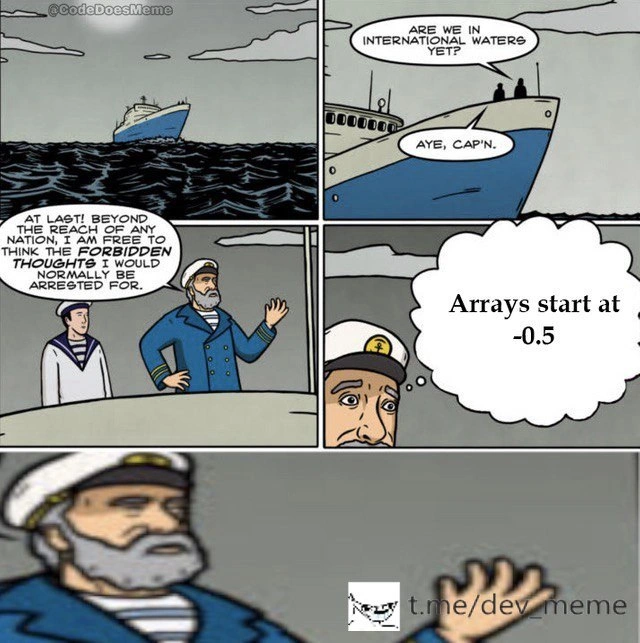
Beyond jurisdiction, the captain proposes arrays that start at minus-one-half
Why is this CS Fundamentals meme funny?
Level 1: Starting at Half
Imagine you and your friends have a rule that when you count things, you always start with 1 as the first number. It’s like how when you line up or number items, you go “1, 2, 3…” Now picture a silly sea captain who sails his ship far away where no teachers, parents, or anyone can correct him. Once he’s completely free from all the rules, he proudly declares, “From now on, I’m going to start counting at half!” In other words, instead of counting “1, 2, 3,” he says “0.5, 1.5, 2.5…” which is totally odd. Normally, if a kid tried to count like that in math class, the teacher would say “Hey, you can’t do that!” But this captain is in a place with no rules (like international waters), so he thinks he won’t get in trouble for this wacky idea. The reason this is funny is because everyone knows it’s a really silly idea. It’s as if someone broke a basic rule of how numbers or lists work just to be goofy. We all know how counting is supposed to start, so hearing someone start at half feels absurd, like a joke. It’s the same kind of laugh you’d get if a friend said, “Let’s label the first page of a book page 0.5 instead of page 1!” It’s wrong on purpose. This meme makes us giggle because the captain is basically doing a secret, naughty version of counting that no regular system would allow – and he had to go out to sea, away from everybody, to do it!
Level 2: No Half Measures
To understand the joke, let’s break down the basics. An array in programming is a ordered collection of items, kind of like a row of lockers, where each locker holds a value and has a number (an index) on it. Typically, different programming languages have set rules for what that first index is. In many popular languages (such as C, Java, Python, JavaScript and more), the first element of an array is at index 0. This is called 0-based indexing. If you have an array and you want the first item, you ask for index 0 (myArray[0]); the second item is index 1 (myArray[1]), and so on. However, some other languages use 1-based indexing, meaning the first element is index 1. For example, MATLAB and R (which are often used in math and statistics) start counting array elements at 1, so the first item is A(1) in MATLAB. Some older languages like original FORTRAN defaulted to 1-based as well, because it felt more natural for mathematicians. There are even languages like Pascal or Ada that let you explicitly define the index range of an array – you could start at 1, 0, or even a negative number (as an integer). But here’s the key: all these indices are whole numbers – integers. You might go from index 0 to 9, or 1 to 10, or even -5 to 5, but you’d never have something like “half” as an index. The notion of index -0.5 is a made-up rule that doesn’t exist in any standard language. It’s basically saying, “Hey, what if the first locker in our array was labeled -0.5 instead of 0 or 1?” That’s why this falls under SyntaxHumor and LanguageQuirks – it’s playing with the syntax/rules of how arrays work in an absurd way.
The meme uses the idea of international waters as a metaphor. International waters are areas of the ocean where no country’s laws apply; people joke that you can do anything there because you’re beyond jurisdiction. In the cartoon, the captain waits until they’re in international waters to announce a “forbidden thought.” In programming terms, this translates to being outside the realm of all normal language rules or best practices, so he can propose a rule no language allows. The forbidden thought he declares is “Arrays start at -0.5.” Why is this considered so forbidden? Because it breaks a fundamental language rule: array indexes must be integers (and normally follow a simple sequence). OffByOneError is a term for a very common mistake where a programmer miscalculates an index by 1. For example, suppose you have 10 items. If you start counting at 0, the last index is 9. A beginner might mistakenly go to index 10 (off by one) which is out of bounds – this causes an error or unexpected behavior. Or if someone thinks the first index is 1 when it’s actually 0, they might skip the real first element or overshoot at the end. These mistakes happen so frequently that they’re an inside joke among developers (we’ve all been there). Now, index -0.5 isn’t just off by one – it’s off by half a step in a way that doesn’t even make sense in real code. It’s like an “off-by-one” error on steroids. It exaggerates the concept to a point where any compiler or interpreter would just throw up its hands. For instance, if you tried something like this in a real programming session:
# Hypothetical code: Don't try this at home (or anywhere!)
arr = [10, 20, 30]
first = arr[-0.5] # trying to access index -0.5
A language like Python would immediately respond with a TypeError, essentially saying “Index must be an integer or something slice-like, not a float.” Even languages that allow negative integers as indices (like Python does for convenient backwards indexing, where arr[-1] gives the last element) will balk at a fraction. Negative indexing in Python (and some other high-level languages) is a quirk that means “count from the end”: arr[-1] returns the last item, arr[-2] the second last, etc. But -0.5 is not an integer, so it’s not a valid position from either the start or end. It’s as nonsensical as saying “give me item number three-and-a-half” in a list.
In simpler terms, this meme is lampooning a very nerdy debate in programming: “Should array counts begin at 0 or 1?” It’s a relatable developer experience for many new coders to trip over this difference. If you learned in one language where you write myList[1] for the first element, then switch to another where myList[1] actually gives you the second element (because you should’ve used 0 for the first), you get bugs. Imagine writing a loop to go through 10 items. In a 1-based system, you might loop for i = 1 to 10. In a 0-based system, that would be for i = 0 to 9. Mix those up, and things go wrong by one count. That’s the infamous off-by-one error biting you. After getting bitten a few times, programmers learn to be very careful with their start and end conditions. It becomes almost an instinct to double-check: “am I indexing this correctly?” So the idea of someone not just messing up 0 vs 1, but intentionally choosing an index start like -0.5, is hilarious in a tongue-in-cheek way. It’s beyond a simple mistake – it’s portrayed as a deliberate crime against logic. And the meme acknowledges it as such by framing it as something you’d have to say in a lawless place because no programming language or community would allow it normally.
Finally, let’s connect it back to the visuals and the absurdity. The captain is basically a stand-in for a rogue programmer or computer scientist. He literally sails out to international_waters_meme (the high seas of no rules) to unleash a thought that breaks the rules of all programming languages. It’s a nod to the fact that in any normal setting, whether it’s a strict compiler or a code review with peers, suggesting “arrays start at -0.5” would be immediately shot down. It’s not just a LanguageGotcha – it’s completely off the map. The humor comes from that extremity. Developers laugh because it’s like a friend making an obviously outrageous suggestion just to be funny. It also pokes a bit of fun at language design debates: after all the serious arguments about 0-based vs 1-based indexing (the array_bases_debate), this cartoon pirate-captain throws in an idea so ridiculous that it underlines how trivial the original debate might seem. If 0 vs 1 is Coke vs Pepsi, then -0.5 is new Coke mixed with sea water – nobody ordered that! In summary, for a junior developer or someone learning: the meme exaggerates a fundamental concept (where array indexing begins) to a crazy extreme (-0.5) for comedic effect. It assumes you know that normal indices are integers like 0 or 1 and that using a fraction would break everything. Understanding that, you see why the captain had to go “beyond the reach of any nation” – because no normal programming environment would let this fly. It’s a joke about breaking programming laws in a place with no laws at all.
Level 3: Off-by-One Outlaw
This meme combines two realms of humor: a SyntaxHumor absurdity in programming and the classic image of a renegade going into international waters to flout the law. Seasoned developers immediately recognize the satire of the scenario. The captain’s question, “Are we in international waters yet?”, followed by “I am free to think the forbidden thoughts I would normally be arrested for,” sets up a perfect analogy for escaping the jurisdiction of programming conventions. In software development, certain ideas (like using a goto everywhere, or indexing arrays starting at an arbitrary non-integer) are considered so taboo that proposing them in a serious context might get you figuratively “arrested” by the community’s best practices police. Here, the forbidden thought given voice in the final panel is “Arrays start at -0.5.” This is a humorous exaggeration of the kind of forbidden_programming_thoughts that would cause an uproar in any code review or language design discussion. It lampoons the array bases debate (0-based vs 1-based indexing) by leaping outside the confines of reason. It’s as if a programmer said, “You’re all fighting over 0 or 1 – hold my grog, I’m choosing -0.5!” – effectively becoming an off-by-one outlaw who goes one step further (or rather, a half-step backwards before the start).
Why is this funny to an experienced developer? Because it satirizes real pain points and holy wars in programming. The question of how to index arrays is a classic LanguageQuirk that varies across languages and has caused countless OffByOneError bugs. Every senior dev has tales of the off-by-one errors that haunted their early coding attempts (or embarrassingly, their production code). An off-by-one error typically occurs when you miscalculate an index by 1, often because of confusion over start or end conditions. For instance, iterating one too many or one too few times in a loop can lead to skipping a needed element or going out of bounds. These errors are so common that they’ve become a running gag in the industry. (In fact, there’s a famous jest:
“There are only two hard things in Computer Science: cache invalidation, naming things, and off-by-one errors.”
Notice anything off about the count in that quote? Exactly – it demonstrates an off-by-one in the joke itself.)
Now, seeing someone intentionally suggest starting arrays at -0.5 is like combining all possible off-by-one mistakes into one insane idea and doubling down. It resonates as TechHumor because it’s a parody of those endless debates where people argue whether the first element should be at index 0 (like in C, Java, Python) or index 1 (like in MATLAB, R, older BASIC dialects). Those debates can get surprisingly heated for something so fundamental – entire threads of developers passionately defending why their preferred indexing is superior for readability or correctness. But no matter which side you’re on, everyone can agree that fractional indexing is ludicrous. It’s as if the meme is saying, “We’ve heard from Team 0 and Team 1, now here’s Team -0.5 to really spice things up!” This absurd stance is funny precisely because it’s beyond even the most extreme position anyone would seriously take. It’s LanguageGotchas humor in overdrive – not just a gotcha, but a complete facepalm.
The use of international waters in the meme is a clever metaphor in itself. In popular meme culture, doing something “in international waters” implies breaking rules with impunity (since no single nation’s laws apply). Translating that to programming: the captain had to metaphorically leave the domain of all programming language standards and community guidelines to even utter such a blasphemous idea. It implies that if he were within any civilized developer community (on land), syntax laws and best practices would “arrest” him for even suggesting that arrays start at -0.5. Seasoned engineers also recall times when certain coding practices felt almost illegal. For instance, using an out-of-bounds array index in C is not just frowned upon; it’s a serious error that can crash programs or lead to security vulnerabilities. We usually treat memory violations as grave errors – in a sense, doing array[-1] (accessing before the first element) or array[n] (past the last) is indeed a kind of crime in programming that will at least get your program terminated (if you’re lucky) or silently corrupt data (if you’re unlucky). Thus, a senior dev sees the captain’s brazen proclamation as the ultimate LanguageQuirk rebellion: not just off by one in either direction, but off by half a step in a direction no one uses, something that would break every interpreter, compiler, and runtime’s assumptions.
There’s also an element of shared trauma being playfully triggered. Developers have been bitten by confusing indexing differences when switching contexts. Imagine a veteran Python programmer (0-based indexing) writing pseudo-code for an algorithm intended for MATLAB (1-based indexing), or vice versa. Off-by-one bugs lurk in those translations. Many can relate to debugging a piece of code for hours only to realize the loop never touched the first or last element because of a mis-set boundary. By exaggerating the indexing to an impossible scheme, the meme provides a cathartic laugh: “At least we only deal with 0 vs 1, and not something crazy like this!” It reminds us of the RelatableDeveloperExperience that no matter how long you’ve coded, you still occasionally check, “Did I fencepost that loop correctly? Did I go from 0 to < length, or 1 to <= length?” Here the captain figure is a stand-in for that mischievous voice in every programmer’s head that wonders about breaking a rule just because. We don’t actually want to change array indexing to something nonsensical, but entertaining the notion for a split second is like a pressure release valve – it’s silly and we laugh, precisely because we know exactly why it’s wrong. In summary, the meme lands so well with experienced developers because it merges a familiar comedic setup (outlaw thoughts in lawless territory) with an exaggerated twist on a fundamental programming concept, highlighting the absurdity and the shared understanding that some rules (like array indexing) are not meant to be broken.
Level 4: Beyond Zero and One
At the frontier of programming language theory and CS_Fundamentals, the idea of an array starting at a fractional index like -0.5 is downright heretical. In formal terms, an array can be seen as a function from an index set (usually a contiguous range of integers) to values. Traditional index sets are discrete (like 0,1,2,... or 1,2,3,...). By suggesting a start at -0.5, the meme proposes a non-integer index set – essentially a shift of the integer line by half. This breaks the fundamental assumption that array indices are whole numbers. Standard array indexing relies on integer arithmetic: the memory address of array[i] is computed as base_address + (i - start_index) * element_size. If start_index were -0.5, this formula yields non-integer multiples of element_size for integer values of i. For example, if each element occupies 4 bytes, index -0.5 would correspond to an offset of 0 bytes (start of array), index 0.5 to 4 bytes (next element), and so on – mathematically it “works out” for spacing, but conceptually it means every index is offset by half an element. No real hardware or type system supports addressing half an element: memory is addressed in whole bytes (or larger words), and variables occupy whole units of memory. A fractional index implies pointing into the middle of a memory cell, violating alignment and type safety. In other words, array[-0.5] is nonsense in any sane language’s type system, as it doesn’t align with the atomic units of storage. This highlights why indices are defined over integers: the discrete nature of memory and data elements.
From a mathematical stance, numbering array elements from 0 or 1 has deep roots. Renowned computer scientist Edsger Dijkstra once argued that 0-based indexing is more elegant, in part because it simplifies formulas for array access and loop boundaries. In a 0-based system, the n-th element’s index (starting count at 1 for humans) is n-1 in code, making the offset calculation direct. 1-based indexing, favored in early languages like FORTRAN and in mathematical notation, aligns with how humans naturally count (first element as 1). Each scheme has its rationale: 0-based indexing often arises from pointer arithmetic (where array[0] points to the base address, and array[i] is an offset of i elements) and modulo arithmetic convenience, while 1-based feels intuitive in algebraic contexts (summing from 1 to N in math, for instance). Some languages even generalize the concept: Pascal and Ada allow defining arrays with an arbitrary starting index (as long as it’s an integer). You could have an array indexed from -5 to 5 in Ada, for example, but even these flexible systems demand the index be an integer – the index set might shift negative, but it remains discretely stepped. A fractional_array_index like -0.5 has no place in these models; it’s a type of forbidden programming thought that violates the very definition of an array.
Delving deeper, consider how code and compilers handle array indexing. In low-level terms, arrays are laid out in contiguous memory, and an index represents an offset into that memory. Pointer arithmetic in C/C++ exemplifies this: if ptr is an address pointing to the start of an integer array, ptr + 1 moves to the next integer (e.g., 4 bytes ahead). ptr + 0.5 is meaningless in code – you can’t move half an integer forward, since pointers advance in increments of the pointed-to type’s size. Even if you attempted something wild like treating a pointer as a byte-address and adding half the byte count of an element, you’d end up misaligned between elements. CPUs enforce alignment for most data types; reading an integer from a half-offset address could trigger a hardware fault or yield gibberish. On a theoretical machine with byte-level addressing, you could in principle retrieve a byte at that half-offset (the second byte of the first element), but then what? You’d be treating that byte as if it were a standalone value, effectively breaking the abstraction of the array element. In essence, non-integer indexing contradicts the fundamental contract of arrays in programming: that each index corresponds to one whole element. The meme’s absurd proposition underscores how deeply ingrained and non-negotiable this contract is. It’s a playful jab at language design and the array_bases_debate – poking fun at those spirited discussions about whether indices should start at 0 or 1 by suggesting an option so outlandish that it’s beyond the reach of any nation (or any language spec).
Description
Four-panel cartoon meme. Panel 1 shows a blue-white ship on dark seas with the watermark "@CodeDoesMeme" in the corner. Panel 2 zooms on the bow; a speech bubble asks, "ARE WE IN INTERNATIONAL WATERS YET?" and a reply bubble answers, "AYE, CAP'N." Panel 3 moves to the deck: a uniformed captain and sailor (faces blurred) as the captain announces, "AT LAST! BEYOND THE REACH OF ANY NATION, I AM FREE TO THINK THE FORBIDDEN THOUGHTS I WOULD NORMALLY BE ARRESTED FOR." Panel 4 zooms on the captain while a large cloud-shaped bubble declares, "Arrays start at -0.5." Bottom right carries "t.me/dev_meme." The joke subverts standard array indexing rules - most languages begin at 0 or 1 - by suggesting an impossible negative fractional base, poking fun at language design, off-by-one errors, and the extremes of programming thought

Comments
15Comment deleted
Arrays start at - 0.5: the only spec where every off-by-one cancels itself under maritime law and the unit tests pass by rounding
After 20 years of arguing whether arrays should start at 0 or 1, this captain discovered the real forbidden thought: fractional indexing. Next he'll suggest we use imaginary numbers for multidimensional arrays and quaternions for database keys
Finally, a solution to the zero-vs-one indexing holy war: just start at -0.5 and make everyone equally uncomfortable. It's the Switzerland of array indexing - technically neutral, practically useless, and guaranteed to cause international incidents in code reviews
Start arrays at -0.5: the compromise where 0-based, 1-based, and your static analyzer all disagree - and every bounds check becomes a floating‑point meeting
International waters: where off-by-one finally aligns halfway between Lua's 1 and C's 0
Arrays starting at -0.5: the C - MATLAB peace treaty - off-by-one bugs cancel in expectation, memory models do not
😂😂😂😂😂 Comment deleted
Y tho Comment deleted
Ауе Comment deleted
cringe Comment deleted
Arrays start at 1/0 Comment deleted
Arrays start at -Infinity Comment deleted
Arrays start at NaN Comment deleted
Arrays start at EPSTEIN DIDN'T KILL HIMSELF Comment deleted
Arrays start at Random.Next() Comment deleted