Timezone Issues: So Bad They Violate Causality
Why is this Bugs meme funny?
Level 1: Can’t Catch a Break
Imagine you and your friends have a chart on the wall that says “Days since our last problem.” You all try really hard to have at least one day with no mess-ups. But things are so chaotic that a new problem happens before the day is even over – it’s like you couldn’t even get to zero days without trouble! So as a joke, you write “-1” on the chart. Of course, in real life you can’t have negative days; this is just a funny way to say “we’re doing really badly at avoiding problems.” It’s like spilling your juice, cleaning it up, and then spilling another cup of juice immediately – you didn’t even stay accident-free for a day. The sign with “-1” shows everyone is feeling a bit exasperated, but they’re laughing about it. It means the team has had a lot of time zone mix-ups in their software, and those mistakes are happening so often that it’s as if they’re going backwards. The emotional punchline is “we just can’t catch a break!” – every time they think they’re in the clear, another timezone bug pops up right away. Even if you don’t understand timezones, the idea is simple: sometimes problems happen one after another so fast that all you can do is throw up your hands and joke about how unlucky you are.
Level 2: Time Zone Troubles
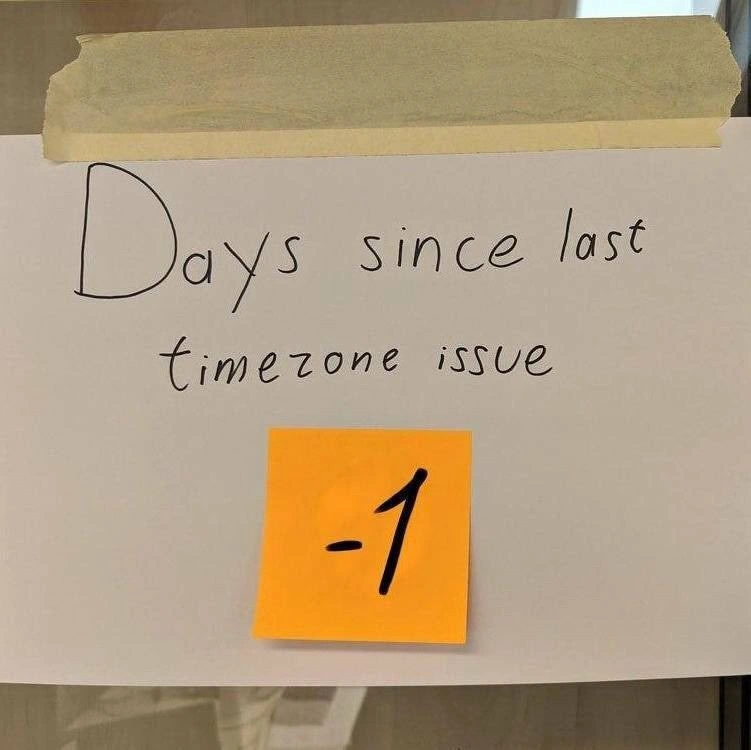
Let’s break down what’s going on for those newer to these concepts. The sign in the image reads “Days since last timezone issue” and shows -1 on a sticky note. This is parodying a common workplace sign that might say “Days since last accident” to highlight safety. Normally, if an accident or incident happens, that counter resets to 0 and then increases with each incident-free day. Seeing negative one days is a humorous exaggeration – it means a new incident happened so soon that they’re “below zero days” without an issue. It’s basically saying, we didn’t even get through a single day before another problem hit. That’s a dramatization of how frequent and frustrating these timezone bugs have been for the team.
Now, what exactly is a timezone issue in software? It has to do with how computers handle dates and times across different regions. A time zone is a region that has the same standard local time. For example, Pacific Time (on the west coast of the US) is one timezone, Central European Time is another. The world is divided into these zones so that 9 AM is morning for each local area, even if in absolute terms the times differ. The reference point is usually UTC (Coordinated Universal Time), which is like the global time standard that doesn’t change for any region. Zones are defined by how far offset they are from UTC (like UTC-5, UTC+8, etc.).
Handling time zones in programming means converting between a universal time and local time. A timezone issue typically refers to a bug where this conversion or handling went wrong. For instance, say your app saved a record at “2023-09-03 00:30” in New York and another at “2023-09-02 21:30” in California. Those are actually the same exact moment (because California is behind in time), but if the software doesn’t account for the different zones, it might think the California event happened earlier because “09-02” is before “09-03”. This can lead to confusion like events appearing out of order or calculating an incorrect difference in days. You might end up with a situation where the system thinks the gap between two events is negative because of a timezone mix-up – essentially a timestamp_handling_fail. That’s analogous to why the sign jokingly shows a negative day count.
Another common culprit is Daylight Saving Time (DST) changes. Many regions adjust their clocks twice a year (spring forward, fall back). During those changes, one hour magically disappears or repeats. If you have a program scheduling something during the lost hour, that time doesn’t exist – boom, bug. Or if something happens during the repeated hour, your system might log two 2:30 AMs and get confused. Engineers call these things edge cases – rare situations that are easy to overlook but can break the logic. A datetime_edge_case could be something like February 29th on a leap year or the midnight of New Year’s in a different timezone. New developers often assume each day has 24 hours or that time just moves straightforwardly, but these edge cases prove that’s not always true. That’s why you’ll hear people say “Time zones are hard.” It’s a bit of programmer folk wisdom acknowledging that there are many hidden pitfalls in handling dates and times.
So, the team in the meme likely had a series of production bugs (issues in the live system users interact with) all related to dates/times – maybe mis-scheduled jobs, incorrect displayed times for some users, or crashes when the clocks changed. Each time it happened, they’d “reset” their counter of days without a problem. Things were so bad (perhaps bugs on consecutive days, or even two in one day) that they jokingly set the counter to -1. It implies “We’ve had so many timezone glitches, we can’t even claim zero days clean – it’s that bad.” It’s a playful way to vent their debugging frustration. Instead of just being upset, they turned it into a visual joke in the office.
For a junior dev, the takeaway is: time handling in software is tricky. You have to be careful about how you store and compare times. A best practice is usually to store times in UTC (an absolute time) and only convert to a user’s timezone for display. Also, use well-tested libraries for date/time (like moment.js in JavaScript, or datetime with timezone info in Python, or Java’s java.time API) rather than doing manual calculations. Those libraries incorporate the ever-changing timezone rules and handle a lot of quirks for you. If you ignore these and do it by yourself, you might end up with the kind of bugs that make your team put up a sign counting negative days since the last incident! In summary, this meme falls under Bugs and Debugging_Troubleshooting because it’s about a coding mistake, specifically with timezones, that keeps happening in production. It’s a lighthearted warning: even something as simple as counting days can go wrong if you’re not careful with time zones.
Level 3: Negative Progress
For experienced developers, this image hits a nerve because it’s too real. The improvised sign – “Days since last timezone issue” – mimics those workplace safety boards (“X days since last accident”) and turns it on its head. In a healthy environment, you want that number to keep going up. But here, not only has it reset, it’s gone negative, implying a new bug struck before the previous one was even fully resolved. It’s a perfect snapshot of on-call hell: you’re still firefighting yesterday’s production bug when another one pops up, effectively erasing any notion of uptime progress. The humor is dark: it says we’re not just failing to handle these bugs, we’re moving backwards – truly negative progress.
Why specifically a timezone issue counter? Because date/time bugs are the stuff of developer nightmares. Every seasoned engineer has a war story about a TimeZonesAreHard moment. Perhaps a scheduled job that didn’t run (or ran twice) when clocks changed for DST, or an international date line fiasco where tomorrow became yesterday. This meme speaks to that shared pain. Time zones and date computations are infamous for causing BugsInSoftware that slip past tests and explode in production at the worst times (usually at 2 AM on a Sunday when DST switches – prime time for on-call misery). The fact it’s a production bug counter (the kind SREs and on-call devs track) ties directly into real-life OnCall_ProductionIssues culture. We often joke that along with “It’s always DNS,” the other universal culprit is “It’s always timezones.”
The negative counter is also a sly nod to off-by-one errors – another classic bug type. It’s as if our “days since last incident” calculation had an off-by-one and wrapped around below zero. Senior devs smirk at this because it blends two of the most notorious bug categories: time handling and off-by-one. (There’s an old joke: “There are only two hard things in Computer Science: cache invalidation, naming things, and off-by-one errors.” Time zone mishaps often feel like they deserve to be on that list!). Here we’ve literally got an off-by-one day error thanks to timezones.
In practice, teams truly do keep track of incident-free days as a point of pride (or dark humor). So a team dealing with repeated production bugs might actually put up a sign like this in jest after the third calendar bug in a week. It’s a bit of gallows humor that helps developers cope with the frustration (DebuggingFrustration is real). The sign taped on the cabinet with marker and a Post-it screams “we give up, this keeps happening.” It’s analog tech tracking a digital fail. Engineers who’ve lived through constant firefighting find this funny because it’s a coping mechanism: laugh so you don’t cry. They know that timezone_edge_case bugs have a sneaky way of surviving every fix. Each time you patch one issue (“Finally, the calendar shows the right date for PST users!”), another emerges (“Oh no, now EST users are off by a day!”). It’s like the Hydra: cut off one head, two more pop out. The negative day joke suggests the beast won this round so badly that we went backwards in time.
From an organizational perspective, this highlights how some problems persist due to systemic complexity. Why do these bugs keep happening? Often, legacy code and inconsistent datetime handling lurk in different parts of the system. One microservice uses UTC, another uses local time; one library updated its DST rules, another didn’t. These out-of-sync components create datetime_edge_case scenarios that only explode under specific conditions (like a daylight saving transition or New Year’s Eve). Testing all those cases is hard, so ProductionBugs keep slipping through. And when they do, it’s all hands on deck in the middle of the night. No wonder seasoned devs develop a dark, sarcastic humor about it. The sign basically says: “We’re so jaded that we expect failure. In fact, we’ve invented a new level of failure.” It’s a cheeky commentary on the reality that sometimes, despite our best efforts, bugs feel inevitable and continuous. We fix one and immediately brace for the next – as if we can’t even get to day 0 without incident. In summary, the humor works on multiple layers for a senior developer: it references the notorious difficulty of time-related bugs (TimeZonesAreHard), the shared trauma of on-call firefighting, and the absurdity of measuring success when the failures are faster than the clock.
Level 4: Time Travel in Prod
At the deepest technical level, this meme hints at a temporal paradox in software. A counter for "days since last timezone issue" dropping to -1 is absurd in real life – you can't have negative days since an event – but in code such weirdness can happen. Why? Because time in distributed systems is hard. In a globally distributed app, one server’s "today" can literally be another server’s "yesterday". If two microservices record events without a common reference, a log from California (PST) at 1:00 AM might be technically “earlier” than a log from New York (EST) at 4:00 AM on the same moment. To a naive calculation, it looks like the later event happened “before” the earlier one. Subtract those timestamps without accounting for timezones, and you could get a negative elapsed time. It’s as if your software thinks an event went back in time. This negative day counter is a tongue-in-cheek nod to that kind of bug – essentially a time-traveling bug where the timeline of events collapses into nonsense.
Under the hood, computers typically keep time in a unified standard like UTC (Coordinated Universal Time, akin to GMT) – an absolute reference unaffected by zones. But as soon as you convert to local time for humans, you invite chaos. The Earth is divided into shifting time zones maintained by the IANA time zone database (also known as tzdata or zoneinfo). This database is a notoriously complex, constantly-updated catalog of regional clock rules. For instance, Daylight Saving Time (DST) means many zones jump forward or wind back by an hour each year. On a DST transition, one day might be 23 hours and another 25 hours long – so much for the neat idea of 24-hour days! There are even historical oddities and half-hour (or 45-minute) offsets in places like India (+5:30) or Nepal (+5:45). If your code isn’t very careful, scheduling something on a DST shift (say, 2:30 AM on the missing hour) might crash or schedule incorrectly. And if your system doesn’t update its timezone rules when governments tweak them (imagine a country deciding next month to change its timezone or abolish DST), your calculations can be dead wrong.
This seemingly simple paper sign touches on deep chronometry issues. In theory, time should be a straightforward linear progression. In practice, software deals with relativity of a different kind – not Einstein’s $E=mc^2$, but the fact that what’s “tomorrow” for one user is still “yesterday” for another. Seasoned engineers know to convert everything to UTC internally and avoid ambiguous local times, but even then the edges bite. There’s a famous list of falsehoods programmers believe about time, including gems like “every day has 24 hours” or “time zones are always whole hours offset” – all false. The negative counter in the meme satirically suggests we’ve broken even those assumptions so badly that we’ve wrapped around from 0 to -1. It’s like the software equivalent of a divide-by-zero error in the space-time continuum of your application. In short, the meme exaggerates a real phenomenon: date/time bugs can warp our software’s sense of reality so much that the impossible becomes possible – like having -1 days since the last incident.
Description
This is a close-up photograph of a handmade sign, likely in an office setting. A white piece of paper is taped to a surface with masking tape at the top. On the paper, the words 'Days since last timezone issue' are written in black marker. Below this, an orange sticky note is placed, on which a large '-1' is handwritten. The visual humor mimics the 'days since last accident' signs found in industrial workplaces, but applies it to a common software development problem. The joke lies in the impossible number '-1', which suggests that a timezone-related bug is so severe and confusing that it has somehow broken the linear flow of time, implying a problem from the future has already happened. This deeply resonates with developers who have struggled with the notorious complexities of timezones, UTC offsets, daylight saving time, and various date-time libraries, which often lead to bugs that feel paradoxical and nonsensical
Comments
11Comment deleted
I'm not surprised the timezone bug counter is at -1. Our server in the future is probably just warning us about the temporal paradox it's about to create when it tries to parse a log file from the past
The counter hit - 1 because DST rolled the clock back at 02:00, the cron reran, and PagerDuty paged us before the incident even happened - congrats team, our MTTR is now negative
The only thing more reliable than a timezone bug appearing in production is the senior engineer who confidently says 'just store everything in UTC' before discovering the application needs to handle recurring events across DST boundaries with user-specific local notifications
The negative counter perfectly captures the quantum superposition of timezone bugs: they exist both before and after you think you've fixed them. It's not a bug, it's a temporal anomaly - your code is so broken it's creating timezone issues retroactively. This is what happens when you store timestamps as strings and let users pick their timezone from a dropdown that includes 'UTC-12' through 'UTC+14' plus 37 variations of 'America/Indiana/Tell_City'. The real joke? Somewhere, a senior architect is explaining why their new microservices architecture will finally solve the timezone problem, while this Post-it note silently mocks them from the break room wall
Hitting -1 proves timezone configs are the ultimate CAP theorem violation: consistent in theory, partitioned by DST
We standardized on UTC, then marketing scheduled “midnight local” crons in 23 regions - DST gave us -1 before standup
Days since last timezone issue: -1. Naive local timestamps + UTC incidents + DST - the only KPI that literally goes backwards
Don't even get it Comment deleted
I saw symphogear Comment deleted
It’s actually not hard. Comment deleted
Tomorrow will be timezone issue. It is guaranteed. Comment deleted