Safety board shows negative days after 32-bit signed integer rollover mishap
Why is this Bugs meme funny?
Level 1: When Counting Goes Wrong
Imagine you have a little counter that’s supposed to count how many days it’s been since something bad happened. Every day, you add one to the counter. Normally, if something bad happens, you’d reset it to 0 and start counting fresh days again. Now, think of that counter like a simple odometer or a two-digit scoreboard. What if the counter can only show numbers up to a certain point? When it reaches the biggest number it can show, one more tick makes it start over or show something weird. This meme shows exactly that scenario in a silly way. The sign in the picture is like a workplace safety sign that says “Days since last accident.” But here it says “Days since last integer rollover,” which is a nerdy way to say “days since our numbers flipped over.” And instead of a normal number, it’s showing a huge negative number of days. That’s obviously wrong — you can’t have negative days since something. It’s as if the sign is claiming an accident will happen 2 billion days in the future!
Why is that funny? Because it clearly means the counter broke. It counted so high that it couldn’t count any higher, and it wrapped around into negative numbers. Think of a kid learning to count who says “..., 7, 8, 9, 10, 11, 12...” and imagine if after “12” they suddenly said “-13” by mistake. You’d laugh because that’s not how counting works! In the same way, this sign is “counting” days, and one day it went from a really big number back to a nonsensical negative number. It’s like if you had a clock that after 11 o’clock went to -12 o’clock instead of 12. Totally goofy, right?
A simpler analogy: pretend you have a cheap digital counter toy that only has three digits. It can go up to 999. You’re counting days on it. 997, 998, 999... and when you add one more day, it doesn’t have a fourth digit to display 1000, so what if it just shows something crazy like 000 or a negative sign? In real life, some old car odometers would roll over to 000000 after hitting the max mileage. Here, our poor counter rolled over and somehow showed a negative. The humor is in the absurdity: it’s a “days since last accident” sign that itself has had a little accident. It’s basically saying, “Oops, I can’t count that high!”
Even if you don’t know the technical details, you can laugh because negative days since the last incident is a silly idea. It’s like saying, “It’s been -5 days since I cleaned my room” — which would mean you plan to clean it 5 days from now, which is nonsense. So the meme is funny on a simple level: the counter clearly malfunctioned, and it’s showing an impossible value. It’s a bit like a scoreboard suddenly showing a negative score because it couldn’t handle a really high score — you immediately know that’s wrong. In summary, the picture is comical because the counter went haywire and started counting backwards after reaching its limit. It’s a playful reminder that even something as straightforward as counting can go wrong if you push it too far.
Level 2: Counting Past the Limit
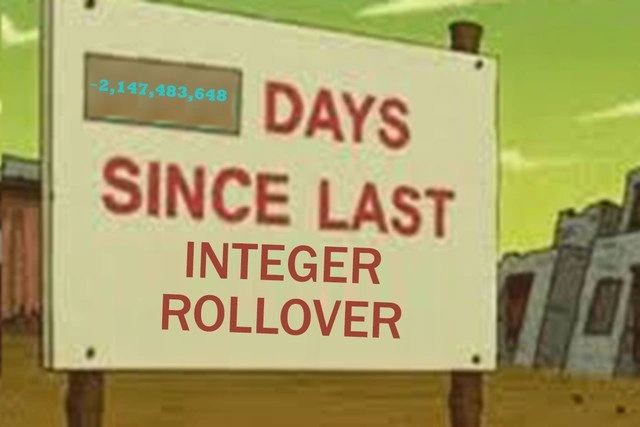
Let’s break down what’s happening in this meme in simpler terms. We have a sign that reads “Days Since Last Integer Rollover” — styled like those workplace signs that say “__ days since last accident.” Instead of tracking real accidents, it’s jokingly tracking how long it’s been since the last integer overflow bug. Now, the funny part is that the counter on the sign is showing a crazy number: -2,147,483,648 days. Negative two billion+ days? That doesn’t make any sense in real life! You can’t have negative days since something — you’d have to invent a time machine for an accident “-5 days ago.” So clearly, this negative number is an error. And indeed, it’s a very specific error known as an integer overflow (or rollover).
What is an integer overflow? Imagine you have a simple digital counter that can only count so high. For example, think of a 32-bit signed integer as a storage box for numbers that can hold any whole number between about -2.14 billion and +2.14 billion. (To be exact, the range is from -2,147,483,648 to +2,147,483,647, because 32 “bits” of memory give about 4.29 billion possible combinations of zeros and ones. Half of those are used for negative numbers, half for non-negative, with 0 in the positive half.) Now, if you start at 0 and increment this integer one by one, you can count up to 2,147,483,647 just fine. But what happens if you add 1 more? You’ve reached the limit of what can be represented in 32 bits for positive numbers. The computer doesn’t automatically throw an error in many languages – instead, it rolls over. It’s just like an old car’s odometer going past its max reading. If a car odometer could only show up to 999,999 miles, driving one more mile would flip it back to 000,000. In this case, our 32-bit counter flips from the largest positive value to the largest negative value. So 2,147,483,647 + 1 turns into -2,147,483,648. This is exactly what’s shown on the sign’s little digital display.
Why that weird negative number? It’s not random; it’s the mathematical result of the overflow in a system using two’s complement (the typical way computers encode negative numbers). In simpler terms, the highest bit (the leftmost of the 32 bits) acts as the “negative sign.” When all 32 bits were 01111111 11111111 11111111 11111111 (binary for +2,147,483,647), adding 1 made it 10000000 00000000 00000000 00000000 (binary), where that leftmost 1 now means the number is negative. So the computer interprets it as -2,147,483,648. In a nutshell, the counter ran out of room to count up and circled around into negative territory. That’s an integerOverflow bug — the software didn’t prevent the number from wrapping around when it hit its max. If the program had been written with a bigger integer type (like 64-bit, which has an astronomically larger limit), or with a check that resets to 0 when it hits the max, this wouldn’t happen. But someone either didn’t expect the number to ever get that high or just didn’t think about it. It’s a classic bug in software where an assumption (“this counter won’t overflow”) turned out wrong.
Now, the meme context: “Days since last rollover.” In real-world terms, imagine a factory sign that says “__ days since last accident.” Every day without an accident, you increment the count. If an accident happens, you reset it to 0. These signs are about safety tracking. Here, the joke is treating an integer overflow as the “accident” we want to avoid. And the hilarious twist is that the sign itself malfunctioned due to such an accident! Instead of resetting to 0 days after an integer overflow occurred, the poorly programmed counter wrapped into a negative number. So it looks like it’s saying, “It’s been negative two billion days since our last rollover.” That’s obviously impossible — it effectively means the last rollover is over two billion days in the future, which is nonsensical.
This captures a few key concepts in a humorous way:
- Integer Rollover: Another term for integer overflow — the value reached the max and “rolled over” to the minimum. Picture an old analog odometer or a digital counter flipping back around.
- 32-bit Signed Integer: A common integer type in programming (like
intin many languages) that uses 32 bits of memory. “Signed” means it can represent both negative and positive numbers (as opposed to “unsigned” which would only be zero or positive). The sign comes from one of the bits being reserved to indicate negative vs positive. The 32-bit signed range is roughly -2.1 billion to +2.1 billion, and that’s why those particular numbers show up. If you see 2,147,483,647 or -2,147,483,648 in a program, you’re likely dealing with that exact limit. - Bug/Glitch: The sign showing a negative value for “days since last incident” is a bug. In a real program, this might be a subtle bug that goes unnoticed until the counter gets that high. It doesn’t crash the program (unless the language chooses to throw an error for overflow), so it’s a logic error that yields a wrong result. Programmers have to either use bigger data types or implement logic to prevent this unintended wrap-around. For example, in many high-level languages like Python or JavaScript, integers can grow arbitrarily large (Python) or convert to a different type as needed, so you wouldn’t normally see this. But in C, C++, Java, C#, and many others, integers have fixed sizes by default, so hitting the cap is a known risk.
- Undefined Behavior vs Defined Wrap-around: In C/C++, an overflow of a signed int leads to what’s called undefined behavior, meaning the C standard doesn’t guarantee what happens — but on most systems it will wrap around using two’s complement arithmetic. In languages like Java and C#, it’s defined to wrap (so you will reliably get that negative number). Some languages provide options to detect overflow (e.g., Rust will panic in debug mode on overflow, or offer wrapping arithmetic explicitly). The meme implicitly assumes the typical behavior of a wrap-around happened, hence the sign got that specific negative number.
For someone newer to coding, the takeaway is: integers in computers have limits. When you exceed those limits, weird things can happen — like counters resetting or going negative. This is a fundamental concept you learn in computer science: the data types (like 32-bit int) can only hold so much. If you don’t handle the possibility of an overflow, your program might produce wildly incorrect results after a certain point. This meme uses that idea to make a joke: the “incident” the sign was tracking is exactly this kind of programming blunder.
To make it even more concrete, here’s a tiny illustrative snippet in a C-like pseudocode:
int days_since_last_rollover = 2147483647; // this is 0x7FFFFFFF, the max 32-bit value (2,147,483,647)
days_since_last_rollover += 1; // add one day
printf("Days since last rollover: %d\n", days_since_last_rollover);
On a typical system, this would print out -2147483648 for days_since_last_rollover. Instead of wrapping to 0 or erroring out, it silently overflowed. The program would now think the last rollover happened “negative 2.14 billion days ago,” which is clearly wrong. This is exactly what our meme’s sign is displaying, just in a funnier format.
So, the meme is essentially an educational joke. It reminds developers about the importance of knowing your numeric limits (CSFundamentals!). And it points out a specific common bug: forgetting that a counter might eventually get too large for its britches. The categories it’s tagged with, like Debugging_Troubleshooting, are apt because figuring out why a value went negative would be a debugging exercise. If you ever see such an odd value in an application (say, a high score turning negative or a timer resetting unexpectedly), your mind should jump to “aha, possible integer overflow!”
Finally, the whole gag also lightly emphasizes the idea of safe coding practices. In a safety-critical system, you’d never want a “days since last accident” counter to fail — similarly, in programs, we strive to use safe data types or add checks so that these rollover accidents don’t happen. The sign wasn’t built with that in mind, and the result was a negative_days_bug for the world to see. In summary, counting past the limit without precautions caused the counter to behave absurdly, which is both a lesson and a laugh for anyone learning about how computers count.
Level 3: Wrap-Around Woes
For experienced developers, this image triggers an immediate “I know that bug!” reaction. It’s lampooning a classic bug in software: an integer overflow that wasn’t accounted for, causing a counter to wrap around. The meme cleverly mashes up a familiar workplace safety sign (“X days since last accident”) with a programming twist (“integer rollover” instead of “accident”). The big red text “DAYS SINCE LAST INTEGER ROLLOVER” sets the stage for a nerdy in-joke. The punchline is in that digital counter display: -2,147,483,648 days. In a real factory, a negative number of days since the last incident is nonsensical — it would imply an accident that’s going to happen in the future! This absurdity is exactly why it’s funny. It screams “something broke”. To those in the know, that specific negative number is a dead giveaway that what “broke” is a 32-bit counter that just overflowed. It’s the hallmark of a wrap-around bug that many of us have seen in logs or on dashboards: one second a value is extremely high, the next it’s a huge negative or back to zero. Cue the mixture of amusement and PTSD as we recall late-night debugging sessions chasing down why our statistics suddenly made no sense.
The sign is essentially an “inside joke” for developers. It parodies the idea of tracking how long it’s been since the last major mishap. In a coding context, an integer rollover is a kind of mishap — not a physical accident, but a software accident. We often joke about “days since last deployment failure” or “days since last bug” boards; here it’s days since last integer rollover. The irony is that the counter on the sign itself became the failure. It’s like having a “days without incident” board that causes an incident on day 2,147,483,648. The humor has a bit of that dark, self-referential wit: the safeguard (counter) wasn’t safeguarded against its own limits. Anyone who has dealt with long-running systems or big counts can relate — you might start a counter assuming it’ll never max out in any reasonable timeframe, and then reality (or a test, or simply more usage than ever expected) proves that assumption wrong. In this case, you’d have to run that day counter for over 5.8 million years to naturally overflow a 32-bit int (since 2,147,483,647 days ≈ 5.87 million years!). Safe to say, no actual safety sign in a factory will run that long. But in software, counters can tick much faster (milliseconds, events, etc.), or a developer might reuse code without adjusting the data type. The meme exaggerates this to hilarious effect: the counter maxed out and looped around, so instead of resetting to 0 days, it’s showing a colossal negative number of days. It’s a CodingHumor wink: “We broke the counter by counting too high.”
Senior engineers nod at this because it reflects decades of recurring lessons in computing. We’ve learned (sometimes the hard way) the importance of choosing the right data type and adding boundary checks. This image encapsulates a classic debugging_troubleshooting story: imagine seeing a negative value where only a positive duration makes sense. You’d immediately suspect an overflow bug. It’s “undefined behavior fun” in C/C++ terms, or just a logic error in languages like Java/C# that silently wrap on overflow. Either way, the result is the same woe: your nice increasing counter suddenly teleports to a negative space. The wrap-around can wreak havoc — consider a monitoring system that alerts if the number of days since last incident goes below 0 (since that’s impossible under normal conditions, it might trigger an alarm). In real systems, such a bug could cause false alarms or incorrect safety shut-offs. This is why robust software (especially for things like industrial controls or finance) includes safeguards against overflow. But in many non-critical systems, developers may assume “eh, we’ll never hit that number” — until one day, a counter for, say, milliseconds uptime, or message IDs, or inventory counts, does hit its limit and chaos ensues.
The meme resonates because it packs multiple layers of truth and humor:
- It references CS_fundamentals that every developer is taught, but that still bite in practice (the finite range of fixed-size integers).
- It highlights a specific value
-2,147,483,648that is an instantly recognizable “error code” to us – it basically screams “IntegerOverflow happened here!” - It uses the format of a workplace safety board, something everyday and serious, but subverts it with a nerdy twist. The background even looks cartoonishly apocalyptic (washed-out desert, tilted sign), teasing that “integer rollover accidents” are a kind of disaster in our little software world.
- It’s coding humor that also educates: only those who know about 32-bit limits fully get the joke, and if you don’t, well, you might learn why that number is special.
For veteran developers, this might also induce a chuckle with a side of eye-roll because we’ve been there. We remember issues like the overflow_counter_reset on old systems: e.g., a classic anecdote is how YouTube’s view counter had to be upgraded from 32-bit to 64-bit when a single music video got more views than 2,147,483,647 – a real-life instance of “days (well, views) since last integer rollover” hitting zero and flipping. There’s also the impending drama of legacy 32-bit systems facing the year 2038, where time values will wrap negative — essentially a scheduled global “integer rollover accident” if not fixed. These are the woes of wrap-around in real life. Within organizations, such bugs often live in the category of “we’ll worry about it later,” very much like technical debt. And when later comes, someone ends up on a late-night debugging call saying, “Wait, why does this value suddenly show as negative?! Oh no… it’s an overflow.” The meme’s exaggerated scenario of a safety sign showing negative days is like a caricature of that experience. It’s poking fun at our sometimes naive assumptions. The bugs_in_software that stem from numeric limits are both trivial (just use a bigger number!) and tricky (they hide until they dramatically appear). Even the undefinedBehavior tag hints: if you’re in a language like C, an overflow might not just give you a funny negative — it could do unpredictable things, making such a bug really hard to troubleshoot. Many a debugging_troubleshooting session has been spent hunting down why a variable “magically” became negative or rolled over to zero.
In sum, the senior perspective sees this meme as a perfect fusion of humor and cautionary tale. It’s funny because it’s absurd, and it’s funny because it’s true. The sign that’s supposed to assure us “all is well, no accidents” instead becomes evidence of an “accident” in the code. It reminds us that even something as mundane as an integer counter isn’t truly safe without forethought (pun intended, since this safety board wasn’t safe from overflow!). And of course, it’s a bonding moment: if you laugh at this, you’re likely part of the club that has wrestled with low-level issues and learned respect for those seemingly enormous, but very finite, limits of data types. Wrap-around woes spare no one — eventually, every sufficiently large count can overflow, and every programmer who forgot that will get a crash course (hopefully just in a meme and not in production 🔥).
Level 4: Two’s Complement Catastrophe
At the lowest level, this meme is all about binary arithmetic and the quirks of how computers represent integers. The bright turquoise number -2,147,483,648 is instantly recognizable to seasoned engineers as a magical boundary value: it’s exactly the minimum value of a 32-bit signed integer (often called INT_MIN). Why that strange number? It comes from the way two’s complement representation works in computer systems. In a 32-bit signed integer, one bit is reserved for the sign (positive/negative), leaving 31 bits for magnitude. This gives a range from $-2^{31}$ up to $2^{31}-1$, which is -2,147,483,648 up to 2,147,483,647. Add 1 to the maximum 2,147,483,647, and you hit a mathematical overflow: the binary pattern wraps around, flipping the sign bit from 0 to 1 and resetting all other bits to 0. In two’s complement arithmetic, that bit pattern 1000 0000 0000 0000 0000 0000 0000 0000<sub>(2)</sub> (hex 0x80000000) isn’t +2,147,483,648; it’s interpreted as -2,147,483,648. In other words, $2^{31}$ in an unsigned sense becomes $-2^{31}$ when viewed as signed – a bizarre outcome of modular arithmetic. This is not a bug in hardware; it’s a deliberate design that makes addition and subtraction seamless, treating the integer arithmetic like a clock that resets every $2^{32}$ ticks (numbers wrap around modulo $2^{32}$). The catastrophe here is that the counter hit that modular reset point and produced the largest negative number representable instead of continuing forward.
This behavior is rooted in fundamental CS_fundamentals of data representation. Two’s complement is the standard for almost all modern CPUs because it elegantly handles negative numbers (with only one zero and simple addition circuitry). However, it imposes a hard limit on the values you can represent with a fixed bit-width. When that limit is breached, you get a rollover: the next increment to the maximum representable value causes a jump “around the circle” of numbers. The humor of the meme arises from this precise two’s complement twist — the integerOverflow turned a positive day count into a huge negative value overnight (figuratively speaking). It’s a runtime error scenario that exists because of mathematical constraints: with $2^{32}$ possible bit patterns, any operation exceeding the limit will lose the high-order bit (like an odometer rolling over from 99999 to 00000). Formally, if you treat 32-bit arithmetic as happening in the ring of integers modulo $2^{32}$, you get:
$$2,147,483,647 + 1 \equiv -2,147,483,648 \pmod{2^{32}}.$$
The sign flipped, and suddenly time went negative. This is an inherent risk of using a fixed-size int32 for a continually incrementing counter. If not anticipated, it leads to what we see on the sign. Computer scientists and engineers study these limits to avoid undefined behavior — for instance, in C/C++ adding 1 beyond INT_MAX isn’t just a cute negative number; it technically invokes undefined behavior, meaning the program could do anything. (On typical two’s complement hardware it seems to wrap around, but compilers might optimize code assuming no overflow ever happens, which can cause truly bizarre side effects.) In managed languages like Java or C#, the overflow is defined to wrap around in two’s complement fashion (as shown by this sign), while some others might throw an overflow exception or auto-promote to bigger integers. There’s a deep CS_fundamentals lesson: the limits of binary representation are very real, and ignoring them is unsafe. This sign is a tongue-in-cheek illustration of that principle — a two’s complement catastrophe where what should have been a large positive count turned into a colossal negative number because of a numerical rollover.
Historically, these rollover mishaps have caused both headaches and humor in computing. A famous real-world example looming in the future is the Year 2038 problem: many systems count time as the number of seconds since January 1, 1970 in a 32-bit signed integer (time_t). In January 2038, that count will reach 2,147,483,647 and one second later will wrap to -2,147,483,648, potentially confusing systems into thinking it’s the year 1901 (a negative offset from the epoch!). It’s essentially the exact scenario shown on this safety board, but with clocks. Similarly, older video games and software have run into these limits — for example, the classic Pac-Man arcade game famously crashes on level 256 due to an 8-bit overflow, and older high-score counters would roll over if you scored too many points. Even modern platforms aren’t immune: YouTube once had to upgrade its view counter from 32-bit to 64-bit when Psy’s “Gangnam Style” music video exceeded 2,147,483,647 views, a real-life int32_rollover incident. Each of these cases is a two’s complement story: when you hit the max count, the next tick sends you to the minimum value. The meme’s negative day counter is a playful reference to these fundamental arithmetic limits that every programmer learns (sometimes the hard way): don’t let your counters hit their maximum, or they might roll over into the absurd.
Description
A cartoon-style roadside safety sign sits on two wooden posts against a washed-out desert backdrop. The sign reads, in large red letters centered on the board, “DAYS SINCE LAST” on the first two lines and “INTEGER ROLLOVER” on the third line. In the upper left corner of the sign, a digital counter displays the turquoise number “-2,147,483,648”, the minimum value of a 32-bit signed integer, creating an absurd negative day count. The meme humorously highlights an integer overflow bug where a day counter wrapped around, turning positive time into a gigantic negative value - an inside joke for engineers familiar with two’s-complement limits and rollover incidents. Visually, the muted greens and browns of the background and the exaggerated red headline mimic a workplace “days without accident” board, giving technical context about counters, overflow errors, and the importance of boundary checks
Comments
29Comment deleted
When the safety board flipped to - 2,147,483,648 days, leadership bragged about six million years of zero incidents - turns out unsigned optimism and signed integers don’t mix
The irony is that if this sign's counter is using a 32-bit integer, it'll overflow in about 129 days, resetting to -2,147,483,648 and suddenly claiming we had an integer rollover 5.8 million years ago - which, coincidentally, is exactly how production incidents feel when you're the one who has to fix them at 3 AM
The real tragedy isn't the overflow itself - it's that someone chose a signed integer for a counter that should never be negative. This is what happens when your 'days since incident' tracker becomes the incident. At least they're consistent: if you're going to have an integer overflow, might as well have it on the sign tracking integer overflows. It's the software equivalent of a fire station burning down, except this one was entirely preventable with a uint32_t or, you know, a proper data type for counting days since the Unix epoch. But hey, at least we know exactly when this happened: sometime after 5.8 million years of incident-free operation
When your legacy counter wraps to INT_MIN, proving even time travel can't save 32-bit systems from themselves
Our safety KPI uses int32; after 2,147,483,647 days it wraps to −2,147,483,648, and suddenly we’ve been compliant since before the Unix epoch
We implemented the safety KPI with int32; one overflow later and compliance says we’re safe for the next −2,147,483,648 days - two’s‑complement optimism at enterprise scale
JS joins chat Comment deleted
"-2,147,383,648" Comment deleted
js: "" Comment deleted
JS has no integers limit. Numbers can exceed max_safe_integer_value with loss of precision, soon after they turn into exponential number, and when engine considers that it cannot increase number anymore, the value turns into special Infinity value There is also BigInt type in js which allows to process VERY BIG numbers. It never becomes Infinity and never commits rollover (nor simple numbers do it) JS doesnt know what rollover is Comment deleted
so js has float-like semantics for ints Comment deleted
afaik js only has floats Comment deleted
even lua now has ints Comment deleted
now? You mean it didn't have them from the beginning? Comment deleted
only in 5.4 Comment deleted
is that new, old, ancient…? Comment deleted
that's newest Comment deleted
So they just now added ints Comment deleted
almost a year ago Comment deleted
oh, so the newest release of lua is almost a year old, yes? Comment deleted
yes Comment deleted
Yep, they are stored in IEEE-754 format, 52 bits for ints, 11 for floats and 1 for sign Comment deleted
MAX_SAFE_INTGERER constant is 2^53 - 1 Comment deleted
The fun part is you cannot store 2^53 in the memory to subract one of it Comment deleted
No, you can, but you will instantly lose precision Comment deleted
you're just describing how floats work here, no? and BigInts. Comment deleted
may i introduce you to Haskell Integer type Comment deleted
there is also BigNumber (bn.js) Comment deleted
If this integer was unsigned it would be allways correct Comment deleted