Root Means Different Things
Why is this SystemsAdministration meme funny?
Level 1: Same Word, Different Danger
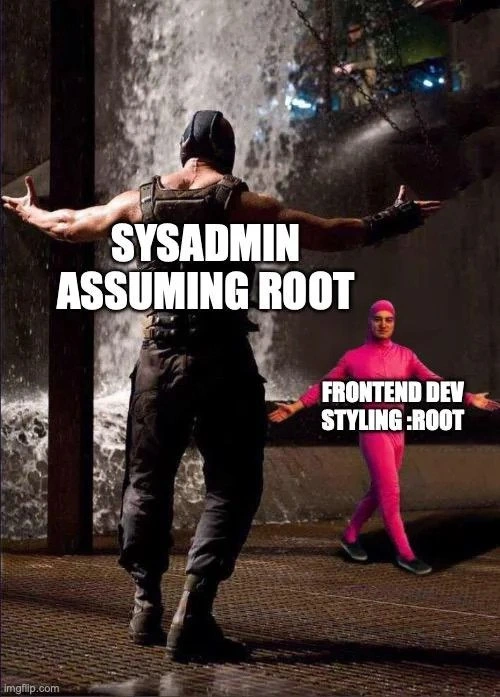
Imagine two people saying they are using "the master key." One person means a key that opens every door in a giant building. The other means a button that changes the color of all the curtains. Both are talking about something important, but one is much scarier. That is why the big serious figure and the tiny pink figure make the meme funny.
Level 2: Two Roots, Two Worlds
In Linux and other Unix-like systems, root is the most powerful user account. A sysadmin might become root with tools like sudo or su when they need to perform administrative tasks. This is why root access is tied to AccessControlMechanisms and PrivilegeEscalation: it decides who is allowed to do dangerous things.
In CSS, :root means something very different. It selects the root element of the document. Web developers often put global CSS variables there so the whole page can reuse the same colors, fonts, sizes, and spacing values. Those variables are called custom properties, and they usually look like --main-bg or --text-color.
The visual joke comes from the size difference. The sysadmin version is huge and intense because system root is serious power. The frontend version is small and colorful because styling :root sounds dramatic but is usually routine web work. Both are valid developer language; they just live in very different neighborhoods.
Level 3: Root Access Theater
The meme is built on a clean technical homonym. The large, armored figure is labeled:
SYSADMIN ASSUMING ROOT
The much smaller bright-pink figure is labeled:
FRONTEND DEV STYLING :ROOT
Same word, wildly different blast radius. For a SystemsAdministration person, "assuming root" means taking on root privileges, the superuser identity on Unix-like systems. That account can modify system files, install packages, kill processes, change ownership, bind privileged ports, and generally turn a server into either a well-maintained machine or a smoking lesson about backups. The huge figure in front of rushing water makes that version feel appropriately dangerous.
For a Frontend developer, :root is a CSS selector. In an HTML document, it usually targets the top-level html element, and developers commonly use it to define custom properties:
:root {
--brand-color: #3366ff;
--spacing-unit: 8px;
}
That can affect an entire site's visual system, but it is still stylesheet territory. The smaller pink figure mirrors the same dramatic arms-out pose, turning a normal CSS move into a tiny cosplay version of system-level power. The image is funny because both people can sincerely say they are dealing with "root," but only one of them can brick a production host before lunch.
There is a sly truth underneath the scale joke. Frontend global styles are not harmless just because they are not sudo. A bad :root design-token change can recolor every button, break contrast, shift spacing, or make a component library look like it lost a fight with the theme generator. It will not overwrite /etc/passwd, but it can absolutely trigger a product manager asking why the checkout page is lavender now.
Description
The image uses a cinematic scene with a large armored character standing in front of rushing water and a smaller person in a bright pink suit mirroring the same arms-out pose. Bold white meme text over the large figure reads "SYSADMIN ASSUMING ROOT", while text over the smaller figure reads "FRONTEND DEV STYLING :ROOT". The joke hinges on the overloaded word "root": for a sysadmin it means privileged Unix-like superuser access, while for a frontend developer `:root` is the CSS selector commonly used for document-level variables and global styles. The size contrast makes the sysadmin interpretation feel ominous while the frontend interpretation is harmless stylesheet work.
Comments
3Comment deleted
One `root` can rewrite your whole system; the other just rewrites your design tokens, which is sometimes the same outage with better colors.
Hehe Comment deleted
Ng-deep Comment deleted