The Dangers of Overlooking the Happy Path
Why is this Testing meme funny?
Level 1: Forgot the Obvious
Imagine you build a super fancy door lock for your house. You test it against everything: you try to pick it with hairpins, hit it with a hammer, even blast it with air – nothing can break it. You’re confident it’s unbreakable. But then your friend comes over, inserts the correct key to unlock the door, and the lock jams and breaks. In other words, the lock works against every wrong way of opening it, but fails for the one right way. That’s exactly what’s happening in this joke. The programmer made a date picker (like a little calendar for choosing dates) and made sure it doesn’t crash when people input silly or wrong things (like weird symbols or negative numbers). But they forgot to check that it works when someone inputs a normal date – the very thing it’s supposed to do! So when a user finally tried to pick an actual date, the whole thing crashed. It’s funny in the same way as the lock story: the one obvious thing that should have been tested was overlooked. We laugh because it shows how someone prepared for all the crazy possibilities but missed the simplest, most expected case. It’s a gentle reminder not to overlook the basics, wrapped in a simple, goofy scenario that anyone can understand.
Level 2: Edge Cases vs Basics
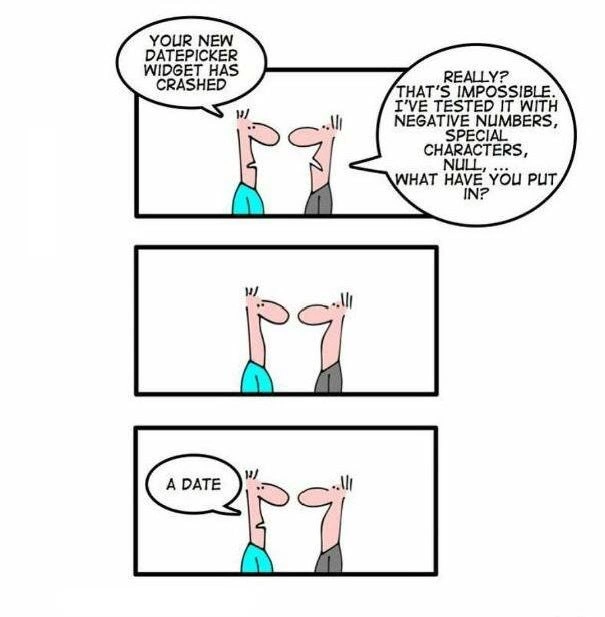
At its heart, this comic is about testing and the importance of covering the basics. A datepicker widget is a common frontend component – think of the calendar pop-up or date input field you use to select a date on a form. Its whole job is to let a user pick a date (like your birthday or a meeting day) and make sure that input is valid. In the first panel, one developer says "Your new datepicker widget has crashed." In software, a “crash” means the program or component encountered an error so bad that it stopped working (in a web context, maybe a JavaScript error that breaks the page or the widget). The second panel shows the widget’s developer stunned: they respond, “Really? That’s impossible. I’ve tested it with negative numbers, special characters, null… What have you put in?” This developer is listing all the edge cases they checked. Edge cases are unusual or extreme inputs/situations at the boundaries of what you expect. For a date picker, examples of edge cases are: entering a negative number (there’s no such thing as “-5” of a month or day), typing strange symbols like @#$% (which are not typical in dates), or providing a null/empty input (meaning no date at all). These are things a good developer might test because they can potentially cause errors if the code isn’t prepared for them. By saying “That’s impossible, I tested with…”, the developer is confident the widget can handle invalid inputs gracefully.
However, the joke is revealed in the third panel when the first character answers the question "What have you put in?" with: “A date.” In other words, the person used the widget correctly, supplying a normal valid date (the very thing the widget is made for). And that is what caused it to crash! This is funny and ironic: the developer guarded against all the weird wrong inputs, but the one valid input – a real date – wasn’t tested and turned out to break the system. In software development, the happy path means the expected, ordinary scenario where everything is correct (here, the user enters a proper date and you get a proper result). It’s called “happy” because it’s supposed to work smoothly. Here the happy path was entering a date, and it failed because of a bug. The developer’s facepalm moment is realizing they didn’t test the most basic case.
This comic is a lighthearted lesson in testing practices. It reminds newcomers that while it's important to test oddball cases (to prevent crashes on bad input), it's equally important to test the normal cases that your code is actually supposed to handle. In practical terms, if you wrote a bunch of unit tests for your datepicker, you’d write tests for weird inputs (like null or "-5" or "@@@@") and tests for typical inputs (like "2023-12-01" or "Jul 4, 2024"). Missing that second part is what happened here – a unit_test_gap in the test coverage. The result was a bug in the production code: as soon as someone tried to use the widget in a real scenario, it crashed. Frontend developers often have to consider all kinds of input from users, but this comic shows what happens if you focus so much on “What if the user does something crazy?” that you forget to ask “What if the user does the right thing?” It’s a goofy example, but it drives home a real point: always verify that your code works on the basic, valid input it’s meant to handle. That’s usually priority number one in testing. The humor makes it memorable – next time you write tests, you’ll chuckle and double-check that you didn’t skip the happy path!
Level 3: The Happy Path Paradox
This meme highlights a scenario where the developer defended against every weird input except the one that actually matters – a valid date. It's an ironic twist on input validation. The right-hand stick figure (the developer) proudly says they've tested the new datepicker widget with all sorts of junk: negative numbers, special characters, even null values. In robust software, handling such edge cases is good practice – you don't want your UI crashing if someone enters -42 or @@@@ into a date field. They essentially built a fortress around their code for all corner cases. Yet, humorously, this fortress has a glaring hole: the normal case. When the other character simply entered a date (the most expected, everyday input for a date picker), the widget crashed. This is a classic example of happy path failure – all the exotic scenarios work fine, but the straightforward use-case (the “happy path”) blows up. Seasoned developers chuckle at this because it rings true: we’ve seen code that survives torture tests but fails on basic input due to an overlooked assumption. It’s a testing paradox: the code is bulletproof against absurd inputs but brittle with real data. The humor (and pain) comes from the developer’s disbelief – “Impossible! I tested everything!” – and the punchline that the one thing they didn't test was the thing no one expected to break. This underscores an unspoken law in development: never assume the obvious will just work. In complex systems, especially on the frontend, a bug can hide in plain sight if you’re too focused on esoteric cases. The meme playfully reminds us that being thorough isn’t just about testing wild inputs – it’s also about not skipping the basics.
// Pseudo-code testing the datepicker widget:
const widget = new DatePickerWidget();
widget.setInput(-1); // Negative number (edge case) -> handles without crashing
widget.setInput("!@#$"); // Special characters (edge case) -> handles without crashing
widget.setInput(null); // Null input (edge case) -> handles without crashing
widget.setInput("2019-08-27"); // A valid date (happy path) -> 💥 CRASH! (unexpected failure)
In the code above, the developer methodically tested invalid inputs (-1, "!@#$", null) and the widget likely returned some “invalid input” message or safely ignored them. But when passing a well-formed date string ("2019-08-27"), the code hits an untested branch (the actual date parsing) and throws an error – resulting in a crash. It’s comically tragic: the datepicker failed at its core purpose. For veteran engineers, this scenario is a gentle poke at our testing habits. We often speak of “testing edge cases” with pride, yet here the edgeCaseHandling was so over-emphasized that the happy path got neglected. The term "Happy Path Paradox" fits because the happy path – normally the first thing you'd test – was ironically the only path not verified. This kind of bug is more common than one might think, especially in UI components with lots of validation rules. It's a reminder that unit tests and QA checks should cover not just the extremes but also the plain vanilla cases. The meme encapsulates a shared developer experience: that sinking (and slightly humorous) feeling when a user does the most obvious thing... and your app throws up its hands in defeat.
Description
A three-panel comic strip featuring two simple, long-necked characters on a white background. In the first panel, the character on the left (in a blue shirt) says to the other (in a grey shirt), 'YOUR NEW DATEPICKER WIDGET HAS CRASHED'. The developer on the right replies defensively, 'REALLY? THAT'S IMPOSSIBLE. I'VE TESTED IT WITH NEGATIVE NUMBERS, SPECIAL CHARACTERS, NULL. WHAT HAVE YOU PUT IN?'. The second panel is silent, showing the two characters just looking at each other. In the final panel, the character on the left simply states, 'A DATE'. The humor lies in the developer's intense focus on testing for every conceivable edge case and invalid input, while completely forgetting to test the most basic, intended functionality - accepting a valid date. It's a classic satire of developer tunnel vision and a relatable scenario in software testing where the 'happy path' is sometimes ironically neglected
Comments
7Comment deleted
We spend so much time sanitizing inputs for SQL injection and cross-millennium date formats that we forget the user's most malicious payload is just using the feature as intended
Our datepicker survived every fuzzed Gregorian anomaly and a simulated Y3K - then the PM clicked “today” in prod and we realized 100 % test coverage can still miss the happy path
This is why our test coverage reports show 99% but production still breaks on the happy path - we've built Fort Knox to protect against edge cases while leaving the front door unlocked for normal users with normal data
This perfectly captures the senior engineer's nightmare: spending hours crafting an exhaustive test suite covering SQL injection in a datepicker, Unicode edge cases, and null pointer scenarios, only to discover in production that nobody tested whether it actually accepts '2024-01-15'. It's the testing equivalent of building a fortress with impenetrable walls but forgetting to install a door - technically impressive defensive programming, functionally useless. We've all been that developer who can recite the OWASP Top 10 by heart but somehow ships a date widget that crashes on dates
We finally hit 100% test coverage - unfortunately it was all guard clauses; the happy path throws
Edge cases: ironclad. Nominal path: the Achilles' heel of every test suite
Our datepicker shipped with 100% coverage - null, NaN, emojis, SQL injection - then a user picked an actual date and we discovered what coverage doesn’t cover