Skip to content
DevMeme
535 of 7435
Compiler Insanity: The 'It Might Work This Time' Fallacy
Bugs Post #615, on Aug 27, 2019 in TG

Compiler Insanity: The 'It Might Work This Time' Fallacy

Why is this Bugs meme funny?

Level 1: Square Peg, Round Hole

Imagine you have a toy with different shaped holes, and you’re trying to put a square block through a round hole. You can see it clearly doesn’t fit – the block is just the wrong shape. But still, you keep pushing it, hoping that maybe this time it will magically go through. It’s not going to happen, right? This meme is joking about a very similar situation, but with computer code. The person in the meme is doing something that won’t work (trying to run broken code) over and over, a bit like trying the wrong key in a door again and again expecting it to suddenly unlock. It’s funny in the way it’s funny to watch someone stubbornly try the impossible: we kind of laugh because we’ve all had moments of doing something silly out of frustration. In simple terms, the meme is saying, “I know this is broken, but I’m going to try it one more time anyway!” The dog character with the goofy grin is basically the face of that stubborn part of us. We smile at it because it’s a playful reminder that sometimes we keep trying without reason, and it makes us feel a little better knowing we’re not the only ones who do that.

Level 2: Compile, Error, Repeat

Let’s break down what’s happening in this meme in plain technical terms. The phrase “when you try to compile clearly broken code” describes a very common scenario for programmers. Compiling code means running your source code through a compiler – a tool that translates the human-readable code (like C++ or Java) into machine instructions the computer can execute. Normally, if there’s a mistake in the code (say, a typo or a missing symbol), the compiler will stop and report a compiler error. For instance, in C++ if you forget a semicolon at the end of a statement, the compiler might throw an error and refuse to create the program until you fix that. That situation is what we mean by “broken code” here – the code has a clear mistake that prevents it from building successfully. The meme shows a developer attempting to compile such obviously flawed code anyway. It’s the programmer equivalent of knowingly sending a rocket up with a missing bolt: you’re almost certain it’s going to fail, but you hit the go button regardless. Each attempt leads to a build failure (the program doesn’t compile into an executable due to errors), yet the developer keeps trying. This loop of compile → error → compile again → error… is both frustrating and, in hindsight, a bit funny. We’ve all experienced that moment where we run the compiler again out of habit or hope, even though nothing meaningful changed in the code. It’s a small tech version of groundhog day, repeating the same action expecting a new outcome.

To visualize a simple example, consider this tiny C++ snippet:

#include <iostream>
int main() {
    std::cout << "Hello, world!" // Oops, missing semicolon here
    return 0;
}

If you try to compile this code, the compiler will complain with an error message, something like:

main.cpp:4:38: error: expected ';' after statement

The error is pretty clear: we forgot a semicolon, so the code is broken in terms of C++ syntax. Now, what the meme jokes about is the act of compiling this same code again without fixing the mistake. If you immediately rerun the compiler on the unmodified file, you’ll get the exact same error at line 4. The compiler dutifully does it again, as the meme’s punchline says, and returns the same verdict: “still broken, buddy.” No matter how many times you retry, that semicolon isn’t going to magically appear by itself. The only way out of this loop is to change the code (insert the missing ; in this case) or give up.

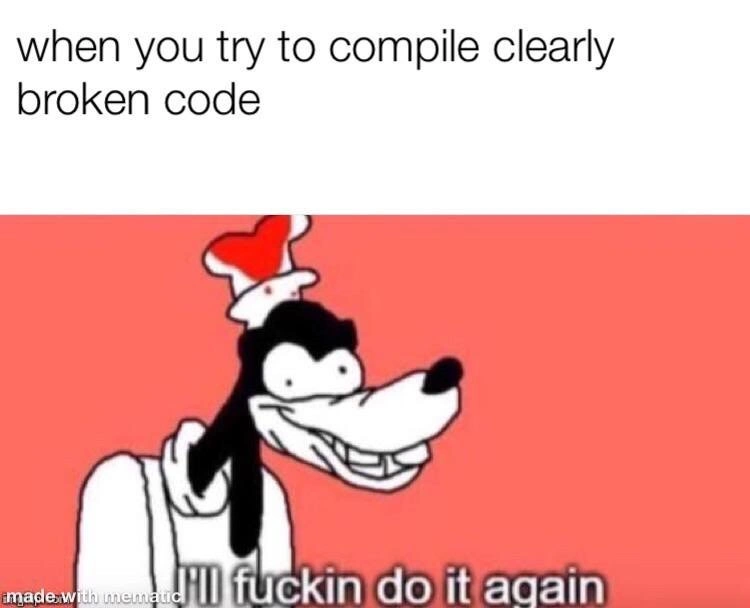
The bottom panel of the meme – the goofy-looking cartoon dog with a manic grin saying “I’ll fuckin do it again” – is a popular internet meme template (often called the “I’ll do it again” meme). In this context, it represents either the developer or the compiler being comically eager (or oblivious) about repeating the process. It’s like the compiler saying, “Sure, I can compile it again, why not!” or the developer saying, “I know it failed, but let’s run it once more!” The cartoon character is actually Goofy (from Disney) in a surreal, exaggerated form, which perfectly matches the absurdity of the situation. The tiny chef hat and mischievous grin give a vibe that something foolish is about to happen (again). This is classic coding humor – it takes a frustrating real-life coding experience and exaggerates it using a meme for comedic effect. It’s developer humor that practically anyone who’s written code can relate to: that moment you hit the compile or run button while suspecting deep down, “This isn’t going to work…”, and then acting mock-surprised when the error message pops up again. The meme format simplifies the story into two captions: setup (trying to compile broken code) and punchline (doing it again anyway). The reason it’s funny is because it’s true – programmers often get stuck in these little debugging loops. We know we should stop and fix the error properly, but sometimes we just reflexively try one more time, as if the computer might have changed its mind. This shared experience of debugging frustration and stubborn optimism makes the meme instantly understandable to anyone who’s battled with a compiler. It’s essentially saying, “Hey, we all do this silly thing when coding,” and that solidarity in our folly is what gets a laugh (along with a sigh) from developers.

Level 3: Definition of Insanity

Seasoned developers immediately recognize the scenario depicted: hitting “compile” repeatedly even though you know the code is still broken. It’s a textbook example of that famous adage often (mis)attributed to Einstein: “Insanity is doing the same thing over and over and expecting different results.” The meme nails this relatable dev experience with dark humor. The top caption sets the stage: “when you try to compile clearly broken code” – a situation we’ve all been in, especially under stress or late at night. You wrote something that you suspect (or outright know) has no chance of passing the build, yet here you are, fingers twitching on the compile command like a nervous tick. The bottom image’s punchline – the crazy-eyed cartoon dog (a distorted Goofy) proudly declaring “I’ll fuckin do it again” – is the personification of that stubborn, almost delusional optimism that creeps in during moments of debugging frustration. It’s funny because it’s true: as developers, we sometimes act like that goofy character, grinning through the pain and launching yet another compile attempt as if sheer willpower might compel the code to work this time.

Why do experienced devs chuckle (and cringe) at this? Because it satirizes a common anti-pattern in our workflow. Ideally, when the compiler throws an error, you’re supposed to tweak the code to fix the issue before retrying. But in practice, especially when chasing a tricky bug or a cascade of compile errors, we get into a rapid cycle of compile–fail–fix a bit–compile again. The meme exaggerates this into a futile loop: hitting compile with no actual fixes, which we’ve done at least once in despair. Maybe you thought you changed something important but forgot to save the file, so you recompile and – surprise – build failure again. Or you’re so perplexed by the error message that your first reaction is “Huh, maybe it was a fluke” and you run it again just to see the same red text scroll by. Senior engineers know that feeling when you’ve seen the same exact error for the tenth time – it almost becomes a weird friend or a mantra on your screen. (“Undefined reference to FooBar… hello again, old pal.”) This meme captures that head-against-the-wall moment with perfect absurdity.

There’s also a hint of coping mechanism here. Re-compiling repeatedly can be a form of denial or procrastination. Instead of stepping away or methodically diagnosing the root cause, even battle-scarred coders sometimes just angrily mash make or hit the build hotkey again, as if the computer might suddenly have mercy. It’s analogous to hitting an old TV set in different ways hoping the signal clears up. We smile (or groan) at the meme because we see ourselves: exhausted, maybe caffeinated to the gills at 3 AM, eyes glazed over, debugging a nasty problem. The code crashed or the compile failed, but we’re not ready to fully confront it, so we reflexively go “build -> run” once more, like some ritual to appease the silicon gods. Of course, nothing changes – the compiler is brutally consistent – and that’s the joke. It’s a form of gallows humor for developers: “Haha yeah, I’ve been that idiot hitting compile hoping for a miracle. We’ve all been Goofy in the red chef hat.” In a team setting, this might even become a running joke – e.g. a colleague asks “Did it compile, or are you doing the Goofy again?” and everyone instantly gets the reference. By sharing this meme, developers collectively acknowledge the folly and pain of those compile loops, finding camaraderie in the fact that even the best of us succumb to tech insanity once in a while.

From an organizational and historical perspective, the meme also implicitly contrasts ideal workflow vs reality. Best practice: read the compiler error carefully, understand it, fix the code, then recompile. Reality: rapid-fire compile attempts while blindly fiddling with the code or hoping the error magically disappears. In the old days of longer compile times (imagine C code on a 90s machine or, going further back, feeding punch cards into a mainframe compiler overnight), you bet programmers were double-checking their syntax before running it. Wasting a compile attempt on broken code was a costly mistake when turnaround was hours. But today’s compilers and IDEs are fast, and hitting that build button is almost reflexive – the feedback loop is seconds. That convenience is generally great, but it enables the kind of broken build retry loop we see in the meme: it’s so easy to try “just once more” that we do it without thinking. We treat the compiler like a slot machine: maybe this time it’ll compile! All of this is wrapped in the meme’s simple two-panel format, which delivers a knowing wink to every developer: we’ve been there, and it’s hilariously futile.

Level 4: Unwavering Determinism

At the most granular technical level, this meme highlights the deterministic nature of compilers and the futility of expecting a different outcome without changing the input. A compiler is essentially a strict algorithm following formal rules (a specified grammar and semantics) to transform source code into machine code. It operates like a meticulously programmed machine: given the same source code, it will always produce the same result – be that a successful build or a list of compiler errors. There’s no randomness or whim in this process. If the code is clearly broken (for example, a missing semicolon or a mismatched brace in C++), the compiler’s parser will encounter the exact same syntax violation on each run. It doesn’t matter if you compile it one time or a hundred times in a row – the underlying parse tree construction and semantic analysis will fail at the same point every single time. In other words, from a theoretical standpoint, compiling the identical broken input again and again is an idempotent operation: f(broken_code) -> error each time. The phrase “I’ll fuckin do it again” perfectly fits this deterministic behavior – the compiler will do it again, it will reprocess the code from scratch, and it will reliably arrive at the same error state without any magical self-correction.

This touches on fundamental computer science concepts. Compilers adhere to the formal grammar of a programming language (often defined in BNF or similar formalisms). If your code deviates from these rules, a syntax error is thrown and compilation halts (or attempts some error recovery strategy to continue checking the rest). The compiler isn’t an AI that “knows” your code is broken in a higher logical sense; it’s simply executing a series of well-defined stages (lexical analysis, parsing into an AST, type checking, optimization, code generation). At each stage, strict conditions must be met. For instance, during parsing, encountering an unexpected token (like a stray brace or missing semicolon) triggers a failure in the state machine that recognizes language grammar. The compiler might print “expected ';' before '}'” and stop there. If you immediately re-run the compilation without fixing that ;, the compiler doesn’t get “frustrated” or try a different approach – it performs the same lexical scanning and parsing steps and hits the same wall again. The meme humorously personifies the compiler as a grinning, oblivious agent happily willing to repeat the work (compiling code again) despite the outcome being a foregone conclusion. It’s showing the compiler’s unwavering devotion to its job: garbage in, garbage out (the classic GIGO principle of computing).

Moreover, there's a deeper implication about the limits of static analysis. If by “clearly broken code” we mean logically broken (a bug that’s obvious to a human but not a syntax or type error), the compiler will still cheerfully produce an executable or bytecode without complaint. This is because compilers generally can’t detect bugs that don’t violate the language rules – a consequence of undecidability in program analysis (related to the Halting Problem and Rice’s theorem). For example, you could write a program that obviously divides by zero or has an infinite loop; it’s clearly broken in terms of intent, but the compiler will happily compile it since no rule is formally broken. It’s up to the runtime or the developer’s tests to catch such logic errors. In that sense, the meme might also be poking fun at how a compiler will “do it again” and build a program that’s bound to misbehave, because it has no insight into the programmer’s higher-level mistake. The build failure happens later at runtime, but the compiler’s job was done flawlessly – it did exactly what we asked. This deterministic obedience is both the power and the limitation of compilers: they are unforgiving with syntax, and utterly indifferent to your emotional hope that the next run will be different.

Description

This is a two-part meme format known as 'I'll Fuckin' Do It Again'. The top section contains the text 'when you try to compile clearly broken code' in a simple black font on a white background. The bottom section features a crudely drawn, wide-eyed, and crazed-looking Goofy character against a solid red background. Below him is the caption, 'I'll fuckin do it again'. A watermark 'made with mematic' is partially visible in the bottom left corner. The meme humorously captures the irrational act of a developer repeatedly trying to compile code they know is flawed, hoping for a different result through sheer persistence. It's a relatable satire of the definition of insanity applied to software development, highlighting moments of desperation or brain-fade during a difficult debugging session
Comments

7
Anonymous ★ Top Pick The build failed. I changed nothing. I ran it again. It passed. This is not a success story
  1. Anonymous ★ Top Pick

    The build failed. I changed nothing. I ran it again. It passed. This is not a success story

  2. Anonymous

    Changing one newline and rerunning the entire 45-minute CI pipeline is my daily reminder that hope isn’t a strategy - it’s just the most expensive part of compile-fail-tweak roulette

  3. Anonymous

    After 20 years, I've learned that hitting compile again without changes isn't debugging - it's just negotiating with the compiler to see if it's having a better day than you are

  4. Anonymous

    Every senior engineer has been here: staring at code with three missing semicolons, two unclosed braces, and a type mismatch so obvious the compiler is practically screaming - yet hitting Ctrl+B again like maybe the AST parser will have a change of heart this time. It's the programming equivalent of checking the fridge repeatedly hoping food magically appeared. We all know the definition of insanity, but when you're 8 hours into a refactor and your brain is running on fumes and cold coffee, that 'Build Failed (127 errors)' message becomes a personal challenge rather than a diagnostic tool

  5. Anonymous

    The compiler's error count climbs past 999, but your Ctrl+B finger? Unyielding as a distributed consensus algorithm

  6. Anonymous

    Hitting build on clearly broken code is my chaos test - if it ever goes green, our CI isn’t hermetic, the remote cache is lying, and we’ve got bigger problems than a missing semicolon

  7. Anonymous

    If the third clean-and-rebuild works, you didn’t fix anything - you just achieved eventual consistency with your non-hermetic build graph

Use J and K for navigation