TCP vs. UDP: A Tale of Two Protocols
Why is this Networking meme funny?
Level 1: Every Drop Counts
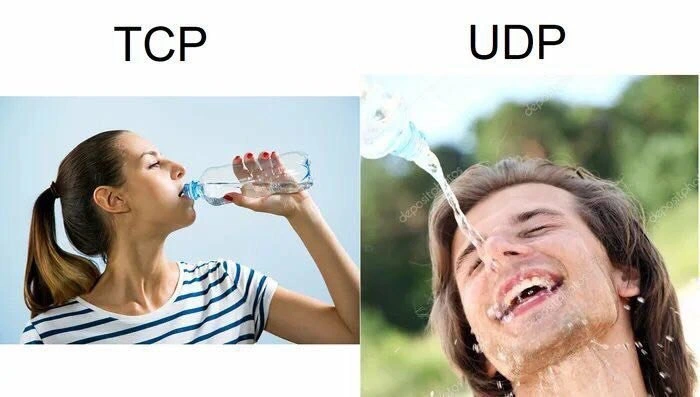
Imagine you have two people who are thirsty and have bottles of water. The first person opens their bottle and calmly pours the water straight into their mouth, not spilling anything. They get a nice full drink – every drop of water goes where it should. Now the second person does something silly: they hold the bottle up above their head and try to pour the water into their mouth from way up high. What happens? Water splashes everywhere! Sure, a little bit might go into their mouth, but a lot of it ends up on their face, in their hair, and on the ground. They’re soaked and probably still thirsty because most of the water didn’t make it in. 😂 It’s a funny scene because it’s obvious to anyone watching which method works better. The first person’s careful method ensures they actually get all the water, while the second person’s careless method wastes most of it. This meme uses that everyday idea (not spilling your drink) to poke fun at two different ways of sending information. One way is careful and makes sure nothing is lost – like drinking normally – and the other way is quick and messy, kind of like tossing water and hoping for the best. Even without knowing anything about computers, you can laugh at the poor guy drenched in water and think, “Yup, that’s not the smartest way to take a drink!” The joke at its heart is simple: doing something in a reliable way versus a sloppy way can lead to very different results, and the pictures make that super clear (and silly!).
Level 2: Precise Pour vs Splash Zone
Let’s break down the basics behind this meme in plain terms. It’s comparing two important networking protocols: TCP and UDP. These are both ways that computers send information over the internet, but they work very differently. The meme uses a water bottle metaphor to represent each protocol’s behavior. On the left side labeled “TCP,” a woman pours water from a bottle directly into her mouth carefully, not spilling a drop. On the right side labeled “UDP,” a man tries to pour water into his mouth from high above his head, and water is splashing everywhere. This side-by-side is a lighthearted illustration of how TCP vs UDP handle data delivery. Now, what do TCP and UDP really mean?
TCP (Transmission Control Protocol) is the reliable one. Think of TCP as a dedicated delivery service that guarantees your message will get to the other side (or you’ll be notified that it didn’t). When your computer sends data via TCP, it first establishes a connection to the receiving computer (like making sure the other side is ready – this is often called a “handshake”). Once connected, TCP breaks your data into packets and sends them in sequence: packet 1, packet 2, 3, and so on. Here’s the key: TCP keeps track of these packets. Each time a packet arrives, the receiver sends back a tiny acknowledgement saying “Got it!” for that packet. If the sender doesn’t hear that acknowledgment (meaning the packet might have been lost on the way), it will resend the missing packet. In the end, TCP makes sure that every packet reaches its destination and reassembles them in the original order. It’s like you’re handing someone water directly and watching them drink it – you’ll notice if a drop doesn’t make it and you can try again. Because of this careful approach, TCP is used for things where we really can’t afford to lose information. For example, loading a webpage, sending an email, or downloading a file – you want the data to be perfect with no pieces missing, just like you want all the water in the bottle to actually end up in your mouth.
UDP (User Datagram Protocol) is the fast but “best-effort” one. UDP is often described as a connectionless protocol, which means it doesn’t set up a dedicated connection or do a handshake before sending data. Your computer just tosses the packets out towards the receiver without checking in first. There is no built-in mechanism in UDP to ask “Did you get that packet?” or to resend it if it’s lost. It also doesn’t ensure packets arrive in the same order they were sent – they might take different paths across the internet and show up shuffled, or not at all. Using UDP is a bit like standing across the room from your friend and trying to throw water from your bottle into their mouth: you might get some water in (if you’re lucky and well-aimed), but a lot might spill onto the floor. And importantly, you’re not running over to confirm which sips they caught – you just keep tossing. This sounds reckless, but it has its uses! UDP’s lack of overhead (no handshakes, no checking and resending) makes it very fast with low latency. It’s great for situations where getting most of the data quickly is better than getting all of it perfectly. A classic example is live streaming or online gaming. In a video call, if a tiny bit of data is lost and you miss a millisecond of audio or one video frame, it’s usually unnoticeable – and trying to recover it might cause a bigger delay. Similarly, in an online game, you’d prefer the game state updates to be fast and up-to-date; if one update is lost, the next one will usually have the new position of a player anyway. This way, the game or video keeps running smoothly. UDP powers a lot of these real-time applications (and also simple queries like DNS lookups) precisely because it’s okay if a small fraction of packets get dropped as long as the majority arrive almost immediately.
In the meme’s terms, TCP is the tidy drinker making sure no water is wasted, while UDP is the guy who doesn’t mind getting wet as long as some water makes it in. The humor comes from exaggeration: of course no one would actually choose to drink water like the UDP guy – it’s obviously inefficient and messy! But that exaggeration helps us remember the difference. In tech, we often explain it like this: TCP is like sending a series of numbered letters through certified mail – each letter must be signed for, and they must be read in order, so you know if one goes missing and you can resend it. UDP, on the other hand, is like dropping postcards in the mailbox without tracking – most will get there, but if one or two don’t, you probably won’t even know unless the message on the postcard was critical. And if they arrive out of order, well, each postcard is independent so it’s up to the recipient to sort it out.
This meme is a bit of developer humor that has become part of internet meme culture for techies. It takes a dry concept from textbooks – the difference between two NetworkProtocols – and makes it instantly understandable with a funny picture. Even if you’re new to these terms, the images give you a gut feeling: left side feels efficient and controlled, right side looks haphazard and lucky if it works. Now when you hear “TCP is reliable, UDP is not,” you might recall these images. And if you ever find yourself learning about packet loss (when data packets get lost in transit) or debugging why some data isn’t arriving, you’ll understand why someone might joke, “Is our code using UDP? Because this feels like water missing the mark.” The side-by-side two_panel_meme format effectively delivers the lesson. Networking students and junior developers often have an “aha!” moment when they first visualize it this way. So, the next time you download a file or stream a video, think about our two friends with the water bottles: one quietly ensuring reliability (all the water/data goes in), and the other embracing a bit of chaos (water/data flying around) for the sake of speed. It’s a fun and memorable way to compare protocols that are normally taught with far more boring diagrams and ACK tables!
Level 3: Spray-and-Pray Protocols
For seasoned developers, this two-panel meme hits home immediately. It’s a clever visual metaphor that condenses a fundamental protocol comparison into everyday imagery. The left panel (labeled TCP) shows a woman calmly drinking from a water bottle, ensuring every bit of water goes where it’s supposed to. If you’ve spent any time in systems or Networking development, you recognize this as TCP’s vibe: careful, controlled, reliable delivery. TCP is that colleague who double-checks every detail – no packet left behind, no data out of order. The right panel (labeled UDP) shows, well, the opposite: a guy dumping water over his face from above, water splashing everywhere but his mouth. That chaotic scene perfectly embodies UDP’s “send it and forget it” attitude. No courtesy of a handshake, no “did you get that?” follow-up – just a euphoric spurt of data (or water) that might mostly hit the target… or might drench everything else. The humor here is that anyone who knows these network protocols instantly gets it: TCP is the reliable one making sure every drop/pocket gets delivered, UDP is the wild one where who-knows-what happens to some of the packets. The absurdity of someone trying to drink water in such a sloppy way draws a direct parallel to how absurd it would be to expect all your data to arrive when using UDP in a scenario that really needs reliability.
Why do developers find this funny (and painfully true)? Because it reflects real-world experiences and trade-offs we’ve all faced. Imagine you’re designing a system for sending messages or data across the internet. With TCP, once you hand your data to the protocol, you can almost relax: you know under the hood it’s doing that three-way handshake to establish a connection (kind of like politely checking “are you ready? let’s talk”), then numbering each packet, checking receipts (ACKs), and retrying anything that gets lost. It’s the comfort of a guaranteed delivery – much like the comfort of tilting the bottle directly into your mouth, knowing you’ll actually drink the water. Seasoned engineers recall countless times where TCP’s reliability saved them: files downloaded without corruption, orders in an e-commerce transaction arriving intact and in sequence, or simply not having to worry about lost data when calling an API.
On the flip side, UDP is familiar as that high-speed but unpredictable option. In practice, using UDP can feel like the meme’s right panel. For example, many online multiplayer games and real-time streaming apps use UDP because they value speed and low latency over perfection. A senior developer chuckles at this image remembering the late-night debates: “Should we use UDP for this? It’s faster… but what if packets drop?” In a first-person shooter game or a video conference, a few lost packets (like a few drops of water) usually aren’t fatal – a single missed position update or a dropped video frame might not even be noticed, and trying to recover it could cause more delay. NetworkingProtocols often force you to choose between guarantees and performance. The meme humorously exaggerates the UDP side: in reality, UDP isn’t always that messy, but it is a best-effort approach. We’ve all seen what happens when a network is spotty: using UDP, you might get glitches in audio or gaps in data with no instant remedy. The person drenched in water captures that feeling of UDP perfectly – you got some of it, but you also got a whole lot of nothing where something should be.
This resonates as developer humor because it simplifies a textbook concept into a punchy image. Think of the countless times a developer has had to explain the difference: “TCP is like a phone call where you say ‘hello’ and wait for a response, UDP is like shouting out of a window – you hope someone hears you, but you’re not sure.” In fact, there’s an old joke in meme culture and programming circles: “I could tell you a UDP joke, but you might not get it.” 😏 It’s corny, but it always earns a knowing grin. We laugh because it’s true – UDP doesn’t ensure you “get” the message! In a similar vein, the meme’s imagery is funny because it’s so literal. TCP’s careful sip = all data received; UDP’s wild pour = data everywhere, with inevitable packet loss. The emotional core for veteran devs might also include a tinge of “Yep, learned that one the hard way.” Perhaps they recall debugging a distributed system where some log messages sent via UDP just vanished, or having to bolt on their own acknowledgment system on top of UDP for a custom protocol – basically reinventing a crude version of TCP and thinking, "Maybe we should’ve just used TCP."
The two-panel format is a classic in tech memes for highlighting “expectation vs reality” or two opposite approaches. Here it wonderfully contrasts reliability with chaos. It’s the kind of analogy you might even see in a CS_Fundamentals lecture to wake up the class: one picture worth a thousand words about how these protocols differ. Senior engineers appreciate this bit of humor because it cuts through jargon with an everyday situation. It’s a gentle reminder that beneath all our complex systems, sometimes the concepts are simple – like pouring water properly vs. not – and that simplicity makes it funny and accessible. Plus, there’s an almost nostalgic nod: we all learned about TCP vs UDP at some point, and this meme brings that dry lesson to life. The next time you’re on a shaky video call that freezes or drops audio for a second, you might picture that guy on the right getting a face full of water and think, “Ha, UDP at work.” Meanwhile, when your file download inches along but finally completes in one piece, that woman on the left sipping patiently is basically TCP saying, “Don’t worry, I got every bit of it.” It’s a fun, relatable snapshot of network protocol reality that both pokes fun and educates at the same time. In short, the meme lands so well because it captures the essence of a fundamental tech trade-off in a goofy, human way – and what seasoned dev doesn’t love a good, geeky inside joke that also rings true?
Level 4: Sliding Window Wisdom
Deep in the world of networking, the contrast between these two protocols comes down to how they handle delivery guarantees. TCP (Transmission Control Protocol) employs an elegant system of sequence numbers and acknowledgments to ensure each byte of data arrives at its destination in order and intact. It's built on a classic concept from computer science called an ARQ (Automatic Repeat reQuest) protocol – essentially a “you send, I’ll confirm” dance. Every byte stream sent via TCP is chopped into packets, each given a sequence number. The receiving end keeps track, acknowledging (ACK) the packets it gets. If the sender doesn’t receive an ACK for a particular packet within a timeout, it assumes that packet got lost in transit (dropped somewhere in the network) and retransmits it. This guarantee mechanism is often implemented using a sliding window algorithm: multiple packets can be in flight before needing an ACK, which keeps the pipeline full for efficiency. The window "slides" forward as acknowledgments come in, allowing more data to be sent. This is how TCP achieves a reliable byte stream on top of unreliable IP packets. The result is that data eventually arrives one way or another, much like carefully ensuring every drop of water goes from the bottle into your mouth without spilling. TCP’s meticulous bookkeeping creates a controlled flow where losses are corrected and out-of-order arrivals are sorted before the application ever sees them.
By contrast, UDP (User Datagram Protocol) takes a radically simple approach. UDP is a connectionless protocol – there’s no handshaking or ongoing session. It just injects packets (datagrams) into the network and doesn’t wait around to see what happened to them. Each UDP packet is like a single, independent message with a destination address and port, but no built-in guarantee that it reaches the other side. There are no sequence numbers or ACKs at the UDP layer; if a packet gets dropped or delayed, UDP itself remains blissfully unaware. This simplicity means low overhead: just a small header (with source/dest ports, length, and a checksum) and the data. But it also means if the network is shaky, packets can be lost or arrive out of order with no automatic recovery. It’s the equivalent of pouring water from a bottle without aiming – some water might land where you intend, but a lot could splash elsewhere or never reach at all. UDP’s philosophy is often summarized as “fire-and-forget”. From a theoretical standpoint, UDP makes sense for scenarios where the occasional lost packet is acceptable or where the application can handle reliability on its own. By forgoing the delivery guarantees, UDP avoids the extra latency of waiting for acknowledgments and retransmissions, which is crucial in real-time applications (like live video or voice) where outdated data is as good as lost data.
Beyond reliability, TCP carries more sophisticated machinery under the hood to tame the chaos of network traffic. It implements flow control, making sure a fast sender doesn’t overwhelm a slow receiver (the sender will slow down if the receiver’s buffer is filling up). It also has built-in congestion control algorithms (e.g. AIMD – Additive Increase Multiplicative Decrease, slow start, etc.), which automatically adjust the sending rate to avoid flooding the network when it’s congested. These algorithms were born from hard lessons in networking (to prevent congestion collapse of the Internet). In our water analogy, TCP not only makes sure every drop arrives, but also that you’re not pouring water faster than the drinker can swallow or faster than the funnel (network path) can handle – no one gets drowned or choked. UDP, by design, doesn’t do any of this hand-holding. If you send UDP packets at a rapid rate and the network can’t keep up, packets will just be dropped left and right with no back-off — it’s like pointing a fire hose at someone trying to drink; the excess water (packets) simply gets flung out with no feedback to slow down. This difference is why TCP is called a “reliable, stream-oriented” protocol, ensuring an ordered, controlled stream of data, whereas UDP is “unreliable, datagram-oriented”, providing raw firepower with minimal interference. Each approach has its theoretical trade-offs, rooted in the end-to-end principle of Internet design: put complexity (like error recovery) at the endpoints if needed, and keep the core network simple. The meme humorously captures this dichotomy – one side illustrating the almost over-engineered reliability of TCP’s sliding window and ACK system (every drop matters), and the other side showing UDP’s beautiful simplicity (or chaos), where once a packet leaves, it’s at the mercy of the network gods.
Description
A two-panel meme that visually contrasts the TCP and UDP network protocols. The left panel, labeled 'TCP' in black, sans-serif font, shows a woman in a striped shirt drinking water neatly and carefully from a clear plastic bottle, ensuring none is spilled. The right panel, labeled 'UDP', depicts a man with long brown hair laughing as water is poured messily all over his face from a bottle, splashing everywhere. The meme humorously illustrates the fundamental difference between TCP (Transmission Control Protocol) and UDP (User Datagram Protocol). TCP's reliable, orderly, and connection-oriented nature is compared to the careful drinker, who ensures every packet is received. In contrast, UDP's fast, connectionless, 'fire-and-forget' approach, which doesn't guarantee delivery or order, is perfectly captured by the chaotic and carefree splash of water
Comments
7Comment deleted
TCP is that diligent senior engineer who insists on atomic commits and extensive integration tests. UDP is the intern who force-pushes to main on a Friday
TCP is the DevOps engineer who hands you the water, waits for the ACK, and only then closes the connection; UDP is the architect who yells “hydrate!” and flings the bottle over the firewall - observability will tell us if you’re still alive
UDP is what happens when you optimize for throughput in your 20s and then spend your 40s explaining to the board why half the customer data never made it to the analytics pipeline
TCP: 'I'll make sure every drop reaches your mouth in the exact order it left the bottle, with acknowledgments and retransmissions if needed.' UDP: 'YOLO, here's your water - whether it hits your mouth, your face, or the ground is not my problem. But hey, at least there's no handshake overhead!'
TCP implements ACKs, retransmits, and backpressure; UDP hits p99 latency by redefining “delivered” as “some water reached a surface.”
TCP architects sip reliably; UDP SREs embrace the spray, patching losses in userland for that sub-50ms p95
TCP is hydration with flow control - every sip ACKed and retransmitted if you spill; UDP is “hydration as eventual consistency”: fast, lossy, and you’ll reinvent TCP the moment you care where the water ended up