Skip to content
DevMeme
5100 of 7435
Data Structures Personified as Party Hosts
CS Fundamentals Post #5583, on Oct 16, 2023 in TG

Data Structures Personified as Party Hosts

Why is this CS Fundamentals meme funny?

Level 1: When Code Runs the Cafe

Imagine a restaurant run by computer rules instead of normal human rules – things would get pretty silly! For example, what if the bartender always served the last person who came in before anyone who was already waiting? The people who arrived earlier would be stuck until no newer guests were left – not very fair, right? Or picture a hostess who, instead of taking you straight to a table, says: “What’s your ticket number? 83? Okay, turn left, then left again, now right, then left to find your seat.” It’d feel like following a secret treasure map just to sit down! How about a dinner where everyone has to hold hands with the person in front of them and behind them the whole time so no one gets lost in line – that’s pretty cute and awkward. And if the place gets too full, suddenly the manager shouts, “Hold on folks, we need a bigger room!” and everyone has to get up and move to new tables just because one more group came in. The craziest one: the moment you walk in the door, they declare you’re now the CEO of the restaurant, handing you a fancy title – but a few seconds later they’re like, “Actually, please step down to manager... hmm, maybe be a supervisor... okay, there you go, regular customer – that’s your correct spot.” 😂 These wacky scenarios are funny because we know real restaurants never work this way. But in the world of computers, each of those silly rules is exactly how a certain data structure works to keep things organized. The meme makes us laugh by showing just how absurd it would be if people had to follow the strict logic that computers use internally. It’s a goofy reminder that computers think in algorithms, while people just want their dinner without all the nerdy nonsense!

Level 2: Data Structure Sampler

Let’s break down the meme’s data structure analogies in simpler terms. Each "welcome to..." line personifies a basic computer science data structure as if it were running a restaurant. For a junior developer (or a CS student just learning these concepts), here’s what’s happening with each structure and why it’s humorous:

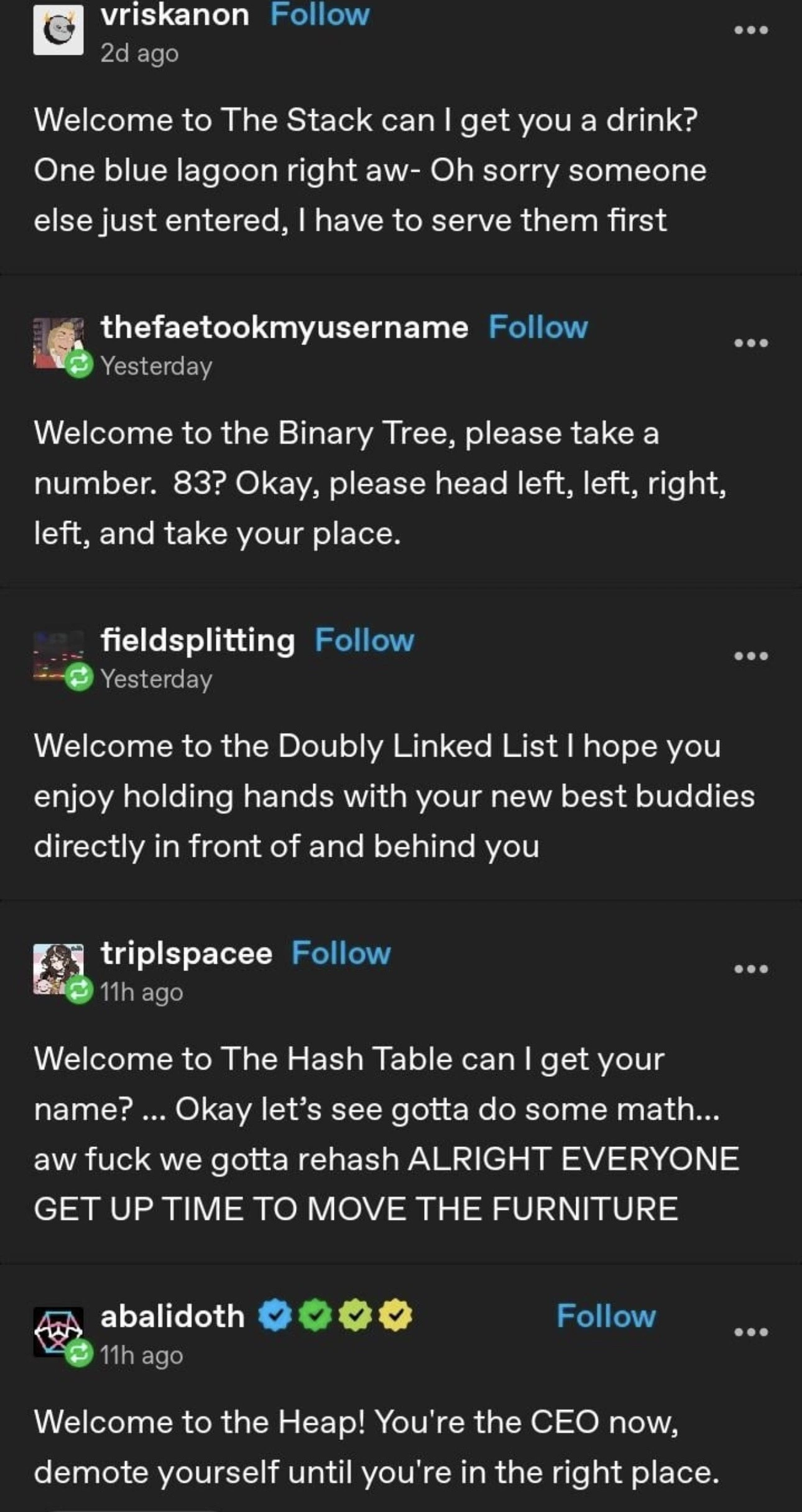
  • Stack (Last-In-First-Out) – A stack is like a stack of plates: you add new plates to the top and also remove from the top. The last item put on is the first taken off (LIFO). In normal restaurants, customers are served in order (first come, first served), but The Stack restaurant does the opposite. In the meme, the bartender says: "One Blue Lagoon coming up—oh sorry, someone else just walked in, I have to serve them first." That’s LIFO in action: the newest customer jumps to the front of the line. If you’ve just started coding, you might have used a stack for things like undo operations or evaluating math expressions. The joke is funny because treating customers this way (always serving the most recent arrival first and making others wait) would be super rude and chaotic in real life, even though it’s perfectly normal behavior for a stack in code.

  • Binary Tree – A binary tree is a structure where each item points to up to two sub-items (commonly called left and right child). A special kind, the binary search tree (BST), keeps items in sorted order: smaller values go to the left branch, larger ones to the right. The meme’s "Binary Tree" restaurant tells you to "take a number. 83? Okay, go left, left, right, left..." which sounds weird for finding a seat! What’s happening is exactly how a BST inserts or finds a value: the host is comparing your number 83 with some reference values at each step. For example, if the root of the tree is 50, since 83 is bigger, you'd go right; then compare with say 75 (83 is bigger, go right), then maybe 90 (83 is smaller, go left), and so on – a series of left/right turns until you find the correct spot. For a newcomer to CS, think of it like a game of 20 Questions: "Is 83 higher or lower than X? Now go this way." It’s efficient for computers to locate data (O(log n) steps usually). The humor arises because a diner in a restaurant would never be asked to navigate a labyrinthine path based on binary decisions to find their seat! In everyday terms, it’s like if a librarian told you to find a book by repeatedly going left or right in the stacks depending on your book’s number – effective in theory, but pretty funny as a literal set of directions for a person.

  • Doubly Linked List – A linked list is a chain of items where each item knows the next one in line. A doubly linked list knows both the next item and the previous item (two links per node, hence "doubly"). In the meme’s Doubly Linked List restaurant, the host says they hope you enjoy “holding hands with your new best buddies directly in front of and behind you.” This directly references how a doubly linked list node has a pointer to the neighbor ahead and the neighbor behind. For a junior dev, imagine a conga line or people holding hands in a queue: each person is connected to the one before and after – that’s exactly how nodes in a doubly linked list are hooked up in memory. The benefit in code is you can move in both directions easily (say, go to previous page and next page in a browser history). The joke exaggerates it: customers literally holding hands to maintain the order! It’s a playful way to remember that in a doubly linked list, every element is aware of who’s next and who’s previous. If you’ve written a little code with linked lists (maybe in C or Java using prev and next pointers), you know that feeling of keeping the links consistent. The meme makes it physical and silly – because in reality, we keep our place in line without white-knuckle handholds 😄.

  • Hash Table – A hash table (or hash map) is a data structure that lets you store and retrieve data via a key (like a name or ID) very quickly. It works by running the key through a hash function (some math formula) to turn it into an index, which points to where the data is stored in an array. Think of it like a locker system: you give your name, the computer hashes it into, say, 37, and puts your info in locker #37. In the meme’s Hash Table restaurant, the host asks for your name and says "gotta do some math..." – that’s the hashing process. But then, "aw fuck, we gotta rehash," he shouts, meaning the current set of lockers (tables) is too full or someone else is already at the computed spot (a collision). Rehashing is when the hash table has to expand to a bigger size, and rehash all existing keys (basically recompute new positions and move everybody). The meme illustrates this by the host yelling for everyone to get up and move furniture to make room. If you’re new to this, imagine a classroom where each student’s seat is determined by the first letter of their name. If too many kids come and seats conflict, the teacher suddenly says "We need a bigger classroom and a new seating chart!" – everyone has to stand up and relocate according to a new plan. It’s chaotic but that’s how a hash table maintains efficient access: by resizing (doubling the number of buckets, often) and then recalculating positions so that each key is in a new spot based on the new size. In code (like a Python dict or Java HashMap), this happens automatically when the table gets too crowded, ensuring your operations stay fast on average. The joke is funny for beginners once you realize rehashing is literally like a sudden restaurant makeover mid-service, which is a wild thing to imagine.

  • Heap (Priority Queue) – A heap is a binary tree-like structure that always keeps the highest priority element at the top (if it’s a max-heap, or the lowest if it’s a min-heap). You can think of it as a kind of "at any moment, who’s the VIP?" data structure. Every time you add a new element, a heap will arrange itself so the correct VIP is on top. In a priority queue (often implemented with a heap), when you insert a new item, it might bubble up to the top if its priority is high, or stay down if not. The meme’s Heap restaurant jokes: "You’re the CEO now, demote yourself until you’re in the right place." This sounds bizarre in plain terms, but it reflects how a heap insert or removal works: sometimes a new element might be temporarily placed in a high position (say at the root, like being CEO), but if it doesn’t actually have the highest priority, it will sift down to its proper level. For example, if you insert a task with low priority into a max-heap, one algorithmic approach could place it at the root initially and then realize "whoops, you’re not that important" and swap it down with bigger elements until order is restored. If you haven’t seen heaps yet, consider a sorted waiting line where whenever someone with higher priority comes, they should be closer to the front. A heap automates this by always bubbling the highest priority to the front. The meme takes that to the extreme by instantly making a random newcomer the CEO of the restaurant, then immediately correcting that mistake by demoting them repeatedly. It’s humorous because it’s a topsy-turvy way to manage a lineup, but it does echo the idea that a heap will enforce priority rules no matter how chaotic the insertions are. In real code, heaps are used for things like scheduling (where tasks with higher priority should run first) or algorithms like Dijkstra’s shortest path (where the next closest node is picked first). So if you ever used a priority queue (maybe in Python via heapq or in C++ with priority_queue), you were using a heap – and the data structure was busy making sure the smallest or largest element stayed on top by doing exactly these kinds of swaps behind the scenes.

In summary, the meme serves up a plate of data structure humor. Each “restaurant rule” is a direct analogy to how a particular data structure operates:

  • A Stack’s push/pop order is flipped compared to normal service.
  • A Binary Tree’s sorted placement becomes a wacky seating direction game.
  • A Doubly Linked List’s bi-directional links turn into literal hand-holding between neighbors.
  • A Hash Table’s resizing (rehash) is like a sudden dining room expansion where everyone moves.
  • A Heap’s priority sorting is caricatured as promoting and demoting a customer until hierarchy is correct.

For a junior developer or student, this is a fun way to remember what each structure does. It connects the abstract concept (like LIFO or hash collisions) to something tangible and silly (like serving drinks out of order or moving furniture). You might even recall these jokes next time you implement one of these in code. And importantly, it highlights that computers often use different rules than real life to organize things – rules that seem ridiculous if people had to follow them, but that help programs run efficiently. So, if you’re just learning data structures, this meme is a lighthearted study guide: it takes those definitions from your textbook and injects them with a bit of real-world absurdity so they stick in your mind. After all, who could forget what a rehash is once you’ve imagined a panicked restaurant host screaming for patrons to relocate? 🙂

Level 3: Algorithmic Table Service

At Data Structures R Us, the service runs on pure code logic, not customer courtesy. Each joke in this meme takes a classic data structure and imagines it managing a restaurant, with hilariously chaotic results that senior developers recognize instantly:

  • Stack (LIFO) – At "The Stack" bar, the bartender operates on a strict last-in, first-out policy. In the meme, as soon as a new patron walks in, the bartender drops whatever he's doing (mid-pour on that Blue Lagoon) to serve the latest arrival first. This is exactly how a stack works in code: the most recently added item (the top of the stack) gets popped out and handled before older entries. It's a comic reversal of normal restaurant queues (which are FIFO, first-in-first-out). Experienced devs chuckle here because we've all seen the call stack in action – the last function called must return first – but applied to bar service it feels absurdly unfair. The LIFO service model would leave early customers waiting indefinitely while newcomers get immediate drinks, much like how an algorithm might starve earlier tasks if using a pure stack for scheduling. It’s a clever nod to how a simple ordering rule (LIFO) is great for undo stacks or recursion in computing, but would create customer service hell in real life.

  • Binary Tree (BST) – At the "Binary Tree" diner, getting seated involves an oddly specific sequence of directions: "take a number... 83? Okay, head left, left, right, left...". This mirrors inserting a value into a binary search tree. In a BST, each node branches into a left (for smaller values) and right (for larger values). The host treating your ticket number 83 as a key and comparing it at each decision ("go left" if 83 is less than the current node, "go right" if greater) is textbook BST logic. The humor is that a patron essentially performs a binary search traversal to find their seat! Seasoned devs recognize this as the path you'd trace down a tree data structure: e.g., "Is 83 less than the root? Go left. Now compare at the next node... go right," and so on until you find a NULL spot to sit (or in this case, your table). In real restaurants, you'd never be sent on a binary O(log n) treasure hunt to locate your table number—but in code, this left-right routine is how we quickly locate or insert data by value. It's highlighting how algorithmic decisions (which make perfect sense inside a sorted binary tree for efficiency) would be convoluted and funny if a maître d’ actually made diners follow that logic physically. The senior perspective here also appreciates the subtext: if this "Binary Tree" restaurant isn't balanced, some poor guest with a certain number might have to traverse a comically long chain of lefts and rights (a nod to how unbalanced trees degrade in performance). It's a reminder of why balanced trees or AVL rotations exist, wrapped in a joke.

  • Doubly Linked List – "Welcome to the Doubly Linked List, I hope you enjoy holding hands with your new best buddies directly in front of and behind you." This line anthropomorphizes a doubly linked list as a dining arrangement where each customer is physically linked to two neighbors. In a doubly linked list, each node has pointers to both its previous and next nodes, so you know who comes before you and who comes after. The meme paints the picture of a restaurant where part of being seated means literally gripping the hands of the people in front and behind to maintain the chain order! It's a perfect analogy: in a doubly linked list data structure, you can move or remove nodes easily because each node knows its two neighbors (unlike a singly linked list which only knows one direction). A senior dev finds humor in this because it’s over-the-top literal – we often diagram linked lists as nodes with arrows pointing forward and backward; here those arrows become people holding hands. And of course, the absurdity of dining while clinging to strangers reflects the pointer logic in code. It hints at real CS scenarios too: for example, many of us have debugged tricky null-pointer bugs in linked list manipulation – if one person's "handshake" broke, the whole chain could fall apart. The meme transforms that meticulous pointer bookkeeping into a silly social requirement. It’s an embrace the awkwardness moment: developers recall that doubly linked lists are super handy for things like browser history or LRU caches because you can go both directions, but you pay the price of extra complexity (or in the restaurant, extra awkward hand-holding).

  • Hash Table – At "The Hash Table" grill, giving your name to the host triggers mathematical mayhem. The host says, "Okay let’s see, gotta do some math… aw f it, we gotta rehash! ALRIGHT EVERYONE GET UP, TIME TO MOVE THE FURNITURE." 🤭 This is a spot-on dramatization of how a hash table works (and what happens when it rehashes). In a hash table, your name (the key) is run through a hash function (the math the host is muttering over) to decide which table (bucket) you should sit at. But if the restaurant (hash table) has gotten too crowded — say the array of buckets is full or the load factor is exceeded — it’s time to resize and rehash. In code, rehashing means allocating a bigger table and recalculating all the keys' positions with a new hash function or modulo. The meme humor is that the restaurant literally yells for everyone to stand up and move furniture around to make space, which is what a dynamic hash table does behind the scenes (rehashing all entries into a larger array). Seasoned devs laugh (and maybe cringe) because we've seen this in production: e.g., a dictionary suddenly expanding can momentarily freeze things, much like a sudden reshuffle at a restaurant causes chaos. The F-bomb from the host and the urgency ("time to move!") capture that very real developer feeling when a resizing operation kicks in at the worst time (like a sudden spike in users causing a rehash storm). We also note the irony: hash tables are celebrated for average O(1) fast lookups and inserts, but when they rehash, that insertion can degrade to O(n) as every item is moved — an expensive but necessary furniture shuffle to keep future operations fast. In real life you’d never see a manager stop service to rearrange the whole dining room just because one more party came in... but that’s exactly how a HashMap keeps order. This joke hits home for any senior engineer who’s had to explain a mysterious performance hit, only to find it was a resizing hash table doing exactly this sort of all-hands rearrangement.

  • Heap (Priority Queue) – Finally, "Welcome to the Heap! You’re the CEO now, demote yourself until you’re in the right place." Here the restaurant treats each newcomer like they’ve instantly become the top dog (CEO) and then asks them to step down level by level until a proper hierarchy is restored. This is a clever take on how a heap (specifically a max-heap) maintains order. In a heap data structure, the highest priority element should always be at the root (like the CEO at the top of an org chart). When a new element is inserted, one common method is to initially place it at a leaf and then bubble it up if its priority is higher than its parent. But the meme flips it: it imagines the newcomer starts at the root (“CEO now”) and then gets sifted down until the heap property is valid. The phrasing "demote yourself" riffs on heap algorithms like heapify-down, where an out-of-place element swaps down with larger children until the binary heap is sorted. It’s a goofy scenario because in a real company or restaurant you’d never mistakenly crown the intern as CEO the moment they walk in the door 😅. But in a heap, transient violations of hierarchy happen whenever you insert or remove elements, and the data structure quickly fixes itself by moving nodes up or down. Veteran devs appreciate this gag because it alludes to priority queues – e.g. if you insert a new task with lower priority into a max-heap, it might temporarily sit at the root (due to how some in-place heap constructions work) and then get demoted as the tree reorganizes. The line also evokes the idea of heap sort, where the largest element is continually removed (CEO fired?) and the next in line takes over, then gets demoted accordingly. Overall, it’s poking fun at the heap’s strict rules: only one element can be on top, and every newcomer must find their correct rank. The result in the restaurant is a farcical management musical-chairs, which conceptually illustrates how a heap enforces priority order. Seasoned programmers grin because they've dealt with heaps for things like scheduling (CPU task priority or the classic "balanced parent" problem in tournament brackets) and know that behind the scenes the data structure is constantly swapping elements to keep the heap property intact – much like an overzealous restaurant that reassigns job titles until everyone is in the proper place.

Collectively, these vignettes land with a senior dev audience because they take dry textbook behaviors and turn them into a comedy of errors in a familiar setting. Each scenario exaggerates the quirks and costs of the data structure:

  • A Stack's unfair service order (LIFO) would never fly with thirsty customers.
  • A Binary Tree’s convoluted seating directions lampoon how data gets slotted in sorted order.
  • A Linked List’s tight neighbor links imagine pointer references as literal hand-holding (and hint that one broken link could break the chain – a reality in code).
  • A Hash Table’s disruptive rehash highlights the sudden overhead we dread when our hash buckets overflow.
  • A Heap’s priority shuffles caricature the rigid importance hierarchy heaps impose.

For developers, the meme is a buffet of inside jokes from Computer Science 101 served in the wrapper of everyday life. It’s funny because it’s true — these are exactly the rules our programs live by, but they’re the last rules you’d want at your dinner joint. The experienced folks reading this likely recall writing these structures from scratch in school or using them in real systems, so seeing them mis-applied to restaurant management triggers that nerdy giggle: "Haha, yep, resizing a hash table does feel like moving an entire restaurant of people!" Each line carries an extra wink – we know how elegant these structures are in code, and that contrast with their absurdity in the real world is the punchline.

Description

A screenshot of a social media thread where different users personify computer science data structures as if they are hosts at a party or establishment. The first post, from user 'vriskanon,' describes 'The Stack' using a last-in, first-out (LIFO) analogy of a bartender serving the newest customer first. The second post, from 'thefaetookmyusername,' explains 'The Binary Tree' by giving directions (left, left, right, left) to a numbered guest, mimicking tree traversal. The third post, from 'fieldsplitting,' welcomes someone to 'The Doubly Linked List' where they will be 'holding hands' with buddies in front and behind, describing the forward and backward pointers. The fourth post, from 'triplspacee,' comedically illustrates 'The Hash Table,' where a collision forces a 'rehash' and everyone has to 'MOVE THE FURNITURE.' The final post, from 'abalidoth,' describes 'The Heap' by telling a new arrival they are the CEO and must 'demote yourself until you're in the right place,' explaining the heapify or sift-down operation

Comments

21
Anonymous ★ Top Pick This is the only party where the host of the hash table occasionally yells 'EVERYBODY MOVE' and you spend the next ten minutes shuffling around because two people named 'John Smith' showed up at the same time
  1. Anonymous ★ Top Pick

    This is the only party where the host of the hash table occasionally yells 'EVERYBODY MOVE' and you spend the next ten minutes shuffling around because two people named 'John Smith' showed up at the same time

  2. Anonymous

    Dinner at the Data-Structure Diner seemed harmless until the hash table crossed 0.75 load factor, triggered an O(n) furniture-rehash, the stack waiter only remembered the last order, and the heap quietly demoted the CEO to busboy - Big-O fine dining at its best

  3. Anonymous

    After 20 years of explaining data structures, I've realized the best way to teach them is through nightclub analogies - though I'm still waiting for someone to implement a Red-Black Tree as a VIP section with strictly enforced dress code balancing

  4. Anonymous

    This thread perfectly captures why junior devs struggle with data structures - they're expecting a nice restaurant experience but instead get a Stack that serves the last person first, a Binary Tree that makes you navigate like you're in a corn maze, a Doubly Linked List that forces awkward hand-holding with strangers, a Hash Table that triggers a full restaurant reorganization when your name collides, and a Heap that immediately promotes you to CEO just to watch you bubble down to your actual position. It's like each data structure hired the world's most pedantic maître d' who insists on following their operational constraints to the letter, regardless of customer satisfaction

  5. Anonymous

    Our org is basically data structures: incidents are a stack, titles a heap, approvals a binary tree, blame a doubly linked list - then Q4 hits, the load factor passes 0.75, and HR rehashes the office so everyone ends up in a new bucket

  6. Anonymous

    Amortized O(1) seating until the load factor hits 0.75 - then we rehash the floor plan, the stack waiter preempts your blue lagoon, and the CEO heapifies down to busboy

  7. Anonymous

    Heaps in the C-suite: root always CEO, but one reorg and it's a full garbage collection

  8. @WaterCat73 2y

    А как же queue (очередь)?

    1. @sylfn 2y

      please use english in this chat

      1. @WaterCat73 2y

        Oh, sorry "what about queue?"

        1. @RiedleroD 2y

          "welcome to the queue, I'll get to you after talking to these 10 people that came before you"

          1. @azizhakberdiev 2y

            Welcome to the deque. You are 100th customer, so from now we will revert our serving order.

        2. @Danich 2y

          ... (ochered)

  9. @Algoinde 2y

    which is what normally happens actually

  10. @Odinmylord 2y

    Heap vector: Welcome to the heap vector, the older you are the further you are from your father (just like real like)

  11. @sylfn 2y

    not for "а как же" part (at the moment of sending my message)

  12. @Mikle_Bond 2y

    You open a door to the Singly Linked List. You hear Lambada.

  13. @beton_kruglosu_totchno 2y

    i totally do not get the rehash part

    1. Deleted Account 2y

      https://www.geeksforgeeks.org/load-factor-and-rehashing/

      1. @beton_kruglosu_totchno 2y

        wow that was a dumb joke then it's not even an inherent trait of hash table

    2. @CcxCZ 2y

      Possibly some implementation with dynamic amount of buckets? But yeah, sounds weird.

Use J and K for navigation