The CAP Theorem's Eventually Useful Guarantees
Why is this DistributedSystems meme funny?
Level 1: Eventually Means Later
Imagine you ask your parents for a cookie, and they say, “You can have one eventually.” That’s a fancy way of saying not right now. You might pout and reply, “So I can’t have it now?” and they respond, “You’ll get it later, I promise.” In that moment, all you care about is that there’s no cookie in your hand when you want it. 🙁 This meme is joking about the same idea, but with computer systems. One person says the system will be correct later (eventually), and the other person basically replies, “so it’s not correct now.” It’s funny because the first person is trying to make it sound okay by using the word “eventually,” but the second person just hears the truth behind the word: later, not now. It’s like when a friend keeps telling you, “I’ll come help you soon,” and you keep asking, “Are you here yet?” Eventually, you just say, “So you’re not here now, got it.” The humor comes from someone using a clever phrase to hide a delay or a problem, and someone else plainly calling it out. Even if you don’t know anything about computers, you can laugh at the idea that “eventually” basically means waiting. The meme makes an over-the-top joke by saying the system will eventually do all the things it’s supposed to – just not immediately. It’s as if a kid promised to do all their chores... eventually. We all know that feeling: it’ll get done later, but right now things are a bit messy! 🤷♂️
Level 2: Why Not All Three?
If you’re a newer developer or just encountering these terms, let’s break down the core joke. It centers on the CAP theorem in the context of distributed systems (like big web applications or databases that run on multiple servers). CAP stands for Consistency, Availability, and Partition tolerance – three important qualities we want in a database or system that’s spread out over a network. The theorem says you can’t have perfect consistency, perfect availability, and perfect partition tolerance all at once. In simpler terms, “pick two, and figure out how to live without the third.” This becomes an issue only when bad things happen (like part of your network goes down). Normally, when everything is fine, a distributed database can be consistent and available. But if some servers can’t talk to others (a network partition), you hit a wall: either the system stops responding until the partition is over (to avoid any inconsistent data), or it keeps working despite the split (but then different servers might have slightly different, out-of-date data until they sync up later). That’s the tough choice.
Now, Consistency here means every user or every part of the system always sees the same data at the same time. For example, if you update your profile picture, a consistent system would let your friend see your new picture immediately on their device. Availability means the system is always ready and returns an answer when you ask – i.e. no downtime, no “server not responding” errors. Partition tolerance means the system can keep going even if messages between servers are lost or delayed (imagine one data center can’t talk to another due to a network hiccup). Real-world distributed databases (such as those used by social networks, e-commerce sites, etc.) have to balance these factors. If a network hiccup happens, they either have to say, “Sorry, can’t process requests right now” (to stay consistent), or “No problem, we’ll take the request” (and risk some data being out-of-sync temporarily).
Eventual consistency is a term you’ll hear for one common approach: the system chooses availability during a problem, and promises that consistency will be achieved later. “Eventually” is the key word – it implies there might be a window of time where different parts of the system don’t agree on the latest data, but given a bit of time (usually seconds or less, ideally), everything will catch up and become consistent. A classic example is how DNS updates work on the internet: when you change the IP address for a domain name, not everyone in the world sees that change instantly. For a short while, some servers still return the old IP (inconsistent state), but eventually all DNS servers update and everyone gets the new correct IP. During that propagation period, the DNS system is eventually consistent. Another everyday example: think about your email or chat notifications. Sometimes you read a message on your laptop, but your phone still shows it as unread for a moment – then it updates a bit later. That’s eventual consistency in action: the two devices (or rather the servers behind them) reconcile the read/unread status after a short delay.
Let’s illustrate eventual consistency in a simplified way. Imagine a distributed database with two replicas (two servers holding copies of the data). You write a new value to one server, and then immediately read from the other server. With eventual consistency, it’s possible that second server hasn’t gotten the update yet at that exact moment:
# Two replicas in a distributed database cluster
db_node1["status"] = "shipped" # You update an order status on Node1
print(db_node2["status"]) # Reading right away from Node2 might show the old value
# Output: "processing" (stale data, since Node2 hasn't caught up yet)
# ...some time passes, replication happens behind the scenes...
print(db_node2["status"])
# Output: "shipped" (now Node2 received the update, consistent with Node1)
In this code, db_node1 and db_node2 are two nodes holding the same record. Right after we write "shipped" to Node1, Node2 might still say "processing" (the old status) until it receives the update. Eventually, though, Node2 gets the memo and both nodes agree the status is "shipped". The system was inconsistent for a brief period, but eventually consistent after that. This strategy is very common in NoSQL databases like Cassandra or DynamoDB, which favor being up and running over being instantly in sync. They’ll let you read and write during a network partition, accepting that some reads might be a bit behind, and then fix up any differences as the data copies around.
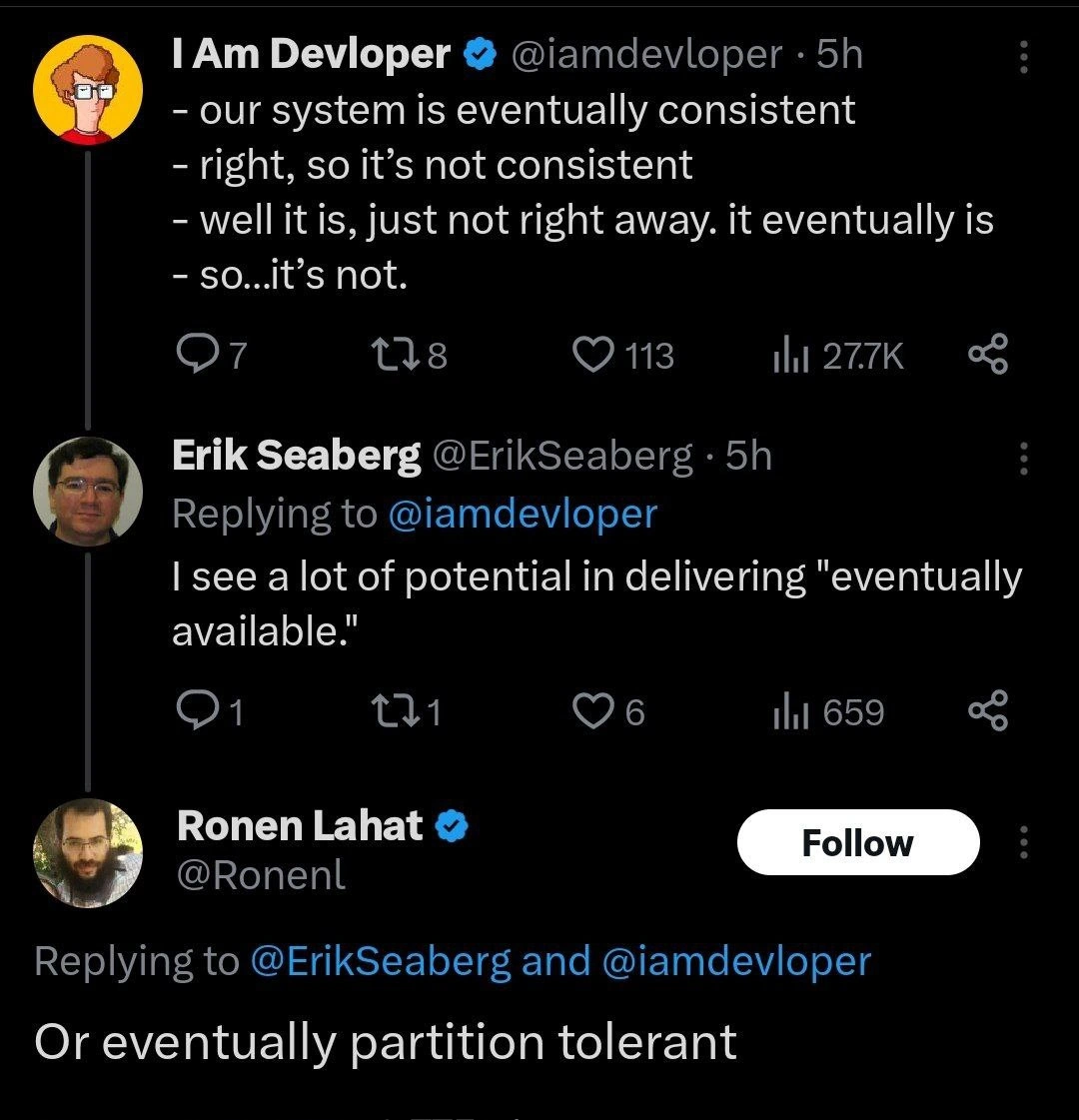
Now, the meme takes this concept and makes a joke by applying that word “eventually” to the other CAP qualities. A Twitter user jokes about making a system “eventually available.” There’s no real technical term “eventually available” – it’s made-up to be funny – but imagine what it implies: a website that might not load now, but don’t worry, it will load later! We usually expect availability to mean the system is working right now. If someone said a site is eventually available, you’d probably laugh and say, “You mean it’s down at the moment?” Exactly! It’s poking fun at how silly it would sound to be so lax about uptime. Then another user adds “eventually partition tolerant,” joking that the system can’t handle network problems when they happen, but will sort it out later. Again, not a real term – if your system isn’t handling a network split as it happens, it’s not really partition-tolerant at all. These replies are riffing on the original phrase “eventually consistent,” which is a real technical term. They’re basically saying: “Hah, why stop at weakening consistency? Let’s weaken everything!” It’s a form of tech humor where you play with definitions.
To understand why this is funny, think of it this way: Engineers often use fancy jargon like “eventually consistent” when describing system designs to sound constructive, even though it’s admitting a limitation. It’s a bit euphemistic. The person hearing it in the tweet responds in plain language: “so… it’s not consistent (right now).” That’s exactly the kind of straightforward logic a beginner might have, and it’s correct! If someone told you “I’ll eventually pay you back,” your immediate thought might be, “Okay, but you haven’t paid me now.” The tweets mirror this logic. Consistency models can be confusing, so it’s relatable to see someone cut through the buzzwords. The joke lands especially in engineering circles because everyone knows CAP’s famous limitation, and we’ve all had to explain it or justify it at some point. Even if you’re new, you can sense the tug-of-war: we want everything, but reality says nope. So we invent terms to cope, like “eventual consistency,” which effectively means “we’ll get it right, just not instantly.” The Twitter thread is just taking that to a comedic extreme by suggesting similar hand-wavy promises for the other aspects of system design.
Level 3: If Not Now, Eventually
For the seasoned engineer, this meme hits close to home by satirizing the jargon we use to sugar-coat hard truths. The Twitter thread reads like a dialogue out of a dev ops war room or a cheeky coffee-break debate among senior backend engineers. The first line – "our system is eventually consistent" – is a classic claim in distributed systems design. Seasoned folks immediately nod knowingly: eventual consistency is that gentle way of admitting, “we chose availability over immediate accuracy.” It’s a cornerstone of many large-scale systems (from NoSQL databases to cache invalidation schemes) that prioritize uptime and performance, even if it means users might see out-of-date information for a short while.
The humor escalates when the responder bluntly translates this into plain English: “right, so it’s not consistent.” This is funny because it’s brutally true in a practical sense – to anyone outside the bubble of tech lingo, “eventually consistent” does sound like a fancy way of saying “currently inconsistent.” It’s the kind of retort a skeptical QA engineer or a sharp product manager might throw at a developer in a design review: “So you’re telling me the data might be wrong at first?” The original poster (@iamdevloper, known for satirical dev tweets) then doubles down, trying to defend the term: “well it is, just not right away. it eventually is.” This is the exact rationalization engineers give when explaining the trade-off: “Relax, the system will sort itself out quickly.” But the skeptical listener isn’t buying the spin: “so… it’s not.” This punchline lands because it cuts through the technobabble — it’s the exasperated common-sense response that calls a spade a spade. Every senior dev in the room has witnessed this conversation play out in real life, where someone tries to sell a compromise as if it’s not a compromise, and someone else dryly points out the emperor has no clothes (or at least, not immediately!).
The replies in the thread then take the joke further into engineering absurdity. One user quips about “eventually available,” and another adds “eventually partition tolerant,” completing the holy trinity of CAP properties with the same cheeky qualifier. This is hilarious to industry insiders because it highlights how ridiculous it would sound if we were as lax with the other guarantees as we are with consistency. High availability is supposed to mean your system is up, serving requests continuously. Could you imagine paging an on-call engineer at 2 AM and their response is, “Don’t worry, the service will be eventually available”? 😅 It’s absurd – if your website is down now, users don’t care that it might come back later today; availability is all about the here and now. Likewise, claiming partition tolerance but only “eventually” is poking fun at tech buzzwords. Partition tolerance implies your system keeps working even if messages are dropped or delayed (say one data center loses connectivity from another). Stating it’s “eventually partition tolerant” conjures an image of a system that crashes or misbehaves during a network split, then recovers afterward and retroactively says, “All good now!” – which totally defeats the purpose. This is the kind of dry humor senior developers love: it exposes the slippery wording we sometimes use when marketing our architectures. It’s an industry in-joke about how we present trade-offs. We’ve all seen glossy tech talks or docs bragging about capabilities while hiding caveats in fine print. “Eventual X” is basically the fine print.
The meme also reflects the reality that distributed systems often force uncomfortable compromises. Those of us who’ve built or maintained large-scale systems know the pain of the CAP theorem. We’ve had that meeting where we decide, “Ok team, do we care more about consistency or availability for this feature?” It’s never an easy choice, and whichever side you pick, someone’s going to be unhappy. If you pick strong consistency, the system might lock up or reject requests during a partition (and some VP will scream about downtime). If you pick availability with eventual consistency, you’ll inevitably get a bug report about data being out-of-sync (“Why did user A see old info?!”). You can’t win – that’s the CAP curse. This tweet thread humorously embraces that no-win scenario by saying, essentially, “Fine! We’ll just promise everything… eventually.” It’s the kind of dark humor an engineer uses after a grueling incident: “Hey, at least our database is consistent… you know, eventually.”
To really visualize the joke, consider the three guarantees of CAP and how the “eventual” qualifier humorously subverts them:
| CAP Guarantee | Normal Meaning | "Eventually" Version (Joke) |
|---|---|---|
| Consistency | All nodes show the latest data at all times | Eventually consistent: data might be stale now, but will sync up later |
| Availability | Every request gets a response right away (uptime is 100%) | Eventually available: the system can be unresponsive or down now, but hey, it’ll come back later |
| Partition Tolerance | The system keeps working despite network splits | Eventually partition tolerant: the system fails or misbehaves during a network failure, but will recover after the partition is resolved |
Looking at this, it’s clear why the replies are so comical to an experienced dev: they’re essentially reducing the proud claims of a distributed system to wishful thinking. 😅 It resonates as relatable humor because we’ve all seen projects or vendor products that promise the moon, only to add caveats later. “Eventually consistent” has always sounded a bit like a dodge, and this meme extends that dodge to absurdity: “Don’t worry, our site will eventually be up, and it’s eventually resilient to failures.”
In the daily life of back-end engineers, these terms are often thrown around in architecture discussions. The meme captures that moment when someone less versed in the lingo hears “eventually consistent” and responds with plain logic, inadvertently deflating the buzzword. It underscores a common communication gap in tech teams: engineers might talk about consistency models and trade-offs, while others just hear “not working right now.” The humor works on multiple levels — it’s an inside joke about CAP theorem debates (which can get pretty heated on forums and in design meetings), and it’s also a wink at the way we sometimes use language to obscure uncomfortable truths in engineering. For veterans, it’s a chance to chuckle at our own tendency to complicate simple things. We remember the times we proudly explained our “globally eventually consistent, highly available datastore” to the team, only for someone to ask, “So… will I or will I not always get the latest data?” and having to answer, “Well… not always immediately.” Cue the eye-rolls. This Twitter thread nails that scenario in a few punchy lines. It’s the kind of thing you’d paste in the team Slack with the caption, “Literally our meeting yesterday 😂.”
Level 4: As t → ∞
At the cutting edge of distributed systems theory, the humor in this meme stems from the fundamental truths of the CAP theorem. In theoretical terms, CAP (short for Consistency, Availability, and Partition tolerance) asserts that in any networked shared-data system, you cannot guarantee all three properties simultaneously — especially during failures. This was outlined by Eric Brewer around 2000 and later formalized in a proof by Gilbert and Lynch. The scenario in the tweet is essentially probing the fine print of this impossibility: what if we water down the guarantees to “eventual” instead of immediate?
In a strictly consistent system, all nodes see the same data at the same time. Formally, this often means linearizability – any read reflects the most recent write (an invariant that’s mathematically tight). However, if a network partition occurs (imagine the cluster splitting into two isolated islands), Brewer’s theorem forces a choice: either some nodes stop responding (sacrificing availability) or they risk serving stale data (sacrificing consistency). Eventual consistency arises as a design strategy to favor availability: allow temporary divergence in data, but ensure that given enough time (as t → ∞, so to speak), all replicas converge to the same state. In theoretical form, one could say: if no new updates are made to a distributed system, eventual consistency guarantees that eventually (after some delay) every read will return the same latest value. This guarantee is weaker than strict consistency, yet it satisfies a crucial safety property: the system will settle on a single truth in the limit. It’s a bit like a mathematical function approaching a limit asymptotically — initially, different nodes might have different values, but over time their states merge to one value, achieving consistency in the end.
The tweet humorously extends this “deferred guarantee” concept to the other pillars of CAP. In theoretical terms, talking about “eventually available” or “eventually partition tolerant” is absurd. Availability in CAP is defined as every request receiving a valid (non-error) response if the responding node hasn’t crashed. You can’t really be “eventually available” in any formal sense — a service is either responding now or it’s effectively down. Similarly, partition tolerance is a binary criterion: a system is designed to withstand network partitions whenever they occur, not just after some delay. An algorithm can’t postpone handling a partition until later; if it fails during a split and only recovers afterward, it wasn’t truly partition-tolerant when it mattered. By appending “eventually” to these properties, the joke highlights a theoretical nonsense: it’s a tongue-in-cheek way of saying “we’re giving up on the strict definition, perhaps hoping no one notices.” In formal logic, it’s almost tautological — saying a system is “eventually X” means it’s not X in the interim, which from a purist standpoint indeed means it fails to meet property X when it counts. The humor lands for those deep in the theory: it’s like proposing an “$\epsilon$-relaxed” version of a guarantee and pretending nothing’s changed. Observers versed in consistency models and distributed algorithms recognize that the CAP trade-offs are inescapable – adding “eventual” just acknowledges the inevitable with a wink. After all, eventually consistent databases (think Amazon’s Dynamo or Apache Cassandra) intentionally forsake immediate consistency to remain available during partitions. The meme takes this practical compromise and jokingly suggests applying it to everything. It’s a playful nod to the academic underpinnings: you might delay consistency (a known strategy), but delaying availability or partition tolerance is purely facetious. In summary, the tweet thread’s comedy is rooted in the theoretical constraints of distributed computing – it’s poking fun at how we stretch definitions to navigate an otherwise impossible trilemma. It’s a laugh born from the elegance (and frustration) of the mathematics of distributed systems, where time becomes a pliable dimension in which guarantees shift from now to eventually.
Description
A screenshot of a Twitter thread that satirizes jargon from distributed systems architecture. The initial tweet is from the popular account 'I Am Devloper' (@iamdevloper) and presents a dialogue: '- our system is eventually consistent - right, so it's not consistent - well it is, just not right away. it eventually is - so...it's not.' This exchange highlights the common misunderstanding or skepticism surrounding the concept of eventual consistency. Following this, a reply from Erik Seaberg (@ErikSeaberg) extends the joke: 'I see a lot of potential in delivering "eventually available."' Finally, Ronen Lahat (@Ronenl) adds the punchline: 'Or eventually partition tolerant.' The humor stems from applying the 'eventually' qualifier, which is a legitimate concept for consistency, to the other two non-negotiable guarantees of the CAP theorem (Availability and Partition Tolerance), rendering them meaningless and absurd
Comments
10Comment deleted
My project plan is 'eventually complete.' It's not done, but it will be. Theoretically. Don't ask for the JIRA ticket, it's 'eventually available.'
Enterprise take on CAP: eventually consistent, occasionally available, and permanently partitioned by the org chart
After 20 years of building distributed systems, I've learned that 'eventually consistent' is just engineering speak for 'we've accepted that physics exists and given up on the illusion of simultaneity' - much like how 'eventually available' is code for 'we promise it'll work, just not when you need it for the demo.'
This thread perfectly captures the existential crisis of explaining CAP theorem to stakeholders: 'It's consistent... eventually... which means it's not... but it will be... so it is... but not now.' Meanwhile, the reply about 'eventually available' hits different when you've been on-call for a system that's 'eventually' recovering from a network partition at 3 AM. The real joke? We've all been in that first conversation, desperately trying to convince someone that 'eventual' is a feature, not a bug - right before the partition tolerance comment reminds us we're just picking which consistency guarantee we're willing to sacrifice today
If your SLA uses future tense, your consensus algorithm is Marketing, not Raft
We’re CAP-compliant: pick any two now - get the third after the cache TTL and the network partition heals
Eventual consistency: where 'consistent' means 'after your on-call shift ends and you've already escalated to the DBAs'
I'll eventually understand this post Comment deleted
Eventually sustainable Comment deleted
We're eventually dead ( Comment deleted