Generative AI Tackles a Classic Programmer Pun
Why is this AI ML meme funny?
Level 1: Robot's Mixed-Up Joke
Imagine you have a robot friend who’s just learned a new riddle but can’t quite pronounce all the words correctly. You ask it to tell you a funny joke about a programmer. The robot draws a picture of a programmer wearing a warm scarf and drinking hot cocoa, shivering at their computer. So far so good – we can tell the programmer is cold. Now the robot tries to say why the programmer is cold. The joke it wants to tell is: “Because they left their windows open!” – you know, like when you leave a window in your house open on a cold day. That’s a silly play on words because “Windows” is also the name of the computer program on the screen.
But our poor robot friend mixes up some letters when speaking. Instead of saying “because they left their windows open,” it jumbles it up. It comes out sounding like “beeecalse they left thir windoos oopen!” The funny part is, you can still understand what the robot was trying to say (so the joke isn’t lost), but it said it in such a goofy, messed-up way that you can’t help but giggle. It’s like when a little kid tells a joke and gets the words a bit wrong – the joke becomes twice as funny: once for the original punchline and once for the cute mistakes.
In this meme’s case, the “robot” is actually a computer program making a cartoon by itself. It drew everything great, but when it wrote the words, they looked all crazy. We find it funny and charming because even though this high-tech computer can create art, it slipped on a tiny banana peel of spelling. It reminds us that sometimes even smart machines can act a little silly, just like people do. The heart of the humor here is: the idea of the joke is warm and familiar, but the way it’s delivered is clumsy and cold – much like our shivering programmer who really should go and shut that window!
Level 2: AI Tries a Programmer Joke
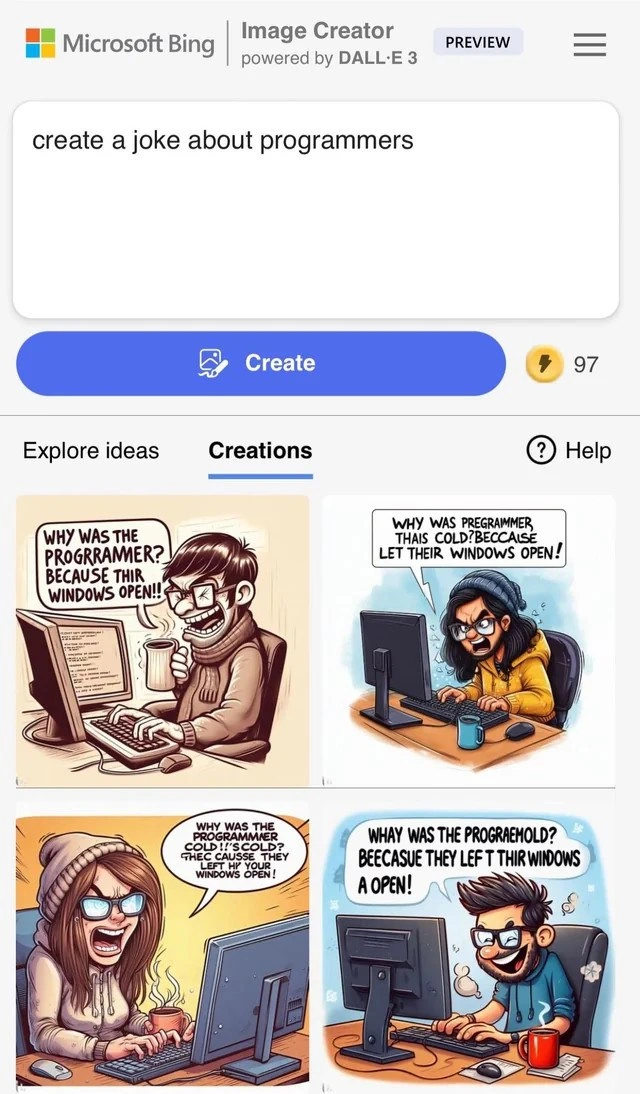
At this level, let's break down what's happening in the meme in simple terms. We have an AI-generated cartoon that’s trying to tell a programmer joke. Specifically, the person who made this meme went to Microsoft’s Bing Image Creator (an app/website where you can type in a description and an AI will draw it for you) and entered the prompt: “create a joke about programmers.” Bing’s Image Creator uses DALL-E 3, a powerful image-generating AI model, to handle that request. Think of DALL-E as a super advanced drawing program that can create pictures from text descriptions. It’s part of the new wave of AI tools that many developers are experimenting with for fun and productivity.
Now, the AI needed to decide on a joke to draw. It apparently chose a classic coding humor pun: “Why was the programmer cold? Because they left their Windows open.” This joke is a play on words. Windows (with a capital W) is the name of Microsoft’s famous operating system that many developers use on their computers. But "windows" (lowercase) are also the glass openings in a house. So the joke pretends to ask about a programmer feeling cold, and the punchline is that they left their windows open – implying both the literal window letting cold air in, and cheekily referencing that the programmer uses Windows OS. It’s a bit of a groaner, but it’s well-known in programmer circles.
The Bing Image Creator produced four cartoon images (it typically gives multiple options). In each image, we see a programmer character bundled up in warm clothing (like hoodies, scarves, maybe a beanie) sitting at their computer with a hot drink. The setting looks wintry – the developers are clearly cold, which visually sets up the joke. Each image has a speech bubble or caption attempting to deliver the punchline. Here’s where things get goofy: the text in those speech bubbles is messed up. Instead of neatly saying, “Because they left their Windows open!”, the AI’s text is scrambled with spelling mistakes. For example, one panel’s bubble reads: “BECCALSE LET THEIR WINDOWS OPEN!” – which is a jumbled attempt at “Because they left their windows open!” You can still make out the meaning, but it’s full of typos. Another panel says something like “BEECAUSE THEY LEFT THIR WINDOWS A OPEN!” – you can decipher that as “Because they left their windows open!” too, but the AI added an extra "A" and misspelled "their". All four panels are basically the same joke with variations of these strange spelling errors: extra letters, swapped letters, or missing letters.
Why did that happen? It turns out that generative AI image models (like DALL-E) are famously bad at writing text accurately. They’re trained to create images as a whole, and they don’t truly understand text the way a human or a word processor does. So when they try to paint letters, it often comes out looking correct-ish, but not quite right – almost like a child learning to write or a person drawing letters from memory and getting some backward. This meme is a prime example of that limitation. Even though DALL-E 3 is much better at understanding prompts than older versions (it actually knew to make a joke about Windows and windows!), it still struggled with spelling when it actually drew the speech bubbles. You might have heard of captchas or seen images where text is distorted – this is kind of similar, except the distortion wasn’t on purpose. The AI did it accidentally.
For a junior developer or someone new to these concepts, a few definitions might help:
- Generative AI: This is a type of artificial intelligence that can create new content. It could be text (like how ChatGPT writes sentences) or images (like DALL-E drawing pictures) or even music. Here, Bing’s tool is using generative AI to make pictures from a prompt.
- DALL-E 3: Pronounced like the artist “Dalí” (with a nod to Pixar’s WALL-E), this is the third iteration of a model by OpenAI that can draw images based on descriptions. It’s known for creating some impressively detailed art from complex prompts. The “3” means it’s a newer, improved version; earlier versions had even more trouble with things like text.
- Bing Image Creator: This is Microsoft’s user-friendly interface for DALL-E. Instead of coding or going to a research lab, you can just go to Bing, type what you want to see (in this case, a programmer joke), and it will generate images. The screenshot in the meme shows this interface, including a big blue Create button and a lightning bolt icon with “97” next to it – that icon is a credit system indicating the user has 97 generate credits left (you spend a little token each time you make images).
- AI-generated meme: A meme created by an AI rather than a human. Usually, developers make memes by picking screenshots or drawing cartoons and adding captions themselves. Here the AI did almost all of it: drawing the art and writing (well, attempting to write) the caption. It’s a fairly new thing in meme culture because only recently have image models become good enough to produce cartoon-style images on demand.
The combination of elements in this meme is funny to developers because it’s both familiar and absurd. Familiar because:
- Many of us know the “Windows open” joke.
- We also recognize the scenario of being cold at your desk because of actual open windows or excessive AC (the winter coding theme with hoodies and hot coffee is very relatable in office life or late-night coding sessions).
- And we’ve seen AI quirks before – like code autocomplete suggesting something slightly off, or Siri/voice-to-text botching a phrase.
Absurd because:
- You’d think a computer (especially one made by the company behind Windows!) would spell “Windows” or “because” correctly. It’s unexpected to see such blatant typos coming from a high-tech tool.
- The speech bubbles read almost like a meme template that hasn’t been filled in correctly. It’s as if someone copy-pasted the text and their keyboard went haywire.
This meme is also a gentle poke at the current state of AI in the developer experience. It shows that while AI can be very powerful and even creative, it can also make silly mistakes that a human probably wouldn’t. A human making a cartoon about this joke would spell it right without thinking twice. The AI, on the other hand, did all the hard work of drawing a multi-panel cartoon in seconds – something a human would take much longer to do – but stumbled on the easy part (writing a single sentence correctly!). It’s a bit like watching a supercomputer win at chess but then trip over a toy on the floor when leaving the room.
So if you’re newer to programming or AI: the key takeaway is that this meme is funny because the AI is demonstrating both competence and incompetence at the same time. It nails the idea of a programmer pun (competence) but fails at writing it out (incompetence). For developers, it feels like when you use a fancy new library that does something really complex for you, but then you find out it can’t handle a basic edge case. It’s both frustrating and comical. And as the poster hinted, this was more of an experiment – they’re not really going to let a bot flood the meme feed. It’s just a one-off fun example of what these AI tools can do (and where they still fall short) in the context of developer humor.
Level 3: No Spellcheck in Latent Space
For seasoned developers and tech enthusiasts, this meme hits on multiple levels of developer humor and insider experience. First off, it’s showcasing a well-worn programmer pun: “Why was the programmer cold? Because they left their Windows open.” This joke is an old classic in the coding community – a goofy play on words where "Windows" refers to both the Microsoft operating system and the literal windows in a room. It’s the kind of dad-joke level humor that you groan at and chuckle anyway. Seeing it here, we immediately recognize the setup and expect the punchline.
But the twist? The AI-generated meme absolutely fumbles the delivery! Each of the four cartoon panels tries to present that punchline, and each time the wording is hilariously garbled. An experienced developer, especially one who’s dabbled with the latest AI tools, will nod knowingly at this. It's so on-brand for generative AI to be 90% correct and 10% nonsense. AI humor often comes from these almost-but-not-quite outputs. We’ve seen it in AI-written code that nearly works but contains a subtle bug, or in AI-drawn images where the hands have six fingers. Here, the speech bubble text is the giveaway. The essence of the joke survived, but the syntax looks like it went through an obfuscator. For example, one panel says:
WHY WAS PROGRAMMER, THAIS COLD? BECCALSE LET THEIR WINDOWS OPEN!
It’s as if the AI had a minor stroke while typing. 😅 A senior dev might jokingly think, "Did the neural net forget to install the spell-check library?" We know there’s no String.correctSpelling() in a diffusion model’s pipeline, but it really feels like a missing feature. In classic developer fashion, we might label this a "front-end issue" — the backend (concept) is fine, but the UI text rendering failed. It’s a TechHumor gem because it demonstrates a tool built by one of the biggest tech companies (Microsoft’s Bing AI) bungling Microsoft Windows in a joke. The irony levels are off the chart: the AI is operating inside a Bing interface, making a joke about Windows (a Microsoft product), yet it can’t spell "because" or "their" correctly. Talk about an unexpected edge case in the product demo!
This also reflects current MemeCulture and developer culture: we’re in an era where even memes can be machine-made. The four-panel format with cartoon programmers in hoodies and scarves, sipping hot drinks at their PCs, is a typical developer cartoon vibe (with the added winter theme for the "cold" joke). The AI did a decent job capturing the look – the developers have exaggerated expressions (shivering, teeth chattering or grinning), the environment screams “coding session in a cold office,” and each panel has a speech bubble for the caption. A human meme-maker might do the same, just with correctly spelled text. So the humor partially comes from recognition: we see what it was supposed to be. It’s like when a junior dev writes code that almost works but has a small typo, and everyone on the team instantly spots it. Here the AI is that junior dev, and the internet meme audience is the code reviewer, collectively facepalming and laughing.
Furthermore, the fact that there are four attempts of the same joke is telling. With Bing’s Image Creator, when you hit "Create", it often gives you four variations. An experienced person might expect different angles or entirely different jokes about programmers. Instead, the AI latched onto one idea (the Windows pun) and just mutated it slightly across four images. That’s a bit like an algorithmic overfitting to the most obvious joke in the dataset. It’s amusing and also a sly commentary: the AI isn’t really creative in the human sense; it found one cliché and basically did a four-thread stack dump of it. From a DeveloperExperience_DX standpoint, anyone who’s played with these AITools knows this feeling – sometimes the AI keeps giving you more of the same, even when you hoped for variety. It’s both impressive and underwhelming: impressive that it knew a joke format at all, underwhelming that it couldn't break out of that one pattern.
We also have a meta layer: the screenshot of the Bing Image Creator interface itself, with the prompt create a joke about programmers visible. It's as if the meme is pulling back the curtain and showing the IDE where the meme was coded. In dev terms, this is like including the debug console in a production screenshot. It adds to the humor because it’s explicitly showing "Yup, I let an AI auto-generate this." The post’s author even commented (in the post message) something to the effect of: "I promise that there will not be autoposted autogenerated memes just to fill the feed... 👀". That wink and promise tell us that the community is aware of the novelty (and perhaps dubious quality) of AI-generated memes. There’s a mild concern being lampooned here: if it became too easy to auto-generate content, our meme feeds could get spammed with low-effort, robo-made jokes. This meme pre-empts that by saying, essentially, "Don’t worry, we did this one for laughs, we won’t replace all our original memes with AI spam." MemeCulture thrives on authenticity and shared struggle, and here the shared experience is, "Haha, look, even with fancy AI, making a genuinely good dev joke isn’t trivial."
Finally, seasoned devs might also appreciate the subtle winter coding theme. Many of us have literally sat in a chilly office or an over-air-conditioned server room wearing a hoodie, sipping coffee to stay warm while coding. The images capture that relatable scenario, which makes the absurd text even funnier. It’s as if the AI got the setting perfect but delivered the punchline as if it had a mouthful of byte-code. In sum, this level of the joke pokes fun at the current state of AI-generated content in our field: impressive, amusing, but still needing a human to polish the punchline. As the saying goes in coding: “Works on my machine” – here the AI’s joke works in concept, but the execution? Well, that’s why we’re laughing. After all, who among senior devs hasn’t seen a project that was technically advanced but had a silly oversight? This meme is exactly that scenario, packaged in a cartoon: bleeding-edge AI technology making a classic programming joke... and tripping on a banana peel of spelling errors.
Level 4: Latent Lexical Lapses
At the cutting edge of AI/ML, generative image models like DALL-E 3 operate in a latent space where they synthesize pictures from text prompts. Instead of understanding text as discrete letters the way a human or a word-processing AI would, these models learn visual patterns of shapes and pixels. In the training process, the model sees millions of images (some containing text) and tries to reproduce the overall vibe rather than the exact alphanumeric sequence. This often leads to AI spelling errors in generated images – the model knows something should be written, but it hasn't truly learned the strict rules of spelling.
In the meme above, the AI clearly grasped the concept of a classic programmer pun about Windows vs. windows, but its generative AI limitations show in the garbled text. The phrase "WHY WAS THE PROGRAEHOLD? BEECAUSE THEY LEFT THIR WINDOWS A OPEN!" is a direct artifact of how the AI represents language: it’s assembling letter-like shapes from its learned latent representations of images. There's no explicit spelling or grammar check in a diffusion model – no separate module that says "hey, that's not how you spell because." The result is a kind of neural network dyslexia, where the letters are jumbled or duplicated because the AI is painting an image that looks like text, rather than writing text from an alphabet.
Under the hood, Bing Image Creator (powered by DALL-E 3) likely uses a combination of a language model and an image model. The language model (a cousin to ChatGPT) interprets the prompt "create a joke about programmers" and conceives the idea: "A programmer is cold because they left their Windows open." It passes this concept to the image generator. The image generator then attempts to draw scenes of a chilly programmer with that caption. However, when it comes time to render the text in the speech bubble, the diffusion process struggles with exact letter placement. Each character is not produced by a deterministic font engine, but by iterative refinement of random noise towards an image that the model thinks matches the prompt. In that process, letters easily get mangled. The AI might have an internal representation for the word "Windows," but translating that precisely into pixel patterns of a cartoon font can introduce drift – an extra “A” here, a swapped letter there.
This phenomenon has been observed since earlier image models like DALL-E 2 and Stable Diffusion – they’d produce convincing artwork but signage or text in those images looked like gibberish. DALL-E 3 has improved alignment with language (leveraging the latest in multimodal models), but as we see, it’s still imperfect. Essentially, the model's embedding for the words of the joke guides the image content (so it draws a PC, a shivering coder, maybe even a Windows logo vibe on the screen), yet the exact phrasing in the speech bubble comes out as a corrupted clone of the intended text. It’s a bit like a lossy compression of language when moving from the textual domain to the visual domain – the meaning survives, but the exact syntax does not.
From a theoretical perspective, this highlights the challenge of binding discrete symbolic information (like written language) in a continuous generative process. Research into Neural Codec Avatars or models that explicitly incorporate text rendering is ongoing, but until then, asking an image AI to spell is like asking a painter to also hand-letter a sign perfectly while blindfolded. The system was optimizing for the image’s overall joke concept, not the orthography. So we end up with these latent lexical lapses – the AI humor here is that the machine got the joke, but couldn’t execute the punchline text without scrambling it. It’s a fascinating reminder that even the most advanced generative models still operate on learned statistical correlations, not a true understanding of writing as we know it. As a result, the meme’s text looks like a CAPTCHA – ironically requiring a human brain to decode the AI-generated content.
Description
This image is a screenshot of the Microsoft Bing Image Creator, which is powered by DALL-E 3. A user has entered the prompt 'create a joke about programmers'. The AI has generated four cartoon-style images, each depicting a programmer at a computer with a speech bubble. Every image attempts to tell the same classic joke: 'Why was the programmer cold? Because they left their windows open!' However, the AI's text generation within the images is hilariously flawed. The text is garbled, with misspellings and nonsensical words like 'PROGRRAMMER', 'THAIS COLD?', and 'PROGRAEHOLD?'. The core joke, a pun on Microsoft Windows, is lost in the AI's struggle to render coherent text. The humor comes from observing a sophisticated AI model fail at a simple task, a relatable experience for anyone who has worked with the limitations and 'bugs' of cutting-edge technology. The original post caption adds a meta-layer: 'I promise that there will not be autoposted autogenerated memes jsut fill feed with something 👀'
Comments
31Comment deleted
This is the AI equivalent of a junior dev trying to resolve a merge conflict by copying and pasting both versions. The intent is recognizable, but the output is a mess that technically compiles
Only an LLM would treat a dad joke like a Kubernetes deployment: replicate it to four pods, ignore the spelling errors, and call it production-ready
The real joke here is that an AI trained on the entire internet still generates the same Windows pun your non-technical uncle posted on Facebook in 2012 - proving that even with billions of parameters, DALL-E 3 has perfectly captured the essence of corporate-approved 'safe' humor that makes senior engineers die a little inside during mandatory fun team-building events
When you ask DALL-E to generate programmer humor and it produces the same Windows pun four times with different art styles, you've discovered the AI equivalent of a junior dev copy-pasting Stack Overflow answers without understanding the underlying problem. At least the AI is consistent - unlike our microservices after the last 'minor' config change
Asked an AI for a programmer joke; got four replicas of the same “Windows open” pun with spelling drift - high availability, eventual consistency, originality not in the SLO
GenAI did beam search for “programmer joke,” hit mode collapse on ‘Windows open,’ and then applied lossy compression to the spelling - humor-as-a-service with CRC errors
Resource leak via open Windows? That's SIGKILL from HR - faster than any OOM killer
POV Comment deleted
Emacs user, no doubt Comment deleted
1.2x Progrmmer Comment deleted
Image generation AIs appear to treat letters purely as visual elements, disregarding their inherent meaning. Comment deleted
Yes, because they're not trained to produce words Comment deleted
project lead when customer tries to talk to devs Comment deleted
Real Comment deleted
mold Comment deleted
There are too many jokes about open windows. AI was overfitted on them. Comment deleted
Why was cold open? Comment deleted
why programmers are so cold because their windows are open Comment deleted
I didn't get the joke (I use arch btw) Comment deleted
You must use Windows and let it open to understand the joke Comment deleted
Same Dalle3, but ChatGPT. Comment deleted
have some deep sht Comment deleted
Everyone asks "Why was the progrrarmer?" But no one asks "How was the progrrarmer?" Comment deleted
AI is not very good at jokes... Comment deleted
Cringe… Comment deleted
Qwinge Comment deleted
Why programmers don't work on submarines? Because they always want to open windows. Comment deleted
ah fuck Comment deleted
this thing is actually a deleted account Comment deleted
It wasn't It was signed as DevMeme Comment deleted
Humor often based on social rank fluctuations - we craft an absurd scenario where someone appears vulnerable, foolish, or taken advantage of. This gives us joy as we perceive ourselves superior to them, but the situation's absurdity resets the rank, triggering the cycle repeatedly. Humor is a bug. AIs can make only safe jokes due to developer constraints, so it feels "wrong". Comment deleted