Skip to content
DevMeme
5545 of 7435
Explaining Data Structures with Pokémon Analogies
CS Fundamentals Post #6087, on Jun 29, 2024 in TG

Explaining Data Structures with Pokémon Analogies

Why is this CS Fundamentals meme funny?

Level 1: Gotta Catch ’Em All!

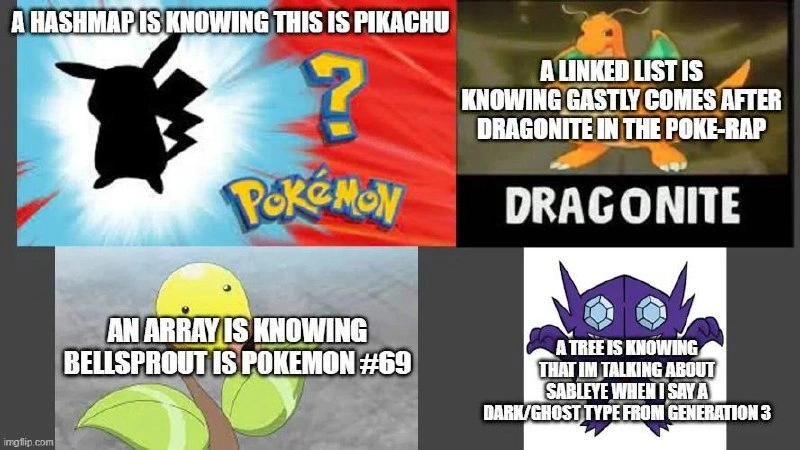
Imagine you have a bunch of Pokémon (or any set of items) and you want to find one of them. This meme shows four playful ways to do it, each like a different strategy. First, it’s like recognizing a friend just by seeing their shadow – you don’t need any other info, you just know it’s them right away (that’s the quick magic of a direct lookup, like saying “Oh, that shadow? That’s Pikachu!”). Second, it’s like singing the Pokémon theme song or alphabet song to figure out what comes next – you go through the sequence step by step (“…W, X, Y, Z” or “Dragonite, Gastly!”) until you reach the one you want. Third, it’s like having everyone lined up with numbers and knowing that number 69 in line is your friend Bellsprout – if you have the number, you can skip straight to them without searching. And fourth, it’s like a guessing game where you use clues to narrow it down: “I’m thinking of a Pokémon from the third game generation, and it’s Dark/Ghost type” – with those hints, you zoom in until you realize it can only be Sableye, just like figuring out someone’s identity by asking a few specific questions.

It’s funny and charming because it turns a complicated idea (different ways to organize and find data) into a simple, familiar scenario with Pokémon. It feels like a teacher using your favorite game to explain something that could have been boring. Essentially, it says there’s no single way to “catch” information – sometimes you jump right to it, sometimes you go in order, sometimes you pick a number, sometimes you follow clues. By shouting out things like “It’s Pikachu!” or remembering a PokéRap lyric, we’re actually learning about computing concepts without even realizing it. That mix of childhood nostalgia with a smart lesson makes us smile. It’s the joy of realizing that all those hours memorizing Pokémon aren’t wasted – they can help explain real-world tech ideas. Gotta catch ’em all, indeed – not just Pokémon, but knowledge too!

Level 2: Data Structures, I Choose You!

Let’s break down the joke in a straightforward way. The meme is using four different Pokémon scenarios to explain four fundamental data structures. If you’re new to these terms (or not a Pokémon aficionado), here’s what each panel really means:

  • Hash Map: This is a data structure that stores key–value pairs for very fast lookup. Think of it like a dictionary: you provide a unique key (word) and get back a value (definition) almost instantly. In the meme’s first panel, the key is the Pokémon’s silhouette (essentially a unique identifier for Pikachu) and the value is the name “Pikachu.” Knowing the silhouette corresponds to Pikachu is like having a direct dictionary lookup in your brain. In practice, a hash map (in Python it’s a dict, in Java a HashMap) lets you do things in O(1) average time – meaning it doesn’t matter if there are 3 Pokémon or 800; if you have the key, you jump right to the answer. The caption “A hash map is knowing this is Pikachu” riffs on the classic “Who’s that Pokémon?” TV segment, where they’d show a black silhouette with a question mark. If you shouted “It’s Pikachu!” without needing any other hints, you effectively did a constant-time lookup from silhouette to name. No need to scroll through a list of all Pokémon silhouettes – you just know it. That’s what a hash map does in code with keys and values.

  • Linked List: This is a data structure where each element (node) holds a value and a pointer/reference to the next element in the sequence. It’s like a chain – you only know how to get to the next link from the current one. To find something in a linked list, you typically start at the beginning and move step-by-step through the links until you find what you want. The meme’s second panel says, “A linked list is knowing Gastly comes after Dragonite in the PokéRap.” The PokéRap was a song listing Pokémon in a fixed order, one after another (kind of like nodes in a list). If you want to know who comes after Dragonite, you can’t instantly jump to that Pokémon; you have to recall the song’s sequence (or iterate through the list) until you reach “Dragonite, Gastly!”. This is exactly how traversing a linked list feels. With a linked list, there’s no random index access – you go node by node. So if Dragonite is a node, you look at its next pointer to get Gastly. It’s a sequential access, often O(n) in complexity for finding an arbitrary element (n is the length of the list). In simpler terms: imagine reading names off a linked chain of flashcards – to get to card number 5, you have to flip through 1, 2, 3, 4 first. The meme perfectly captures that: the PokéRap’s order is a linked chain, and you only know Gastly follows Dragonite because you remember the chain in order. It’s a fun way to illustrate what a linked list traversal is like using Pokémon nostalgia.

  • Array: An array is a basic list of elements, indexed by position. It’s like a numbered lineup – if you want the 5th item, you just go directly to position 5. The third panel says, “An array is knowing Bellsprout is Pokémon #69.” In the world of Pokémon, each creature has an official index number in the Pokédex (the encyclopedia of Pokémon). Bellsprout being Pokémon number 69 means if you have all the Pokémon in an array (say an array where index 1 = Bulbasaur, 2 = Ivysaur, ..., 69 = Bellsprout), you can directly access Bellsprout by its index. In an array, this is an O(1) operation as well – you simply calculate the memory address of that index and fetch it. The meme is conveying that if you know the exact index of an item (like knowing a Pokémon’s number), retrieving it from an array is immediate. There’s no searching or traversing needed as long as you have the index. It’s akin to knowing the page number of a chapter in a book – you flip straight to that page instead of reading every page to find it. Arrays are great for direct indexing; the trade-off is you need to know the index (or maintain ordered data). The humor in the meme comes from the very specific trivia: only a devoted fan knows #69 is Bellsprout, which makes it a geeky example. But technically, it’s spot-on: the Pokédex list is like an array of length 151 (in Gen 1), and Bellsprout’s position is 69. If you treat that number as an array index, you get your Pokémon in one step.

  • Tree: A tree is a hierarchical data structure where each node can branch out into multiple child nodes, forming a treelike shape. It’s used to organize data by hierarchy or categories. For example, a family tree, a company org chart, or a directory structure on your computer are all trees. To find something in a tree, you often make a series of decisions or follow a path down the branches. The fourth panel’s caption, “A tree is knowing that I’m talking about Sableye when I say a Dark/Ghost type from Generation 3,” is describing exactly that kind of search by classification. Let’s break it down: Generation 3 is a category (one branch splits into Gen 1, Gen 2, Gen 3, etc., since Pokémon are grouped by generation). Dark/Ghost type is another category (a branch of Pokémon types, like under Gen 3 you’d have branches for different type combinations). If you follow the Gen 3 branch, then within that go to the Dark/Ghost branch, you end up at a particular Pokémon: Sableye. In other words, you’re traversing a conceptual tree: first filter by generation, then by type. In a data structure sense, you could imagine something like pokemon_tree["Gen3"]["Dark/Ghost"] = "Sableye". By providing those two keys (like a path), you reached the node “Sableye.” This is analogous to how you might traverse a binary search tree or any decision tree: multiple steps to zero in on the answer. It might not be as instantaneous as a hash map or array lookup, but it’s very logical and organized. And for certain kinds of queries (like “find any Pokémon that is Dark/Ghost in Gen 3”), a tree or hierarchical index is very useful. The meme expects you to know that Sableye is the only Dark/Ghost Pokémon in Gen 3 (a true bit of Pokémon trivia!). If you did know that, you essentially performed a tree search mentally. For someone learning, the key point is: a tree organizes data by categories or decisions, and you find an item by following the branches that match the description. The meme makes this concept memorable by using a classification of a Pokémon instead of a dry example like, say, a taxonomy of animals or a file path.

Context recap: In case some references flew over your head – “Who’s that Pokémon?” was a segment in the old Pokémon TV show where kids guess the Pokémon from its silhouette (usually revealed after the commercial break). The PokéRap was an end-of-episode song that rapidly listed all the Pokémon names in a fixed sequence — a very nostalgic bit of 90s gaming culture. Generation 3 refers to the third wave of Pokémon games (Ruby/Sapphire era), which introduced new Pokémon like Sableye; calling something “Dark/Ghost type” means the Pokémon’s elemental types (kind of like categories or classes in a taxonomy). So each panel is taking a piece of Pokémon knowledge and saying “if you know this, it’s similar to using this data structure.” It’s a fun way to learn data_structure_analogies because it ties a coding concept to something concrete and familiar.

By mapping hashmap vs array vs linked list vs tree to Pokémon scenarios, the meme turns abstract ideas into relatable images. Even if you’re a junior dev or a student, you can use these analogies to remember how each data structure works:

  • A hash map is like a magic Pokédex: give it a clue (key) and it instantly tells you the monster (value).
  • A linked list is like a Poké song: you go in order, one by one, no skipping.
  • An array is like the official Pokémon list: each one has a number, and you can jump right to that slot.
  • A tree is like a classification chart: filter by traits (gen, type) and pinpoint the item.

It’s no wonder the original poster quipped that this meme is good enough for edu-materials. It genuinely can help make these concepts stick in your mind. After all, learning is easier when it feels like a game you already know. Who knew Gastly’s spot in a rap or Bellsprout’s Pokédex ID could teach us about algorithms and data storage? This is the kind of cross-domain, lightbulb moment humor that both teaches and entertains. So if you find yourself chuckling and also thinking “hey, I actually get this better now,” that’s the meme doing its job!

Level 3: Who's That Data Structure?

This meme brilliantly mashes up computer science fundamentals with Pokémon nostalgia to create pure developer humor. It’s leveraging our knowledge of data structures and beloved game trivia at the same time. Each panel equates a way of identifying a Pokémon to a different data structure’s method of data lookup or traversal. The result is a piece of clever ComputerScienceHumor that makes seasoned devs smirk in recognition. Why? Because under the hood, it’s contrasting how a hash map, a linked list, an array, and a tree each let you find things in very different ways – and it does so using examples from a game we geeks grew up with. It’s the ultimate algorithm humor meetup of Big-O and Pikachu.

Let’s unpack the four panels from a senior engineer’s perspective:

  • Hash map (direct key lookup) – The top-left panel shows the iconic “Who’s that Pokémon?” silhouette (a blacked-out Pikachu with a ?). The caption says, “A hash map is knowing this is Pikachu.” In technical terms, a hash map (or hash table/dictionary) gives near-instant lookup when you have the exact key. Here the key is Pikachu’s distinctive shape. If you’ve hashed that silhouette in your brain, you retrieve the value “Pikachu” in O(1) time. It’s a direct mapping: silhouette -> name. The humor is that any 90s kid instantly knew that shadow was Pikachu (the TV show made it too obvious), just like a program using a hash map instantly finds a value by key. For a senior dev, this analogy clicks: our brain is performing constant-time retrieval from a precomputed map of shapes to Pokémon names. No need to iterate through all Pokémon; one look and boom – it’s Pikachu, just as a hash table yields a result without scanning through all entries. It’s a nostalgic twist on how efficient key-based lookups can be.

  • Linked list (sequential traversal) – The top-right panel features Dragonite with the text, “A linked list is knowing Gastly comes after Dragonite in the PokéRap.” The PokéRap was a famously cheesy song that listed all original 151 Pokémon in a specific order. If you ask “which Pokémon comes after Dragonite in that song?”, you’re forced to recall the sequence or step through it until you find Dragonite, then see Gastly next. This is exactly how a linked list works: each element knows who comes next, but to find a particular node or the successor of a given node, you may have to traverse node by node in order. There’s no constant-time index jumping here – it’s an O(n) walk through the chain unless you’re already at the right spot. The meme humorously equates knowing the next Pokémon in a memorized sequence to following a next pointer in a linked list. Seasoned devs grin because we’ve all dealt with the joys and pains of linked list traversal. If you wanted to find Gastly in a list of Pokémon names, you’d start at the head and go one by one… just like singing the PokéRap verse until Gastly comes after Dragonite. It’s a perfect analogy for sequential access. (And bonus points for the deep-cut PokéRap reference – that’s some serious geek cred, remembering that “Dragonite, Gastly…” sequence from the song!)

  • Array (index lookup) – The bottom-left panel shows Bellsprout with the caption, “An array is knowing Bellsprout is Pokémon #69.” This highlights how an array allows direct lookup by an index (position). In an array or list, if you know the index (say 69th position), you can immediately fetch the item at that slot in O(1) time. The Pokédex in the games is essentially a 1-indexed array of Pokémon: e.g., Bulbasaur is #1, Ivysaur #2, ... and Bellsprout #69. So if you’ve memorized that Bellsprout is the 69th Pokémon, you can go straight to it without reciting any names in between. That’s array access in a nutshell – constant time access provided you know the index. The humor here is twofold: first, only a true fan or trivia buff recalls such a specific index (why #69 of all numbers? Perhaps because it’s a famously snicker-worthy number – a sly little GeekHumor bonus layered in). Second, it contrasts with the linked list example: with an array (like an ordered Pokédex list), you don’t need to traverse through Dragonite to get to Gastly; you just jump to position 69 to grab Bellsprout. Any senior dev remembers learning that arrays give you direct access by index, and this panel exemplifies it in a memorable way. It’s the random-access superpower of arrays, illustrated via Pokédex indexing.

  • Tree (hierarchical lookup) – The bottom-right panel shows a sprite of Sableye and says, “A tree is knowing that I’m talking about Sableye when I say a Dark/Ghost type from Generation 3.” This one is a bit more cerebral and oh-so-satisfying for the Pokémon-savvy. In data structures, a tree organizes information in a hierarchy of nodes and sub-nodes (think of a family tree or file directory). To find a specific item, you traverse down branches based on categories or decisions. Here, the categories are Pokémon attributes: Generation 3 (the third generation of Pokémon games) and Dark/Ghost type. If you treat “Generation -> Type -> Pokémon” as a tree of classifications, narrowing down to Generation 3 then the Dark/Ghost branch yields a unique leaf node: Sableye. In Gen 3, Sableye is (notably) the only Pokémon with the dual typing Dark/Ghost, so that description acts like a path down a tree to a single result. This panel’s joke is essentially about a hierarchical query. Instead of a single key or index, you’re using a combination of traits (like a compound query) — first filter by generation, then by type — much as a tree data structure would let you drill down. Senior devs appreciate this because it’s analogous to how we structure complex data: e.g., an object tree or a database query with multiple WHERE clauses. It demonstrates a more conceptual data lookup. And it’s funny because it reads like a nerdy trivia question: “Which Pokémon fits these criteria?” — a true fan’s brain will do a tree search through their mental Pokédex and pop out “Sableye!” If you got that reference, congrats, you just executed a tree traversal in your head.

Overall, the meme tickles developers because it takes dry academic concepts and makes them instantly vivid. It’s a data_structure_analogies masterclass. Each panel distills the essence of a data structure’s lookup method using Pokémon knowledge as the dataset. The juxtaposition is hilarious and satisfying: you’re reading about hash maps and linked lists in the same breath as Pikachu and the PokéRap. For many of us, that’s a delightful collision of worlds. We remember grinding through algorithms in class, and we also remember collecting Pokémon cards or memorizing useless Pokéfacts as kids. Seeing them come together is both educational and absurdly fun.

This kind of joke is relatable humor for anyone who’s straddled those two worlds — the developer who can discuss pointer arithmetic one minute and Pokémon evolutions the next. It highlights why choosing the right data structure is like having the right Pokémon for the job: the approach to “find the thing” can be wildly different based on how you stored your data. In short, the meme speaks to our inner Poké-nerd and CS nerd simultaneously. A senior dev will nod knowingly at the CS_Fundamentals on display (yes, we must know our hashmaps vs arrays), while grinning at the Games reference that makes the lesson unforgettable. It’s the kind of geeky crossover that makes you think, “If only textbooks were this much fun!” The next time you use a hash map or traverse a tree, you might just picture Pikachu or Sableye and smile.

Description

A four-panel comic meme that uses Pokémon trivia to explain fundamental computer science data structures. The top-left panel shows a black silhouette of Pikachu from the 'Who's That Pokémon?' TV show segment with the text 'A HASHMAP IS KNOWING THIS IS PIKACHU'. The top-right panel features the Pokémon Dragonite with the text 'A LINKED LIST IS KNOWING GASTLY COMES AFTER DRAGONITE IN THE POKE-RAP'. The bottom-left panel displays the Pokémon Bellsprout with the text 'AN ARRAY IS KNOWING BELLSPROUT IS POKEMON #69'. The bottom-right panel shows the Pokémon Sableye with the text 'A TREE IS KNOWING THAT IM TALKING ABOUT SABLEYE WHEN I SAY A DARK/GHOST TYPE FROM GENERATION 3'. The meme effectively creates analogies for complex topics: a hash map for direct key-to-value lookup, a linked list for sequential access, an array for indexed access, and a tree for searching by attributes. This makes abstract concepts highly relatable and understandable for developers who grew up with Pokémon

Comments

23
Anonymous ★ Top Pick The real test of a senior engineer is knowing the Big O notation for finding a specific Pokémon in the Poké-Rap. It's O(n), and the n stands for 'nostalgia'
  1. Anonymous ★ Top Pick

    The real test of a senior engineer is knowing the Big O notation for finding a specific Pokémon in the Poké-Rap. It's O(n), and the n stands for 'nostalgia'

  2. Anonymous

    Whenever someone proposes sharding a 151-entry lookup table, remind them the entire Kanto region still fits in a hash map

  3. Anonymous

    The real tree traversal is realizing that knowing Sableye's type combination is actually easier than debugging a red-black tree rebalancing operation in production at 3 AM

  4. Anonymous

    This meme perfectly captures how we explain data structures to juniors: 'A HashMap is O(1) lookup... like knowing Pikachu without checking the Pokédex.' But the real senior engineer move? Recognizing this is actually teaching Big-O complexity through nostalgia - because nothing says 'I understand algorithmic efficiency' quite like debating whether the Poké-Rap qualifies as a doubly-linked list or just a really inefficient array traversal with extra steps and catchy music

  5. Anonymous

    HashMap for O(1) Pikachu, but good luck with LinkedList rollbacks reciting the Poké-rap during 3AM outages

  6. Anonymous

    The Pokédex is a key/value store until PM asks for “next in the Pokérap” - now you’re maintaining a linked list, a type tree, and an index; congrats, you accidentally built a graph and called it MVP

  7. Anonymous

    Polyglot persistence in disguise: map for identity, list for adjacency, array for index, tree for classification - force all four into one model and you’ll get O(n) meetings and exponential tech debt

  8. @Sp1cyP3pp3r 2y

    i love trees

  9. @itimonin 2y

    Oriented negative weighted graph wants to know your location

    1. @azizhakberdiev 2y

      Oriented negative weighted graph knows your location

  10. @ZgGPuo8dZef58K6hxxGVj3Z2 2y

    I have no idea how any of those look like in memory but I will pretend I know

  11. @grinchfox 2y

    for me it's just harder to understand because of pokemons

  12. @grinchfox 2y

    also syntactically reversed queries are messy

  13. @AmindaEU 2y

    💀

  14. @ZgGPuo8dZef58K6hxxGVj3Z2 2y

    Damn why is the "can't find logout button" more relatable than I would like to admit?

    1. @ZgGPuo8dZef58K6hxxGVj3Z2 2y

      For context my only social media is literally telegram and YouTube if you count that

    2. @sylfn 2y

      "Clear site data"

      1. @AmindaEU 2y

        Close tab, temporary containers will soon erase it

      2. @ZgGPuo8dZef58K6hxxGVj3Z2 2y

        💀💀💀

      3. @ZgGPuo8dZef58K6hxxGVj3Z2 2y

        *skips server side invalidation* any% logout leaderboard joined any% getting hacked leaderboard joined

  15. @AmindaEU 2y

    https://t.me/soatok/70144 is my baseline view which makes this more horrible

  16. @dsmagikswsa 2y

    Can we say everything is tree in the end?

  17. @callofvoid0 2y

    i don't know any of these; I'm a void.

Use J and K for navigation