Skip to content
DevMeme
2140 of 7435
The Over-Engineered Linked List: A Unary Tree
CS Fundamentals Post #2390, on Nov 29, 2020 in TG

The Over-Engineered Linked List: A Unary Tree

Why is this CS Fundamentals meme funny?

Level 1: Fancy Words for Simple Things

Imagine you have a plain cookie. It’s yummy, it’s simple – it’s just a cookie. Now, say you want to sound really fancy when you talk about this cookie. Instead of calling it a cookie, you describe it as “a handcrafted gourmet chocolate-chip delight.” 😇 Suddenly, it sounds like something super special from a luxury bakery, right? But here’s the thing: it’s still just a cookie. Nothing changed except the big fancy words used to name it. That’s exactly the joke this meme is making, but with programming stuff.

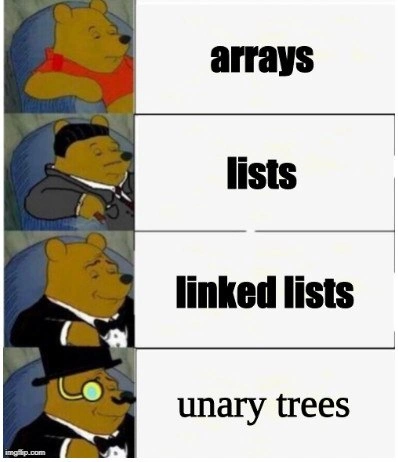
In the meme, there’s a cartoon bear (Winnie the Pooh) who starts off normal, just like our plain cookie. The word next to him says “arrays,” which is a basic term in coding (nothing flashy). But as we go down the panels, Pooh Bear gets dressed up in a tuxedo, then in an even fancier tux, and finally he’s wearing a top hat and monocle like some kind of royal gentleman. Along with this, the words next to him change from the simple “arrays” to the much fancier-sounding “unary trees.” By the last panel, Pooh is super dressed up and the name is super dressed up too! It’s as if someone took a very simple idea and just put a tuxedo on it, language-wise.

Why is this funny? Because we all recognize that using fancy titles or big words doesn’t actually change what the thing is. It’s like if your friend took a pencil and insisted on calling it “a graphite-based writing apparatus” — technically that describes a pencil, but come on, it’s overkill and kind of silly! In the same way, an “array” and a “unary tree” in this meme are basically the same kind of thing (a bunch of items in a sequence), but “unary tree” is just a needlessly grand way to say it. The bear getting fancier and fancier helps us visually imagine someone puffing up their chest and speaking in a posh accent about something very simple. Even if you don’t know what arrays or linked lists are, you can giggle at the idea that a down-to-earth thing got a royal makeover in name. The core feeling is: calling something ordinary by an outrageously fancy name is playful and absurd, and that contrast is what makes it so amusing. In everyday terms, it’s a reminder not to take ourselves too seriously — a simple list of things is still a simple list, no matter how much you dress it up in big words or monocles and top hats.

Level 2: A List by Any Other Name

Let’s break down what’s happening here in simpler terms. The meme uses the popular Winnie-the-Pooh format where Pooh Bear’s appearance becomes more refined in each panel while the caption text gets more elaborate. In the first panel, we have plain Pooh casually sitting back with the label “arrays” in bold text. Next, Pooh dons a tuxedo and bow tie for “lists”. By the third panel, Pooh looks even more polished (white tie attire) under the label “linked lists.” Finally, in the fourth panel, Pooh is ultra-fancy — complete with a monocle and top hat — next to the ultra-fancy term “unary trees.” The font of “unary trees” even switches to an elegant serif style, like a classy old book, to emphasize how posh and elevated it sounds. This visual progression reinforces the joke: each term refers to a kind of data structure, but the names (and Pooh’s outfits) are getting unnecessarily extravagant.

Now, what do these terms actually mean? An array is one of the most basic data structures. You can think of an array as a simple row of slots in memory, where each slot holds an element (like numbers or words) and you can instantly get an element if you know its index (position). Arrays are usually of fixed size and are straightforward – like a line of cubbyholes numbered 0, 1, 2, 3, … where you store things. It’s a term every beginner encounters in programming.

A list, in programming, generally means an ordered collection of elements as well, but it’s often a bit more flexible than a plain array. For example, Python’s list or Java’s ArrayList can grow or shrink in size. In some contexts, “list” is just a more abstract way to refer to a sequence of items, not specifying how it’s stored. The meme treats “lists” as the next fanciest thing after arrays — perhaps implying a slight upgrade in abstract thinking. (In reality, depending on the language, a “list” might internally be an array or something similar, but conceptually it’s a step up in abstraction: you just care about the sequence of items, not the underlying memory.)

Moving on to linked lists: this is a specific type of list where each item (called a node) holds not only the data but also a reference (or pointer) to the next item in the sequence. Visually, it’s like a chain — you go from one node to the next and so on. Unlike arrays, linked lists aren’t in one contiguous block of memory; each node is separate, and the “link” is the connection between nodes. You might recall linked lists from a CS class or coding tutorials because implementing a linked list (with nodes and pointers) is a classic exercise. They allow efficient inserting or removing of elements in the middle (just rearrange some pointers), but accessing an item by index is slower because you have to follow the chain from the start to that position. So, linked_lists are a level more “advanced” in data structure terms compared to plain arrays or dynamic lists, and the meme signifies that by giving Pooh an even snazzier outfit for this term.

Finally, unary trees: this is where the meme goes into comically highbrow territory. In computer science, a tree is a hierarchical data structure — think of a family tree or an organization chart, where each node can branch out into multiple children nodes. A binary tree, for instance, is a tree where each node has at most two children (left and right). So what’s a unary tree? By definition, it would be a tree where each node has at most one child. If you picture that, it doesn’t branch out widely at all — it just sort of degenerates into a straight line. In fact, a unary tree essentially is a linked list in terms of shape: each node goes to one next node, down and down, with no branching. We normally wouldn’t bother using the term “unary tree” in day-to-day programming because it’s an overly formal way to describe such a simple structure. But here the meme rebrands the linked list as an aristocratic-sounding tree to exaggerate how pretentious it feels. It’s as if someone took a basic concept and gave it a lofty spin just for the sake of formality. If you’re a newer developer, you might not have heard the phrase “unary tree” before, and that’s exactly why it’s funny — it makes you stop and realize, “Oh! They’re just talking about a single-branch tree… which is basically a list… why say it like that?”

So, in this meme, each term from arrays up to unary trees is referring to a sequence of elements, but with different structures or contexts:

  • Array: a plain, indexed sequence of elements in order.
  • List: a general sequence (possibly dynamic in size, depending on the language – a bit more abstract).
  • Linked list: a sequence of nodes where each points to the next (a specific implementation of a list using pointers).
  • “Unary tree:” a tongue-in-cheek way to describe a structure that only ever has one child per node – effectively the theoretical CS description of a singly linked list as a degenerate tree.

The humor is that each term is arguably describing nearly the same thing (a bunch of items in a row) but with increasing grandiosity. By the time we say “unary trees,” we’ve reached peak over-engineering in naming. The winnie_the_pooh_format drives this home visually: Pooh’s transformation from casual to classy mirrors the terms going from plain to pompous. If you’re new to these concepts, the meme is basically laughing at how computer scientists or developers sometimes invent fancier names for simple ideas — or point out connections between concepts that are technically true but overcomplicating the obvious. It’s a playful jab at how we sometimes love to categorize and rename things in ComputerScienceHumor fashion. After seeing this, a junior programmer might chuckle and think, “Okay, I get it… a unary tree is just a dressed-up way to say linked list. Got it!” and also appreciate that in coding, using clear and simple names is usually better than unnecessary complexity.

Level 3: Single-Child Sophistication

At first glance, this meme is poking fun at how developers sometimes give incredibly grand names to very simple things. In the four-panel Winnie-the-Pooh image, each panel represents essentially the same linear data structure described with increasing pretension, and Pooh’s demeanor becomes more aristocratic with each step. By the bottom panel, Pooh is wearing a monocle and top hat, and the humble linked list has been rebranded as a “unary tree” in an elegant serif font. This dramatic escalation satirizes computer science pedantry. Seasoned engineers recognize the joke: a singly linked list can indeed be viewed as a degenerate tree (each node has at most one child, hence unary), but calling it a “tree” is ridiculously grandiose for such a simple structure. It’s a classic case of naming inflation in tech culture, where someone needlessly elevates terminology to sound more sophisticated. The meme format itself (Pooh getting progressively fancier) underscores the tongue-in-cheek notion that we’re dressing up a basic concept in royal trappings for no real reason, much to the amusement (and slight eye-rolling) of experienced developers.

From a senior developer’s perspective, the humor lands because it’s technically not wrong — just hilariously over the top. In real software discussions, you’d rarely hear a colleague insist that “Actually, a linked list is just an instance of a unary tree” unless they’re being facetious or pedantic. We all know an array is a straightforward contiguous block of elements in memory (simple and unpretentious). A list (in many languages) is a more flexible, dynamic array or an abstract sequence of items. A linked list is the classic chain of nodes, each pointing to the next — a staple of any CS fundamentals course. Now, elevate that one notch further into formality: a unary tree is essentially the computer science textbook way of saying “a tree where each node has one child at most,” which, yes, is structurally a chain. Describing a plain linked list in such lofty terms is like using academic jargon for a trivial case, and that absurdity is exactly the joke. The meme’s punchline is that a linear list doesn’t magically become more powerful or complex just because we’ve slapped a fancy name on it; it’s still the same sequence of nodes, no matter how puffed-up the nomenclature.

Seasoned engineers find this comedic because it rings true with industry experience. We’ve all encountered moments where someone describes a simple solution with needlessly complex language — maybe to impress management or to sound uber-architectural. This Pooh meme exaggerates that habit. The progression from “arrays” to “lists” to “linked lists” and finally to “unary trees” feels like a tongue-in-cheek evolution of terminology that might appear in a overly formal design document or a cheeky interview answer. It’s computer science humor highlighting how academics or overzealous developers can reframing basic DataStructures in pompous ways. In fact, there’s a well-known saying in programming circles:

“There are only two hard things in Computer Science: cache invalidation and naming things.”

This meme zeroes in on that second point. By over-naming a simple construct, it humorously illustrates how absurd our terminology can become. A CS_Fundamentals geek might chuckle because they remember learning about lists and trees and can see how a “unary tree” is technically a correct term — it’s just one nobody uses in everyday coding because it’s unnecessarily pedantic. In summary, the meme resonates with experienced developers as a lighthearted jab at our own tendency to occasionally make things sound more complicated or aristocratic than they truly are. After all, putting a top hat on a linked list doesn’t change its nature — it only makes the rest of us smirk and say, “Alright, your majesty, it’s still just a list.”

Description

This meme uses the four-panel 'Tuxedo Winnie the Pooh' format to show increasing levels of sophistication. Each panel features Winnie the Pooh in progressively fancier attire next to a term for a linear data structure. The first panel shows regular Pooh next to 'arrays'. The second shows a slightly more dapper Pooh next to 'lists'. The third features Pooh in a full tuxedo beside 'linked lists'. The final, most sophisticated panel shows Pooh with a top hat and monocle, alongside the term 'unary trees'. The joke lies in the final panel: a unary tree (a tree where each node has at most one child) is structurally identical to a linked list. This meme humorously critiques the tendency in software development to use overly complex or academic terminology to describe simple concepts, a form of intellectual posturing that senior developers often find amusing

Comments

14
Anonymous ★ Top Pick Sure, you can call your linked list a 'unary tree,' but I'll stick to calling my simple boolean flag a 'binary state machine managed by a singleton factory pattern.'
  1. Anonymous ★ Top Pick

    Sure, you can call your linked list a 'unary tree,' but I'll stick to calling my simple boolean flag a 'binary state machine managed by a singleton factory pattern.'

  2. Anonymous

    Architectural upcharge: rebrand a linked list as a “depth-optimised unary tree” and watch procurement sign off on a six-figure modernization budget for the same O(n) traversal

  3. Anonymous

    When you realize your elegant recursive tree traversal algorithm has O(n) space complexity because the compiler couldn't optimize the tail recursion on your unary tree... which is just a linked list with a PhD

  4. Anonymous

    Ah yes, unary trees - for when you want all the pointer overhead of a tree structure with none of the branching benefits. It's like paying for a Ferrari but only driving in first gear. Perfect for those architecture review meetings where you need to justify why your 'innovative tree-based solution' has O(n) search time just like the linked list it replaced

  5. Anonymous

    Call it a unary tree and the architecture doc says we ‘leverage tree-based structures’ - same pointer chasing, same cache misses, just with a monocle

  6. Anonymous

    Call it a unary tree: enjoy the prestige of a “graph” architecture with the exact same O(n) linked-list latency

  7. Anonymous

    Arrays ship to prod; unary trees haunt LeetCode purgatory - 20 YoE pros know which wins the cache war

  8. Сифуд Кстолу 5y

    Single-path graphs

  9. @choke_hazard 5y

    C# dudes like: "da fuck three different types doing in this meme"

  10. @sylfn 5y

    map with key = index and value = value

  11. @s_yak_dollar 5y

    В петоне лист эта арэй

    1. @Araalith 5y

      Cos python is for retards.

      1. y 5y

        this hurts my retard feelings

        1. @Araalith 5y

          Sorry (

Use J and K for navigation