Returning to a Project After a Short Break
Why is this TechDebt meme funny?
Level 1: Coming Home to a Mess
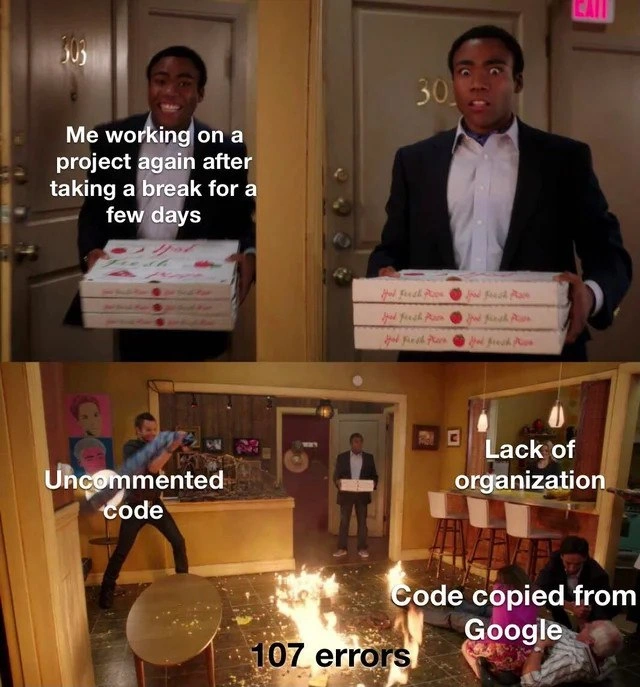
Imagine you left your room in a bit of a mess before going on a short vacation. Clothes and toys are on the floor, but you think, “It’s not too bad, I’ll clean it later.” You come back a few days later, open the door, and surprise! Not only is your room super messy, but somehow a small fire started in the corner and everything is chaotic. Maybe a window was left open and rain messed up your papers, or a curling iron was left on and caused a burn – now the chair is on fire. You stand there at the door, still holding the pizza you brought home, eyes wide, completely shocked at how bad it got while you were gone.
That’s exactly the feeling this meme is joking about, but with computer code. When a programmer takes a break and comes back to their work, they sometimes find a huge mess that they didn’t expect. It’s funny in the meme because it’s so exaggerated – the room is literally on fire with people running around. In real life, the “fire” is just lots of problems in the code. The emotional core is feeling overwhelmed and surprised. Just like coming home to a disastrous mess, coming back to a messy project makes you go, “Oh no, what happened here?!” It captures that mix of panic and dark humor: you have to laugh, because otherwise you might cry. The meme makes us smile because we know that feeling – things going wrong the moment you’re not watching, and now it’s time to grab the extinguisher (or debugger) and clean up the mess.
Level 2: Spaghetti Code Surprise
Let’s break down why this situation happens and why it’s so relatable to developers:
Uncommented code: This means the code has no comments or documentation explaining what it does. For a developer (especially a forgetful post-vacation one), that’s a nightmare. Comments are like little notes or reminders. Without them, when you come back after a few days, it’s as if someone erased your memory of how the code works. You end up staring at a cryptic function named
calcTot()with no clue why it was written that way. If code is a map, uncommented code means there are no street signs – you’re lost in your own project.Lack of organization: A project with poor organization has a messy structure. It’s like a room where nothing is in its right place – maybe all your files and functions are crammed into one giant file, or the logic is scattered arbitrarily across the project. For example, database code might be mixed with UI code, or variable names make no sense (
data1,data2, … everywhere). This lack of structure is often jokingly called spaghetti code – because everything is tangled up like a bowl of spaghetti. When you return to such a mess, it’s Debugging_Troubleshooting hell: you don’t even know where to start looking for the cause of a problem. It’s overwhelming, like walking into a messy apartment and trying to find your keys under piles of junk.Code copied from Google: This refers to a common habit, especially when you’re stuck – you Google a solution or find a snippet on Stack Overflow, then copy-paste it into your project. Now, there’s nothing wrong with learning from online examples (everyone does it!), but blindly copying code can introduce odd pieces that don’t quite fit your program. It’s like taking a part from a different model of car and jamming it into your engine – it might run for a bit, but it could cause issues down the line. If you don’t fully understand that copied code (and maybe didn’t refactor it to match your code style), it becomes a mystery zone. Later, when you come back, you see a function or block of code you barely recognize (“Who wrote this? ...Oh, right, Google did.”). That snippet might be behind some bugs or errors now, hiding behind the figurative chair in panic (as depicted in the meme). Essentially, DeveloperFrustration kicks in because you have to debug someone else’s code – except that someone else is past-you who copied it from the internet.
107 errors: This big number of errors is an exaggerated way to say “the code isn’t working at all.” In a compiled language like Java or C++, you might literally see dozens of compiler errors if, say, you forgot a semicolon or ended a code block incorrectly – one small mistake can cascade into many error messages. In an interpreted language or at runtime, it could mean your console is flooded with exceptions and stack traces. 107 is a comical number to drive the point home: there are a ton of things broken. It evokes that sinking feeling when you run your project after some time and immediately get a huge list of error messages. As a newer developer, the first time you see even 5 errors can be scary; imagine 100+! It basically means the program can’t even start. The meme highlights Debugging Frustration here – you know you'll be spending the whole day (or week) just fixing stuff before you can even add new features.
All these elements together illustrate what we call technical debt in software development. Technical debt is a metaphor: like financial debt, you “borrow” time by doing things the quick-and-dirty way (not writing comments, not organizing code, copying a quick fix). It feels faster initially, but you owe that time back with heavy interest when the shortcuts cause big problems later. Coming back from a break is when the debt often comes due – you have to pay back by cleaning up the mess before you can move forward. This cleanup is what we term refactoring – reorganizing and improving the code without changing what it fundamentally does. For instance, you’d add comments, split that one monstrous file into logical modules, rewrite the weird Google snippet in your own style, and so on. Refactoring is like doing housecleaning or renovation on your codebase to address the cracks in the foundation.
The meme is super relatable for anyone who’s taken a few days off from a project. Even as a junior developer, you might have experienced that shock: you open your laptop after a weekend and nothing runs. 😭 It’s not that the code magically broke on its own (usually); it’s that our memory and context faded, and any latent issues become glaring. If the project was well-maintained with good CodeQuality practices, coming back would be easy. But when there’s a DocumentationGap (no docs, no comments) and TechDebt, coming back to the code feels like inheriting a dumpster fire. You’re basically thrown straight into Debugging/Troubleshooting mode, trying to recall “what was I even doing last week?” while the code screams errors at you. This meme exaggerates it to make us laugh and say, “Ha, I’ve been there!” It’s a humorous reminder to all devs (new and old): take care of your code, or your code will take revenge when you’re not looking.
Level 3: Tech Debt Inferno
Walking back into a project after a short vacation can feel like stepping into an inferno of technical debt. In the meme’s first panel, we see the developer (all smiles, carrying pizzas) as an unwitting firefighter about to enter a blaze. In the second panel, the living room – i.e. the codebase – is literally on fire. This scene resonates with experienced developers because it’s a dramatization of returning to a codebase on fire: things broke, errors exploded, and chaos reigns after just a few days away. It’s funny because it’s true – even a brief break can make a project feel alien, especially if the code was fragile to begin with.
What’s going on under the hood? Likely a perfect storm of neglected code quality practices: uncommented code leaves no hints for your poor brain that’s trying to reload the project context from cold storage. A lack of organization in the project structure means everything’s strewn about – functions in random places, files named temp_final_v2.cpp, and no clear architecture. Sprinkle in some quick “fixes” like code copied from Google (those Stack Overflow snippets pasted in haste), and you have all the ingredients for a codebase bonfire. Each of those shortcuts and sloppy decisions is like dry tinder. Technical debt has been quietly accumulating interest, and the moment you try to restart work, it all ignites into a harsh reality: nothing works and you have 107 errors screaming at you from the compiler or logs.
For a seasoned developer, this scenario is both comically familiar and painfully real. We’ve all opened up a project after some time off and thought, “Who wrote this garbage?” – only to realize with a shiver that it was us. 😅 The 107 errors in the meme are obviously an exaggeration for comedic effect, but honestly, seeing dozens of errors after a git pull or a short break isn’t far-fetched. Maybe a dependency got updated while you were out, or maybe Past-You left half-implemented code (with a // TODO: fix this later comment that never got fixed) which now fails to compile. Each error is like a little fire you have to put out. When you have that many, it feels like the whole room is ablaze.
The humor here also lies in contrast: before the break, you felt everything was under control (you had those metaphorical pizzas of optimism). After the break, your fresh eyes spot all the problems you were blind to earlier. It’s a shared DeveloperExperience_DX joke: stepping away lets the code’s entropy catch up. In software, if you don’t actively keep order, things tend toward chaos – much like leaving an apartment unattended. Senior engineers chuckle (or cringe) at this meme because they’ve been battle-scarred by similar situations. They know that a codebase without safeguards (like tests, documentation, and good structure) will rot surprisingly fast. It’s essentially a spaghetti code horror show – the code’s all tangled, logic is spilling everywhere (like furniture tossed around), and one spark (small bug) sets the whole thing aflame.
In short, the meme is a tongue-in-cheek reminder that technical debt doesn’t take vacations. All those corners we cut – skipping documentation, structuring poorly, copy-pasting “temporary” fixes – will come back to haunt us. And that haunting often happens at the worst time: right when you return, brain still in vacation mode, and you have to play firefighter in your own code. As the cynical veteran might say, “Nothing like a code inferno to welcome you home from PTO.” 🔥
Description
This is a three-panel meme using the 'Troy Enters a Burning Room' or 'Community Pizza' format. In the first panel, the character Troy from the TV show Community, labeled 'Me working on a project again after taking a break for a few days', is shown happily entering an apartment carrying pizza boxes. The second panel shows his expression instantly changing to one of shock and horror. The third, larger panel reveals the source of his horror: the apartment is in complete chaos, with fires on the floor and people fighting. The chaotic elements are labeled with common software development problems: 'Uncommented code', 'Lack of organization', 'Code copied from Google', and '107 errors'. The meme perfectly illustrates the developer experience of returning to a project, even a personal one, after a few days away, only to be overwhelmed by the mess and technical debt that was left behind, making it difficult to regain context and continue working
Comments
11Comment deleted
I'm not saying I have commitment issues, but my git history on personal projects looks like a series of ghostings after the first date
Returned from PTO to find the monolith had auto-refactored into a micro-inferno: 107 compile errors, three StackOverflow cargo-cult patches, and zero comments - apparently entropy got its pull request approved
The only thing more reliable than a distributed system's eventual consistency is a personal project's eventual descent into chaos - at least with microservices, you can blame another team's service for the fire
The half-life of code comprehension without documentation is inversely proportional to the number of Stack Overflow tabs you had open. After a few days away, you're not debugging your code - you're doing software archaeology on a civilization that apparently never discovered the comment block
Coming back after a long weekend: my context cache expired, trunk moved, and the compiler’s 107 errors are the only documentation for the StackOverflow‑driven “refactor.”
Time off is the most aggressive cache invalidation policy - come back cold, the ‘temporary Google paste’ has become core infrastructure, and the compiler greets you with 107 errors
A few days off, and the tech debt compounds faster than interest on a legacy COBOL loan - 107 errors greet you like old friends
the chto za film? Comment deleted
Community Comment deleted
Cum_unity Comment deleted
The spasibo Comment deleted