The Data Scientist's Automation Mantra
Why is this DataScience meme funny?
Level 1: Robot to Do Chores
Imagine you have a big chore to do, like cleaning up your room or doing your homework, and it would normally take you hours. But instead of doing it all yourself, you build a little robot (or create a machine) to do it for you. You press a button, and the robot starts cleaning everything up. Now, while the robot is busy doing the boring work, you get to relax. You pour yourself a nice drink (let’s say a cup of hot chocolate or maybe pretend coffee like the grown-ups) and sit down to look at your favorite funny pictures or cartoons — maybe cute cat videos on a tablet. Doesn’t that sound great? You’re basically getting the job done without breaking a sweat.
That’s exactly the funny idea in this meme! The “data scientist” is like the kid who built a smart robot helper. He wrote a computer program to do his tedious work for him, kind of like programming a robot. While the computer does all the hard stuff, he’s just chilling out, sipping coffee and giggling at silly cat pictures on the internet. It’s a classic “work smart, not hard” situation. We find it funny because usually when someone has work to do, we expect them to be busy or stressed — but here, the person found such a clever shortcut that they can play and relax at the same time their work is getting done! It’s a bit like a magic trick: the boring task disappears (handled by the computer), and the human gets to have fun. The image of a professional just kicking back with coffee and cat memes while the computer handles everything makes us laugh. It shows how being smart (by using technology or a “robot”) can make life easier and a lot more fun. In simple terms, the meme is joking that the data scientist is so efficient and clever that he’s practically on a coffee break with cute cat pics, even as his work gets done for him. And who wouldn’t love to have that superpower?
Level 2: Coffee Break Automation
Let’s unpack the joke in simpler terms. The comment is saying that a data scientist (someone who works with lots of data and uses programming to analyze it) is way too efficient to do some boring task manually. Instead, he’d write a script – basically a small computer program – to do the task for him. While that program runs, he can relax, drink coffee, and browse funny memes (especially cat memes, those goofy cat pictures or videos everyone on the internet loves). This paints a funny picture of a tech professional who’s so good at automating work that he ends up chilling out during office hours! Let’s break down the elements:
Data Scientist: A data scientist is like a mix of a coder, statistician, and investigator. They use programming (often in languages like Python or R) to sift through data, find patterns, and build models (say, for predicting trends or identifying cats in photos). In doing this, they often handle repetitive tasks – for example, reading a bunch of data files, cleaning or reformatting data, running the same analysis on many sets of data, etc. Data scientists are known for creating automation scripts to handle these tasks. It’s part of their everyday toolbox: instead of clicking and copying things 100 times, they’ll write code to do it in one go.
Automation Script (vs. Manual Work): Think of an automation script as a set of instructions you give the computer so it can do a task for you automatically. For instance, if you have to rename 500 files or combine 20 spreadsheets of data, doing it by hand would take forever and be super boring. A data scientist (or any programmer) would write a script – maybe a short Python program or a quick Bash script – to do all those renames or combinations in seconds. This is called automation: making the computer handle the repetitive parts. The meme comment jokes that a data scientist “would never do that” manually, implying they always find a way to script it. It’s a playful exaggeration, but it’s grounded in the real developer mindset: why do something manually twice if you can write a program to do it from now on? This approach is a cornerstone of developer productivity. It’s also known by the saying “work smarter, not harder.” By investing a little time to code a solution, you save a lot of time later and reduce mistakes.
Coffee Break: Now, what does the data scientist do after launching that script? According to the joke, he sits back and sips coffee. In tech circles, coffee is practically the official beverage of coding. It’s the go-to drink when you’re working late or debugging code in the morning. So, saying he sips coffee while the script runs is a lighthearted way to show he’s not stressed – the hard work is being done by the computer, and he can literally take a coffee break. This scenario is actually quite relatable: imagine you start a program or a machine learning model training and it’s going to churn away for a few minutes or more. You can’t really speed it up by staring at the screen, so you might go grab a cup of coffee or tea. The meme plays on this common experience. The coffee_break_automation idea is basically: “I automated the task, so I earned a coffee break.”
Scrolling Memes and Cat Pictures: Besides coffee, the comment adds that he’s looking at “random memes and cat pictures.” Memes are those funny images, videos, or jokes that spread around the internet (often with captions that people in a community find relatable). Cat memes in particular are a huge part of internet culture – from the classic “I Can Has Cheezburger” cat to countless cute or grumpy cat pictures with funny captions. Cat pictures are almost shorthand for “lighthearted internet content.” So if someone is looking at random memes and cat photos, it means they’re basically goofing off in a harmless, fun way online. For a data scientist waiting on a script, this is a comical example of how they might pass the time. It implies that this expert has everything under control (the script is doing the work), so now he can enjoy a little entertainment. Many developers actually do this at times: while waiting for code to compile or tests to run, they might scroll through Reddit, check Twitter, or skim a tech humor site. It’s a very human thing – even in a high-tech job, people love a quick laugh. The mention of cat memes specifically makes the joke extra playful, because it hits on a wholesome, almost silly pastime that contrasts with the seriousness of “data science.” It’s basically saying even smart tech folks love goofy cat pics — which is true more often than not! 🐱
Why It’s Funny: For someone new to this, the humor lies in the contrast. You have a highly efficient worker (the data scientist) who has set up his computer to do everything for him. So he’s pictured doing almost nothing “productive” – just drinking coffee and browsing memes – yet you know his work is getting done in the background by the script. It’s the ultimate “lazy but smart” scenario. Developers often pride themselves on finding clever shortcuts, and here the shortcut is so effective that the person can literally relax. It’s a bit of an exaggeration (real work often requires supervision and checking results, of course), but it’s rooted in a truth: automation can free up your time. And what do people do with free time at work? Sometimes, yes, they watch cat videos! So the comment is a humorous nod to both the power of coding (doing lots of work automatically) and the quirky ways developers enjoy downtime (coffee and internet memes). It’s a form of DataScienceHumor and CodingCulture in-joke – one that both newbies and veterans can chuckle at, because who wouldn’t want to get their work done with a click of a button and spend the extra time relaxing?
In short, this meme comment celebrates the idea of script_over_manual: always choose the coding shortcut over the slog. It also portrays the data scientist as having a pretty sweet moment of leisure thanks to coffee_break_automation. It’s funny and kind of aspirational – the dream of automating away the boring parts of our jobs. Even if you’re new to programming, you can appreciate that doing less manual work and more “scrolling_memes_during_runs” (browsing memes while code runs) sounds like a pretty good deal!
Level 3: Script, Sip, Scroll
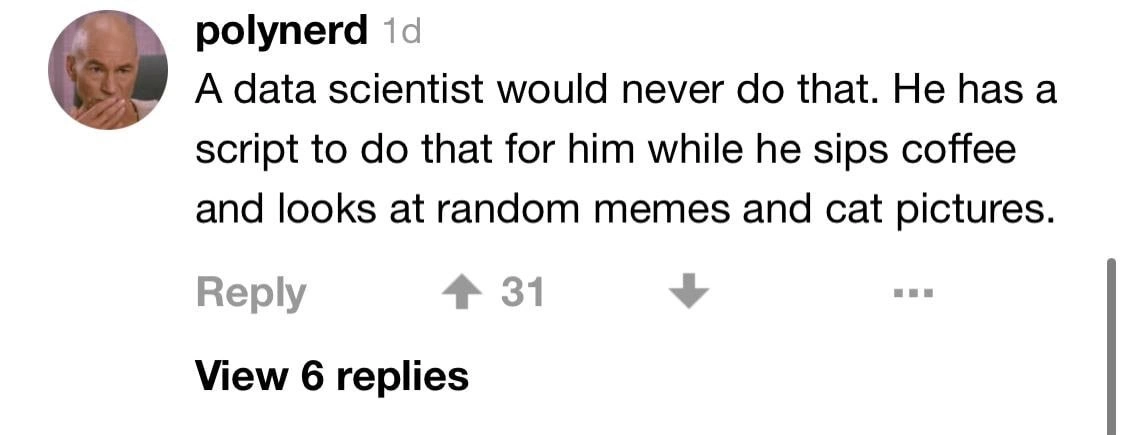
polynerd: “A data scientist would never do that. He has a script to do that for him while he sips coffee and looks at random memes and cat pictures.”
This tongue-in-cheek comment nails a well-known data scientist stereotype: when faced with a tedious task, they’ll automate it instead of doing it manually. The humor comes from pairing hardcore efficiency with laid-back leisure. In other words, the data scientist’s code is hard at work, so he’s free to enjoy a coffee and scroll tech memes (yes, probably on Reddit) without guilt. It’s an example of developer productivity culture at its finest – or as some might say, peak lazy genius. Let’s break down why seasoned developers and data scientists find this so relatable and funny:
Script Over Manual: A data scientist (or any savvy developer) practically has a reflex to write a quick automation script for repetitive tasks. Why click through steps a hundred times when a 5-line Python script or shell command can do it in seconds? It’s the classic “Automate All The Things!” mantra. The comment “would never do that” implies it’s almost unthinkable for them to do boring work by hand. This satirizes how strongly coding professionals favor writing code to eliminate grunt work. In practice, a data scientist might automate data cleaning or report generation with a
Pythonscript, sparing themselves from hours of drudgery. The DRY principle (Don’t Repeat Yourself) is basically their religion. They’d rather spend a bit of time coding a solution once than suffer through mindless repetition.Coffee Break Automation: While the script runs, our data scientist comfortably sips coffee. This is a nod to the coding culture cliché that coffee is the fuel of software development. Many developers joke that their job is 90% waiting for code to run or compile and 10% actually writing it – hence a lot of coffee breaks. In a data science context, running a heavy computation (like training a machine learning model on a huge dataset) can take minutes or hours. Seasoned folks know that once you’ve launched the process, there’s not much to do but wait. Grabbing a cup of coffee is almost a ritual during these waiting periods. The comment humorously implies the data scientist planned it this way: coffee in hand, script on autopilot. It’s efficiency mixed with a bit of self-indulgence. (After all, if the computer’s doing the work, why not treat yourself to a caffeine boost?)
Memes & Cat Pictures: The kicker is the image of this highly skilled professional casually browsing random memes and cat pictures. This juxtaposition is gold: high-tech automation meets low-effort leisure. It reflects an inside joke in tech communities that much of the internet – even advanced technology – ultimately serves the purpose of sharing cat memes. In fact, there’s a running joke that the internet was “built for cat videos.” Here, our data scientist is living that truth. He’s supposedly working, but really he’s on a mini-vacation scrolling through r/funny or cute cat GIFs. The mention of cat pictures is classic because cats are an unofficial mascot of internet humor (from TechMemes to Slack channels full of kitten GIFs). Fellow developers reading this comment likely chuckled because they too have been caught on a “meme break” while scripts run or tests compile. It’s relatable: even the most serious techies unwind by looking at something silly online.
Efficient (and a bit lazy) by Design: Underneath the humor is a badge of honor for programmers: being effectively lazy. In programming lore, “laziness” is even considered a virtue (Larry Wall, the creator of Perl, famously listed Laziness, Impatience, and Hubris as the three virtues of a good programmer!). The idea is that a great developer writes programs to save themselves (and everyone else) time and effort later. This meme comment perfectly encapsulates that ethos. The data scientist has optimized his workflow to the point where the most labor-intensive part left is waiting for the computer. The scenario might be exaggerated – real data scientists can’t slack off all the time – but it’s rooted in truth. Automating tasks really can free up time, and what one does with that time (be it analyzing the next problem, or sneakily checking Twitter) is up to them. The 31 upvotes on the comment show many developers see themselves in this picture; it’s a gentle “been there, done that” acknowledgment.
Let’s illustrate this with a lighthearted snippet of pseudocode:
# Data scientist's approach to a tedious task:
if can_automate(task):
write_script(task) # create a script to handle the task
run_script(task) # let the script do the work
print("Task in progress... time for coffee and cat memes!")
else:
do_task_manually(task) # (unlikely, they avoid manual toil)
In essence, the meme highlights that quintessential developer superpower: turning boring tasks into code. The result? The computer does the heavy lifting while the human supervises casually, mug in hand. It’s funny because it flatters tech folks’ sense of cleverness – “Look, I’m so effective I can relax!” – while poking at the reality that, yes, we love a good coffee and cat meme break. This combination of automation and lighthearted procrastination is a familiar scenario in data science humor and coding culture. The comment’s sarcastic tone is just for fun; it celebrates the idea that true efficiency means getting the job done with minimal manual effort (and maximum enjoyment on the side). It’s an inside joke of DataScienceHumor circles: being productive and indulging in a scrolling break are not mutually exclusive when you’ve got scripts on your side!
Description
A screenshot of a comment on a social media platform, likely Reddit or a similar forum. The commenter, 'polynerd', has a profile picture of Captain Picard from Star Trek in a thoughtful, chin-stroking pose. The comment reads: 'A data scientist would never do that. He has a script to do that for him while he sips coffee and looks at random memes and cat pictures.' The comment has 31 upvotes. This text humorously reinforces the stereotype of data scientists as automation experts who prioritize efficiency, building scripts to handle repetitive tasks so they can focus on higher-level problems (or, as the comment cheekily suggests, browse the internet). It speaks to the core engineering principle of automating manual labor
Comments
9Comment deleted
Why do data scientists love their jobs? Because their scripts do all the work, giving them plenty of time to build a robust mental model of... the office coffee machine's performance degradation over time
I just turned a 5-minute manual task into a 17-step Airflow DAG so I can spend the rest of the sprint A/B-testing espresso beans while Grafana swears I’m “actively processing.”
The real irony is that the data scientist probably spent 3 hours writing and debugging that automation script to avoid 10 minutes of manual work, then another hour creating a dashboard to monitor the script's performance metrics that nobody will ever look at
The real measure of a senior data scientist isn't their knowledge of gradient descent or hyperparameter tuning - it's their ability to automate themselves into a state of 'productive idleness' where their scripts run flawlessly while they achieve inbox zero and become a connoisseur of internet cat photography. After all, why manually wrangle data when you can write a cron job once and spend the next three hours optimizing your coffee-to-meme ratio?
Senior DS move: script the task, then script the script's monitoring - now that's scalable slacking
Senior DS efficiency: replace a 90‑second manual step with a 900‑line Airflow DAG, then use the “saved” time to tune alerting so it only pages between cat photos
Senior data science: spend a sprint wiring an Airflow DAG so 10 minutes of toil disappears, then call scrolling cat memes “real-time model monitoring.”
I have a script to sip coffee and look at random memes and cat pictures while I do actual work. 👍👍 Comment deleted
https://github.com/NARKOZ/hacker-scripts Comment deleted