Skip to content
DevMeme
2067 of 7435
Among OS: DevOps twist on Among Us with shared VM and JIRA sabotage
DevOps SRE Post #2309, on Nov 15, 2020 in TG

Among OS: DevOps twist on Among Us with shared VM and JIRA sabotage

Why is this DevOps SRE meme funny?

Level 1: Who Broke the Computer?

Imagine you and your friends are all using the same computer to do a group project together. Each of you has a specific job, like one friend is organizing the files and another is drawing a picture in a document. But one of your friends is secretly trying to mess everything up instead of helping. They might delete important files or change settings to make the computer crash when no one is looking. And here’s the tricky part: none of you are allowed to talk to each other while you’re working. You can only discuss what’s going wrong when a teacher suddenly says, “Stop! Let’s talk.” At that moment, everyone has to pause what they’re doing on the computer, and you all try to figure out which friend is the sneaky troublemaker. It’s like turning a normal team project into a little mystery game. One person is making mischief in secret, and the rest have to stop working and solve the mystery together. That mix of everyone cooperating yet also being suspicious of each other makes the whole situation feel silly and fun.

Level 2: Tasks, Tickets, Traitors

To a less experienced developer, this meme basically says: imagine turning your DevOps job into a round of Among Us. Among Us is a popular team game where most players (the crew) do simple chores on a spaceship while a couple of hidden “imposters” secretly sabotage things. Now, instead of a cartoon space setting, picture everyone working together on the same server. The meme sets up a scenario where normal IT work becomes a mystery game. Here’s how the parody lines up with the game concepts:

Among Us (game) “Among OS” scenario
All players share one spaceship map All players share one virtual machine (one server for everyone)
To-do tasks (e.g. “Fix the wiring”) JIRA tickets for issues (e.g. “Fix the config file setting”)
One imposter secretly sabotages the crew One imposter secretly tries to break the server (brick the VM)
Sabotages cause crises (lights off, reactor meltdown) Sabotage means messing up config or crashing a service on the VM
Call an emergency meeting to discuss/vote Run the meeting command in chat to discuss (an IRC bot opens the chat)
During meeting, tasks pause (no one can do chores) During meeting, all server work pauses (no changes, no network traffic)

In plainer terms, all the engineers are logged into a single virtual machine, which is like a computer inside another computer that everyone can access at the same time. They each get some JIRA tickets – JIRA is a task-tracking tool many software teams use, basically a to-do list managed by software. Each ticket describes a configuration fix they need to perform on that server (for example: “update the database password in the config file” or “restart the web service with a new setting”). These are the “tasks” they must complete, similar to how Among Us gives each player little tasks to do around the spaceship.

However, one of the engineers is an imposter – meaning that person is pretending to help but is actually trying to cause trouble. In this context, to “brick” the machine means to break the server so badly that it stops working entirely (as useless as a brick). The imposter will try to do something sneaky like deleting important system files or changing a setting that crashes the whole VM. Meanwhile, the rest of the team is trying to finish their config fixes and also keep an eye out for anything fishy that could reveal who the saboteur is.

Communication among the players is intentionally limited, just like in the real Among Us game where you can only talk during meetings. Here, the only time the team can chat freely is when someone initiates a meeting. Instead of pressing a button, they trigger it by typing the word meeting in an IRC channel. IRC (Internet Relay Chat) is an old-fashioned group chat system (think of it as a predecessor to Slack) where people and bots hang out in chat rooms. An IRC bot is an automated program that can respond to certain commands or keywords in the chat. In this scenario, when the bot sees someone say meeting, it knows to allow everyone to talk and simultaneously block all VM traffic. Blocking the VM’s traffic means no one can do anything on the server while the meeting is in progress – essentially pausing all the action. This mimics how in Among Us, when a meeting is called, players temporarily stop doing tasks or sabotaging so they can discuss who the impostor might be.

If you’re a newer dev, imagine a situation at work where everyone is SSH’d into the same server trying to fix things. It’s rare (because it’s chaotic!) but let’s say you had a shared testing server and all your teammates are on it at once. One person’s slip-up could mess up the whole environment for everyone else – like if someone accidentally shuts down the database that all your applications are using. Suddenly nothing works, and you all have to scramble. In real life, you’d probably hop on Slack or yell across the room to say “hey, what just happened?!” In this meme’s version, that scramble is formalized: you literally have to call a meeting in the system to talk it out. By using an IRC bot to control communication, it exaggerates the idea that sometimes we need to pause all work and have a quick meeting to sort out a problem.

The part about JIRA tickets will resonate once you’ve used JIRA. It’s very common for teams to break down work into tickets like “fix this config bug” or “update that library.” They can feel a bit like game quests or chores. Here the meme jokes that even in a high-stakes sabotage scenario, you still can’t escape your ticket queue! Everyone’s busy fixing things assigned to them via JIRA, which is both funny and true to corporate life. It’s a lighthearted jab at the everyday routine of resolving tickets, now with the twist that one of those teammates might be actively undoing those fixes behind your back.

The meeting mechanic in the meme pokes fun at office culture. Think about those moments when the team stops all work to have an emergency discussion – in a real outage, you’d hop on a video call or chat room and coordinate. The meme gives that a comical spin: you have to enter a command to “unlock” the ability to chat, as if conversation is a special mode of its own. And when that mode is on, nothing else can happen to the server (which is actually not far off from some real practices, like imposing a code freeze during an incident). It’s highlighting the notion that meetings often feel like they block progress until the talking is done. If you’ve sat through a deployment stand-down or an all-hands troubleshooting call, you know that feeling.

Overall, the joke here is turning a serious situation (fixing a broken system) into a party game scenario. Even as a junior developer, you can appreciate why that’s funny. It’s taking tools and situations you might encounter in IT – servers, config issues, ticket systems, and urgent meetings – and mashing them up with a whodunit game premise. The result is both ridiculous and relatable. It reminds us that sometimes working in tech, especially in DevOps, can feel like a game where you’re racing to fix things and not quite sure who (or what) will throw a wrench in the works next. By imagining a literal “imposter” in the mix, the meme exaggerates that feeling in a fun way. If you know the game Among Us, you’ll get the reference immediately; if not, you can still laugh at the idea of a coworker secretly trying to crash a server while everyone else frantically tries to keep it running. It’s an inside joke about the challenges of teamwork in IT, dressed up as a mini sabotage game.

Level 3: Suspects on the Server

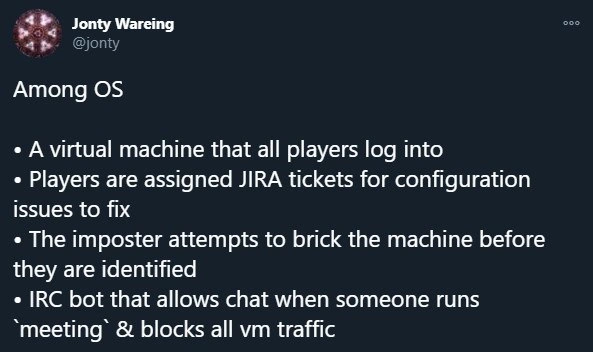
This meme merges the world of DevOps with the hit social deduction game Among Us, humorously dubbed “Among OS.” The tweet lays out a mini scenario where engineers share a single virtual machine (VM) as their “spaceship,” complete with tasks, sabotage, and emergency meetings. In this DevOps social deduction game, all players log into the same server and receive chores as JIRA tickets — mundane configuration issues to fix (just like Among Us tasks, but in shell prompts). Meanwhile, one sneaky player is the imposter, secretly trying to brick the machine (render the VM unusable) before anyone figures out who’s behind the chaos. It’s a parody that hits home because it turns real sysadmin nightmares into a multiplayer challenge.

On a technical level, a shared VM for multiple engineers is a recipe for mayhem. Normally, each developer would have their own environment or at least use separate containers to avoid stepping on each other’s toes. But here, everyone is in one operating system instance, so any destructive command affects all players instantly. (No “works on my machine” excuse here — it’s the same machine for everyone!) The idea of multiple people with possibly root access on one VM conjures images of production servers where one wrong keystroke by an unsuspecting admin can bring everything down. The meme plays on that risk: an imposter could run a deadly command like:

sudo rm -rf --no-preserve-root /
# Imposter's ultimate sabotage: deletes everything on the VM, effectively "bricking" it.

Such a command would wipe critical files and turn the VM into an unbootable mess (a brick). For any Site Reliability Engineer (SRE) or sysadmin, it’s the ultimate horror scenario – and here it’s the imposter’s winning move. It’s like a round of chaos engineering turned into a gameplay mechanic, where one person becomes a human Chaos Monkey unleashing random destruction in the system. Everyone else (the “crewmates”) has to race to fix configuration issues (restart services, patch config files, close security holes) to stabilize the VM, all while keeping an eye out for suspicious behavior that might reveal the saboteur.

The reference to JIRA tickets as tasks is another tongue-in-cheek detail. In real software teams, JIRA is a tool for tracking work items (bugs, feature requests, config changes — you name it). It’s often joked about because engineers can find JIRA chores a bit tedious, much like the simplistic duties in Among Us (wiring mini-games, swiping keycards, etc.). Here JIRA issues are the equivalent of the game’s task list: players dutifully resolve config problems one by one, and completing them presumably inches the team closer to “victory” – i.e. a stable system. It’s a funny gamification of IT drudgery: patch the Apache config, update the DNS entry, clean up a cron job – all ordinary DevOps tasks, but now you do them while wondering if the person next to you in the terminal is deliberately undoing your work. There’s an implied configuration-fix challenge going on, where you must solve these issues under time pressure and potential sabotage. It captures that daily DevOps/SRE grind (fixing things under weird conditions) and makes it a part of the game’s thrill.

The real comedic masterstroke is the IRC bot that enforces communication rules. In this scenario, normal collaboration is restricted: no chatting freely on the side. The only way players can discuss who the imposter might be is by typing the command meeting in the shared terminal, which triggers an IRC bot to allow group chat and simultaneously blocks all other VM traffic. This precisely mimics Among Us’s emergency meeting mechanic: in the actual game, all gameplay (tasks and sabotage) pauses whenever a meeting is called so players can talk and accuse the “sus” (suspicious) crewmates. By making an IRC (Internet Relay Chat) bot the gatekeeper, the meme hilariously nods to old-school developer culture — before Slack or Discord, many dev teams used IRC channels with helper bots to coordinate or deploy code. Here, the bot essentially says “Stop everything, we’re in a meeting now,” freezing the server’s activity. It’s poking fun at the idea that in real life too, when an incident happens, we often jump into a dedicated chat or call (sometimes literally an IRC channel or a Zoom war room) and impose a “change freeze” (nobody touch the system!) until the issue is figured out. The phrase “blocks all vm traffic” is over-the-top but drives the joke home: meetings in corporate life often feel like they halt all real work, exactly as this bot does literally. Only when the meeting is over can everyone resume fixing stuff (or breaking stuff, if the imposter is still at large).

All these elements land well with developers because they map a tense on-call experience onto a silly game framework. The humor comes from how absurdly relatable it is. Anyone who’s been in a production outage at 2 AM can tell you it sometimes feels like a murder mystery: “What changed?”, “Who ran that script?”, “Find the culprit before the system dies!” In real incidents, teams try to avoid blaming individuals (no one’s actually voting a colleague out the airlock in a blameless post-mortem), but it can feel like everyone’s a suspect until the root cause is found. This tweet basically says: let’s make that stressful scenario into a fun competition. It exaggerates the truth that in DevOps work, you often juggle routine fixes (the JIRA tasks) while hunting for hidden problems causing trouble (the imposter’s sabotage). It’s essentially turning an outage post-mortem into a round of Among Us.

There’s a bit of social commentary wrapped in the tech humor too. The idea that you must run a special command just to communicate hints at how formal team coordination can be. It’s mocking the meeting culture: you can’t even talk freely unless a meeting is "officially" in session, akin to how some workplaces feel. And of course, as soon as the meeting is called, all productive work stops (“all VM traffic” blocked) — a feeling every engineer recognizes when a surprise meeting interrupts an afternoon of deep work. By couching it in an Among Us parody, the meme highlights these pain points playfully. It takes the everyday tools of Ops – virtual machines, JIRA, IRC, the dreaded “meeting” – and turns them into props in a cosmic whodunit. The result is a piece of DevOps humor that’s both nerdy and spot-on. Experienced engineers chuckle because they’ve lived through versions of this scenario (minus the actual villainy, hopefully!). It’s funny because for once, breaking the build and sabotaging the server isn’t a career-ending disaster but the objective of the game. (Though in reality, intentionally bricking a server would get you ejected through the corporate airlock, so don’t try this at work!)

Finally, the name “Among OS” itself is a clever pun. OS hints at “Operating System,” grounding the concept in tech, and it echoes “Among Us” so you instantly know it’s a riff on the game. It suggests an operating system full of hidden imposters. In a way, every complex system has its hidden “imposters” – be it a buggy config, an unforeseen dependency, or that one script that brings everything down. Seasoned devs have a wry appreciation for that idea. So this meme operates on multiple levels: it’s referencing pop culture (a viral game) and simultaneously lampooning daily life in IT. The more you know about dev tooling and the game itself, the more layers of the joke you catch. All in all, Among OS imagines DevOps as a high-stakes multiplayer adventure, and let’s be honest – some days it really does feel like one!

Description

Screenshot of a tweet from Jonty Wareing (@jonty) shown in Twitter’s dark theme. The header displays a circular avatar, the name “Jonty Wareing”, handle “@jonty”, and the three-dot menu icon. Tweet text reads: “Among OS” and a bulleted list: “• A virtual machine that all players log into • Players are assigned JIRA tickets for configuration issues to fix • The imposter attempts to brick the machine before they are identified • IRC bot that allows chat when someone runs `meeting` & blocks all vm traffic”. White text is set on a navy background, bullets aligned vertically. The meme humorously recasts the game “Among Us” as a sysadmin mini-game where engineers share a VM, work JIRA tickets, and an imposter bricks the box while an IRC bot controls comms - poking fun at DevOps culture, virtualization, and meeting rituals
Comments

7
Anonymous ★ Top Pick It’s basically our legacy bastion: everyone SSHs in as root, JIRA tickets are just alibis, the IRC bot locks the channel with /meeting, and the real imposter is whoever labels their `dd if=/dev/zero of=/dev/sda` commit “minor config cleanup.”
  1. Anonymous ★ Top Pick

    It’s basically our legacy bastion: everyone SSHs in as root, JIRA tickets are just alibis, the IRC bot locks the channel with /meeting, and the real imposter is whoever labels their `dd if=/dev/zero of=/dev/sda` commit “minor config cleanup.”

  2. Anonymous

    Finally, a game where 'works on my machine' becomes a legitimate alibi, and the post-mortem is just voting someone off the VM before they can alias 'rm -rf /' to 'ls'

  3. Anonymous

    Finally, a game that accurately simulates production: everyone's frantically fixing tickets while one person's changes mysteriously break everything, and the moment someone types 'meeting' all productivity grinds to a halt. The real twist? In production, you never actually identify the imposter - they just get promoted to architect

  4. Anonymous

    Every major outage already plays like this: one shared bastion VM, a dozen SSH sessions, Jira alibis, and the imposter is whoever sets 'iptables -P OUTPUT DROP' milliseconds before someone types `meeting`

  5. Anonymous

    Shared VMs: where isolation is a myth, and the imposter's just the dev with unchecked sudo

  6. Anonymous

    Among OS: everyone SSHs into one VM to clear Jira chores; the impostor “hardens” with iptables -P INPUT DROP, and you can only talk after `meeting` blackholes traffic - aka Thursday

  7. @R_Semenovych 5y

    Ctrl+C

Use J and K for navigation