Data Science Skills Podium: The Third-Place Coder's Victory Lap
Why is this DataScience meme funny?
Level 1: Third Place Showoff
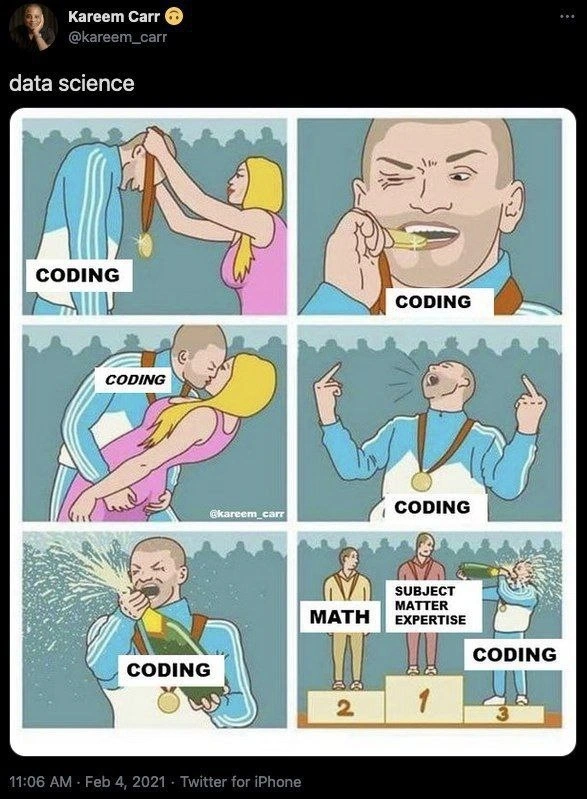
Imagine a school race where one kid finishes third but is throwing the biggest celebration, acting like they got first place – they’re high-fiving, spraying soda everywhere, and showing off their bronze medal. Meanwhile, the actual first-place winner and the second-place runner are standing quietly at the top of the winners’ podium, happy but not making a fuss. It looks pretty silly, right? This meme is just like that, but for the world of data science. The overexcited third-place kid represents coding – he’s the show-off who thinks doing the flashy part (like writing a computer program) means he won the whole thing. But the contest he’s in is actually about solving problems with data, and the quiet people on the higher steps are the real champions: one symbolizes knowing a lot about the topic (the subject matter expert who understands what the data is about) and the other symbolizes being good at math (the one who knows how to actually make sense of the numbers). The meme is funny because the person who didn’t truly win is acting like a champion, reminding us that just coding alone (no matter how loudly you celebrate it) isn’t the real winner – you also need the knowledge and the math to get the gold medal in data science. In simple terms, it’s saying: don’t be the show-off who only knows how to use the tools; the real winners are the ones who understand what they’re doing and why.
Level 2: Not Just Coding
This meme is about data science and the trio of skills it requires: coding, math, and subject matter expertise. At first glance, you see a series of images of an Olympic-style podium ceremony. There’s a guy labeled “CODING” who is getting a medal and celebrating like crazy – he’s biting the medal, kissing the lady giving the award, and spraying champagne everywhere. It looks like he’s the winner. But then the last panel zooms out and you realize he’s actually in third place (the lowest spot on the podium). Above him, in second place, stands “MATH,” and in first place (the tallest podium step) stands “SUBJECT MATTER EXPERTISE.” The caption at the top says “data science,” telling us that each of these podium spots represents a component of data science. This olympic_podium_meme_template is a popular way to joke about someone over-celebrating a lower-ranked achievement while the true winners are quietly above them. Here, “coding” is the overenthusiastic third-place medalist, whereas the real winners are the more important skills: math and domain knowledge.
So why is this funny to people in data science? It highlights a common misunderstanding. Data science isn’t just about writing code or using programming languages. Sure, coding (often in Python or R) is how you actually crunch data, make charts, and build models – it’s very important. But it’s not the most important part by itself. You also need math – especially statistics and linear algebra – to know how to correctly analyze data, measure results, and avoid fooling yourself with wrong conclusions. And crucially, you need subject matter expertise, which means knowledge about the field you’re working in (the business or scientific domain). This could be finance, healthcare, marketing, physics – whatever area the data comes from. That expertise helps you ask the right questions and interpret the results correctly. In the meme, “SUBJECT MATTER EXPERTISE” taking the gold medal means that understanding the domain often proves most valuable; “MATH” with silver means without solid mathematical foundations (like knowing how algorithms work or how to validate results), you can’t trust what the code does; and “CODING” getting bronze shows that while programming is necessary to tie everything together, it’s not sufficient alone to win the data science “competition.”
Think of a data science project as a combination of these three things:
- Coding: This is the programming part – writing the code to clean data, run analyses, and implement models. For example, you might write a Python script using
pandasto process a dataset or usescikit-learnto train a machine learning model. Coding is how you execute the work. Without coding, your math knowledge and domain ideas would just stay on paper. - Math (Statistics): This is the brainy part – understanding formulas, algorithms, and techniques that make sense of data. For instance, knowing how linear regression works, why you might use a logistic curve, what a p-value or a confidence interval is, or how to avoid overfitting by using techniques like cross-validation or regularization. Math skills ensure that what you’re doing with the code actually makes sense and that you can trust the patterns you find. It’s the quality control and the toolkit for choosing the right approach.
- Subject Matter Expertise: This is the context part – being knowledgeable about the specific problem domain. If you’re analyzing medical data, it helps a lot to understand biology or healthcare. If you’re working on a retail sales forecast, knowing how retail works (holidays, seasonal trends, etc.) is key. Domain experts can tell you, for example, “This data variable corresponds to X real-world thing, and here’s why it might be unreliable,” or “That result doesn’t make practical sense because of industry reasons.” They guide the project so it actually solves a real problem and the results are meaningful outside of just numbers on a screen.
The meme’s joke is that sometimes people get really excited about the coding part – like learning a new programming trick or training a complex neural network – and they act like they’ve won the gold. In reality, if you ignore the other two parts (math and domain), your project might fall flat. It’s a critique of overemphasis_on_coding in the data science field. For example, imagine a newbie data scientist who learns just enough Python to use a machine learning library on some data. They manage to get some model to output predictions and they’re super happy (akin to that champagne-spraying third-place guy). But if that person doesn’t understand the math fundamentals behind what they did, they might have no idea if the model is actually correct or if it’s just nonsense. Similarly, if they lack domain knowledge, they might be solving the wrong problem or misinterpreting the results – like predicting ice cream sales perfectly without realizing all they did was correlate with seasonality (something any ice cream shop owner could have told them!). The real winners, those first and second place positions, represent ensuring the solution makes sense in the real world and is based on sound math.
In simpler terms, the meme is saying: in data science, knowing how to code is great, but it only gets you so far. You will do much better if you also understand the math behind the models and have knowledge about the area you’re working in. Those who focus on all three – coding, math, and subject expertise – end up truly succeeding (standing on top of the podium). Those who focus just on coding might deliver something flashy, but they’re missing the foundation, kind of like coming in third. It’s a lighthearted reminder to beginners that being a good programmer is not enough to be a good data scientist; you also need to balance those other critical skills to truly shine.
Level 3: Champagne for Third
At a senior developer’s glance, this meme is painfully relatable. It parodies the common scenario where coding prowess gets a disproportionate amount of hype in data science, while mathematical rigor and subject matter expertise quietly do the heavy lifting. The image draws on the classic Olympic podium meme template: the guy in third place (labeled “CODING”) is biting his medal, kissing the presenter, and spraying champagne in wild celebration – all while actual first place (“SUBJECT MATTER EXPERTISE”) and second place (“MATH”) stand above him looking understated. It’s a perfect visualization of the data_science_skill_balance problem. In many organizations and online communities, the person who builds a flashy model or writes complex code often gets showered in praise (the champagne moment) like they’ve won gold, even if what they solved is only a small part of the problem. Meanwhile, the domain experts who ensured the data made sense, and the statisticians who verified the model’s validity, are standing on the top podium without nearly as much fanfare.
This satire reflects real-life dynamics. We’ve all seen projects where an engineer whips up a fancy deep learning pipeline and basks in glory (“Look, I used 10,000 GPU-hours and TensorFlow to get 99% accuracy!”) while the crucial contributions of colleagues get overlooked. That exuberant medal-biting coder might have ignored that the dataset was, say, unbalanced or full of quirks that only a domain expert would spot (“Hey, all the top results are just picking up an ID column leakage!” 🤦). The subject matter expert (the quiet gold medalist) perhaps provided the key perspective: like a healthcare analyst saying “These patterns don’t make clinical sense,” preventing a fiasco. The math guru (silver medalist) maybe ensured the model was properly cross-validated and not just lucky. But it’s often the coding part – the cool app, the neat visualization, the clever script – that gets immediate applause in demos or on Twitter. This meme exaggerates that to comic effect: the coder is basically throwing himself a parade for coming in third.
In the DataScience and AI_ML world, this joke hits a nerve because it’s a known anti-pattern. There’s a running gag (and a bit of a sore spot) about the industry sometimes hiring “data scientists” who are basically just software engineers in Python land, or about managers who ask for “fancy AI” without understanding the statistics or the business problem. Overemphasis on coding shows up when job listings demand five programming languages and every ML framework, but barely mention understanding the actual domain (be it finance, biology, etc.) or degree-level math. Veteran data scientists know the reality: success comes from blending all three skills. As an insider joke, people often reference the Venn diagram of data science skills – where coding, math (statistics), and domain knowledge overlap. This meme is essentially that Venn diagram turned into a comedy sketch: the coding guy is throwing victory signs, but without the other two, he wouldn’t even place in a real competition.
The humor also lies in the champagne_medalist_meme itself. In the full panel, we see “CODING” at the third-place spot on the podium, with the gold and silver spots taken by “SUBJECT MATTER EXPERTISE” and “MATH.” This visual punchline delivers the message: in the hierarchy of data science needs, coding comes after you have the right knowledge and a solid mathematical approach. It’s a bit like celebrating the bronze medal as if it were gold – funny and absurd. Seasoned developers chuckle (or groan) because they’ve experienced this imbalance. For example, a senior might recall how a junior teammate bragged about automating a model training (pip install a-new-ML-library and go!), but later it turned out the results were meaningless because they didn’t understand the business context or the statistical validity – something the quiet analysts had warned about.
In summary, the meme’s developer humor resonates by highlighting a truth we often learn the hard way: writing code is just one part of data science, and not actually the part that deserves the biggest trophy. The real winners – understanding the problem and applying the right math – might not spray champagne, but they’re the reason any data project truly succeeds. To drive the point home, here’s how each “medalist” contributes in practice:
| Skill Emphasized | Likely Outcome in Projects |
|---|---|
| Coding (only) | A working pipeline or fancy model deployment, but potentially solving the wrong problem or chasing a misleading metric. Lots of action, little insight. |
| Math (only) | Sound analysis and theoretically correct models, yet possibly stuck in a report or academic paper, not implemented or not adapted to messy real-world data. |
| Domain (only) | Deep understanding of what the data should mean and which questions matter, but no automated way to crunch the numbers or scale the solution to lots of data. |
| All combined 🏆 | A robust solution: relevant questions asked, proper methods used, and a working system to deliver results. In other words, a real data science win (gold medal performance). |
So, the meme uses absurd celebration to poke fun at a real imbalance. It’s saying: “Go ahead, celebrate your coding, but remember – without math and domain insight, you’re literally on the lowest step of the podium.” It’s a friendly jab at all of us who might get a little too excited about our code compiling or that slick machine learning demo, reminding us that true excellence in data science comes from balance. In practice, the quiet domain expert and the math geek might not seek the spotlight, but they’re the champions making the whole team look good.
Level 4: No Free Lunch
Deep in the theory of data science, this meme hints at a fundamental truth: you can’t win the race with programming chops alone. In machine learning theory, there’s even a concept called the No Free Lunch theorem. It essentially says that no single algorithm (or coding trick) wins on all problems – to truly beat the rest, you must bring in prior knowledge about the problem. In other words, an algorithm needs an inductive bias, which usually comes from math (statistical assumptions) or domain expertise (problem-specific insights). A coder spraying champagne around by brute-forcing algorithms is like someone trying every combination on a lock: without a clue (domain insight) or a strategy (math rigor), it’s pure luck if they succeed. Mathematically, garbage in, garbage out is a law: if your input data or assumptions are flawed, even the fanciest code can’t produce a meaningful result. The celebrated programmer in the meme might have written 1000 lines of Python and hit 99% accuracy on the training data, but a seasoned statistician knows this smells of overfitting – the model is just memorizing quirks rather than learning real patterns. Overfitting is precisely what happens when coding enthusiasm isn’t tempered by mathematical discipline: the model looks gold-medal worthy on paper but collapses in the real world.
From an academic perspective, subject matter expertise and solid math fundamentals are what impose structure on a problem, letting data scientists generalize beyond the data they have. They help decide things like: Is our model form appropriate (e.g. linear vs. non-linear)? Are our features actually meaningful or just noise? How should we measure success reliably? Coding can implement solutions at scale, but it’s the theory – statistical tests, probability distributions, linear algebra – that tells us which solution to implement and whether the solution is sound. Historically, the field of data science grew out of statistics and domain-specific analysis long before we had fancy programming notebooks. That calm figure on the top podium (labeled “SUBJECT MATTER EXPERTISE”) and the second-place “MATH” stand for those enduring, foundational forces. They quietly ensure the analysis is asking the right question and using the right methods. The boisterous coder celebrating with champagne in third place? He represents the flashy part of AI/ML work – necessary, but without the others, he’s standing on a very short podium. The meme’s humor lands because, beneath the silliness, it’s technically inevitable: to truly claim victory in data science, you need the timeless principles of math and domain knowledge, not just a victory dance with the latest code library.
Description
A six-panel comic meme, often called the 'Bronze Medalist Celebration' format, is used to comment on the field of data science. The first five panels depict an athlete in a blue tracksuit, labeled 'CODING', celebrating ecstatically. He receives a medal, bites it, kisses a woman, flips off the crowd, and sprays a bottle of champagne as if he's won the grand prize. The final panel reveals the full context: a winners' podium where the 'CODING' athlete is standing on the third-place step. The first-place podium is occupied by 'SUBJECT MATTER EXPERTISE', and the second-place podium holds 'MATH'. This meme humorously critiques the over-glorification of coding skills in data science, suggesting that while coding is important, it's ultimately less critical than deep domain knowledge and a strong mathematical foundation. The joke resonates with experienced practitioners who understand that coding is a tool, not the end goal, and that true value in data science comes from analysis and insight, which are impossible without subject matter expertise and statistical rigor

Comments
11Comment deleted
A junior data scientist boasts about their TensorFlow skills. A senior data scientist asks 'Why?' and 'So what?' until the junior realizes they've built a V12 engine for a skateboard
Coding’s on bronze spraying champagne, math’s on silver double-checking the p-value, and the domain expert on gold is just wondering why we needed a Kubernetes cluster to average a 5 MB CSV
After 15 years in the industry, I've learned that 'data scientist' is just a fancy title for 'person who writes pandas one-liners while their PhD in statistics gathers dust' - and don't even get me started on how we sold management on 'AI/ML' when 90% of production models are still logistic regression wrapped in Docker containers
Every data scientist's journey: spending six months mastering TensorFlow and distributed computing, only to realize the VP of Sales who's been in the industry for 20 years can spot a flawed model assumption in 30 seconds because they actually understand customer behavior. Turns out, knowing why churn happens beats knowing how to parallelize gradient descent across a GPU cluster - who knew the 'data' in data science actually meant something about the domain?
Gold for wrangling pandas DataFrames, bronze for proving PAC-learnability
In data science, coding is the champagne; math and domain expertise are the loss function - guess which one shows up in the OKRs
Data science: Coding gets the champagne; Math catches the leakage; Domain expertise asks why the KPI has no revenue signal
fuk off bot Comment deleted
@devs_chat (is this how i ping admins now?) Comment deleted
Fuck off, you goddamn bot Comment deleted
>math Get real Comment deleted