A Brutal Code Review in Three Lines
Why is this CodeQuality meme funny?
Level 1: Broken Instructions
Imagine you’re trying to build a new toy, and your friend gave you a sheet of instructions. If the instructions are really good and clear, you can put the toy together easily and it turns out great – that’s like good code that makes sense. Now suppose the instructions are pretty bad – maybe the steps are messy or hard to follow, but if you puzzle over them for a while, you still manage to build the toy and it works. That’s like bad code that’s messy but at least does what it’s supposed to. Finally, think about what would happen if the instructions your friend gave you made no sense at all and after trying to follow them, your toy still doesn’t work. You’d be totally confused, right? You might even laugh and say, “These instructions are so terrible, I can’t even build the toy!” That’s exactly what this meme is joking about. It’s saying someone’s computer code is like those useless instructions – nobody can understand it, and it doesn’t even do its job. It’s funny in a teasing way, because it’s such an over-the-top way to tell someone their work is really, really bad. The character in the picture is even doing a little victory dance (a dab) because of how silly and epic that joke is. So the joke is basically: good code is easy to read, bad code at least works, but your code? – it does neither, ha! It makes people laugh because it’s a cheeky way of saying “this is the worst toy-building guide ever,” or rather, the worst code ever, and we all hope we never see instructions or code like that in real life.
Level 2: Spaghetti Code 101
Let’s break down the joke in simpler terms. The meme compares good code, bad code, and your code (the code being reviewed) in a funny, exaggerated way. In software development, good code is code that other programmers can easily read and understand. It’s logically organized, has clear names for variables and functions, and overall makes sense. For example, good code might have a function calculateTotalPrice() that cleanly does what its name suggests, with straightforward steps and maybe a comment or two for clarity. When you read good code, you can quickly figure out what it does and why – it doesn’t surprise you with weird tricks or confusing jumps. Good code is also correct, meaning it produces the right results; it’s not just tidy but also functionally right. In a phrase, “good code makes sense” both to the reader and in terms of accomplishing its task.
Now, bad code is the opposite in style: it’s hard to understand, messy, or written in a hurry. This is often called “spaghetti code” – a slang term for code with a tangled, twisty structure that’s as hard to follow as a bowl of spaghetti. Spaghetti code might have things like functions that go on forever, deeply nested loops and conditions (if inside if inside if, etc.), or variables with names like x, temp, foo that tell you nothing about their purpose. It might jump around in a non-linear way (like using a bunch of goto statements or odd breaks/continues) so you can’t easily trace the execution path. Despite these problems, sometimes bad code still “just works.” That means even though it’s ugly or weird, it manages to do its job (at least under the conditions it was tested in). For instance, imagine a function that calculates a discount on a price but is written in 200 sloppy lines with duplicated logic everywhere – it’s not good code, but if you give it a price, it does output the correct discounted price. It works, though any programmer reading it would groan or worry about potential hidden bugs. There’s a common saying among developers for this scenario: “It works on my machine.” That’s a tongue-in-cheek way of saying the code runs (at least in one place) even if it’s of poor quality or might break elsewhere. So “bad code just works” in the meme implies at least the program runs and gives the expected result, even if the way it’s written is problematic.
Finally, we have “yours doesn’t do either.” This is the meme delivering an insult: the code under review (attributed to “you,” the hypothetical author) is neither understandable nor functional. In other words, it fails both key expectations – it’s confusing and it’s broken. That’s a harsh scenario! It means when the reviewer tries to read through this code, they can’t even follow what it’s supposed to do (poor readability and structure), and also when they test or analyze it, they find it doesn’t actually do the right thing (bugs or logic errors). For example, say we have a piece of code committed that is intended to sort a list of names alphabetically. If it’s good code, it might use a clear sorting function and be done. If it’s bad code, maybe it implements a weird hand-written sort with multiple loops that’s hard to read but still ends up sorting the names correctly. If it’s code that “doesn’t do either,” it might be written with a confusing approach and end up not sorting properly at all (perhaps it sorts some of the names and leaves others out of order due to a bug). The reviewer would then say, “I can’t figure out what this code is doing, and whatever it’s doing, it’s not the right thing!” This is extremely frustrating for developers who have to work with such code, because you don’t have a clear starting point to fix it – you first have to decipher it (which could take a while) and then correct its behavior. That’s why the meme exaggerates this feeling into a one-liner on a sign, to poke fun at how exasperated a reviewer can feel.
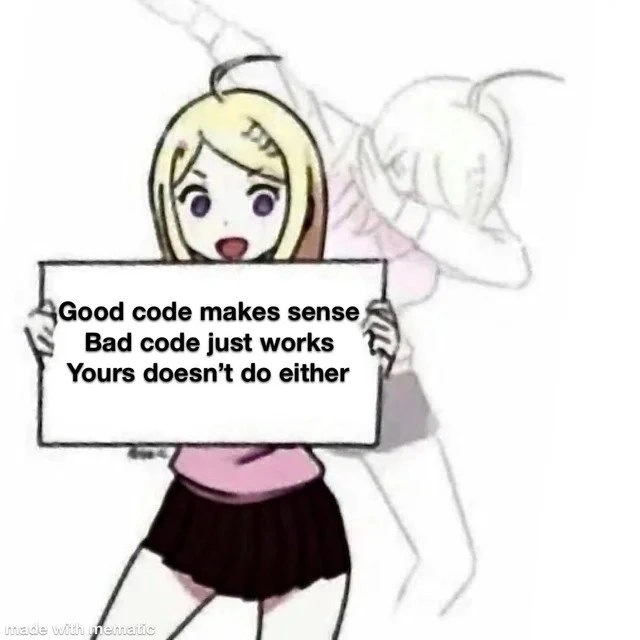
The image itself – an anime-style girl holding a sign – is a popular meme format for delivering short messages or jokes. People take a character (often from a known show or just a generic cartoon) and edit an image so it looks like the character is showing you a sign with custom text. Here, the text is formatted like a little poem or slogan about code quality: each line contrasts good, bad, and your code. The contrast setup makes the punchline stronger. The character’s cheerful face and posture add to the comedic effect, because she’s smiling while delivering this devastating critique. In the background, you can see a faint copy of the same girl doing a dab. A dab is a dance move that became an internet trend – basically the person drops their head into their bent arm, as a kind of playful celebratory gesture. In memes, someone “dabbing” often symbolizes boastful triumph or a cheeky “owned!” moment. So in this picture, the faint dabbing figure reinforces how savage the joke is: it’s like the character is so proud of this sick burn on your code that she’s literally dancing in celebration. It’s a lighthearted way to exaggerate the win/lose dynamic of the joke – the reviewer (or the meme character) “won” by delivering the joke, and the code author “lost” by being the butt of the joke.
The humor here is very relatable to developers, especially when it comes to code review pain points. A code review is when colleagues check each other’s code before it’s merged or released. The goal is to catch mistakes, improve the code’s clarity, and maintain high code quality in the project. During these reviews, people leave comments like “I think this function could be simplified,” or “There’s a bug here, this logic won’t work for all cases,” etc. Reviewers also look out for code smells – this term refers to hints that something is off in the code’s design. For instance, a very long function might be a smell that it should be broken into smaller ones, or repeated code might smell like it should be refactored (rewritten) into a single common function. When the meme says “yours raises existential questions,” it’s of course an exaggeration, but it taps into that feeling when a reviewer is so confused by code that they start jokingly questioning reality. It’s like saying, “This code is so incomprehensible that I’m questioning everything – does the author even know what they wanted to do? How did we get here?” It’s hyperbolic humor: no one literally thinks about the meaning of life because of code, but they might stare at baffling code and dramatically sigh, “Why ... just why?”
So overall, this meme is poking fun at a situation every programmer wants to avoid: writing code that not only other developers can’t understand but that also fails at its job. It reminds us in a joking way that code quality matters. Good code should ideally have both: it should make sense to others and it should work correctly. If you only achieve one of those (the code works but is messy, or it’s clean-looking but doesn’t actually do anything useful), there’s a problem. And if you achieve neither, well... you get a meme like this aimed at you! The sign’s message is a comically blunt form of code review feedback. In real life, a reviewer would (hopefully) be more polite and specific, saying things like “I’m not sure I follow this part” or “This doesn’t produce the expected output, please fix the logic” and “Could you refactor this? It’s hard to understand.” But inside, they might feel as shocked as the meme implies. That’s why developers find it funny – it takes a common situation in programming teams and cranks the drama up to cartoonish levels, complete with a cheeky anime figure literally announcing the critique on a poster. It’s both a bit of edgy coding humor and a cautionary tale: don’t be the person whose code ends up in this third, infamous category!
Level 3: The Worst of Both Worlds
In this meme’s code review roast, an anime character holds up a sign delivering a brutal verdict on someone’s programming: “Good code makes sense; Bad code just works; Yours doesn’t do either.” This punchline lands because it highlights a third, truly dire category of code that seasoned engineers dread. Normally, good code has clarity and purpose – you can follow its logic and it behaves correctly. Bad code (we’ve all seen it) is the kind of messy, hacky stuff that might violate every code quality guideline but at least functions (the infamous "it works, don’t touch it" code). But the meme jokes that your code isn’t even meeting that low bar: it’s neither understandable nor operational. It’s the worst of both worlds – a pile of inscrutable logic that also fails to produce correct results. This scenario is painfully familiar to senior developers. We’ve cracked open modules that not only break in spectacular ways, but the implementation is so baffling that reviewing it raises existential questions like, “What was the author thinking? Why does this code even exist?”
From a senior engineer’s perspective, the humor hits close to home because it satirizes real CodeReviewPainPoints. During a thorough code review, an experienced reviewer sometimes encounters changes that are supposed to implement a feature or fix a bug but instead reveal a labyrinth of poor decisions. Instead of a clean update, the diff is full of code smells – things like meaningless variable names, inconsistent indentation, dead code, and convoluted logic. Perhaps you see a function doing ten unrelated tasks with a cascade of if/else so tangled that it’s essentially spaghetti code. And to top it off, the code doesn’t even produce the right output or breaks with exceptions for any input outside a narrow happy path. It’s the kind of submission that prompts a reviewer to write a long comment or initiate “The Talk” about coding standards. The meme distills that exasperation into a sassily concise message on a sign. It’s the sort of biting comment you wish you could leave on the pull request, even if professional etiquette means you’d phrase it more gently in reality.
The code quality issues being mocked here are not trivial nitpicks; they’re the sort of fundamental problems that make maintainers lose sleep. If “good code makes sense,” it means it’s designed with clarity: functions are logically structured, variables have descriptive names, and the flow can be followed without consulting a psychic. If “bad code just works,” it implies a lot of technical debt – maybe the code is full of quick fixes, global state, or copy-pasted snippets, but somehow it produces the expected output (at least in the original author’s environment). We often tolerate such bad code temporarily because, hey, it runs in production and we fear touching it might break things. There’s a dark industry joke that the only metric for bad code is the number of WTFs per minute a reviewer mutters – in other words, it might be ugly, but if it works, you grumble and move on. However, when code lands that doesn’t even do its job, it’s inexcusable. That’s the flavor of DeveloperHumor here: everyone on the team can relate to the horror of code that fails both criteria.
Consider a real-world example that would provoke this reaction. Imagine a function that’s supposed to calculate something but is written so poorly that its logic is nonsensical and it never returns the correct result. It might look like this:
function authenticate(user, pwd) {
if (pwd === "letmein") {
// TODO: allow access (developer forgot to implement this part)
} else {
denyAccess(user);
}
return true; // Always returns true, even if access was denied above!
}
In a code review, encountering code like this would make a senior dev’s eye twitch. First, it doesn’t make sense: the critical branch where pwd is correct is empty (nothing happens when the password is right?), and regardless of the logic, the function always returns true. The author probably intended to return true only on successful authentication, but instead, they wrote it such that it always claims success – even in the wrong cases. This snippet “just works” only in the sense that it runs without crashing, but it certainly doesn’t work correctly (it would let every user in, or conversely, maybe no user gets the proper handling). And as you read it, you’re left scratching your head because the intent is utterly lost. Why would someone design a function this way? Reviewing such code feels like deciphering a riddle with pieces missing.
The meme’s backdrop of an anime girl dabbing (faintly visible in the background) amplifies the savage nature of the critique. In internet culture, a dab is a triumph pose – a kind of cheeky “gotcha!”. Here it’s as if the character just dropped an epic burn (“your code doesn’t do either”) and is doing a victory dab to celebrate how hard they roasted your code. That semi-transparent dabbing figure symbolizes the unspoken mic drop moment in a code review: the reviewer delivered their zinger and can’t help a tongue-in-cheek celebration, while the author of the code presumably sits there in stunned silence. It’s a humorous exaggeration of code review dynamics, where in reality feedback is formal, but internally, reviewers might be facepalming or laughing to themselves at how absurd some code is. Every developer who’s been in a CodeReview meeting or left comments on a pull request can relate to that internal monologue: “I’m trying to be nice, but holy cow, what is this?!”
There’s also a grain of truth in this over-the-top insult that makes it resonate. Code that “doesn’t do either” is not just an isolated goof-up; it’s symptomatic of deeper issues: perhaps rushed development, lack of peer review or mentorship, or someone copy-pasting from StackOverflow without understanding it. In teams, we establish coding standards and best practices to avoid precisely this scenario. The relatable humor here is that despite all our processes, such code still slips through sometimes, and when it does, it unites the reviewers in a mix of horror and laughter. As a battle-scarred programmer, you can’t help but recall that 3 AM incident where legacy code that had always “just worked” suddenly didn’t, and you discovered it was as indecipherable as ancient hieroglyphs. This meme lets us laugh at that trauma: at least we can joke that the code caused an existential crisis in the calm environment of a code review, instead of causing a production outage at 3 AM. It’s better to have an existential crisis over a cup of coffee during review than a real crisis in the middle of the night. So the humor is cathartic – by absolutely trashing this mythical “worst code ever,” we feel a little better about the WTFs we’ve encountered in our own careers.
Description
An anime-style character with blonde hair and a pink shirt holds up a white sign. In the background, a faint outline of the same character is 'dabbing'. The sign has three lines of black text: 'Good code makes sense', 'Bad code just works', 'Yours doesn't do either'. This meme presents a cynical but relatable hierarchy of code quality for developers. It humorously categorizes code into three tiers: the ideal (good code), the functional but messy (bad code, often riddled with technical debt), and the absolute worst-case scenario - code that is both broken and incomprehensible. It's a common joke shared among developers to vent frustration about poorly written software, legacy systems, or during a particularly painful code review
Comments
10Comment deleted
This is the kind of code that makes you question if the original author was writing a program or a cry for help in a language only they and a Cthulhu-level debugger could understand
During review we couldn’t decide whether to tag your PR as “needs tests” or “needs archaeologists” - turns out unreadable AND non-functional is an entirely new severity level
After 20 years in the industry, you realize the real achievement isn't writing code that's elegant OR functional - it's convincing the PM that the bug-ridden, unmaintainable mess you inherited was actually a 'microservices-ready event-sourced architecture' that just needs a little refactoring budget
There's a special circle of engineering hell reserved for code that achieves the impossible: being neither elegant enough to maintain nor functional enough to ship. At least with legacy spaghetti code, you can grep through the mess until something works. But code that fails both the 'does it make sense?' and 'does it work?' tests? That's when you realize the real technical debt isn't the code - it's the time you'll never get back trying to salvage it. Senior engineers know: sometimes the most valuable code review comment is 'git reset --hard && start over.'
Good code is SOLID poetry, bad code duct-tapes microservices together - yours is the monolith that ghosts prod with a 500 on hello world
Good code makes sense; bad code just works - your PR invented a third category: a non-idempotent no-op that only has side effects in prod
Code review verdict: you discovered the secret fourth quadrant - neither readable nor functional - an entropy microservice; ship it behind a feature flag called “hope” and watch MTTR asymptote to infinity
Kaede... Comment deleted
Пояснительную бригаду, плиз Comment deleted
Хороший код имеет смысл Плохой код просто работает Твой код не делает ни того ни другого Comment deleted