Skip to content
DevMeme
2453 of 7435
When a Nonbinary Person Encounters Binary Code
DevCommunities Post #2727, on Feb 6, 2021 in TG

When a Nonbinary Person Encounters Binary Code

Why is this DevCommunities meme funny?

Level 1: Only Two Choices

Imagine you walk into an ice cream shop, and they tell you there are only two flavors available: chocolate and vanilla. 🍨 Those are the only choices, nothing else. Now, if you happen to love strawberry, or mint, or any flavor that isn’t chocolate or vanilla, you’d probably pause and say, “Huh? Really? Only two options? That’s it?” You might even blurt out something like, “What the heck!” out of surprise or frustration. It seems pretty silly that in a world of many flavors, you’re forced to pick just one of two, right?

That’s essentially the joke this meme is making, but with computer code and gender. Computers are like that strict ice cream shop: they fundamentally only “understand” two basic things (kind of like only having two flavors). Those two things are represented by the numbers 0 and 1, similar to how the shop only had chocolate or vanilla. A nonbinary person (which in simple terms means someone who doesn’t feel like they are just a boy or just a girl) is like someone who really knows there should be more flavors available. So when the meme shows a nonbinary person looking at a screen full of just 0s and 1s, it’s as if that person is thinking, “Seriously, computer, you only have two options for everything? That’s so crazy!” Their reaction text — “WHAT THE F**K” (which is a very strong way of saying “What in the world?!”) — is basically the same as you saying “What the heck?!” about the lack of ice cream choices. It’s a funny way to express “this is too limited, and I can’t believe it.”

In everyday life, we know that not everything can be fit neatly into one of two buckets. Most things have variety and many possible answers. This meme takes that simple idea and makes it funny by showing someone who knows about life’s variety reacting to something that’s ultra-strict and only gives two possibilities. It’s humor through contrast: two choices versus a whole spectrum. You don’t need any special tech knowledge to get the feeling of the joke — it’s that same “Wait, there’s gotta be more than just A or B” feeling we used in the ice cream example. In short, the meme is funny because it’s like watching someone open a book that only has the words “yes” and “no” repeated throughout, and them going, “What the...?! Where are all the other words?” It highlights how absurd it can be when something in the world is boiled down to only two options, especially when you know in your heart that things aren’t so simple.

Level 2: Binary 101

Let’s break down the key pieces of this meme in simpler terms. The backdrop image is a sea of bright green numbers 0 and 1 on a black background. If you’ve ever seen screenshots from the movie The Matrix, that visual will look familiar – it’s often called the “digital rain” effect. In tech meme culture, a screen full of 0s and 1s is a way to instantly say “this is about raw computer code or data.” Those green digits represent binary code, which is one of the most fundamental concepts in computing (hence the playful title “Binary 101,” like a beginner’s class on binary). Binary is a numbering system that uses only two symbols: 0 and 1. In the context of computers, binary is the language that computers really understand. Every piece of data in a computer – be it a letter, a number, a picture, or a program instruction – ultimately gets translated into a string of 0s and 1s so the machine’s hardware can process it. Think of 0 and 1 like very simple On/Off signals (like a light switch: 0 for off, 1 for on). Computers have millions of tiny switches inside, and by setting different combinations of on/off, they represent different information. This is why you might hear someone jokingly say “to a computer, everything is just zeros and ones.” It’s true! Those two digits are the fundamental alphabet of electronic computing. This concept is so foundational in CS_Fundamentals that new programmers quickly learn how, for example, the letter “A” or the number 5 are encoded in binary form under the hood.

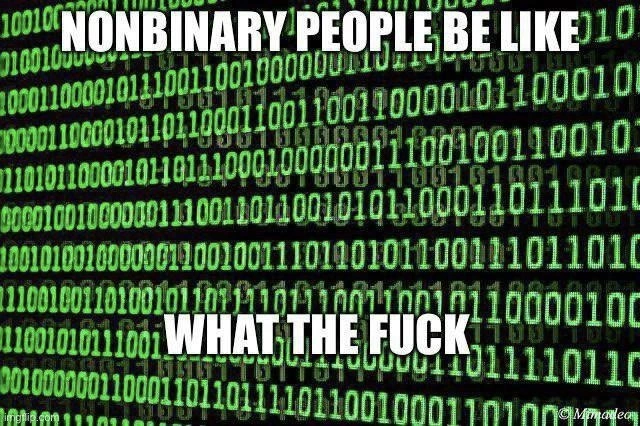
Now, on top of that background, the meme has text in big white letters. It uses the classic bold Impact font that many memes use (white text with a black outline). The top line says “NONBINARY PEOPLE BE LIKE” and the bottom line says “WHAT THE FK”** (uncensored in the actual image). When a meme says “X be like: ‘Y’,” it’s portraying a humorous example of what X might say or how X might react in a given situation. It’s a popular meme format for jokes. So here, “nonbinary people be like ‘WTF’” means the meme is joking that nonbinary people, upon seeing something, would react by saying “What the f**k?!” (which is a very emphatic way to say “What in the world?!” or “I’m extremely confused/annoyed!”).

Let’s clarify the term nonbinary in this context: This has nothing to do with binary numbers. Nonbinary is a term for gender identity. If someone is nonbinary, it means they don’t identify strictly as a man or a woman; they might identify as both, neither, or something outside the traditional two genders. It’s part of the LGBTQ+ community’s understanding of gender diversity. Think of it this way: many forms or legal documents might ask you to tick “M” or “F” for male or female — that’s a binary choice for gender. Nonbinary people are those who say, “I don’t fit into just those two boxes.” So, the word “binary” in gender discussions refers to that two-option system (male/female). Nonbinary, by definition, means “not limited to two.”

The humor of the meme comes from a play on words: “binary” has these two meanings — one in tech (zeros and ones) and one in gender (male/female categories). A person who is nonbinary (gender-wise) encountering literal binary code (tech-wise) is the scenario depicted. The top text sets up who we’re talking about (“nonbinary people”) and hints that we’re about to see how they react. The bottom text “WHAT THE FK”** is the comedic payoff — it suggests that nonbinary folks would look at a screen full of only 0s and 1s and respond with a big, bewildered expletive. In plainer terms: “A nonbinary person would look at all these zeros and ones and go, ‘What the heck am I looking at?!’”

Why would they react that way? It’s basically pointing out how absurd it can feel for someone who doesn’t believe in only-two choices to see an entire system built on only-two values. It’s like a little inside joke for people who know both tech and a bit of gender terminology. If you know one meaning of binary but not the other, the meme might confuse you. But if you know both, it clicks: it’s funny because the computer world is literally binary (no other options but 0 and 1 everywhere), and here you have a group of people (nonbinary folks) whose very identity is about not fitting into a strict two-option framework. So their exaggerated “WTF” reaction is like saying, “This binary stuff is wild, it’s nothing like the way I see the world.”

The categories and tags around this meme clue us into what it’s about. CSFundamentals is relevant because binary code is a fundamental concept in computer science. BooleanLogic is another tag: that refers to the true/false, yes/no logic that underpins binary decisions in code (for example, a boolean variable in many programming languages can only be true or false). The meme is poking at that idea of only-two-options in a very different arena (gender). The tags also mention DevCommunities and RelatableHumor – this indicates the meme is meant to resonate with people in developer or tech circles and make them chuckle in recognition. Indeed, by 2021 (when this was posted), a lot of developer communities were openly discussing diversity and inclusion (like acknowledging nonbinary identities), so this meme fits that culture: it’s techie and also socially aware. It’s the kind of joke you might see on a programming forum or a developer meme page where people appreciate both the nerdy reference and the inclusive nod.

Let’s also note the visual style: the green “zero one pattern” in the background isn’t random. It’s specifically referencing a famous hacker/movie image, which gives the meme a bit of MemeCulture flair. Even if you haven’t seen The Matrix, you’ve likely seen that code rain image used in various memes to denote something very technical or “computer-y.” It immediately tells your brain, “this joke is about programming or computers.” So when the top text suddenly says “nonbinary people,” your brain does a little double-take: “Wait, we’re mixing computer stuff with gender identity?” That little surprise is part of the comedic effect. And then the blunt “WHAT THE F**K” at the bottom is so direct that you can’t help but hear it in your head, almost like a comedic timing beat in a skit. The profanity also adds to the humor by being an over-the-top reaction — in memes, using a strong phrase like that can make the exaggeration clear.

In summary, this meme is explaining a joke through its imagery and words: Computers speak in a binary language of 0 and 1, but nonbinary people (by definition) challenge the idea of having only two categories. So if you imagine a nonbinary person looking at a wall of just “0 1 0 1 1 0 0 1...” everywhere (like in the picture), you get this funny scenario where they’re like, “Ugh, seriously? It’s all just two symbols?!” expressed in a very frank, meme-ish “WTF”. It’s a straightforward gag that combines tech knowledge with social knowledge. You don’t need to be an expert in either to get it, but you do need to know a little: what binary code is, and what nonbinary means. For a junior developer or someone new to either concept, this meme is a quick lesson wrapped in a joke: it teaches that computers think in binary, and also gives a nod to the idea that gender can be nonbinary. And it does all that in one image with two lines of text — pretty efficient, if you think about it, and definitely relatable humor for those in the know.

Level 3: It's Not That Binary

The meme draws its humor from a clever play on the word “binary.” In the world of computers and software (where terms like Boolean logic and binary digits are everyday talk), “binary” means something specific: data represented using 0s and 1s, yes/no, true/false. In everyday language, especially in discussions of gender or ideas, calling something “binary” means it’s divided into two strict categories with no middle ground (like the idea that gender can only be male or female). Here we have both meanings colliding in one image. The top text declares, “NONBINARY PEOPLE BE LIKE,” and the bottom text responds with a big “WHAT THE FK”** (censored here as WTF). This setup is a classic meme formula—“X be like: Y”—which means “this is how X typically reacts.” It sets the stage for a tongue-in-cheek scenario: a nonbinary person (someone who doesn’t fit in only two gender categories) is confronted with a screen full of literal binary code (only two symbols everywhere), and their reaction is an unfiltered “WTF?!”.

Why is that funny to developers? For one, it’s a pun that only coding humor or tech humor circles would immediately get. The background is instantly recognizable to many devs: rows of neon green 0s and 1s on a black screen, famously known from The Matrix movie’s “digital rain.” In meme culture, that image is shorthand for “deep in the code” or “hacking in progress.” So visually, the meme screams “programming” or “computer internals” even before you read the text. Developers have all seen that trope and likely have joked about The Matrix themselves. Now, overlaying that is the phrase “NONBINARY PEOPLE.” This brings in a completely different context—gender identity—one that has nothing to do with programming on the surface. That incongruity is exactly where the humor sparks: it’s an unexpected mashup of a DevCommunity in-joke (Matrix binary code) with a piece of social commentary (acknowledging nonbinary identities).

The punchline “WHAT THE F**K” as the reaction works on multiple levels. It’s obviously a humorous, exaggerated expression of confusion or shock. Nonbinary folks (and really, anyone who doesn’t like being put in a strict either/or box) might indeed feel like saying “WTF” when confronted with something that has only two options and nothing else. This meme hyperbolically imagines a nonbinary developer opening a screen that is literally nothing but ones and zeros—the pure binary essence of code—and just recoiling in mock horror. It’s as if they’re saying, “Computers, what is this nonsense? Only two digits to express everything? What the heck!” The relatable humor element comes from that feeling of bewilderment. Plenty of us have had a moment in tech (or life) where we think, “Surely it can’t be just this oversimplified, can it?” Here it’s framed in a playful identity context. It’s nerdy wordplay: “nonbinary” (the gender term) versus “binary” (the coding term) — a perfect pun that only works because English uses the same root word for two very different concepts.

This juxtaposition also gently satirizes how overly simplistic certain systems can be. The meme resonates with many devs because tech work often exposes you to situations where a simple model isn’t enough for complex reality. A senior developer has probably seen real-world data or user needs that don’t fit neatly into a boolean or a binary flag. Consider the common example of gender in software systems: older database designs might have had a field isMale or a dropdown for gender with just “Male” or “Female”. That was a simplistic binary assumption which today feels outdated. Many modern applications have learned to be more inclusive, perhaps offering multiple gender options or a free-form field, precisely because people aren’t binary in identity. When a nonbinary person encounters a system that still operates on that old assumption, the reaction can indeed be “WTF – this doesn’t represent real life!” In developer terms, it’s like the system threw an exception because it got an input it wasn’t built to handle. Here’s a lighthearted pseudo-code example of that old assumption:

bool isMale = true;
if (!isMale) {
    // assume female
    cout << "Gender: Female" << endl;
}
// Nonbinary? Sorry, not supported by this 1-bit logic.

In the code above, there are only two states accounted for: Male or Female. If someone’s gender doesn’t fit that binary, the program logic has no idea what to do — it wasn’t coded with a third case. This is a humorous analogy to the meme’s scenario: the binary code on screen is like a program that knows only 0 or 1, and the nonbinary person is like an input value that isn’t covered by that program’s assumptions.

Within dev communities, there’s an extra layer of meta-humor: developers have a long tradition of joking about binary and its quirks. A classic nerd joke goes, “There are 10 kinds of people in the world: those who understand binary and those who don’t.” Upon first glance, someone might read “10” as ten (in decimal), but in binary “10” actually means 2. So that joke sneakily divides people into two groups (those who get the joke and those who don’t), illustrating binary understanding by example. In our meme, a similar playful logic is at work but with a modern, inclusive twist. It’s essentially saying: “There are 10 kinds of people in the world: those who think everything is just 0/1, and those who are like ‘WTF, it’s not that simple!’” The nonbinary devs here represent those who know life and identity can’t be fully represented with just a single bit.

Another reason seasoned developers chuckle at this meme is that it reflects the community’s increasing awareness and support of diversity, delivered in a geeky package. Tech circles today include many outspoken nonbinary and LGBTQ+ members, and referencing their identity in a programming joke is both a nod of recognition and a way to normalize it. It’s saying, hey, we can joke about our code and also about our identities in the same breath — and it’s cool. It’s almost a form of insider humor at the intersection of two different “insider” groups: the programming world and the gender-diversity world. Seeing the term nonbinary used in a casual, humorous way alongside hardcore coding fundamentals (like binary digits) signals an inclusive vibe: that this community acknowledges nonbinary people enough to make light-hearted memes about the concept.

In essence, the meme gets a laugh from experienced devs because it’s so spot on. It highlights a real truth (computers are literally binary) and a social truth (gender isn’t binary for everyone) in one very simple image. It pokes fun at the absurdity of a rigid two-option system. And if you’ve spent any time maintaining legacy code or legacy systems, you know how often human complexity crashes into simplistic old assumptions. BooleanLogic in coding is powerful for machines but blunt for representing human reality. So the shared knowing smile here comes from recognizing that contrast. It’s the same kind of wry laugh a dev might have when a business stakeholder asks, “Can’t we just make this a yes/no question?” for something that is clearly more nuanced. Developers love to joke that “there’s no such thing as maybe in a boolean,” but life is full of “maybes” — and this meme personifies that idea with a nonbinary character calling out the code world’s beloved 0s and 1s. It’s a cultural commentary delivered through relatable humor: a perfect example of how meme culture in tech can convey a lot with very little text.

Level 4: Beyond Boolean Boundaries

At its core, all digital computing boils down to binary decisions: everything is represented by 0s and 1s. This is a direct result of how computer hardware and logic were designed. In classical computation, a bit (binary digit) is the smallest unit of information and it can only exist in one of two states. This binary principle comes from Boolean logic, a system of algebra defined by George Boole in the 19th century, where every statement is either true or false. Computers implement this through tiny electrical switches (transistors) that are either on (1) or off (0)—there’s no in-between state in normal operation. The Matrix-green code aesthetic in the meme (cascading 0s and 1s) visually represents this idea: a world where every piece of data, every instruction, is ultimately encoded in a long sequence of ones and zeros. It’s a dramatic illustration of the computer’s strict black-or-white, yes/no view of information.

Why did we stick with 0 and 1? The physical reality of computing devices made binary the most reliable base. A transistor or vacuum tube can be in a high-voltage state or low-voltage state (on/off) with clear distinction, which is robust against noise. In contrast, if you tried to have three or more stable voltage levels (to build a “ternary” computer), distinguishing them becomes harder as circuits get complex and signals degrade. Early computer scientists like Claude Shannon showed that you could map Boolean algebra to electric circuits — basically discovering that a system of switches can perform logic and math if you treat true = 1 and false = 0. With that, the entire modern computing architecture was built around strings of bits. CS fundamentals courses often emphasize this: no matter how fancy your high-level code is, at the lowest level it’s all binary patterns being processed.

It’s not that mathematics or logic requires only two values; that’s just the simplest useful case. There are indeed theories of multi-valued logic (where you can have more than two truth values). For example, ternary logic would allow 0, 1, 2 as distinct states, and fuzzy logic allows a continuum between 0 and 1 (like 0.7 meaning “partially true”). Researchers have even built experimental ternary computers and fuzzy logic controllers. But binary won out in practice because of engineering simplicity and reliability. We can illustrate binary’s exclusivity in a cheeky way:

Symbol Meaning
0 false / off / no
1 true / on / yes
0.5 or 2 maybe / other (not allowed in binary)

In the table above, anything that isn’t 0 or 1 just doesn’t naturally exist for a normal bit — the strikethrough hints that a “maybe” value is nonsense to a standard computer. A bit can’t hold “maybe” or “both” or “something else”. It’s like a rigid two-slot system.

Even the futuristic realm of quantum computing, which introduces qubits, sticks to a binary measurement at the end. A qubit (quantum bit) can exist in a superposition of states (in a way, it’s both 0 and 1 at the same time until observed). That sounds like a “non-binary” bit, right? But crucially, when you measure a qubit, it collapses to either 0 or 1 — you still get a binary outcome. In other words, even quantum computers, for all their mind-bending physics, ultimately output information as classical bits (just with probabilistic results). There is no stable third option that you can directly read out; you only ever get a sequence of 0s and 1s after measurement. So in a deep theoretical and physical sense, computing as we commonly know it runs on binary distinctions with no room for a literal third symbol in normal operation.

Now, consider what this meme is poking fun at: the strict binary encoding of computer logic versus the idea of “nonbinary” in human terms. From a theoretical perspective, it’s almost poetic: machines live in a universe of {0,1}, a tidy Boolean algebra, whereas human gender identity (the context for nonbinary people) operates in a much richer space that isn’t constrained to two states. The humor emerges from this stark contrast. It’s as if the meme asks: What happens when an unstoppable force (real-life complexity) meets an immovable object (computer binary)? For someone who identifies as nonbinary (meaning their gender isn’t exclusively male or female), seeing a wall of only 0s and 1s is like encountering an alien world governed by an overly simplistic rule. In a sense, the meme highlights a fundamental truth in a cheeky way: not everything in reality can be distilled down to a binary. The digital rain of zeros and ones is a symbol of tech’s binary heart, and the nonbinary person’s reaction (“WTF”) is a blunt, humorous acknowledgement that human reality doesn’t run on such absolute black-and-white logic. This is a high-level chuckle at the expense of computing’s beautiful yet rigid foundations.

Description

A meme with a black background filled with green, glowing binary code, reminiscent of the Matrix. At the top, in bold white letters, it says 'NONBINARY PEOPLE BE LIKE'. At the bottom, also in bold white letters, it says 'WHAT THE FUCK'. This meme is a pun, playing on the dual meaning of 'binary'. In computing, binary is the base-2 number system of 0s and 1s that forms the foundation of all digital systems. In the context of gender, 'nonbinary' describes a gender identity that is not exclusively masculine or feminine. The joke is a literal and humorous take, imagining a nonbinary person's bewildered reaction to a screen full of binary data, highlighting the amusing collision of tech jargon and social identity terminology

Comments

8
Anonymous ★ Top Pick I'm not nonbinary, but I still say 'what the fuck' when I see undocumented legacy binary protocols
  1. Anonymous ★ Top Pick

    I'm not nonbinary, but I still say 'what the fuck' when I see undocumented legacy binary protocols

  2. Anonymous

    Architect’s epiphany: storing gender in a BIT(1) column was the real tech debt - now that we’ve migrated it to JSONB, the query planner is still trying to cast humanity to BOOLEAN

  3. Anonymous

    When you're a nonbinary engineer and realize you've spent 20 years working exclusively with systems that only understand two states - suddenly every null pointer exception feels like a small victory for representation

  4. Anonymous

    This meme perfectly captures the cognitive dissonance of being nonbinary in a field where literally everything - from your CPU's transistors to your database's boolean flags - operates on strict binary logic. It's the ultimate 'return 0 or return 1' situation, except for humans who've implemented a more sophisticated type system than C's int. Perhaps we need to upgrade humanity's architecture to support ternary computing, or at least add a 'null' state for those who identify outside the traditional boolean domain

  5. Anonymous

    People say computers are binary; then your boolean hits SQL and becomes TRUE, FALSE, and NULL - the third state that quietly nukes half your LEFT JOINs and turns into a Friday night Sev‑1

  6. Anonymous

    Non-binary input to a strict bit enum: instant SIGSEGV on the gender field

  7. Anonymous

    Every is_enabled boolean lives long enough to become enum {No, Yes, ItDepends} - binary is for bits, not requirements

  8. @V0W4N 5y

    01101100 01101101 01100001 01101111

Use J and K for navigation