Skip to content
DevMeme
1821 of 7435
Geopolitical Data Compliments: Cisco vs. Huawei
Security Post #2029, on Sep 10, 2020 in TG

Geopolitical Data Compliments: Cisco vs. Huawei

Why is this Security meme funny?

Level 1: Stranger Danger

This meme is like a trust lesson at work. Imagine you have a special secret, like a private diary. One day, your close friend (whom you trust) says, “Hey, nice diary entry!” You’d probably smile and say thanks, because you know your friend means well and isn’t going to misuse your secret. Now imagine a stranger or someone your family warned you about says the exact same thing: “Hey, nice diary entry.” You would get a shock: how did they see your diary?! You might run to tell a teacher or parent that this suspicious person has been snooping.

In the comic, Susan’s “data” is like her diary or important secret work, and the Cisco guy is the familiar friend while the Huawei guy is the stranger she’s wary of. When the friendly, trusted person compliments her data, she feels happy (a little heart appears because she’s flattered). But when the unknown/suspicious person says the same, she panics and calls for help (“Hello, Government?” is like yelling “Help, police!”).

The joke shows how the same compliment can feel totally different depending on who it comes from. It’s pointing out that in real life we tend to feel safe with those we trust and get scared if someone we don’t trust suddenly shows interest in our private stuff. In simple terms: a nice comment from a friend = sweet, but the same comment from a stranger = scary.

Level 2: From Compliment to Crisis

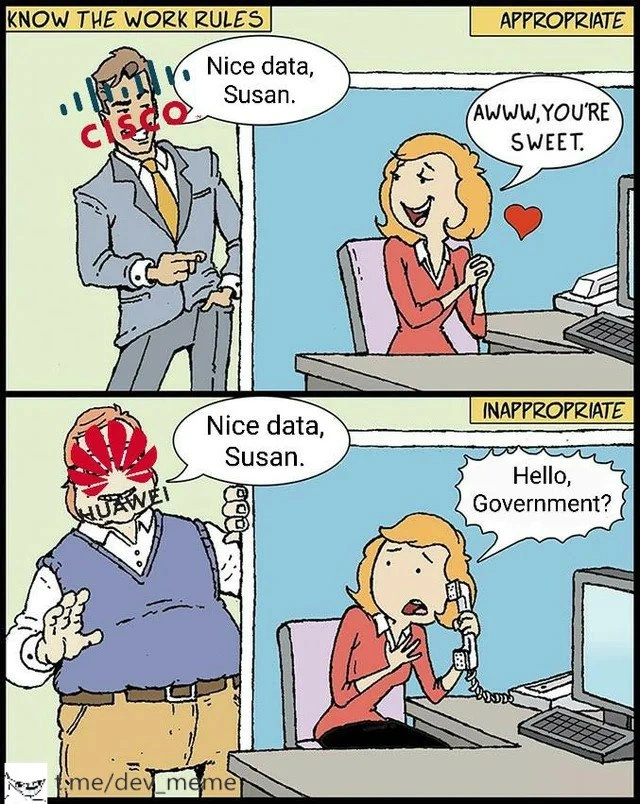
Let’s break this down in simpler terms. In this comic, the same office scenario happens twice with only one key difference: the company logo on the man’s face. In panel one it’s Cisco, a big American tech company known for making the routers and switches that run the internet. In panel two it’s Huawei, a big Chinese tech company that makes similar networking gear (and smartphones). Both times, the man says, “Nice data, Susan.” — he’s complimenting Susan’s data. Susan is just an office worker at her computer.

When the Cisco guy says “Nice data,” Susan reacts like he gave a normal compliment: she smiles, blushes, and even a little heart appears (she’s flattered and thinks “aww, how sweet”). That scene is labeled “APPROPRIATE,” as in appropriate behavior at work. It suggests that coming from Cisco, this comment is totally fine and professional. Why? Because Cisco has a trusted reputation in her eyes and in her company’s culture. Cisco equipment and people are generally trusted by Western companies – they’re the familiar, “safe” vendor. So a Cisco representative noticing or complimenting data seems normal, maybe even like praise for her good analysis or well-managed network data. There’s no fear — it’s just a nice interaction.

Now look at the second panel, labeled “INAPPROPRIATE.” This time the man has the Huawei logo on his face but is otherwise doing the exact same thing: saying, “Nice data, Susan.” Susan’s reaction couldn’t be more different: she looks shocked and immediately grabs the phone in a panic, saying “Hello, Government?” (as if she’s calling some government security agency or maybe her company’s security office to report a problem). Why such a freak-out? It’s because Huawei has a not-so-trusted reputation in that context. Many people (especially in 2020 when this meme was made) have heard news that Huawei could be a security risk – some governments and companies were worried that Huawei’s networking equipment might have “backdoors” allowing the Chinese government to spy on data. In other words, privacy concerns surround Huawei: folks fear that using Huawei’s devices could lead to a data breach or surveillance because the vendor might secretly pass data to authorities.

So, in the comic, when the Huawei guy says “Nice data,” Susan interprets it as “Uh oh, how does he know about my data? Is he spying on it? This is a security emergency!” Her instinct is to call the government, implying she’s reporting a potential security issue or espionage attempt. The humor comes from that extreme double reaction: the exact same compliment is fine from one source but a crisis from another. It’s showing how much vendor trust (or lack thereof) changes our interpretation of a situation. In an office analogy, it’d be like the rules saying it’s okay for a well-known colleague to compliment your work, but if a stranger or someone controversial does it, it’s suddenly not okay.

To a junior developer or someone new in tech, here’s the context: Cisco is a very established networking company that most businesses use without second thought. Huawei, while huge globally, got tangled in accusations of being influenced by the Chinese government. Around 2018-2020, countries like the US, UK, and others were restricting or banning Huawei equipment in critical networks (like 5G cellular networks) because they feared it could be used for spying. This was all over tech news. Companies even had to consider if using Huawei gear might get them in trouble or put their data at risk. That’s why Huawei’s presence in this comic causes a scare.

A few terms to know:

  • Data Privacy: Protecting data so only people (or companies) who are authorized can see it. Susan’s “data” should be private and safe from prying eyes.
  • Security/Surveillance fears: Worries that someone unauthorized (like a hacker or an untrusted vendor) might be watching or recording data. In the second panel, Susan fears Huawei = someone might be secretly watching her data.
  • Supply chain security: This refers to making sure all the hardware and software you use (your supply chain) is secure and not tampered with. Huawei being in the supply chain worries people that something could be fishy inside their products. In contrast, Cisco is generally accepted as secure in that supply chain for Western companies.
  • Vendor Lock-In: This is when a company relies heavily on one vendor’s products, making it hard to switch. It’s common with big vendors like Cisco – many companies stick with Cisco gear for years (partly because they trust it and their whole network is built on it). If a new vendor comes in (like offering cheaper switches), a company might hesitate especially if there are trust issues. Here, Cisco is the incumbent that nobody questions, and Huawei is the “new” option people are wary of.

The comic also spoofs those workplace conduct guides. “Know the work rules” usually means know what’s okay or not okay at work. It’s funny because normally that refers to personal behavior (like dress code or comments to colleagues). Here it’s absurdly applied to data compliments and who’s saying them. Basically: Complimenting Susan’s data is only okay if you’re from an approved vendor! This jokingly reflects how in corporate culture, some companies are seen as friendly partners and others are seen as potential threats.

For a junior dev, think of it this way: imagine you just finished working on a project and an approved vendor (say a consultant from a company your team works with regularly) says “Good job, nice code!” You’d feel good about it. But if a stranger from a controversial company peeked at your code and said the same, you’d be like, “Wait, why are they looking at my code? Are they even allowed to? I should report this.” That’s essentially what’s happening with Susan and her data. It’s a mix of TechHumor and genuine PrivacyConcerns wrapped in a simple cartoon.

Level 3: Root of Trust Issues

At first glance, this comic plays on supply-chain security paranoia in a corporate setting. The exact same phrase“Nice data, Susan.” – triggers two opposite reactions solely because of the speaker’s vendor identity. In the “Appropriate” panel, a suave man with the Cisco logo for a face compliments Susan’s data and she reacts with a blush and a heart. In the “Inappropriate” panel, the same line spoken by a man with the Huawei logo for a face causes Susan to panic and dial authorities, blurting out > “Hello, Government?”

This stark contrast satirizes a vendor double standard deeply rooted in tech industry trust and geopolitics. Cisco Systems, an American networking giant, is portrayed as a trustworthy presence — the kind of vendor whose reps wander corporate hallways freely, where a comment on your “nice data” comes off as a harmless, even flattering, remark. On the other side, Huawei, a Chinese telecom equipment titan, is depicted as the boogeyman of enterprise IT. The Huawei rep’s identical compliment ignites surveillance alarms: Susan immediately suspects espionage, as if the praise means “I’ve peeked at your data” or “your secrets are ours now.” The humor hits home for engineers and IT professionals who’ve seen how one vendor’s gear is embraced as safe while another’s identical gear (or comment) is treated like a Trojan horse.

Why is this funny (and a bit painful)? It underscores the current reality of network_hardware_trust biases. In real life, companies make a big deal about trust boundaries – who and what gets access to sensitive data. Cisco, being a long-established US-based provider, is implicitly inside that trust boundary for many Western firms. It’s the devil you know: decades in networking, lots of certified products, subject (in theory) to US laws and oversight. A Cisco guy complimenting data is like an old friend saying “Good job on that spreadsheet” – innocuous. Meanwhile, Huawei has been painted by Western governments as a potential supply_chain_espionage agent: its hardware could contain hidden backdoors, and the company could be compelled by Chinese authorities to hand over data or facilitate government_surveillance. So when Huawei-guy says the same line, it’s suddenly interpreted as “I’m already spying on you, Susan” – hence she calls the government on him. The meme exaggerates this privacy paranoia in a way tech folks find hilarious because it’s so on the nose. We’ve all sat through security briefings or news cycles where one vendor is demonized while another gets a free pass for essentially similar behavior, purely due to national origin and reputation.

There’s an undercurrent of irony here that a seasoned developer or network engineer would appreciate. The DataPrivacy concern is obvious – someone untrusted showing interest in your data sets off alarm bells. But consider the absurdity: Cisco’s compliment assumes he can see Susan’s data too, yet nobody’s panicking about that. It’s a jab at how corporate_reputation_bias works. We trust Cisco not to abuse access, but suspect Huawei of doing exactly that. It’s a classic case of “It’s fine when our guy does it”. History has given some reasons for these attitudes: by 2020 (when this meme was posted) the U.S. government had banned Huawei equipment from critical infrastructure, citing national security. Countries were ripping out Huawei 5G gear because of what might be in it – a fear of hidden backdoors enabling foreign government surveillance_fears. Huawei was effectively labeled an inappropriate presence in the network – much like in the comic where his mere compliment is “INAPPROPRIATE” workplace behavior. Cisco, despite some past security issues (even NSA was rumored to intercept Cisco routers in transit during the Snowden era), enjoys a status as the appropriate, trusted vendor. This contrast is the crux of the joke: the data_comment_double_standard in action.

The meme also riffs on corporate culture and HR training tropes. The top banner “KNOW THE WORK RULES” and the labels Appropriate vs Inappropriate mimic those cheesy office posters about proper conduct. Typically, you’d see examples like how to compliment a colleague without being creepy. Here it’s twisted into a lesson about what’s “proper” based on vendor identity: a playful dig at how even casual data banter is subject to security clearance. It’s like an unofficial rule in some IT departments: If a Cisco engineer says something about our data center, cool – if a Huawei engineer even hints at it, report to InfoSec! The shared laugh comes from recognition: people in tech have witnessed or read about this exact awkwardness. For instance, a Huawei sales rep visiting a U.S. company might be met with polite, tight smiles and escorted everywhere, while a Cisco rep roams freely chatting about the network. It’s a funny, exaggerated mirror of how security paranoia and geopolitics seep into everyday office interactions.

In summary, this top-level analysis shows the meme is leveraging technical trust issues, industry history, and global politics for humor. It highlights the PrivacyConcerns around data when a less-trusted vendor is involved. Seasoned folks chuckle (perhaps a bit cynically) because they know the joke reflects real debates in boardrooms and network ops meetings: Which vendors can we really trust with our “nice data”? It’s both humorous and uncomfortably true that a simple compliment can be viewed through the lens of espionage when corporate reputation is on the line.

Vendor Reputation/Perception “Nice data, Susan.” interpreted as…
Cisco 🇺🇸 Trusted US network mainstay A harmless compliment on good work. ❤️
Huawei 🇨🇳 Suspected foreign tech risk A possible sign of spying – sound the alarm! 🚨

Description

A two-panel comic strip titled 'KNOW THE WORK RULES' contrasts reactions to the same compliment from different tech companies. The top panel, labeled 'APPROPRIATE', shows a well-dressed man with the Cisco logo over his face saying, 'Nice data, Susan.' A woman at her desk, Susan, reacts with a smile and a heart, saying, 'AWWW, YOU'RE SWEET.' The bottom panel, labeled 'INAPPROPRIATE', depicts an unkempt man with the Huawei logo over his face saying the identical phrase, 'Nice data, Susan.' In this scenario, Susan is shown with a terrified expression, clutching the phone and asking, 'Hello, Government?'. The meme's humor is rooted in the geopolitical tensions and security concerns surrounding Huawei in the late 2010s and early 2020s, particularly in Western countries. The joke is that while a compliment from a US-based company like Cisco might be seen as harmless, the same words from Huawei are interpreted as a threat of data espionage due to its alleged ties to the Chinese government, making it a matter of national security

Comments

7
Anonymous ★ Top Pick The difference between a Cisco and a Huawei engineer complimenting your data is the difference between a feature request and a subpoena
  1. Anonymous ★ Top Pick

    The difference between a Cisco and a Huawei engineer complimenting your data is the difference between a feature request and a subpoena

  2. Anonymous

    When a Cisco box phones home we call it “smart telemetry”; when a Huawei box does it we spin up a SEV-1 bridge and brief the board

  3. Anonymous

    The only difference between a compliment and a data breach is whether you remembered to update your privacy policy's legitimate interest checkbox for "workplace banter" purposes

  4. Anonymous

    The real horror isn't the data bandana - it's realizing your company's access control policy is 'if they can see the screen, they can read the data.' At least this Susan knows to call the authorities; most organizations don't discover unauthorized data access until the breach notification deadline has already passed. Pro tip: If your colleague starts wearing clothing with 'DATA' emblazoned on it, that's not agile methodology enthusiasm - that's a walking GDPR violation waiting to happen

  5. Anonymous

    Same compliment, same packets; our threat model is f(vendor) ∈ {friendly banter, escalate to regulators} - procurement sets the prior

  6. Anonymous

    The CAP theorem of office compliments: consistency impossible, HR availability always eventual

  7. Anonymous

    Our zero trust is mostly vendor trust: “Nice data” from Cisco is small talk; from Huawei it’s a compliance incident with TLAs on CC

Use J and K for navigation