The Infinite Loop of Unclear Requirements
Why is this Stakeholders Clients meme funny?
Level 1: You Can’t Eat a Diploma
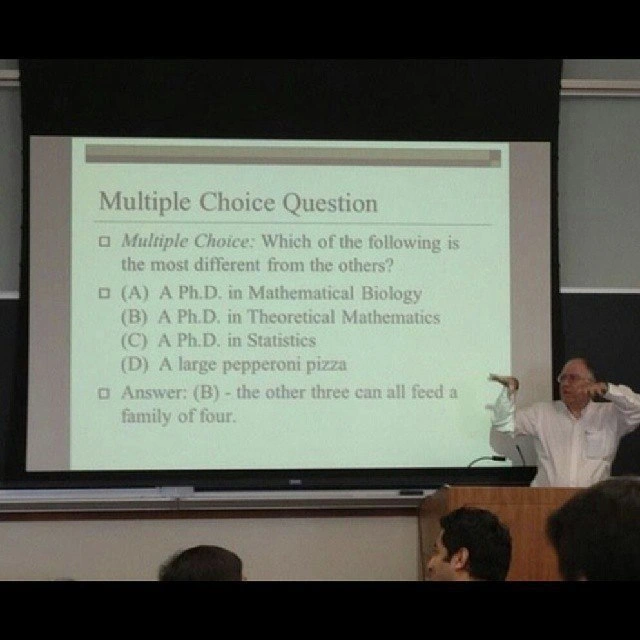
Imagine two people: One spent many years studying super advanced math theories – they have a fancy Ph.D. diploma on the wall, but now they don’t have much money. The other person just has a big pepperoni pizza to share. When dinner time comes, which one helps a family eat? The pizza! 🍕 The joke is that a piece of pizza can fill your tummy, but a piece of paper (a diploma) can’t. It’s a funny way of saying sometimes learning something very fancy doesn’t help you buy dinner, while something simple (like a pizza) can do the job of feeding everyone. It’s silly and a bit sad – you might be really smart, but you still need actual food (or a good-paying job) to take care of your family.
Level 2: Slices vs. Salaries
Let’s break down what’s happening in simpler terms. The slide lists four choices: three of them are Ph.D. degrees in different math-related fields, and the last is a large pepperoni pizza. A Ph.D. is the highest university degree – it means spending many years doing research to become an expert in a very narrow subject. Specifically:
- Ph.D. in Mathematical Biology (A) – a doctorate where someone studies how math can solve biological problems (like modeling ecosystems or diseases). This kind of degree can lead to jobs in biotech or research that usually pay decently, so someone with it could likely support (i.e. feed) a family.
- Ph.D. in Theoretical Mathematics (B) – a doctorate in pure math, focusing on abstract theories and proofs with no immediate real-world application (think of solving math puzzles about numbers or shapes just for knowledge’s sake). Jobs for these folks are often limited to being a professor or researcher, which are hard to get and not known for high pay.
- Ph.D. in Statistics (C) – a doctorate in statistics, involving advanced data analysis and probability. Statisticians are in high demand (for example as data scientists in tech companies or government), and they tend to have well-paying jobs that can definitely support a family.
- A large pepperoni pizza (D) – just what it sounds like: a big pizza with pepperoni. This obviously isn’t a degree or a person, but literally food. A single large pizza can be dinner for a family of four people. 🍕
The multiple choice question format is used to set up a trick. It asks, “Which of the following is the most different from the others?” At first, you’d think the pizza (D) is the odd one out because it’s not an academic degree. But the Answer says (B) – the theoretical math Ph.D. Why? The slide’s answer jokes that the other three can all feed a family of four. In plain terms, options A and C (the applied Ph.D. fields) typically lead to jobs with enough salary to feed a family (an idiom meaning to earn enough money to support a family). Option D, the pizza, quite literally can feed a family of four as a meal. But option B, the theoretical math Ph.D., is implied to not be able to feed a family of four – meaning someone with that degree might not make enough money (or even have a job) to financially support a family. This is a classic academic vs. industry joke. Even though a Ph.D. in theoretical math is a huge intellectual accomplishment, the meme cynically jokes that it’s not very practical in terms of earning a livelihood. In developer and tech circles, we often see tech humor like this because many programmers either considered higher degrees or know people with advanced degrees. The slide’s joke format is also part of the humor: seeing such a multiple_choice_meme in a classroom makes it a playful academic slide moment. Essentially, it’s saying “fancy math knowledge is cool, but can it buy you pizza for your kids?” For a junior or someone new to this kind of humor, remember that “feed a family” here has a double meaning – literal food (the pizza) and having enough income. This meme uses that wordplay to compare the real-world value of different kinds of knowledge.
Level 3: Pure Math, Empty Stomach
At the highest level, this meme highlights the stark reality of academic career prospects with a dose of dark humor. The slide is formatted like a serious exam question – a multiple choice puzzle – but it's actually a tongue-in-cheek academic humor reference. Each option (A, B, C, D) represents either an advanced degree or, humorously, a pizza. The punchline reveals that the Ph.D. in Theoretical Mathematics (option B) is the odd one out because “the other three can all feed a family of four.” This twist satirizes the Academic vs Industry dilemma in career humor style: highly specialized scholars (especially in pure theory) often struggle financially compared to those in applied fields or even compared to something as basic as selling a large pizza. It’s an old quip in academia – the idea that a large pepperoni pizza can literally feed a family dinner, and metaphorically, a well-paying job (like those a Math Biology or Statistics Ph.D. might land in industry or data science) can “feed your family,” but a pure math researcher’s salary (or lack thereof) might not. For seasoned developers or tech folks, this resonates as tech satire because many have witnessed or personally faced the choice between pursuing esoteric knowledge and pursuing practical, high-paying skills. The meme strikes a chord: it pokes fun at how theoretical knowledge, despite its intellectual prestige, doesn’t always translate to real-world dough (money). Seeing this joke presented on an actual lecture slide (with the professor gesturing) adds to the humor – it’s lecture slide humor showcasing a real-life-style delivery of a classic PhD salary joke. In a room full of engineers who survived advanced math courses, everyone immediately gets the reference: this is developer humor that cross-pollinates with academic satire. They laugh (perhaps a bit ruefully) because it's too true: sometimes the highest education in math yields the lowest-paying job. It's a wry commentary on how the tech and academic worlds value different skills – with tech humor highlighting that even a humble pizza (or a pragmatic skill set) can have more practical value than an ivory-tower achievement when it comes to putting food on the table.
Description
This meme uses the 'Draw 25' card game format from Uno. It shows a man in a blue shirt holding a massive hand of cards, so many that he can't hold them all. He looks stressed and overwhelmed. The overlaid text on the top part of the image sets up a choice: 'MAKE THE REQUIREMENTS CLEAR OR DRAW 25'. The scenario implies that the person in the meme would rather draw 25 cards - a significant penalty in the game of Uno - than fulfill the task of creating clear requirements. This is highly relatable for senior developers and architects who frequently suffer the consequences of ambiguous or incomplete project specifications from stakeholders or product managers. The joke highlights the common organizational dysfunction where writing clear requirements is so arduous or avoided that teams would rather endure the massive 'penalty' of rework, bugs, and project delays that inevitably result from a poor foundation
Comments
7Comment deleted
The acceptance criteria for this ticket is just a URL to a competitor's website and the phrase 'Make it like that, but better.'
In our last architecture review I reused that slide: (A) full Rust rewrite, (B) microservices migration, (C) data-mesh initiative, (D) large pepperoni pizza - answer: (D); it’s the only option that ships in 30 minutes and never files a follow-up Jira
The same logic applies to choosing between a PhD in distributed systems theory and actually building one at scale - only one will keep your team from starving during the next incident
This is the academic equivalent of comparing Big O notation complexity: three Ph.D.s have O(n²) time-to-financial-stability while the pizza delivers O(1) family satisfaction. The real kicker? After defending your dissertation on distributed systems at 2 AM, you'll realize the pizza has better horizontal scaling properties and lower operational overhead than your career trajectory
Pizza scales horizontally to feed four; PhDs just vertically integrate into grant-proposal monoliths
Answer (B): same rule we use in architecture reviews - A, C, and D deliver something consumable; B is a 120-page proof with zero endpoints and no SLO
Career counseling in one slide: stats and math-bio (and pizza) give a constructive proof of dinner; theoretical math only proves a family of four exists