Skip to content
DevMeme
5241 of 7435
AI Image Merging: Dune Meets Classical Music
AI ML Post #5749, on Dec 16, 2023 in TG

AI Image Merging: Dune Meets Classical Music

Why is this AI ML meme funny?

Level 1: Silly Story Mixer

Imagine you have two very different storybooks: one is about a desert planet with giant worms and people in robes, and the other is about a fancy music concert where the audience is a bunch of potted plants. 😃 Now picture asking someone to make one single drawing that combines both stories. They might draw a huge hollow worm-like tunnel laying on red sand, and inside it put a beautiful garden with lots of green plants. Then they’d add some musicians in tuxedos playing violins right there in the desert, as if the plants came for a music show. It sounds crazy, right? That’s exactly why it’s funny! It’s like mixing toys from two completely different playsets to create one wacky scene. The AI computer basically played pretend: it took the space desert idea and the plant concert idea and mushed them together into one picture. The result is surprising and silly – we don’t normally imagine musicians serenading plants on Mars – but it looks kind of cool, too. It makes us laugh because our brains go, “Wait, plants don’t go to concerts, especially not on a desert planet!” but the picture treats it seriously, as if that’s totally normal. It’s that mix of serious look and nonsense idea that tickles our imagination. In simple terms, the meme is funny because it’s like telling a child to combine two completely different drawings – the surprise of seeing them together is both weird and wonderful, just like a goofy make-believe adventure.

Level 2: Mashup Mechanics

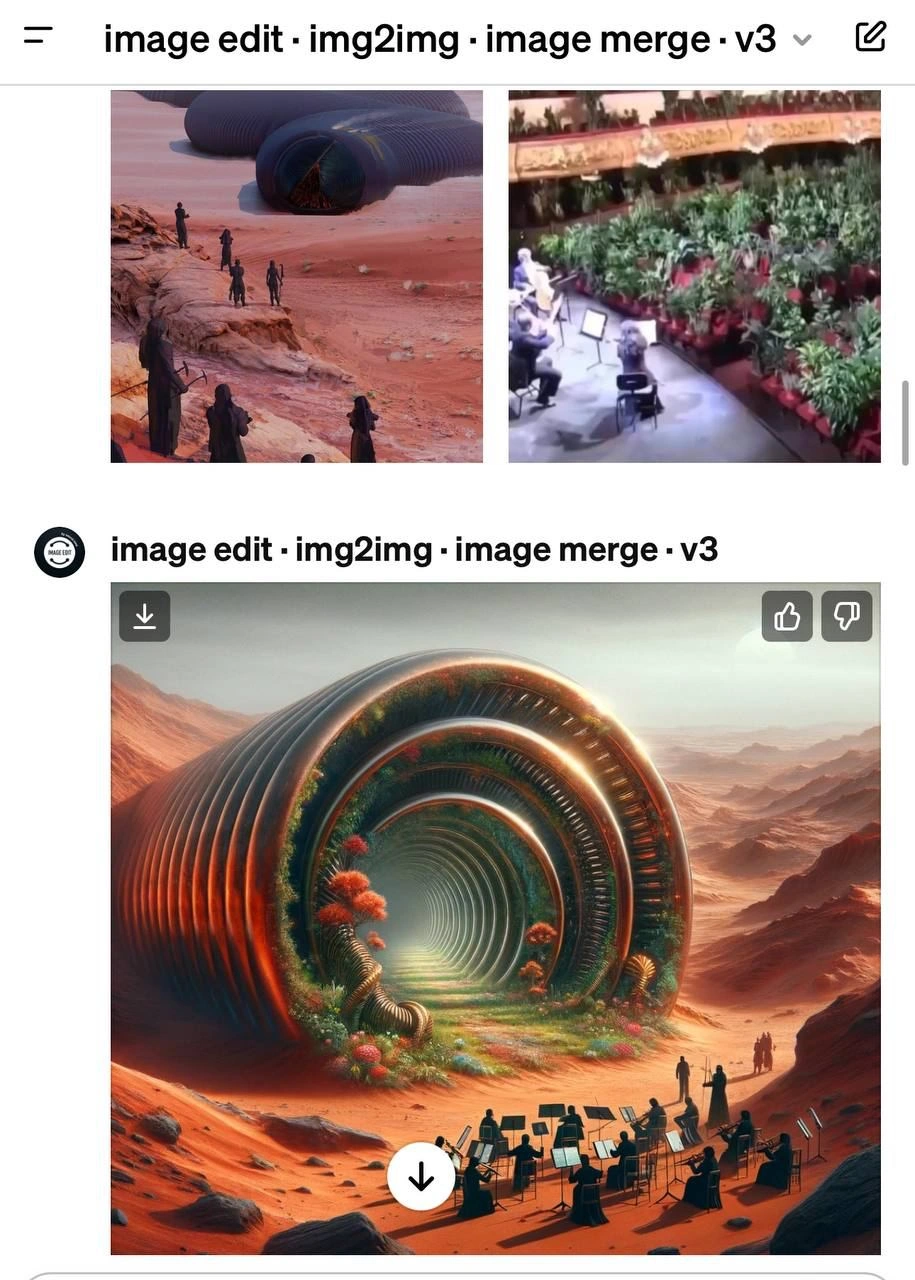
Let’s break down what’s going on in more straightforward terms. This meme is about an AI art tool (an application of artificial intelligence in image generation) that took two very different images and merged them into one. The interface text img2img · image merge tells us the mode being used: img2img stands for “image to image”. In an img2img process, you give the AI an existing image, and it tries to create a new image based on it, usually guided by some instructions or prompts. Here, it looks like the tool allowed image_merge, meaning it accepted two input images: one of a desert scene from Dune (a famous science fiction universe set on a desert planet with giant sandworms), and one of a quirky real-life scene where a string quartet (four classical musicians playing violins, viola, cello) performed a concert to an audience of potted plants. Yes, that second image isn’t sci-fi – it actually happened as an art installation, and videos of an orchestra playing to rows of green plants went viral, making it a bit of an internet meme itself.

The AI took these two source images and, using a Stable Diffusion model under the hood, generated a single output image that combines elements of both. Stable Diffusion is a popular machine learning model for generating images. It learned from a huge database of pictures and can create new images based on what it’s learned. It often needs a text prompt to know what to make, but it also has modes like img2img where you feed in pictures to guide it. Think of Stable Diffusion as an extremely advanced graphics program that doesn’t follow explicit rules or templates, but instead “imagined” a new picture by blending the patterns it knows from other images. When you use two images as input in an image_merge, the model tries to satisfy both inputs: it’s a bit like telling the AI “make something that looks like these two things combined.”

Prompt engineering is a term you might hear in this context. It means crafting the right input (text descriptions or example images) to influence the AI to get the result you want. Early career folks experimenting with these tools learn that how you ask the AI for an image – or what reference images you feed it – can drastically change the outcome. In this meme’s case, the “prompt” was essentially the two images themselves (possibly with some textual guidance like “a concert in a desert tunnel for plants”). The AI then goes through a process of trial and error internally, starting with a random fuzzy image and gradually making it clearer to resemble the requested mashup. This iterative refinement is the diffusion process: it’s called that because the algorithm initially adds noise and then “diffuses” the noise away step by step to form the picture, guided by the input. It uses a lot of math and patterns from training data to do so, but you don’t see that part – you just see the final result after the AI has tried many tiny changes that eventually turn random static into a coherent image.

Now, what do we see in the final image? The bottom frame (the AI-generated one) shows a red-rock Martian-looking canyon (inspired by the Dune desert scene) with a huge tube or tunnel structure across it. This tunnel has ribbed, segmented sides just like the idea of a gigantic sandworm (in Dune, sandworms are enormous creatures; the AI interpreted that shape as a metallic/architectural tunnel – pretty clever!). Inside the tunnel, it’s not empty or dark; it’s filled with greenery – trees, vines, and plants are growing lushly along the interior, which gives a sci_fi_greenhouse effect (imagine a greenhouse or biosphere but on Mars). Finally, in the foreground on the desert floor, we see the silhouettes of musicians in formal black suits or dresses, with musical instruments and music stands (drawn from the orchestra image). They’re arranged just like a small orchestra or quartet would be, seemingly performing amidst this surreal landscape. And rows of plants line up as their audience inside the tunnel, just like in that real concert photo where plants sat in the seats. All the key features from both input images are present: red desert dunes, a giant wormy tunnel, classical musicians, and potted plants. The AI really did merge the two scenes into one! That’s why the meme caption describes it literally: “Dune desert tunnel hosts orchestral concert for potted plants.”

For a newcomer, it’s worth clarifying some terms from the tags and categories:

  • AI_ML (AI/Machine Learning): This refers to the technology used – the image was created by an AI system that learned from data, rather than drawn by a human.
  • Graphics: Because it’s about image generation, it falls into computer graphics/multimedia territory – the kind of thing graphics programmers and digital artists are interested in. Instead of rendering with traditional tools, here the rendering is done by a neural network.
  • Tooling: The meme also highlights the tool/interface itself. AI art generation often involves new tools or UIs that developers create. The v3 might indicate this is version 3 of a particular image generation tool, suggesting it’s evolving with better features (like taking multiple images as input).
  • AIGeneratedContent: This just flags that the content (the picture) was made by AI. In recent years, you’ll see a lot of buzz about AI-generated content in art, music, text, etc. It’s a whole trend where models produce creative works.
  • AITools: The software used here is an AI tool – possibly something like an online image generator or a locally run program. Tools like these often provide modes like text-to-image, img2img, etc., to play with.
  • AIHumor: The result is being shared as a joke or a humorous example. People often find AI mistakes or unexpected creations funny, and communities share them for laughs. It’s humor stemming from what the AI did, often because it’s so outlandish or literal.
  • AIHype / AIHypeCycle: These tags refer to the excitement (and sometimes over-excitement) around AI. There’s a lot of hype around what AI can do. The “hype cycle” is a concept where a new tech gets a lot of attention, people get very optimistic (sometimes too much), then there’s a reality check when limitations appear, and eventually the tech finds a stable, practical place. This meme touches on that – it’s part of the fun, hypey phase of AI art where everyone is experimenting and sharing wild outputs, not all of which make sense, but they sure get attention!
  • StableDiffusion: This is the specific model (or family of models) likely used. Stable Diffusion became popular for being open-source and allowing users to run powerful image generation on their own hardware (if they have a good GPU) or via web services. It’s the engine behind many art tools. Knowing it’s Stable Diffusion tells us it’s using diffusion techniques and was trained on a broad range of internet images.
  • img2img and image_merge: We covered these, but to reiterate – img2img is giving the AI an image to base a new image on. image_merge here implies combining two images as the base. This isn’t a standard feature in all AI image generators, but some implementations let you do multi-image conditioning, effectively merging visual themes.
  • prompt_engineering: This is the skill of getting the AI to output what you intend. For example, if the first try had the worm but no plants, the user might tweak the prompt to emphasize plants more, or vice versa. Or adjust weights saying “pay 50% attention to image1 and 50% to image2”. It’s a bit of a new discipline where you learn tricks to communicate with the AI.
  • orchestral_meme, mars_tunnel, sci_fi_greenhouse: These are more specific descriptors. “orchestral meme” refers to the orchestra-for-plants scenario (because it was kind of a meme-able event). “mars_tunnel” describes the output setting: it really does look like a tunnel on Mars filled with life. “sci_fi_greenhouse” is exactly what the tunnel interior resembles – something out of a science fiction story where humans try to grow Earth plants in a Mars habitat or alien environment. And ai_art is just a general tag for art made by AI, which this certainly is.

For someone early in their career or new to this technology, what’s happening here is a great example of AI’s imaginative but unrestrained nature. The AI isn’t thinking like a human who might say “those two things don’t go together.” It’s more like, “Sure, I’ll put them together and see if I can make it look cool.” When you first use these AI tools, you might start with simple prompts like “a cat” or “a sunset,” but before long, you get curious and start combining ideas to see how far you can push it. It’s a lot like learning to code or use any powerful tool – you start experimenting. Maybe as a junior dev or artist, you’ll recall the first time you wrote a program to generate random combinations of words or images just for fun. The result can be buggy or nonsensical, but sometimes it’s surprisingly interesting. Here, the “bug” (or rather quirk) in the output is that it’s a totally unreal scene, yet visually convincing.

Also, consider how approachable this technology has become: an interface (like the one screenshotted) often lets you upload images or select modes with just a few clicks. You don’t necessarily need to write the complex code that runs the diffusion model; the tooling has abstracted that away. This democratization means even someone new to programming or AI can dabble in AIGeneratedContent. However, understanding what the model is doing (like we explained above) helps a lot in guiding it. For instance, knowing that the model might need a clear prompt or that it might latch onto dominant shapes and colors in the input images can inform how you choose or prep your images for merging. If one image is very bright and the other very dark, you might anticipate the merge could look odd unless adjusted. That’s the kind of practical insight one gains, which is akin to a junior developer learning how different inputs affect a program’s output.

In sum, this meme’s process can be explained like this: take two pictures, feed them to a smart computer program that learned to draw, and ask it to draw something that’s a mix of both. The computer will use what it “knows” about deserts, tunnels, orchestras, and plants to try to make a single scene. The outcome is a wild, imaginative image that makes us chuckle because of how perfectly it merges the two absurdly different ideas. It’s a bit of techie humor and awe rolled into one image – showing off what modern AI image generators can do, while also reminding us they don’t have the common sense to say “maybe not that.” And honestly, that’s part of the fun!

Level 3: Hype-Driven Hallucinations

From a senior developer’s perspective, this meme perfectly encapsulates the current AI hype cycle and the delightful hallucinations our models produce. We have two utterly unrelated scenarios – a scene from the sci-fi classic Dune and a real-life viral orchestral_meme (yes, that concert for potted plants actually happened in 2020 in a Barcelona opera house) – and the AI’s response is: mash them together and see what happens! It’s as if the neural network looked at these inputs and cheerfully declared, “Hold my GPU, I got this.” The humor here comes from the absurd surrealism of the output, but any practitioner familiar with generative AI will nod knowingly, because this is exactly what diffusion models do: they earnestly try to satisfy all prompts given, no matter how incongruous, often yielding bizarre AI humor. The developer community has seen an explosion of these mashups as AI art tools become mainstream – it’s a trend driven by both genuine artistic curiosity and meme-worthy experimentation. Every time new AI tools get released or updated (here we see a v3 version, implying new features like image_merge), enthusiasts flood social media with outrageous composites. It’s a virtuous cycle of hype: new capabilities inspire wild trials, which produce outrageous images, which then fuel more hype about the AI’s creativity. “AI can do anything!” people exclaim, sharing pictures of mars_tunnel greenhouses and tuxedo-clad musicians serenading succulents.

But an experienced eye also catches the tell-tale signs of AIHype meeting reality. We know these models are powerful, but we also know their output can be hit-or-miss. For every coherent and eerily beautiful scene like this, there are dozens of failed attempts – mangled hands on musicians, plants fused into instruments, or a worm-tunnel that just looked like a glitchy blob. Tuning an img2img prompt is a bit of an art; you juggle settings like diffusion strength or guidance scales, and often go through many iterations. In this case, the end result is impressively polished (perhaps after a few tries or careful prompt engineering). It highlights a common pattern: AI will hallucinate connections between concepts even where none logically exist. The model saw “desert tunnel” and “concert with plants” and decided, “Of course, the desert tunnel must be filled with plants and music!” – a solution only an AI (or a very imaginative human) would propose. This unbridled literalism is both the charm and the challenge of generative models. It’s funny because the AI has no common sense filter saying, “Wait, would anyone actually host an orchestra for houseplants on Mars?” It simply recognizes that it can merge visual motifs of Martian landscapes with classical performance settings, so why not?

For seasoned developers, there’s also humor in how this reflects our tooling evolution. A decade ago, merging two images this seamlessly would require hours of Photoshop work or complex 3D rendering. Now a few lines of code or a web UI slider can do it – albeit with unpredictable flair. We also sense the inevitability of strange juxtapositions; after all, when users are given a powerful new tool, one of the first impulses is to try the most outlandish combinations possible (because we can!). This mirrors early days of image editing and the internet meme culture: think of all the “Photoshop battles” where people manually pasted unlikely elements together for laughs. Now the AI does it on demand, automating the madness. The tag AIHypeCycle here is a wink at the broader phenomenon: initial amazement (look, the AI merged Arrakis with a greenhouse concert hall!) eventually gives way to a deeper understanding of limitations (okay, it still sometimes gives nightmare fuel images or needs curation) and then settles into practical use (concept artists actually using it to brainstorm exotic scenes). In this hype-driven phase, however, we’re collectively enjoying the ride – the bizarre, entertaining output like this is half the fun of adopting the tech.

There’s also a subtle commentary on how AI interprets art and context. The StableDiffusion model has essentially created a visual pun or a collage that a human might come up with during a late-night brainstorming joke. It highlights the emergent creativity of these systems: they don’t truly “understand” the meaning, but they remix learned patterns in ways that can surprise even the engineers who built them. We’ve essentially outsourced a bit of the surrealist imagination to the machine. And like any good mashup, it’s simultaneously impressive and a bit ridiculous. Engineers might chuckle, recalling other times an AI confidently generated something that made no practical sense – yet looked amazing. It’s a reminder that these models lack context awareness: they’ll just as soon give you a sci_fi_greenhouse on Mars as they would a realistic landscape, depending on what you ask for. This unfiltered AIGeneratedContent leads to a lot of “AI humor” posts where the joke is often, “Look what the AI did!” – equal parts marveling at the technology and laughing at its alien logic.

In the end, the meme is “too real” for anyone who’s dabbled in prompt-based image generation. We’ve all seen how a carefully crafted prompt or input can yield a masterpiece or a hysterical misfire. Here it yielded a bit of both: a masterpiece of blending that is inherently a comedic misfire in concept. The orchestral_meme and the mars_tunnel fantasy have no business together, yet the AI earnestly merged them. It’s proof that sometimes the best way to understand a new tool is to push it to its absurd limits. And as any senior dev knows, today’s absurd experiment (AI making Martian concert art) can be tomorrow’s inspiration (maybe concept artists actually use this for a sci-fi film idea!). In that sense, the meme also captures the productive chaos of exploring new tech: it’s wacky, it’s fun, and it hints at uncharted creative possibilities hiding in those millions of training parameters. So we laugh, but we also secretly nod in appreciation of the graphics wizardry behind the scenes. After all, this is the state of AI in late 2023 – equal parts hype and hallucination, with a dash of genuine wonder at what our algorithms dream up next.

Level 4: Latent Space Opera

At the deepest technical level, this meme showcases the latent diffusion magic behind modern AI image generation. The interface header image edit · img2img · image merge · v3 hints that an advanced Stable Diffusion-based tool is at work, likely combining multiple input images in a single generative process. Stable Diffusion is a type of diffusion model that operates in a latent space – a compressed mathematical representation of images. In plain terms, the AI doesn’t mix pixels directly; instead, it converts each reference image into a latent vector (essentially a list of numbers capturing high-level features), then computes a new latent that blends those features before decoding it back into an image. This img2img technique means the model uses the provided pictures as conditional inputs: one of the images provides a structural prior (the layout, color tone, and shapes of a desert tunnel), and the other provides semantic cues (musicians performing to plants). Under the hood, the diffusion model starts with random noise and refines it through a series of denoising steps, guided at each step by cross-attention to these conditioning inputs. Each step asks: “does this emerging picture look a bit more like both the red-sand Dune scene and the greenhouse concert scene?” Through many iterations, the model nudges the noise towards an image that satisfies both constraints.

What’s remarkable is how the neural network finds a coherent compromise between such unrelated inputs. It’s effectively performing multi-modal composition: the giant segmented sandworm from Dune is reimagined as a metallic, ribbed tunnel structure arching through a Martian canyon, while the lush greenery and string quartet from the concert photo become the flora and performers inside that tunnel. The model’s U-Net architecture (common in diffusion models) can simultaneously handle global structure and fine details. Global context comes from low-resolution latent features – here it nailed the “vast rust-colored canyon with a colossal tunnel” layout – and finer details emerge from high-resolution features – like the trees and vines lining the tunnel’s interior and the tiny silhouettes of musicians with cellos and violins. The CLIP encoders and attention mechanisms in Stable Diffusion allow it to weave multiple concepts together by essentially “dreaming” in a high-dimensional space of all it has learned. It’s leveraging statistical associations from its training data: it knows what Mars-like deserts look like, it knows how orchestras are typically arranged, and it has seen images of greenhouses and tunnels. By interpolating between these learned representations, the AI can hallucinate a scene that plausibly merges them.

Crucially, there’s no logical reasoning or physics simulation here – it’s all pattern synthesis. The diffusion model isn’t aware that playing a violin to a fern on Mars is absurd; it only cares that the visual patterns from each source are present and look harmoniously combined. The surreal cohesion of the result (a sci_fi_greenhouse vibe on a red planet) highlights how diffusion models exploit the manifold of natural images: they find an image that lies at the intersection of the “desert worm tunnel” manifold and the “concert for plants” manifold. Mathematically, it’s like solving a multi-constraint optimization in image space where the loss function measures similarity to both input images. Given enough computing power (and a hefty dose of GPU acceleration), the model converges on this fantastical solution in latent space – truly an AI-generated content opera of concepts, where disparate themes are orchestrated into one visual symphony. We’re essentially witnessing prompt engineering at an advanced level: instead of just text, actual images serve as prompts to steer the generative process. The “v3” label suggests this tool or model is a third iteration, likely more adept at such merging. It might be employing refined techniques like latent blending or model finetuning that earlier versions lacked. Each version iteration in the AI art world pushes the boundaries – so by v3, the model’s diffusion of concepts is sophisticated enough to produce this intricate cross-genre collage with surprisingly consistent lighting, perspective, and detail. In summary, this meme is a nod to the cutting-edge of Graphics and Multimedia Processing using AI: a demonstration that, with powerful generative models and clever conditioning, even a Dune desert and a botanical concert hall can fuse into a coherent dreamscape. It’s a Latent Space Opera in both the literal sense (an opera performance in a latent-generated space) and the figurative sense (an elaborate showcase of what latent diffusion algorithms can compose).

Description

A three-part image showcasing the power of generative AI. The top section displays two source images: on the left, a desert landscape reminiscent of the movie 'Dune' with several figures looking at a giant, segmented, sandworm-like structure; on the right, a classical orchestra playing amidst lush greenery. The main, larger image below is the AI-generated result, labeled 'image edit · img2img · image merge · v3'. It depicts a surreal scene where a massive, metallic, tubular structure rests in a vast red desert. The interior of the tube is a vibrant, green oasis with a path leading into the distance. In the foreground, the full orchestra is set up and playing in the desert sand, creating a dramatic and beautiful contrast. The meme demonstrates the 'img2img' or 'image merge' technique, where AI models synthesize new visuals from existing ones. For developers, this is a direct and impressive example of the creative potential of AI tools that became highly popular and accessible in 2023
Comments

7
Anonymous ★ Top Pick This is what happens when you give the AI a PRD written by marketing and a technical spec from engineering. The result is visually stunning, completely nonsensical, and everyone claims it's exactly what they asked for
  1. Anonymous ★ Top Pick

    This is what happens when you give the AI a PRD written by marketing and a technical spec from engineering. The result is visually stunning, completely nonsensical, and everyone claims it's exactly what they asked for

  2. Anonymous

    Told Stable Diffusion to show “a fully orchestrated green deployment through a Dune-scale pipeline,” and it literally delivered a string quartet serenading houseplants inside a sandworm - hands-down the most literal Kubernetes demo I’ve ever seen

  3. Anonymous

    The data pipeline is working perfectly - it's just that nobody told the business analysts that 'eventual consistency' meant they'd get their reports sometime before the heat death of the universe

  4. Anonymous

    When your img2img pipeline accidentally merges 'Dune' with 'Secret Garden' and the model decides an orchestra performing for a sentient tunnel-biome on Mars is perfectly reasonable output - this is why we need explainable AI, or at least better loss functions that penalize surrealist fever dreams. Though honestly, this beats another 'six-fingered hand holding a coffee cup' any day

  5. Anonymous

    Img2img merge V3: Fusing cosmic horrors with greenhouses seamlessly - unlike Git, zero merge conflicts into another dimension

  6. Anonymous

    Asked gen‑AI to visualize our Kubernetes orchestration pipeline; it drew an orchestra serenading pods in a sandworm tunnel - still a clearer Helm chart than whatever’s in Confluence

  7. Anonymous

    PM: “Just merge the two features.” I did a cross‑attention rebase in latent space - now an orchestra serenades a sandworm portal and my GPU plays fortissimo

Use J and K for navigation