Skip to content
DevMeme
5242 of 7435
AI-Powered Meme Fusion: Chuck E. Cheese Meets Star Trek
AI ML Post #5750, on Dec 16, 2023 in TG

AI-Powered Meme Fusion: Chuck E. Cheese Meets Star Trek

Why is this AI ML meme funny?

Level 1: Magic Picture Mixer

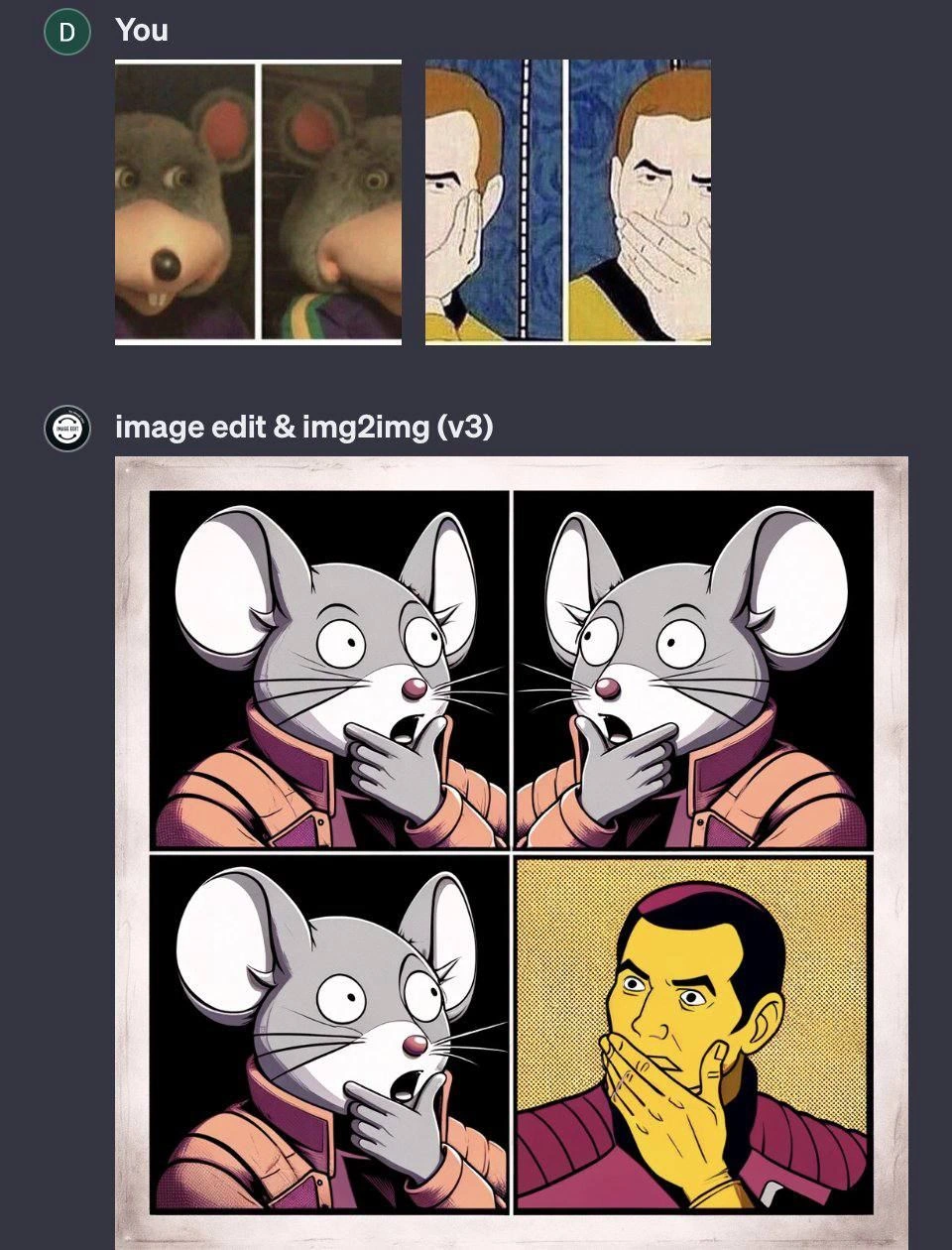
Imagine you have two very different pictures: one is a funny picture of a big toy mouse looking shocked, and another is a picture of a space captain from TV covering his mouth in surprise. You show these two pictures to a special computer friend and say, “Can you mix these together and draw me a cartoon?” Poof! In a few moments, the computer creates a brand new comic strip for you. In the comic it drew, that mouse character and the space captain suddenly look like they’re in the same cartoon story! The mouse is drawn wearing a cool space uniform and making a surprised face in the first three panels. In the last panel, the space captain is doing his shocked face-palm, just like in the photo you gave, except now he’s drawn in the same cartoony style as the mouse. It’s almost like the computer took crayons and ink and traced the idea of your two pictures, but in its own comic-book way. The funny part is seeing these two characters – who normally would never meet – appear side by side as if they’re in one adventure. It’s a bit like if you mixed two very different toys together to make a new play story: say, a Mickey Mouse toy and a Star Trek action figure suddenly acting in the same cartoon scene. It feels magical because the computer’s drawing looks so clean and real, like it came from a comic book, not just some cut-and-paste. We laugh because it’s both surprising and silly: who would’ve thought a pizza arcade mouse and a starship officer would make a great duo? But thanks to the magic picture mixer (the AI), we get to see that wacky idea come to life in a comic – and it actually looks awesome!

Level 2: Cartoonify All the Memes

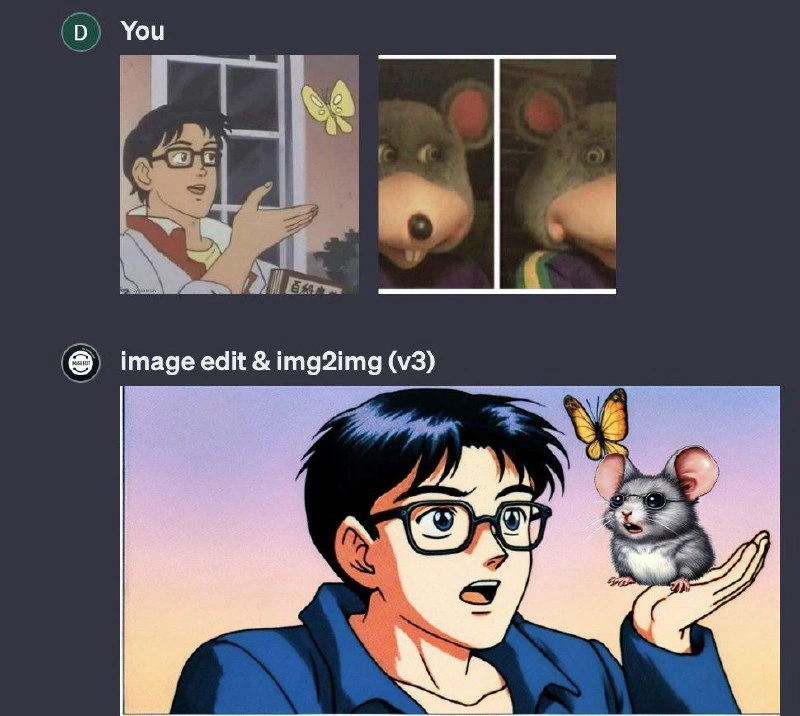
Let’s break down what actually happened in this meme, in plain terms. The top part of the image (the chat screenshot) shows a user – likely on Discord given the dark UI and the "You" label – sending two pictures side by side. On the left is a Chuck E. Cheese meme image: basically the Chuck E. Cheese mascot (a giant grey cartoon mouse from a kids’ pizza arcade) looking startled or giving a funny side-eye. This picture by itself is a popular meme used to react to awkward surprises. Next to it on the right is another meme image, this time from Star Trek: it shows a Starfleet officer with his hand covering his mouth in shock (imagine someone going “oh no!” and covering their mouth). That’s another reaction image people online use to convey “did I really just see that?!”. So the user took these two seemingly unrelated reaction images and gave them to an AI image editing bot with a request: essentially, “please mix these together and redraw them as a unified cartoon.”

The bottom part (“image edit & img2img (v3)” – which likely is the bot’s name and version) is the result: a single image composed of four panels, like a little comic strip. The top three panels show a cartoon version of that Chuck E. Cheese character, with big white mouse ears and a shocked expression, drawn in a clean comic-book style. He’s even wearing what looks like a futuristic outfit (kind of like a Star Trek uniform jacket, with the same color scheme as the Star Trek officer’s shirt). In each of the first three panels, the mouse’s pose and expression change a bit – it’s like the frames of the original Chuck E. Cheese meme have been illustrated anew. The fourth panel (bottom right) shows a cartoon man doing the Star Trek officer’s hand-over-mouth pose. However, humorously, the man’s face is kind of blurred out with a golden rectangle, and only his very surprised eyes are peeking over his hand. Despite that odd blur, you can tell this panel is mimicking the Star Trek meme image, just drawn in the same style as the mouse. All four panels have a consistent look: bold black outlines, yellow and purple shading with little dot patterns (those dots are the halftone effect you see in old comics), and a beige border around the whole image. The final product honestly looks like a page from a retro comic book where Chuck E. Cheese is a starship crew member – pretty wild and funny!

So, how did the AI do this? The key is a technique called img2img, short for image-to-image. This means instead of generating a picture from nothing but text, the AI takes an existing image (or in this case, two images combined) as a starting point. The user likely provided the two images as inputs along with some instructions or a prompt like “make it a four-panel cartoon.” Using img2img, the AI will try to keep the general content of the input pictures (the characters, their poses) but change the appearance according to the prompt or desired style. This often involves style transfer, which is essentially applying the look of one image or a described art style to another image. Cartoonization is a perfect example of style transfer – taking a normal or mismatched image and making it look like a unified cartoon drawing. A few years back, you might have seen phone apps that turn your photo into a painting or a comic; here it’s the same idea, but the AI is doing it for two meme images at once and even arranging them into a comic format.

Under the hood, imagine the AI “looking” at the input memes and noting key features: “Alright, there’s a big grey mouse character with a shocked face on the left, and a human in a yellow uniform doing a face-palm on the right.” Then we ask the AI, “Draw this in a vintage comic book style.” The AI has been trained on tons of images, including cartoons and comics, so it knows what that style generally looks like (flat colors, black outlines, halftone shading dots, etc.). It redraws the scene following those cues. It’s also likely that the user or the tool specified a 2x2 grid layout (which is how we got four panels) – possibly the tool interpreted the two side-by-side images as two sequences and decided to fill a 2x2 grid, or the user explicitly said something like “make a four-panel comic.” Many AI image editing tools have options to maintain or replicate an image’s composition while altering the style.

Let’s clarify some of the terms and tags in context:

  • AI image editing: This refers to using AI to perform edits or transformations on images. Unlike regular image editing (where you manually draw or apply filters), the AI can add elements, change styles, or combine images in a smart way. Here, it edited the original images by redrawing them in a cartoon style and combining them.

  • img2img (image-to-image): A technique where you give an initial image to a generative model as a starting canvas. The model then transforms that image into something else based on a prompt or style instructions. It’s like giving the AI a sketch and asking it to refine or restyle it. In the meme, the two small reference images served as the sketches for the AI to elaborate on.

  • Style transfer: A method in AI where the style of one image (say, Van Gogh’s painting style, or a comic book style) is applied to the content of another image (say, your photograph). Originally, style transfer algorithms would try to keep the shapes from the original picture but repaint it with the colors/brushstrokes of the reference style. In our scenario, the AI took the content of the meme images (the mouse and the Star Trek guy) and rendered them with a vintage comic style (bold lines, halftone dots, limited colors). So it transferred the style of comics onto the content of memes.

  • Cartoonization: This is specifically making a real image look like a cartoon or comic. It’s a subset of style transfer. The Chuck E. Cheese photo was essentially cartoonized – instead of a fuzzy costume with real lighting, we get a clean cartoon character. The Star Trek frame (which was originally a TV screenshot drawing of a person) was also cartoonized further to match the comic-book vibe.

  • Generative comic: This isn’t a standard term, but here it describes the outcome: the AI generated a comic strip. It’s generative because the AI created new art, and it’s a comic because of the multi-panel format. People have started experimenting with AI to make short comics or storyboards by giving prompts, and this is a fun example of that.

  • Chuck E. Cheese meme: Chuck E. Cheese is a chain of family entertainment centers known for its big animatronic mascot (a cartoonish grey mouse). There’s a popular meme image where Chuck E.’s animatronic is caught in a weird pose with a shocked or side-glancing expression – often captioned with something humorous about an awkward situation. It’s that meme that was used as input here (you can recognize the big nose and round ears of the mouse in the tiny image). Even if one doesn’t know Chuck E. by name, the image itself circulates in meme communities to convey “oops, I just saw something crazy and I’m trying to act calm”.

  • Star Trek cover mouth: Star Trek (the original series and its spinoffs) has a huge presence in meme culture too. One common meme format uses a screenshot of a character (like Captain Picard or others) with a hand over their mouth in surprise or shock. It’s a way to react when something is so surprising or dumbfounding that even a starship captain is left speechless. The user gave one of those images as the second input. It looks like it might be Commander Riker from Star Trek: The Next Generation, covering his mouth while trying not to laugh or gasp – a scene turned meme. By itself, that image is used online as a reaction “I can’t believe what I’m seeing/hearing.”

  • Discord chat screenshot: The layout with “You” and a bot response suggests this happened on Discord, which is a chat app popular among developers and gamers. People often interact with AI image generators on Discord (for example, Midjourney or Stable Diffusion bots) by sending commands and images in the chat. The screenshot is showing exactly that: the user’s message with attached images, and then the bot (“image edit & img2img (v3)”) responding with the new image it created. The interface is dark because many of us devs love dark mode for our apps – it’s easier on the eyes, and let’s be honest, it looks cooler. 😎

  • Prompt to image pipeline: This phrase refers to the whole process where you give some input (a prompt, which can be text like “a mouse in a space suit comic” or an image, or both) to an AI model, and it generates a new image. It’s a pipeline because there are multiple steps involved internally (like processing the prompt, setting up the initial canvas, running the model to produce the image, etc.), but from the user’s view, it’s just input prompt -> output image. In this case, the prompt wasn’t just text; it included actual images as well. The pipeline likely took the user’s images, encoded them for the AI model, applied the requested style changes, and output the final comic image.

For a junior developer or someone new to this tech, the key takeaway is how accessible and creative these AI image tools have become. You don’t need to write complex code or be an artist – you can simply drag-and-drop images into a chat with the right bot, maybe add a one-liner like “combine these in comic style,” and voila, the AI does the heavy lifting. It’s a fun way to prototype art or, as we see here, to generate novel memes. A lot of devs play around with these tools to familiarize themselves with machine learning concepts and also just to create hilarious content to share with friends. This meme is a showcase of that playful experimentation: using cutting-edge AI/ML for a bit of TechHumor. It’s educational (“wow, so that’s what the img2img model can do!”) and entertaining (“haha, Chuck E. in Starfleet, that’s gold”) at the same time. If you’re new to it, imagine possibilities: you could input your own doodles or photos, and with the right model, turn them into comic strips, paintings, or any style you like. The combination of two famous meme images into one cartoon panel here demonstrates the remix power of these tools. It’s essentially allowing meme creators to become directors of their own tiny graphic novels, with the AI acting as the illustrator. Pretty cool, right?

Level 3: Mashup as a Service

From a seasoned developer’s perspective, this meme is a perfect storm of AI tools meets meme culture. We’re looking at a Discord chat where a user fed two random meme images to a generative model, and the bot spat out a fully AIGeneratedContent comic strip. The humor here is multi-layered. First, there’s the absurdity of the crossover: a creepy Chuck E. Cheese mascot and a Star Trek officer would normally live in totally different joke universes. Smashing them together into one polished cartoon – with the mouse dressed like he just got a Starfleet commission – is the kind of zany mashup you’d expect from a late-night Photoshop binge. But instead of hours in Photoshop, it took mere seconds with an AI. That contrast is hilarious to anyone who’s ever tried to manually edit memes: the machine does it faster and arguably better, just for fun. It’s as if we now have Mashup-as-a-Service: throw in any two pop culture references, and the generative comic engine will remix them into a meme-worthy graphic while you sit back sipping coffee.

There’s also a tongue-in-cheek satisfaction for devs seeing bleeding-edge AI/ML tech applied to something as frivolous (yet beloved) as meme-making. Traditionally, we’ve used serious image editing suites or painstaking drawing to get a consistent style. Here a random prompt-to-image pipeline handled the heavy lifting. It auto-cartoonized the content and even chose a classic four-panel layout with thick black borders – the hallmark of countless meme comics on Reddit and Imgur. This implies the tool might have a built-in notion of meme templates or just stumbled into the perfect format. It’s the AI humor aspect: part of what we’re laughing at is not just the final comic’s content, but the sheer fact that an algorithm concocted it. It’s humor in tech and humor about tech simultaneously. We’ve reached a point where a developer can offload their shitposting to a neural network — and the neural network delivers tier-1 meme material.

Look closely and you’ll appreciate how cohesive the output is. In the top panels, the anthropomorphic mouse has those giant startled eyes and a hand on his chin – capturing the exact “uh oh” vibe from the original chuck_e_cheese_meme image (a real life animatronic rodent giving a side-eye of doom). In the bottom-right, the pose is unmistakably the star_trek_cover_mouth reaction: the character’s body language says “did we just see that?!” just like the classic Star Trek meme frame. By reimagining the Starfleet officer as a stylized cartoon figure, the AI ensured the whole comic has one unified art style. That vintage halftone texture and flat shading on both the mouse and the man make it look like they’re from the same comic book or maybe two pages of the same Retro Sci-Fi graphic novel. It’s wild because the source images were completely different in medium (one a photographed mascot, the other a TV screenshot). This goes beyond a simple copy-paste meme; it’s AI-driven remix culture. The developer community loves this kind of thing: it showcases what our algorithms can do, and it's a creative new meme format dropping out of the sky.

We should talk about that weird gold rectangle over the officer’s face in the final panel. Any senior engineer who’s tinkered with generative models has seen these glitches in the matrix. Maybe the AI’s training data had some comic panels where shocked faces were partially censored or dramatically shadowed, and it decided a mustard-yellow blur was the proper way to denote “face being covered.” Or it’s just the model creatively failing – a reminder that despite all its AI tools sophistication, it sometimes produces AIGeneratedContent that’s unintentionally funny or off-kilter. In meme terms, that’s half the charm: the imperfections become part of the joke. We laugh with the AI and at the AI. It turned a straightforward “hand-over-mouth” reaction into what looks like a comedic censorship bar. As developers, we recognize this pattern from our own projects: use a tool in a way it wasn’t strictly intended, and you’ll get unintended (but sometimes hilarious and useful) results. This comic probably wasn’t a one-click preset; the person likely experimented with prompts like an engineer tuning parameters, iterating until the style and panel arrangement clicked. The “v3” label on the bot reply hints that this is an evolving system – maybe the third version of an ai_image_editing pipeline – reminding us how fast this tech is improving. Just a year ago, getting this quality of cartoonization from mismatched inputs might’ve required custom GAN models or lots of fiddling. Now it’s practically plug-and-play meme synthesis in a Discord chat.

Historically, meme makers repurposed existing images (think the classic Picard facepalm, or the distracted boyfriend stock photo) because creating original art was too high-effort for a quick joke. But now, generative AI lets us spawn original meme visuals on-demand. This could spawn a whole new subgenre of meme formats that aren’t taken from movies or viral pics, but are wholly AI-invented yet reference familiar themes (Mickey-Mouse-meets-Star-Trek being a prime example here). It democratizes the visual side of humor: if you can dream it, you can meme it – the model will draw it for you. For developers, there’s an extra layer of geeky joy in seeing how different domains collide. It’s reminiscent of a fun coding hack or a whimsical tech demo: someone used serious technology in a not-so-serious way and it worked astonishingly well. We’re essentially seeing an AI tool flex creative muscles, guided by a clever human prompt. It’s both entertaining and a bit mind-bending – the kind of thing you’ll excitedly show your coworkers like, “Check out what this image model just did, it’s both hilarious and kind of awesome!” In the grand scheme, it’s a small preview of how HumorInTech might evolve with generative AI: memes made by man and machine, boldly going where no meme has gone before. 🚀🧀 (Yes, that’s a rocket and a cheese emoji – because this AI-powered crossover truly went to the moon in terms of creativity, with a cheesy cartoon flair!)

Level 4: Latent Space Alchemy

At the cutting edge of AI image generation, the meme’s transformation is a case of high-tech style transfer wizardry under the hood. The two source memes – an animatronic Chuck E. Cheese shock face and a Star Trek officer’s covering-mouth reaction – are being fused in a latent space where the AI represents images as abstract numbers. In this space, visual features (like the mouse’s wide eyes or the officer’s uniform) become multi-dimensional vectors that can mix and mingle. Modern generative models (think Stable Diffusion or similar) perform img2img by taking an input image, adding a sprinkle of noise, then denoising it step by step with a neural network so it gradually morphs into a new image that still echoes the original structure. Here, it’s as if the model treated the two meme images as one combined input: one part contributed the content (characters, poses) and the other provided the style (the sleek cel-shaded comic look).

Underneath, there’s an optimization process trying to satisfy multiple constraints at once – “match the cartoon style” and “preserve the meme cues.” In old-school neural style transfer research, this is often formulated as minimizing a joint loss: one term for content similarity to Image A, another for style similarity to Image B. It’s like solving a tiny puzzle in high-dimensional space: finding an image that looks like a comic-book (style) while still showing a shocked cartoon mouse doing a face-palm (content). Formally, one might imagine something like:

I^* = \underset{I}{\arg\min} \Big( \alpha \cdot \mathcal{L}_{content}(I, I_{meme1}) \;+\; \beta \cdot \mathcal{L}_{style}(I, I_{meme2}) \Big)

Where $I_{meme1}$ could be the Chuck E. pic, $I_{meme2}$ the Star Trek frame, and $\mathcal{L}{content}$ / $\mathcal{L}{style}$ measure how well candidate image $I$ keeps the first image’s layout and the second image’s artsy comic vibe. In practice, diffusion models don’t literally solve this equation with gradient descent on pixels; instead, they’ve learned to implicitly understand style and content from training on millions of images. They generate $I^*$ in one forward pass of iterative refinement, guided by learned representations of “cartoon style” and “mouse in uniform surprise” gleaned from their neural weights.

The result is what we see: a cohesive four-panel comic as if an artist manually redrew those disparate memes in one consistent universe. The thick outlines, halftone shading, and limited color palette show the model effectively applied a vintage comic style transfer onto the content of the original images. The anthropomorphic mouse now sports a sci-fi futuristic jacket (a crossover detail blending Chuck’s character with Starfleet fashion cues), and each panel’s composition mirrors the input memes’ beats. Notably, the bottom-right panel reproduces the iconic hand-over-mouth pose of the Star Trek officer – but the face ended up obscured by a gold rectangle. This odd quirk hints at the delicate balancing act in generative models: sometimes, when two source images conflict or the model is unsure how to faithfully merge a human face with a cartoon rodent universe, you get a surreal artifact (a golden blur) as the network’s “best guess.” It’s a reminder that these AI systems operate on learned statistical associations; if something doesn’t fit their learned distribution (e.g. a 1960s Starfleet human face in a 1980s comic panel with a giant mouse), the synthesis can glitch in oddly artistic ways. Still, from a technical standpoint, it’s impressive – the AI maintained the meme semantics (surprise and shock reaction) while re-imagining the visuals from scratch. We’ve essentially witnessed an algorithm perform cross-domain image composition, bridging a photo and a cartoon into a single, believable graphic narrative.

This sort of prompt-to-image pipeline represents a fusion of two generative paradigms: Neural Style Transfer (as pioneered by Gatys et al. for painting-like effects) and conditional image synthesis (like instructing a model “take this image and make it look like that”). The bot likely used a text prompt under the hood as well, something like “a four-panel comic in retro style featuring a shocked anthropomorphic mouse and a surprised officer,” guiding the network’s many neurons to align on this specific outcome. The AI/ML underpinning this meme is grounded in deep learning research: convolutional networks find features like eyes, muzzles, hands, uniforms; transformer-based text-image encoders (e.g. CLIP) help steer the generation toward stylistic keywords like “comic panel, cel-shading, halftone dots”. Each diffusion step reharmonizes the image towards those targets. In effect, the AI cartoonization pipeline is learning on the fly how to reconcile Chuck E. Cheese with Starfleet aesthetics by referencing its vast training memory of comics, cartoons, and maybe even some sci-fi fan art. It’s delightfully alchemical: turning two mismatched meme inputs into a unified visual story feels like transmuting lead into gold (with a literal gold rectangle as a playful byproduct).

Description

A two-part image demonstrating AI-driven meme remixing. The top section, labeled 'You', shows two source memes side-by-side: on the left, the two-panel 'Staring Chuck E. Cheese' meme showing the animatronic mouse looking shocked, and on the right, the 'Surprised Spock' meme from Star Trek. The main section below, labeled 'image edit & img2img (v3)', displays a four-panel comic generated by an AI. This comic reinterprets the source material in a unified, clean comic book art style. The first three panels feature a stylized, anthropomorphic mouse character showing increasing stages of shock, directly inspired by the Chuck E. Cheese meme. The fourth and final panel shows a character clearly based on Spock, rendered in the same art style and holding the same shocked pose. The image is a meta-meme, showcasing how generative AI tools can deconstruct and fuse popular internet culture formats into new, original content, a concept highly relevant to developers exploring creative AI applications
Comments

7
Anonymous ★ Top Pick My codebase after three different lead architects have had their way with it: a bizarre but stylistically consistent fusion of contradictory design patterns, all expressing the same level of existential shock
  1. Anonymous ★ Top Pick

    My codebase after three different lead architects have had their way with it: a bizarre but stylistically consistent fusion of contradictory design patterns, all expressing the same level of existential shock

  2. Anonymous

    img2img is basically git rebase for memes - splice two deeply cursed commit histories into a squeaky-clean timeline, then wait for the last panel to reveal the merge conflicts you swore were resolved

  3. Anonymous

    When the AI model you trained on Stack Overflow answers starts generating solutions that are technically correct but somehow involve a cartoon mouse explaining dependency injection patterns

  4. Anonymous

    Image-to-image models are like that senior engineer who 'improves' your code during review: you ask for a minor refactor, and three iterations later you're staring at a completely different architecture wondering how you got from a mouse to whatever that yellow thing is. At least the latent space is consistent about one thing - progressive entropy always wins

  5. Anonymous

    That architecture-review face when “event‑driven” means four services polling the same MySQL ‘events’ table with SELECT * WHERE processed = 0

  6. Anonymous

    Multi‑reference img2img nailed three tiles; the fourth was handled by the SafetyChecker microservice, which deployed a yellow rectangle to prod - eventual consistency, but for diffusion

  7. Anonymous

    img2img v3: 'Refine prompt' → lab mice boldly go where no denoiser has gone before

Use J and K for navigation