Skip to content
DevMeme
5240 of 7435
AI Meme Alchemy: Is This a Pigeon?
AI ML Post #5751, on Dec 16, 2023 in TG

AI Meme Alchemy: Is This a Pigeon?

Why is this AI ML meme funny?

Level 1: Silly Picture Mix

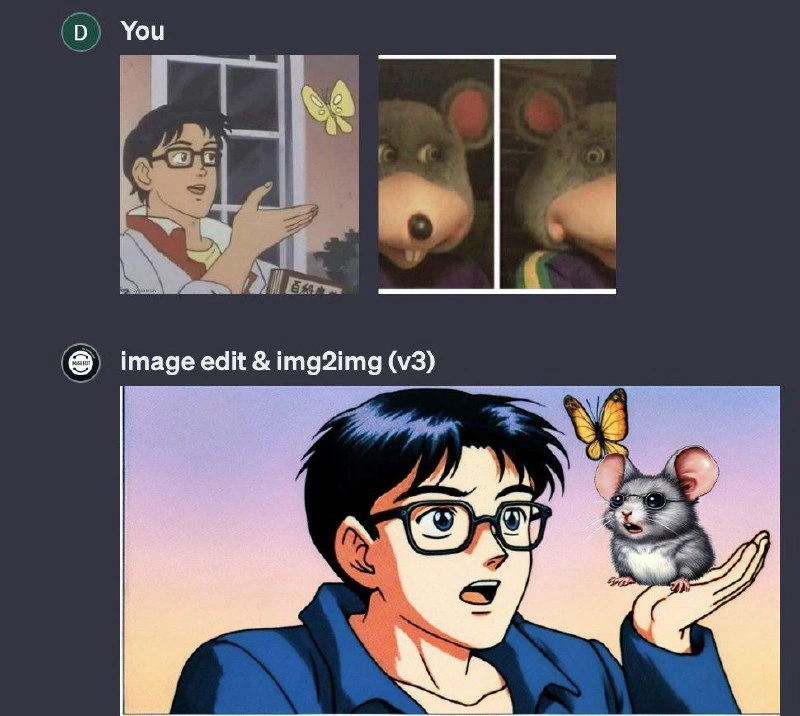
Imagine you have two very different pictures: one from a cartoon story (a boy reaching toward a butterfly) and another showing a big mouse character from a pizza place. Now pretend you show both to your friend and ask them to draw one combined picture. Your friend might draw the boy holding a cute little mouse in his hand while the butterfly is still flying by. The new picture would look a bit silly and mismatched, right? You normally don’t see those things together in one scene, so it’s funny to look at. That’s exactly why this computer-made picture is amusing – the “smart drawing machine” mixed two things that don’t really go together, and the surprise of seeing them in one image makes us laugh.

Level 2: Anime Meets Animatronic

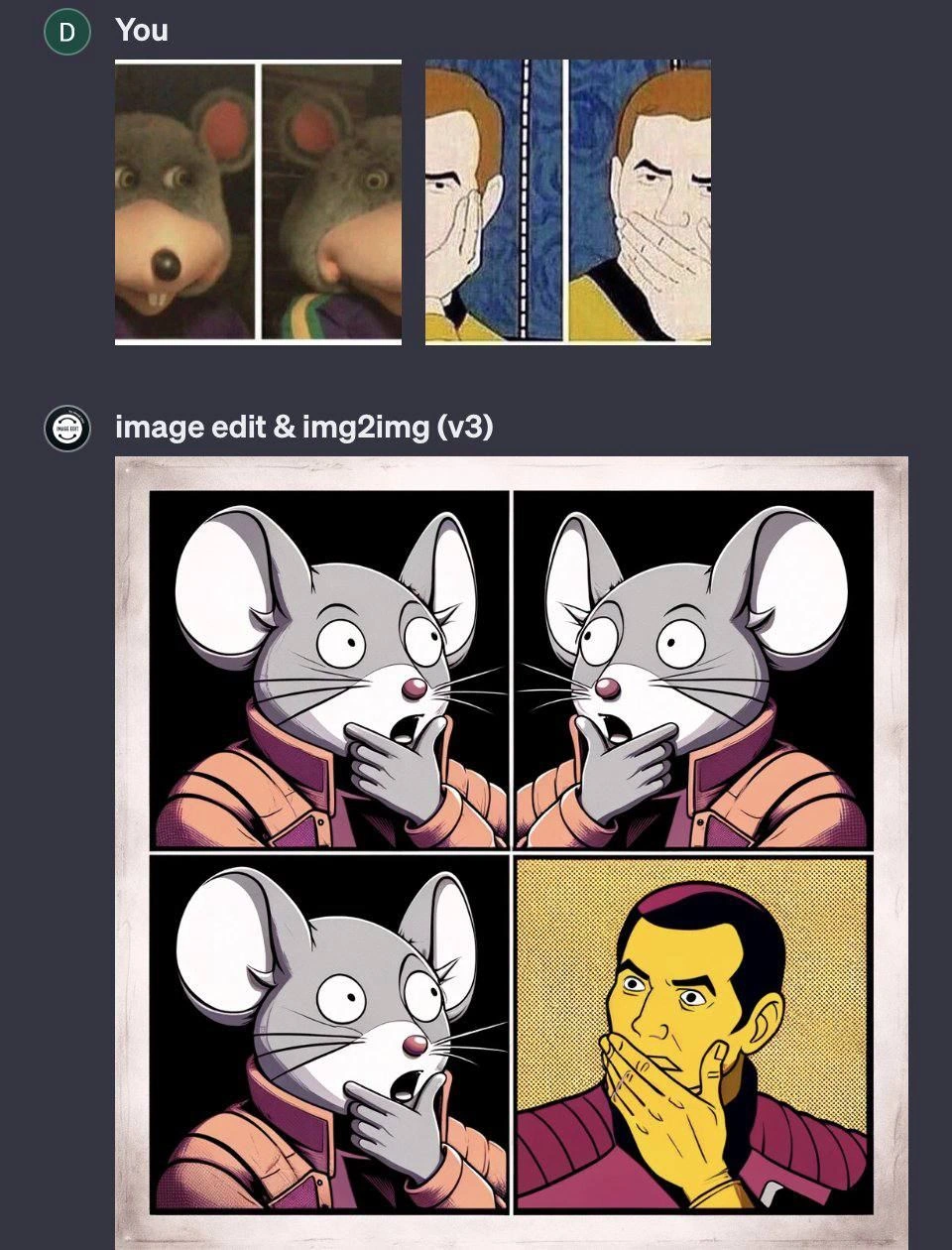
For context, the first image in the chat is from a famous meme often captioned “Is this a pigeon?”. It’s a screenshot from a 90s anime where a scholarly young man, pointing at a butterfly, innocently asks if it’s a pigeon. (Yes, it’s absurd – that’s the joke! He’s completely misidentifying the butterfly.) This scene became an internet meme for labeling anything incorrectly. The second image is a photo of Chuck E. Cheese – specifically, the big grey animatronic mouse mascot from the kid’s pizza arcade. In the screenshot, you see two panels of Chuck E. Cheese’s giant mouse head looking in different directions. So, we have two very different sources: a wholesome anime cartoon frame with a butterfly, and a somewhat creepy puppet-like character head from a restaurant.

Now, in the Discord chat, the user gave these two pictures to an AI tool (likely Stable Diffusion running through a bot) and requested an image edit. The bot used an image-to-image pipeline (often called img2img), which means it uses an existing image as a starting point and then modifies or blends it according to some input. In this case, the AI took the anime scene as the base canvas and then tried to incorporate the mouse element from Chuck E. Cheese. Essentially, it was asked to remix the original meme with the Chuck E. Cheese character using AI. The outcome: the tool redrew the anime boy in high-res detail and added a small grey mouse onto his hand (his hand was empty in the original). And it kept the yellow butterfly in the scene too, fluttering above the mouse. So now the anime guy appears to be holding up an adorable little mouse, almost showing it to the butterfly. It’s like the AI turned Chuck E. Cheese into a cute pet mouse for the anime character! The whole scene looks bright and neatly drawn, as if it were its own legit cartoon image. And because we know the original meme, it now kind of looks like he’s presenting the mouse and thinking, “Is this a pigeon?” — which is ridiculously funny because, nope, it’s clearly a mouse.

What made this possible is Stable Diffusion, a popular generative model (an AI system that creates images). It learned from millions of pictures how to draw in all sorts of styles. When you use Stable Diffusion in an image editing mode like this, you can give it one or more reference images and some instructions (or a prompt), and it will try to produce a new image that matches those. Think of it like a super-advanced merge tool for pictures: you feed in picture A and picture B, and it outputs a picture C that in some way blends elements of A and B. Here, the AI saw “anime boy with butterfly” and “grey mouse character” and merged them into one coherent picture. The label image edit & img2img (v3) in the Discord message likely just indicates the bot’s algorithm/version being used to do this mash-up. The key point is, none of this was drawn by hand – it was AI-generated content. The developer didn’t manually Photoshop a mouse onto the anime; they just let the AI model do the heavy lifting.

For someone new to these AI tools, it’s a neat example of how far AI-based image editing has come – but also a funny example of its limits. The AI was told (implicitly) to combine everything given to it, and it did. There was no filter to say “uh, maybe a random mouse doesn’t belong in this anime scene.” As a result, we got a silly but harmless outcome that makes us laugh. It shows both the power and the quirkiness of generative AI: you can generate imaginative, high-quality art in seconds, but the software doesn’t actually understand the scene. It just knows how to mix patterns. For a junior developer or anyone playing with these tools, the lesson is: the results might not be what you logically expect, especially with multiple images or ideas mixed in. In this case it’s funny – the AI basically made a meme remix on its own – and it gives you a sense of how creative and literal these algorithms can be. You provide the ingredients, and the machine will stir them all together into a surprise dish. Sometimes that dish is weird (like a butterfly guy holding a mouse), but that’s part of the fun when experimenting with generative models!

Level 3: Stable Diffusion Shenanigans

This screenshot is essentially a mini case study in AI image editing gone delightfully awry. To a seasoned developer, it's equal parts fascinating and hilarious. We instantly recognize the classic “Is this a pigeon?” meme format – that famous anime scene of a guy in glasses earnestly presenting his hand toward a butterfly. The last thing you'd expect to invade that scene is Chuck E. Cheese's goofy animatronic mouse head, yet here it is in the input. The Stable Diffusion mash-up delivered an unpredictable but oddly polished result: somehow the boy from the meme is suddenly holding a cute rodent buddy while the butterfly still flutters above. You could even caption this bizarre scene with the line “Is this a pigeon mouse?” as a cheeky nod to the original meme’s joke about misidentification.

From an expert’s perspective, this outcome is a textbook example of what happens when generative models like Stable Diffusion are given multiple unrelated things to include. The AI isn’t actually “thinking” at all – it’s just pattern-matching and trying to satisfy every input cue. Feed it a famous anime meme + a random pizza-chain mascot image, and it will earnestly try to mash them together into one coherent picture, because that’s its job. Seasoned devs have seen this kind of thing before: ask a generative model for two disparate concepts in one output and you often get weird merges. (Heck, ask it for a cat and a dog in one image – you might get a surreal cat-dog chimera 🐱🐶. At least in this case the mouse stayed a separate character and didn’t merge with the butterfly!) The model lacks a common-sense filter, so it ends up following the prompt(s) quite literally. It doesn’t know that the humor of the original is_this_a_pigeon_meme was that the guy is wrong about the pigeon; the poor AI only sees “butterfly image + boy image + mouse image” and assumes we want all these elements present. The result is pure AIHumor: the kind of slightly absurd output that makes developers smirk and think, “Yep, that’s an AI for you – technically right, logically nonsensical, and totally meme-worthy.” It’s basically a meme remix at the push of a button, courtesy of an algorithm that has zero context about why the originals were funny to begin with.

On the bright side, the image turned out incredibly well visually – which is part of why it’s so amusing. The composition is seamless: our anime protagonist looks like he was always meant to hold that adorable mouse, and the butterfly is still there as if nothing odd happened. This speaks to how powerful modern AI tools are for content creation: with a simple command, you get a result that would’ve taken skilled Photoshop work (and a bizarre sense of humor) to produce manually. In developer circles, we marvel at how far things have come – a few years ago, AI-generated images were blurry and cursed; now a Discord bot can crank out high-res mash-ups of almost any concepts you feed it. It’s both exciting and a little disconcerting. Every experienced dev knows the trope “the computer does exactly what you tell it to, not what you mean,” and that’s on full display here. The model was told (via the inputs) to put together anime-boy-plus-mouse-plus-butterfly, so that’s exactly what it did, sensible or not. The humor hits close to home because we’ve all dealt with code or machines taking our instructions way too literally. The poor anime guy just wanted to identify a butterfly, and our AI pal gave him a pet mouse to hold as well, as if that made any sense in context. For us, it’s a hilarious reminder that even the most cutting-edge AITools can behave like an overeager junior dev: super powerful, surprisingly creative, but utterly oblivious to when they’ve produced something utterly absurd. And honestly, that mix of brilliance and cluelessness is why we find ourselves both in awe and in stitches at results like these.

Level 4: Latent Space Alchemy

Under the hood, Stable Diffusion is performing a kind of visual alchemy in the latent space (a compressed mathematical representation of images). It uses a Variational Autoencoder (VAE) to encode each input image into a latent vector, then a massive U-Net neural network with cross-attention tries to decode them back into a single image. In image-to-image mode, the model starts by adding noise to the original image’s latent and then iteratively denoises it, guided by the input(s). Here it wasn’t just one image – the model had to reconcile two sets of visual features simultaneously. This is essentially a multi-constraint problem: the anime scene provides one set of features (cartoon boy, butterfly, outdoor setting) and the Chuck E. Cheese photos provide another (a grey mouse-like character with certain textures). The model’s diffusion process seeks a single output that satisfies all those conditions. And indeed, the result shows that the features from each reference got fused. For example, the network saw the second image’s mouse-like ears and face features and obligingly “painted” a small cute mouse onto the man’s outstretched hand, while still preserving the butterfly from the first image.

Crucially, the model has no semantic guardrails to distinguish which elements should or shouldn’t go together – it only knows how to blend patterns in the data. So when encountering a multisource prompt (multiple images at once), the model has no innate rule like “keep the meme’s joke intact but don’t add random animals”; it simply tries to integrate everything it’s given. The underlying diffusion algorithm uses random sampling and learned associations rather than logical reasoning. It optimizes for an image that matches the statistical features of both inputs, not necessarily one that makes sense conceptually. This is why the output can be unpredictable: the generative process is basically solving an over-constrained puzzle with many plausible solutions in image-space. Mathematically, it’s navigating a high-dimensional energy landscape where “anime boy holding a mouse with a butterfly nearby” happens to be one valid low-energy state that satisfies the mixed input. There’s no separate module going, “Wait, a mouse doesn’t belong here,” because the model doesn’t understand context – it just knows how to replicate patterns that frequently co-occurred in its training data. The diffusion model’s millions of parameters, trained on diverse images of anime, animals, and everything in between, latched onto any overlap it could find between the inputs (perhaps the model has seen anime characters with pet animals, or it knows a butterfly-in-hand pose) and merged them. The lack of a common-sense filter means it will cheerfully perform this stochastic feature fusion even if the result defies logic.

In short, the Stable Diffusion img2img pipeline did exactly what it was asked: blend all provided inputs into one image – a literal interpretation that showcases both the power (high-quality blending of disparate sources) and the amusing lack of common sense in these advanced algorithms. It’s a potent demonstration of generative AI’s strengths and weaknesses: the model can vividly re-imagine an image with new elements (thanks to all those learned patterns), but it has no clue which elements actually belong together in reality. This indiscriminate merging of references is the hallmark of an algorithm that sees the world as abstract features to recombine, rather than concepts to reason about. The end result is technically impressive AIGeneratedContent, born from algorithms and high-dimensional math – yet it’s also a reminder that without explicit constraints, a GenerativeModel will quite happily create a butterfly-boy-mouse tableau if that satisfies the data it was fed.

Description

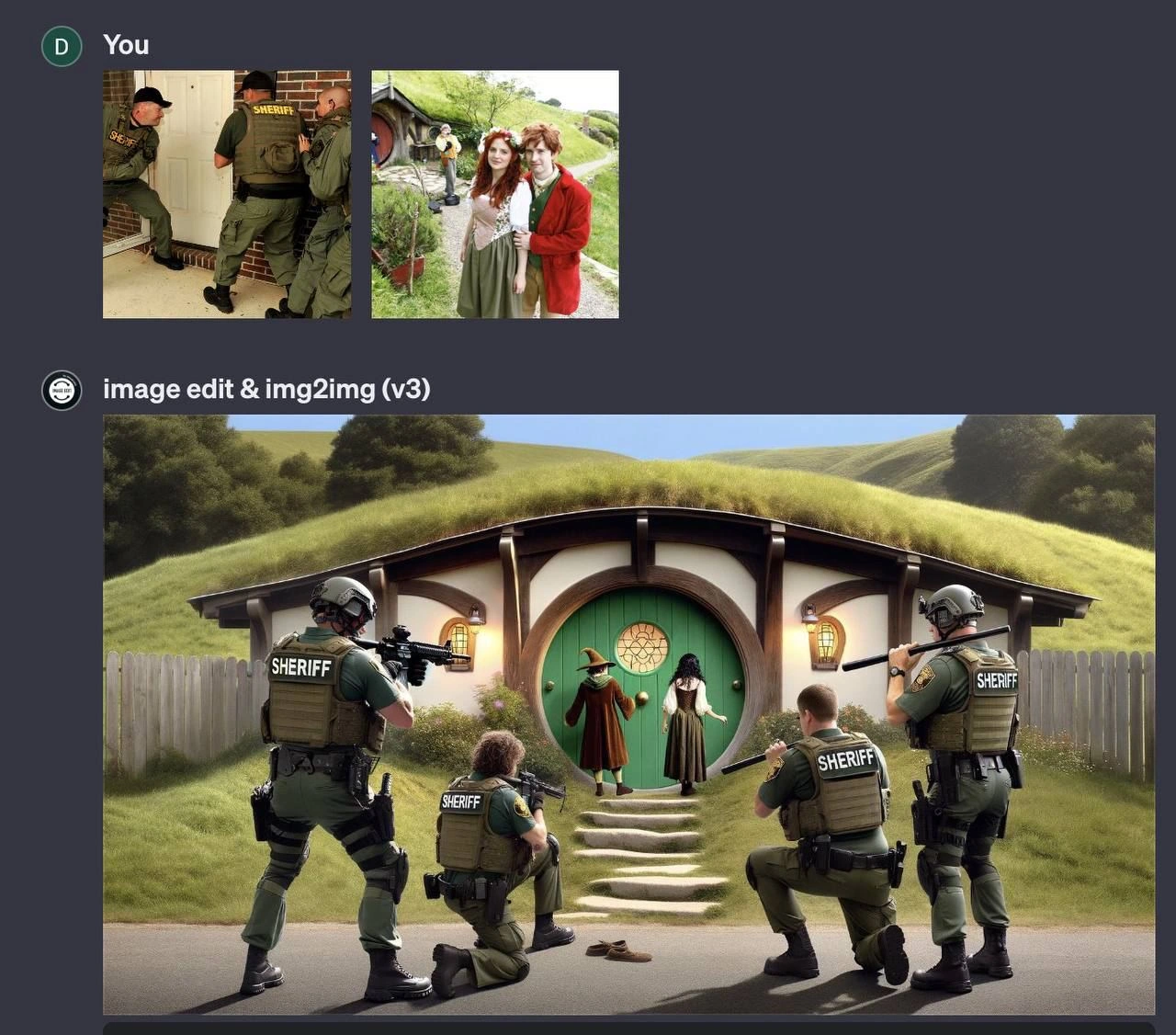
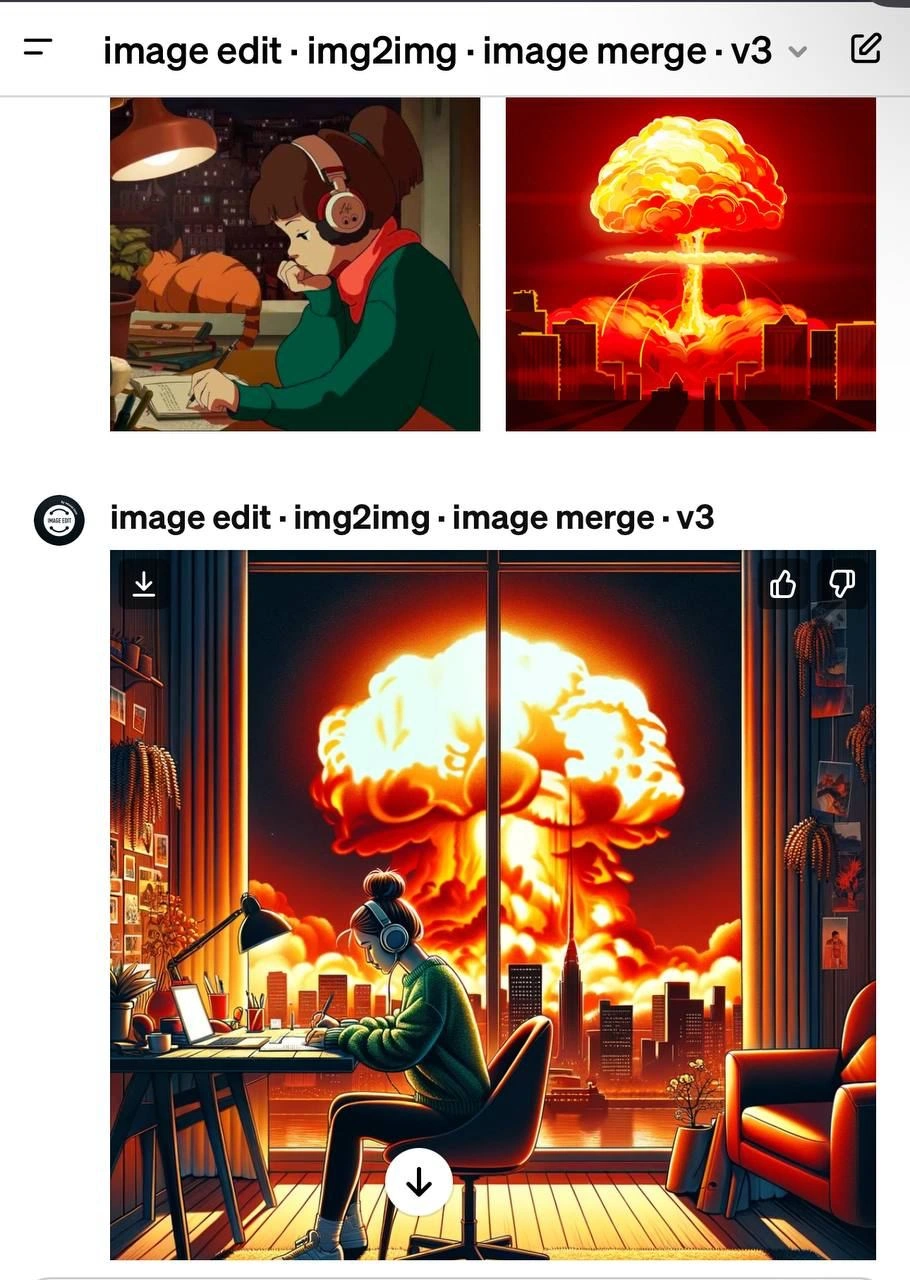
A creative showcase of AI-powered meme fusion. The top of the image displays the two source memes: on the left, the classic 'Is this a pigeon?' anime format showing a character gesturing towards a butterfly, and on the right, the two-panel 'Staring Chuck E. Cheese' animatronic meme. The main, larger image below, labeled 'image edit & img2img (v3)', presents the AI's synthesized result. It masterfully blends the two sources, depicting the anime character in his original pose, but instead of a butterfly on his hand, there is a small, gray mouse wearing tiny glasses, looking just as confused and inquisitive as the character himself. A yellow butterfly still flutters above the mouse, completing the scene. This image is a prime example of 'meme mashing,' where an AI deconstructs the core elements of two separate cultural touchstones and merges them into a new, coherent, and humorous visual, highlighting the advanced contextual understanding of modern generative models
Comments

7
Anonymous ★ Top Pick When you try to explain a simple concept (the butterfly) to a junior dev, but they've just come from a machine learning bootcamp and now everything looks like a high-dimensional vector space representation of a rodent
  1. Anonymous ★ Top Pick

    When you try to explain a simple concept (the butterfly) to a junior dev, but they've just come from a machine learning bootcamp and now everything looks like a high-dimensional vector space representation of a rodent

  2. Anonymous

    Feeding “Is this a pigeon?” and Chuck E. Cheese into img2img is like merging two legacy microservices: the contracts don’t line up, the output’s a mouse with a butterfly, and everyone pretends that was the roadmap all along

  3. Anonymous

    When your stakeholders describe their vision vs what they actually approved in the requirements doc vs what the model ships after three iterations of "minor adjustments"

  4. Anonymous

    When your img2img model has clearly never seen the original training data and decides 'cartoon mouse' means 'photorealistic rodent' - because who needs semantic consistency when you've got 1.5 billion parameters and a dream? This is what happens when your latent space representation treats 'style' as a mere suggestion rather than a requirement. At least it nailed the butterfly - small victories in the world of diffusion models where your carefully curated reference images are just polite recommendations to a neural network with its own artistic vision

  5. Anonymous

    Asked to blend two memes, img2img v3 did a feature union, not an intersection - classic PM-approved MVP with latent-space scope creep

  6. Anonymous

    Asked img2img v3, “Is this a butterfly?” - it returned a mouse. Classic ML semver: minor release, major change, return type quietly refactored to Rodent

  7. Anonymous

    Prompted separate microservices; img2img v3 shipped the monolith. Latency: 5s. Architectural bliss

Use J and K for navigation