Strategic Career Planning vs. Code Maintenance
Why is this TechDebt meme funny?
Level 1: Moving Instead of Cleaning
Imagine you made a huge mess in your room – toys everywhere, paint on the walls, and clothes all over the floor. It’s so messy that cleaning it up would take a lot of hard work. Now, there are two ways you could deal with this:
The Responsible Way: You roll up your sleeves and start tidying your room every day so it never gets too messy. Maybe each week you put your toys back in place and repaint a little spot that got dirty. This is like refactoring code and updating things regularly – doing a bit of cleaning all the time so the mess never overwhelms you.
The Silly Way (the joke of the meme): Instead of ever cleaning your room, you just decide to move to a new house every couple of years. 😄 Each time your room starts to get super messy, you’re like, “Nope, I’m out!” and you go find a brand new room in a new house. The new room is clean (for now) because you just moved in. But of course, if you keep never cleaning, you’d have to keep moving again and again. This is like a developer who switches jobs often to avoid dealing with the messy code they wrote – they leave it behind and start fresh somewhere else.
The meme is funny because obviously moving to a new house every time your old one gets dirty is a ridiculous way to avoid cleaning – it’s way more trouble in real life! Yet, in the software world, some people actually do a milder version of this. They find it easier to start anew than to clean up the mess. The picture of Drake (a rapper known from a meme) is used to show emotional reactions. In the top part, he’s making a “yuck, no way” face at the idea of cleaning up regularly. In the bottom part, he’s smiling and pointing as if saying “Yes, that one!” to the idea of just leaving and getting a new job. It’s like if you asked a kid, “Do you want to do your chores every day or just run away to avoid them?” and the kid excitedly points to running away – it’s naughty and funny because it’s not the right thing to do, but it sure sounds easier in the moment.
So, at a simple level, this meme jokes about a person who would rather escape their responsibilities than do the boring work needed. It makes us laugh because we know the right thing is to clean up our mess (whether it’s a dirty room or messy code), but the tempting thing is to just walk away and start over elsewhere. That little bit of truth – that everyone sometimes wants to avoid hard work – is what makes the joke hit home.
Level 2: Clean Up or Pack Up
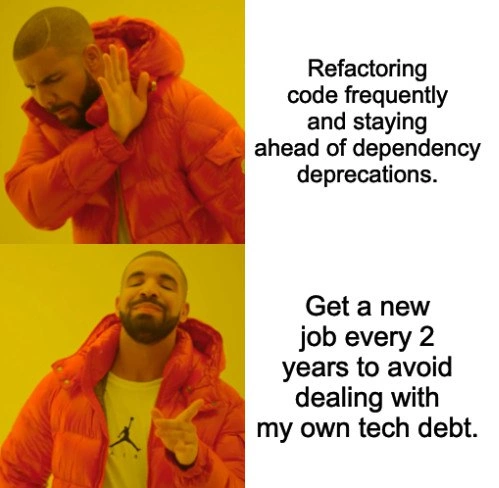
This meme uses the famous Drake format to compare two approaches to dealing with messy code. In the top panel (Drake with a hand out, indicating “nope”), the text says “Refactoring code frequently and staying ahead of dependency deprecations.” This is describing the ideal but tedious approach: regularly clean and update your code. Let’s break that down: Refactoring means improving the internal structure of code without changing its external behavior. It’s like tidying up your room – the functionality (your stuff) stays the same, but you organize it better. Doing it frequently means you don’t wait until the code is a complete mess; you continuously polish it as you add features. Staying ahead of dependency deprecations means keeping all the external libraries, frameworks, and tools your project relies on up-to-date. Software libraries often release new versions, and old versions can become deprecated (no longer recommended or supported, possibly due to security issues or better replacements). A conscientious developer will regularly update those libraries to avoid running on outdated code that might break or become insecure. This proactive maintenance is like changing the oil in your car on schedule so that the engine doesn’t seize up later. It’s undeniably the responsible way to manage a codebase – you address TechnicalDebt incrementally, so it never gets out of hand.
Now, the bottom panel (Drake pointing happily) says “Get a new job every 2 years to avoid dealing with my own tech debt.” This captions the tempting shortcut some developers joke about: if you switch jobs frequently, you can skip out on the long-term upkeep of the code you wrote. Essentially, you enjoy the fun part of writing new code and leave before things get too complicated (or before all those shortcuts you took need fixing). Job-hopping means moving from company to company more often than what used to be the norm (staying only a couple of years at each). In the context of the meme, it’s portrayed as a cheeky “strategy” for avoiding the responsibility of maintenance. Why every 2 years specifically? It’s somewhat arbitrary, but in the tech industry it’s common to see people switching jobs around the 1.5 to 3 year mark. By two years, a developer has usually delivered some features, but any TechnicalDebt introduced (like quick fixes, poor design decisions, or ignored updates) is just starting to show its ugly consequences. If they leave at that point, they personally never have to clean up that legacy code – it becomes the next team’s problem.
For a less experienced developer, here’s what all that means in simpler terms: imagine you built a project quickly by using some shortcuts. For example, instead of doing it “the right way,” you write some messy code that just barely works, and you say you’ll fix it later. That’s creating technical debt. Fixing it later is the refactoring part – it’s like repaying the debt. But refactoring isn’t fun; it can be hard and doesn’t add new visible features, so people procrastinate on it. Also, software depends on other software. Let’s say you built a website using a popular framework or library (maybe React or Django or an npm package). Those external tools get updated over time. If you don’t update your project to keep up, eventually your project might run into problems – perhaps security vulnerabilities or compatibility issues – because it’s using old versions. “Staying ahead of dependency deprecations” means upgrading those libraries regularly so you’re not caught off-guard when the old version is discontinued or breaks. This is a very real task in development: for instance, if you have a site on Python 2 and Python 2 goes end-of-life, you’d better upgrade to Python 3, otherwise nothing will support you (that’s a major deprecation developers faced in the past).
So, why is Drake looking disgusted at the idea of doing all that responsible work? Because many developers find it tedious, time-consuming, and sometimes stressful to constantly clean up code and do maintenance. It’s much more exciting to start new features or even start at a new job with a fresh codebase. That’s where the bottom panel comes in. Drake is grinning and pointing to the phrase about getting a new job every 2 years to avoid dealing with his own mess. It’s a tongue-in-cheek way of saying: “Instead of fixing the problems I created, I’ll just leave and let someone else deal with them.” Of course, this is humorous exaggeration – not everyone can or does job-hop just to avoid refactoring. However, it rings true enough that it’s funny. Many developers have at least joked, “Maybe I’ll quit instead of dealing with this nonsense,” when facing a hairball of a codebase. And indeed, some developers move around a lot, always working on the new projects and never sticking around for the maintenance phase.
For a junior developer or someone new to the field, this highlights a real tension in software teams: maintenance vs. new development. The top panel represents the maintenance mindset – invest time regularly to keep things clean and up-to-date, even if it’s not glamorous. The bottom panel represents the new development mindset taken to an extreme – keep jumping to new projects so you’re always in the honeymoon phase of coding, and never around for the dirty work of upkeep. Neither scenario is 100% black or white in reality, but the meme humorously polarizes them. It’s basically calling out a certain laziness or opportunism: Why fix it if I can just flee it?
To illustrate, consider a snippet of what accruing technical debt might look like in code form:
def process_data(data):
# Quick hack: directly modify input structure instead of proper parsing
data['value'] = float(data['value']) # assuming it's always convertible
# TODO: handle cases where 'value' might not be convertable (tech debt here)
return legacy_system.process(data) # using an old system - should update it later
In the code above, the comment # TODO: handle cases where 'value' might not be convertible is an example of a developer acknowledging a shortcut (and thus a bit of technical debt) that they intend to fix later. If “later” never comes, maybe because that developer leaves the company, someone else will eventually hit a bug when data['value'] isn’t a number and the program crashes. The original dev avoided dealing with the fallout; the next dev in the job gets the headache of fixing it. This is a micro-scale example of the meme’s joke. Now imagine that multiplied by hundreds of decisions and you get a sense of what a codebase with a lot of deferred maintenance feels like.
In summary, at this level, you should understand that the meme is contrasting two ways developers handle the ongoing work needed to keep software healthy. The responsible way (refactor regularly, update your dependencies, address technical debt head-on) versus the easy escape (change jobs and start fresh rather than fix what you wrote). It’s funny to people in tech because it hyperbolically captures a real feeling: fixing old code is hard and sometimes thankless, so the naughty thought of “I’ll just quit” has definitely crossed many minds. Drake’s facial expressions exaggerate that inner dialogue we’ve all had: No thanks to the boring cleanup chores, and yes please to just walking away from the mess. It’s office humor for programmers – a bit cynical, a bit true, and a reminder that tech debt doesn’t magically disappear... it just waits for the next person!
Level 3: Resignation-Driven Development
Experienced developers crack a wry smile at this meme because it nails a real-world anti-pattern: avoiding tech debt by avoiding the job itself. It’s an industry in-joke that sometimes the easiest way to deal with your messy code is to make it someone else’s problem change jobs. Why spend late nights refactoring gnarly modules or upgrading that framework version three generations behind, when you can polish your résumé and hop to a new codebase that (for now) isn’t your mess? Drake’s thumbs-up for “Get a new job every 2 years to avoid dealing with my own tech debt” satirically captures this attitude. It’s a form of avoidance strategy that many devs half-jokingly admit to considering, especially when slogging through a codebase held together by duct tape and TODO comments. The top panel’s rejected option – “Refactoring code frequently and staying ahead of dependency deprecations” – is the Boy Scout Rule of coding (always leave the code cleaner than you found it). It’s what good engineering practices dictate. But in reality, continuous refactoring and proactive dependency upgrades often get de-prioritized. Why? Because:
- No Immediate Glory: Refactoring is invisible when done right – users don’t see features, managers don’t get new demos. It’s maintenance work that only gets noticed when it’s neglected and things catch fire.
- Fear of Breakage: Touching old, fragile code is risky. Update one library version and suddenly half the app breaks. Many seniors have PTSD from a “harmless” upgrade that caused a week-long outage. The meme hints that it feels safer to walk away before things explode.
- Perverse Incentives: Organizations reward feature delivery, new products, and often even job-hopping (since switching companies can net a higher salary). There’s rarely a promotion for “heroic refactoring of legacy modules.” In fact, if you do too good a job cleaning up, people hardly notice – until you leave and they finally see how much you were holding things together.
The Drake format perfectly exaggerates this common dilemma. In countless dev teams, you’ll hear jokes like “Not gonna be my problem in six months!” when confronted with a gnarly refactor. Legacy code, by definition, is code handed down from the past – and it tends to accumulate when each generation of developers postpones the cleanup. If you join a company and inherit a decade-old monolith full of spaghetti logic, it’s because a chain of Drakes before you kept saying “nah” to refactoring. The job-hopping approach is essentially kicking the can down the road (or over to the next poor engineer). It’s a form of short-term thinking that any senior dev recognizes, often with a bittersweet chuckle.
On the flip side, that bottom-panel strategy has an ironic appeal even to battle-hardened engineers. After all, if you bail out every couple of years, you personally never have to confront the full consequences of quick-and-dirty decisions. You get to work on greenfield projects or at least someone else’s legacy for a change. There’s dark humor in that: your past self hands off the ticking time-bomb code to an unwitting successor, and your future self moves on to a shiny new project before things go boom. As cynical as it sounds, many veterans have watched this cycle in action. A developer introduces a risky workaround or leaves a growing pile of TechnicalDebt (perhaps rushing to meet a deadline), then right around the two-year mark – which, not coincidentally, is often when initial stock vesting or boredom kicks in – they announce their departure. That codebase time-bomb is now the team’s problem, not theirs. In some cases, companies even end up hiring new people specifically to handle the mess left behind. (Job security for one group, nightmare for another – all part of the circle of software life!).
Of course, somebody has to pay the piper eventually. Those who stay behind find themselves in RefactoringPain purgatory: endless bug fixes, patching outdated packages, untangling mysteries left in code comments. Seasoned devs share war stories of “I spent three weeks untangling a 5,000-line singleton class from 2008” while the author of that mess is off at a new startup writing microservices (that will become someone else’s headache in 2025). The meme is funny because it’s TRUE – it hits on that guilty thought many have had at 3 AM while slogging through a nasty legacy issue: “Why am I fixing this when I could just... not be here?” It’s a laugh of recognition and a coping mechanism. We joke about job-hopping as a “solution” because sometimes it genuinely feels like the path of least resistance when up against a mountain of crufty code.
To add a dash of ironic realism, consider what staying looks like versus leaving: If you stick around and champion a big refactor or modernization, you’re in for tough sprints of unglamorous work, possible pushback from product managers (“Why are we spending time on this? Where are the new features?”), and the very real risk that you’ll break something that was working. You’re effectively volunteering to handle unwelcomed chores. Meanwhile, the colleague who jumps to a new job gets a clean slate (at least for a while), a salary bump, and no on-call pager blowing up over code they wrote last year. It’s almost a rational career move, which is why this meme triggers both laughter and a sigh. It pokes fun at a tech culture where the refactoring hero often goes unsung, and the career hopper sometimes looks shrewd by comparison. In a perfect world, engineering teams would allocate time to address tech debt regularly (Google’s famous 20% time or the concept of Internal Open Source address this). But in practice, many teams operate in perpetual “just ship it” mode until a breaking point. The Drake meme lays it out in stark, comedic contrast: doing the right thing versus doing the easy thing. And as every grizzled engineer knows, the easy thing often wins – at least until production crashes under the weight of all those easy things.
Finally, let’s not ignore the human element: burnout and frustration. Constantly dealing with grimy legacy issues can really sap a developer’s morale, especially if they feel they’re always cleaning up other people’s messes. A two-year interval is about when the honeymoon phase at a new job ends and the warts of the codebase become apparent. Seeing Drake endorse the “update my LinkedIn” option over the “roll up my sleeves and refactor” option hits a nerve. It’s a shared wink among developers: "Heh, ever feel like just noping out instead of fixing that decade-old module? Yeah, me too." We laugh because we’ve been there, even if we stayed. It’s gallows humor for coders: when the going gets tough, the tough get going... to another company.
Level 4: Compound Interest of Code
Ignoring technical debt is like letting interest accumulate on a loan – eventually, the “interest” (extra effort to fix things) compounds and comes due with a vengeance. The term technical debt itself was coined by Ward Cunningham way back in 1992 to describe how cutting corners in code (for quick gains) creates an implicit debt. Over time that debt accrues interest: the codebase becomes harder to change, bugs multiply, and future development slows to a crawl. In theoretical terms, unmanaged code complexity tends to increase entropy in the system – a bit like the Second Law of Thermodynamics, but for software. There’s even a known phenomenon called software rot or bit rot, where code that isn’t actively maintained gradually becomes problematic, not because the bits literally decay, but because the world around that code (OS, libraries, user requirements) keeps changing. Staying ahead of dependency updates is one way to “pay interest” regularly: for example, updating your frameworks and packages incrementally ensures you aren’t hit with a massive incompatible jump later. This meme’s top panel (which Drake scorns) essentially advocates continuous refactoring and vigilant dependency management – practices celebrated in Agile and Extreme Programming as ways to keep systems clean. In fact, Martin Fowler’s classic Refactoring book (1999) formalized the discipline of continuously improving code structure to avoid design decay. And academic research on software evolution (Lehman’s Laws) reinforces that if we don’t refactor, complexity will inescapably increase. It’s a law of nature in codebases: without intervention, legacy code gets more tangled and difficult over time, much like neglected financial debt growing with interest.
Yet, despite decades of knowing this, the industry often witnesses a different strategy – the bottom panel’s approach of personal debt evasion. In economic terms, it’s a rational actor model: each developer might choose the locally optimal solution for themselves (switch jobs to avoid the cost of maintenance) even though globally it leads to worse outcomes (ever-growing tech debt in every company). It’s a bit like the Tragedy of the Commons: if every engineer avoids refactoring and jumps ship, everyone ends up surrounded by messy code wherever they go. There’s also a game theory aspect – if you suspect other teammates might leave you with the mess, the incentive is to leave first. The humor here is underpinned by this grim logic: our field has solid principles for code quality, but human nature and career incentives can subvert them. In essence, the meme exposes a paradox in software engineering: we know how to prevent monstrous legacy systems (pay down debt through refactoring), but sometimes it’s personally “cheaper” to just flee the monster and start fresh elsewhere. The compound interest of code will catch up eventually – but preferably on someone else’s watch, right? 😅 (That laugh is very much in pain.)
Description
This is a classic two-panel 'Drake Hotline Bling' meme, contrasting two approaches to dealing with software maintenance. In the top panel, Drake looks away with a gesture of disapproval from the text: 'Refactoring code frequently and staying ahead of dependency deprecations.' This represents the ideal but often arduous practice of maintaining a healthy codebase. In the bottom panel, Drake smiles and points approvingly at the text: 'Get a new job every 2 years to avoid dealing with my own tech debt.' This captures a cynical but widespread joke in the tech industry, where developers switch companies frequently, partly to avoid the long-term consequences of the technical debt they themselves have created. The meme resonates with experienced engineers who have both inherited messy codebases and have seen colleagues disappear just before their shortcuts became a major problem
Comments
7Comment deleted
My career strategy is just aggressive garbage collection for my own technical debt; I mark-and-sweep myself to a new company every two years
My favorite tech-debt repayment plan is simple: vest, bounce, and let the next staff engineer wonder why npm audit sounds like a Geiger counter
The real 10x engineer isn't the one who writes 10x more code, but the one who leaves exactly 6 months before the MongoDB cluster they insisted on using hits the 16MB document limit in production
The real technical debt isn't in the codebase - it's the institutional knowledge walking out the door every 24 months. Why refactor when you can simply 'migrate to a new platform' (your next employer's stack) and let the next team discover your creative interpretation of SOLID principles? It's not abandoning ship; it's 'pursuing growth opportunities in greenfield development.'
My tech-debt amortization plan is simple: switch companies before the transitive-dependency balloon payment hits and the Renovate tsunami becomes a rewrite RFC
Job hopping: the ultimate refactor where your tech debt gets forked to the previous employer
I refactor my employer every two years; it’s the only migration strategy that reliably moves all the deprecations to someone else’s backlog