Coding in a New Language Without Reading the Documentation
Why is this Documentation meme funny?
Level 1: Don't Try This at Home
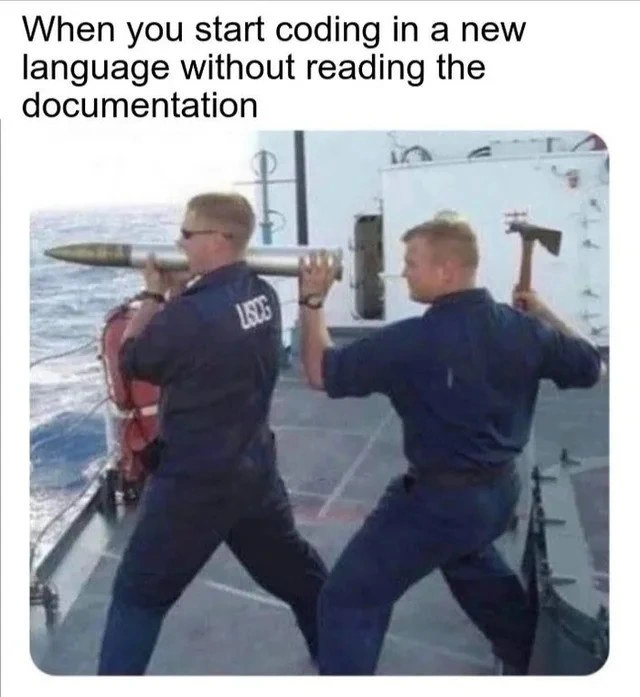
Imagine you got a brand new rocket toy but never bothered to read the instructions on how to launch it. Instead of using the launcher that came in the box, you decide to hit the rocket with a big hammer to set it off. đŹ What do you think would happen? Probably nothing good â maybe the rocket fizzles out, or worse, it blows up in your face!
This meme is joking that starting to code in a brand new programming language without reading any of the instructions (documentation) is just like that crazy rocket scenario. Itâs a very silly and risky way to do things. People who know about rockets (or coding) can see immediately that the person is not doing it the right way. The picture is funny because we all understand the guy with the axe is about to cause a big âuh-ohâ moment. In real life, if you ignore the manual for a complicated gadget, youâre likely to break something or hurt yourself. In the same way, if a new coder doesnât read how a programming language works and just tries random stuff, theyâre probably going to create a big mess or crash the program. We laugh at the meme because itâs a wink to a truth we all learn eventually: read the instructions before you launch!
Level 2: Learning the Hard Way
This meme highlights what happens when someone jumps into a new programming language without taking time to read the documentation. In simpler terms: a developer starts coding in an unfamiliar language and doesnât bother with the languageâs manual or official guide. The top caption sets the stage: âWhen you start coding in a new language without reading the documentation.â The photo underneath shows two sailors trying to launch a rocket in a ridiculously unsafe way â one is holding the rocket on his shoulder, and the other is about to smack the rocketâs tail with a hand axe as if that will fire it. Itâs clearly not how youâre supposed to launch a missile! The joke is comparing that absurd image to a programmer diving into a new coding language with zero guidance, which experienced folks know is a recipe for trouble.
Letâs break it down: documentation is basically the instruction manual or reference guide for a programming language (or any software or tool). It contains the official instructions on how to use that language, including syntax rules, features, examples, and often warnings about common pitfalls. Not reading the documentation means the person is trying to use the tool without any of those instructions â essentially flying blind. Itâs like trying to assemble complex furniture without reading the IKEA manual, or trying to play a new board game without ever looking at the rules. You might figure some things out by intuition, but youâre almost guaranteed to do something wrong and create a mess.
In the image, the sailors skipping the proper launch procedure is a direct parallel to a coder skipping the docs. Normally, to launch a rocket youâd follow a strict procedure (enter codes, press a button, stand back at a safe distance, etc.). Here, these guys are ignoring all that and trying a crazy method. Likewise, a programmer who doesnât read a new languageâs docs is ignoring the proper way to use it and resorting to guessing or improvisation. Thatâs why the second sailor is holding an axe â a tool totally not meant for launching rockets â which symbolizes the developer using random guesses or hacks not meant for the task. The result in both cases can be an explosion (literally for the rocket, and metaphorically for the code).
Thereâs even a common saying among developers: RTFM, which stands for âRead The Manualâ (the 'F' is a spicy adjective weâll omit here). When a newbie asks a very basic question that is clearly explained in the docs, an expert might drop that acronym as a curt suggestion to check the manual first. Itâs a bit blunt, but it underscores a real point â many mistakes happen simply because the documentation wasnât read. Similarly, you might hear programmers talk about a "footgun". A footgun is a slang term for any feature or tool that can cause you to âshoot yourself in the footâ if you misuse it. Using a brand-new language without reading its docs is basically handing yourself a footgun: youâre far more likely to write something that backfires and causes problems.
If a developer skips the docs when learning a new language, several things often go wrong:
- Syntax Errors â Every programming language has its own syntax (grammar). A newcomer might write code in the style of a different language, which leads to errors. For example, using
;semicolons,{}braces, or(type declarations)in Python will immediately cause syntax errors, because Pythonâs syntax doesnât use those in the same way. The documentation (or any intro tutorial) would show the correct syntax. - Misusing Features â Without guidance, itâs easy to call functions or use features incorrectly. For instance, in a low-level language like C, if you donât read about memory management, you might forget to allocate memory or fail to free it. Misusing memory functions in C (like calling
strcpyon a non-allocated pointer) can crash your program. The docs would warn you to allocate (malloc) memory first and free it later, but if you never read that, boom â crash city. - Unexpected Behavior â Sometimes the code runs, but does something very different from what you intended. This often happens because each language has quirks. For example, in JavaScript, if you havenât read about type coercion, you might be surprised that
"5" + 5yields"55"(string concatenation) or that using==vs===can give odd results. A new JavaScript coder might scratch their head at such outcomes if they skipped the part of the docs that explain how comparisons work. - Wasted Time Debugging â Ironically, not reading documentation often means youâll spend more time later trying to figure out why your code is broken. You might be debugging a problem for hours that a quick look at the manual could have solved. In other words, skipping the manual can slow you down in the long run, because youâll likely run into avoidable problems and have to backtrack.
To illustrate, consider a simple example of a syntax mistake a beginner might make by not checking the docs or a tutorial. Imagine someone who knows Java or C trying to write a loop in Python:
# A new Python coder (familiar with C/Java) who didn't read Python's docs might attempt:
for (int i = 0; i < 3; i++):
print("Hello")
# ^^ This is a syntax error in Python! Python doesn't use parentheses or data type declarations in its for-loop syntax.
#
# How the loop should be written in Python (as shown in documentation or any tutorial):
for i in range(3):
print("Hello")
In the code above, the first attempt is using C/Java style syntax (for (int i = 0; i < 3; i++):), which Python will not understand at all. If this person had skimmed the Python docs (or even a one-page intro), theyâd know Pythonâs loops are written as for i in range(n): with no parentheses around the statement and no type declaration. By not reading, they hit a wall with a SyntaxError and might be perplexed why it doesnât work. The second part of the snippet shows the correct Python syntax that the documentation would have taught them.
Another common gotcha: different languages index arrays/lists differently. Most languages (like C, Java, Python, etc.) use 0-based indexing, meaning the first element is index 0. But some environments or math tools use 1-based indexing. If you assumed a new language was 1-indexed without reading, youâd either skip the first element or try to access one past the end of the array, causing an error. A quick read of the language basics in the docs would save you from that off-by-one error. These are simple examples of a learning curve â every language has its own little rules you need to learn.
The memeâs image with the axe and missile is an exaggerated visual metaphor. It says: âLook how ridiculous it is to do something dangerous without following instructions.â Everyone can see those sailors are doing it wrong and are one swing away from a disaster. In the same vein, experienced developers immediately recognize that not reading the docs before coding in a new language is asking for trouble. Itâs a familiar scenario in the LearningToCodeJourney: newbies sometimes dive in head-first, then hit big problems that proper documentation could have prevented. The humor here comes from the DeveloperRelatability of it â most programmers have at some point skipped reading something important and then facepalmed later when they realize the docs had the answer all along. Itâs a lighthearted reminder that when dealing with new tech, a few minutes spent RTFM-ing can save you from launching a âmissileâ in the wrong direction.
Level 3: Cutting Corners With an Axe
Embarking on a new programming language while skipping the documentation is the developer equivalent of standing on a shipâs deck with a rocket you barely understand and an axe in hand. Itâs an absurdly improvised âlaunchâ method â a textbook case of cutting corners with a highly explosive outcome. What could possibly go wrong, right? This image is comical and horrifying at the same time, and every seasoned engineer watching it play out is both laughing and cringing because they know how it ends.
As any battle-scarred programmer will tell you, thereâs a reason RTFM (meaning âRead The Manualâ â weâll pretend the âFâ stands for Friendly here) is an age-old refrain in tech circles. Veteran engineers have seen this scenario too many times: a confident coder decides documentation is optional, cobbles things together by trial-and-error, and then looks stunned when everything blows up. In developer slang, skipping the docs is like handling a loaded footgun â youâre basically pointing a weapon at your own foot. Modern languages and frameworks are powerful (like rocket fuel), but that power can backfire spectacularly if misused. Without reading the safety manual (the docs), youâre lighting a fuse without knowing where it leads.
Consider a real example: a new engineer hacks together a web service in Go without reading Goâs HTTP client docs. They donât realize you must call resp.Body.Close() (as clearly shown in the official examples) to avoid leaking connections. The code works fine in testing, so they deploy it on Friday afternoon â boom đ„ by midnight, the service has exhausted all its file handles and crashed. The on-call senior gets a 3 AM page about a production outage and arrives to find a pile of stuck TCP connections. The root cause? Our intrepid developer essentially âfired a rocket with an axeâ by ignoring the docs. In the post-mortem, you can bet someone muttered under their breath, âShouldâve read the manual.â This kind of self-inflicted outage is exactly what senior engineers dread seeing after a YOLO Friday deployment.
Each programming language is its own beast with unique syntax rules and runtime behaviors. Strolling into a new language armed only with assumptions from a different one is asking for trouble. Itâs like trying to launch a Navy missile with the procedures for a NASA rocket â youâre likely to trigger unexpected behavior. For example, a developer fluent in Java might jump into Python and try to use curly braces and semicolons everywhere or declare variable types explicitly. Python will instantly raise a syntax error or act very strangely because it relies on indentation and dynamic typing instead. Or picture a Python guru dabbling in C without reading up on manual memory management. They might do something like not allocate memory for a string and then call strcpy on it, assuming it âjust worksâ like Python strings do. The result? An immediate segmentation fault (crash) or corrupted memory, because in C you have to manage memory yourself. These pitfalls are widely known and documented in each languageâs tutorials and references. The official docs (and any good beginner guide) would scream âDonât do that!â for these cases â but if you never open the book, youâll walk right into the minefield. These are the kind of new language blunders this meme is poking fun at.
So why do people skip documentation? Often itâs overconfidence or impatience. Thereâs that âI already know how to code, how different can this new language be?â mentality. Or maybe thereâs deadline pressure and reading the manual feels too slow, so they dive in head-first. In the short term, skipping the docs seems to save time â no boring reading, just writing code immediately. But itâs a false economy: every hour âsavedâ can turn into many hours debugging mysterious errors that the docs would have helped you avoid. Weâve all been there: spending an entire afternoon chasing a bug that a ten-minute read of the reference guide would have prevented. Documentation exists exactly to spare you these wild goose chases.
Another factor is the temptation of quick fixes via Google and Stack Overflow. Many newbies (and even some vets) will copy-paste code from an online answer without really understanding it, because itâs faster than reading official documentation. Thatâs akin to grabbing a random tool and whacking the missile hoping it launches. You might get some motion (the code might sorta work for the wrong reasons), but you also might be one hit away from a disaster. If youâve ever browsed Stack Overflow, youâll notice the top comment on some âobviousâ questions is often, âHave you checked the official docs?â â basically a polite way of saying RTFM. Itâs a gentle nudge that the answer was readily available in the manual, had the person looked. This pattern is extremely common in developer communities, which is why this memeâs joke lands so well. Itâs DeveloperHumor drawn from everyday DeveloperRelatability: weâve all seen the question or bug report that screams âI didnât read the instructions.â
Skipping documentation isnât just a newbie problem â even large teams have learned the hard way that neglecting specs and manuals can be catastrophic. A famous real-world example (involving actual rockets) is the NASA Mars Climate Orbiter incident. In 1999, that $125 million spacecraft was lost because one engineering team used imperial units (pound-seconds) while another team expected metric units (newton-seconds) for a force calculation. Essentially, someone didnât catch a detail in the interface documentation about units. The result was a navigation error that made the orbiter burn up in Marsâ atmosphere. Talk about an explosive outcome from missing a line in the manual! If even rocket scientists can face disaster by overlooking documentation, imagine what can happen in a codebase when devs get cavalier with new tech.
The bottom line: reading the docs is like using the proper launch controls, whereas skipping them is whacking the rocket with an axe and crossing your fingers. Whenever I see a colleague charge into a new framework or language saying, âEh, Iâll figure it out as I go,â I immediately picture this meme. Itâs equal parts funny and frightening, because you can practically hear the ticking of the time bomb. Maybe, through sheer luck, theyâll get their project off the ground without an explosion (even a broken clock is right twice a day, and even a mis-axed rocket might skid off the deck). But more often than not, thereâs a âkaboomâ on the horizon. Seasoned devs have learned to duck and cover in these moments, readying the metaphorical fire extinguisher and thinking to themselves, âthis is not going to end well.â Itâs a humorously tragic lesson weâve all absorbed: always RTFM before you hit that launch button (or before you hit the rocket with an axe!).
Description
A popular meme format featuring a caption above a photo. The text reads, 'When you start coding in a new language without reading the documentation'. The image below depicts two men in dark blue U.S. Coast Guard (USCG) uniforms on the deck of a ship over the ocean. One man is holding a large, silver artillery shell or torpedo on his shoulder, aiming it outward. The second man stands behind him, swinging a small hand axe at the base of the projectile, presumably in a misguided attempt to fire it. The scene humorously and absurdly illustrates a completely wrong and dangerous method for handling powerful technology. The technical metaphor is that diving into a new programming language or framework (the torpedo) without reading the documentation is akin to trying to operate it through brute force and flawed assumptions (hitting it with an axe), which is bound to be ineffective and lead to disaster
Comments
7Comment deleted
This is 'framework-agnostic' development. You don't need docs when you have 'percussive maintenance' as a core competency
Jumping into Rust and sprinkling `unsafe {}` before cracking open the Nomicon - congrats, youâve reinvented the axe-primed shoulder-launched segfault
"I've seen senior engineers write Go like it's Java, Rust like it's C++, and TypeScript like it's 'JavaScript with extra steps.' The code review always starts with 'Well, it works...' and ends with someone posting a link to the language's idiomatic patterns guide."
This perfectly captures the senior engineer watching a new hire implement a singleton pattern using global variables and mutex locks in a language that has built-in thread-safe lazy initialization - technically it works, but you're essentially firing a torpedo backwards while your colleague stands ready with a hammer to 'fix' the inevitable race conditions. The documentation was right there, explaining the idiomatic approach, but who has time to read when you can just port your mental model from the last three languages you knew?
The dev footgun where even Rust's borrow checker whispers 'RTFM' before the segfault torpedo launches
Skipping the spec turns every language into C: undefined behavior, undefined warranty, defined pager at 3am
New language, no docs: enable undefined behavior mode and discover the spec at runtime - production is the blast radius