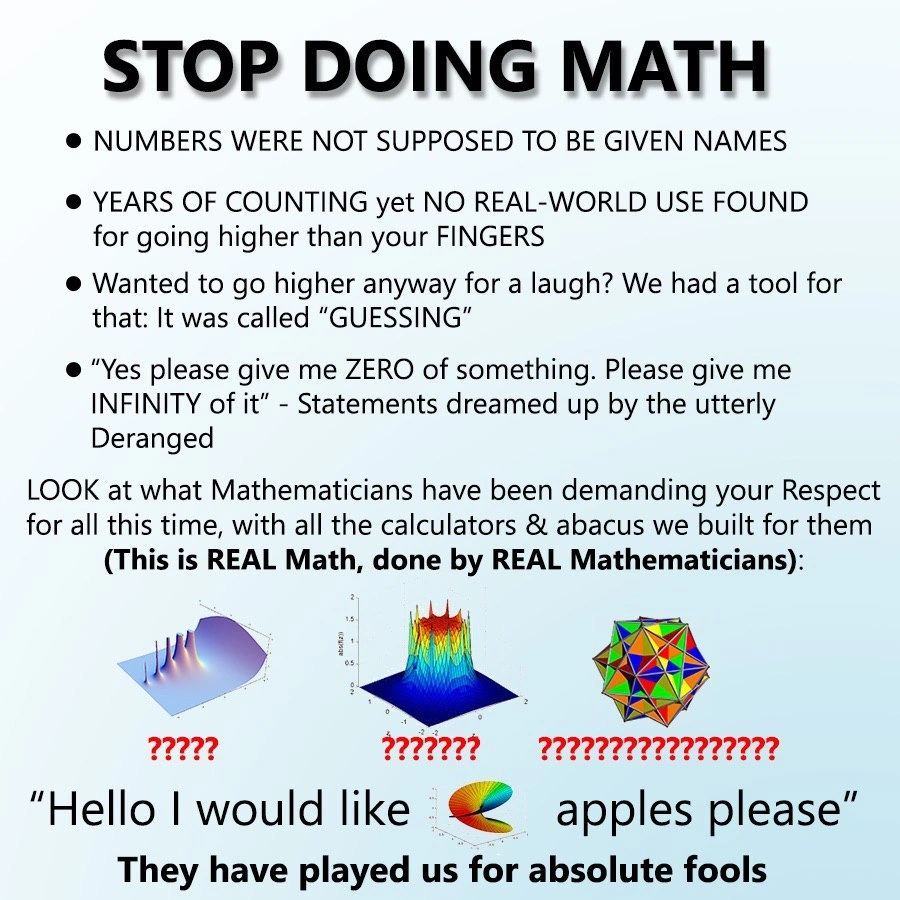
A Satirical Manifesto Against the Absurdity of Mathematics
Why is this Mathematics meme funny?
Level 1: Infinite Apples
Imagine you ask your friend how many cookies they want, and they answer, “I’d like zero cookies,” or even sillier, “Give me infinite cookies!” 😵 You’d probably laugh or be confused, right? Asking for zero cookies means they don’t want any at all, so why ask? And infinite cookies? That’s more cookies than exist in the whole world! This meme is funny because it’s acting like math people talk in that crazy way all the time. It’s saying, “Math is so silly, they might as well be asking for zero or endless apples!”
There are also some super colorful squiggly pictures in the joke. They look like rainbow mountains or funky shapes. It’s as if someone said, “Here’s my important math work!” but all you see are pretty doodles with a bunch of question marks. It’s like if your teacher showed you a confusing drawing and expected you to understand it without any explanation. You’d feel a bit lost.
So, the big text “STOP DOING MATH” is just the meme being dramatic and goofy. The person in the meme pretends to believe that math is useless and weird. Of course, in real life we need math for lots of things (counting cookies, for example 🍪). But it’s funny to imagine someone getting fed up with math and saying “Quit it! No more numbers, this stuff is crazy!” It’s humor that makes us giggle because we remember times when math class felt pointless or too hard. In simple terms, this meme jokes that math might as well be magic gibberish with rainbows – and that’s why it makes people laugh.
Level 2: Counting Past Fingers
For a newer developer or someone early in their CS journey, let’s break down the key pieces of this meme. First, it’s riffing on Mathematics in a very exaggerated way. The phrase “STOP DOING MATH” in big bold letters is intentionally over-the-top – nobody is actually stopping math, it’s just a joke. The bullet points that follow make fun of basic math concepts:
“NUMBERS WERE NOT SUPPOSED TO BE GIVEN NAMES”: This mocks the idea of naming numbers (like one, two, three, or million, billion). In reality, naming numbers is just how we talk about quantity. But the joke pretends it’s silly – why personify numbers with words? A developer might find this funny because in coding we often use numeric literals (
42) or variables instead of saying the number’s name out loud. It’s absurd humor – of course numbers have names, but imagining some caveman logic that they shouldn’t makes us laugh.“YEARS OF COUNTING yet NO REAL-WORLD USE FOUND for going higher than your FINGERS”: This cracks a joke that we’ve been counting for ages but apparently never needed numbers bigger than 10 (assuming you have 10 fingers!). Obviously, in real life we do need bigger numbers – think about counting money, stars, or memory bytes. But early on, kids learn to count on fingers, and 10 feels like a natural limit until you learn more. The meme taps into that naive idea: if you only ever count small things, huge numbers seem pointless. In programming, though, even a simple loop can count far beyond 10 in milliseconds. CS_Fundamentals like data types (
int,long) exist to handle numbers beyond our fingers’ count. So the humor here is a junior dev might recall a time they thought “wow, why would I ever need a number that big?” before encountering things like array indices in the thousands or IDs in the millions.“Wanted to go higher anyway for a laugh? We had a tool for that: It was called ‘GUESSING’”: This one jabs at the idea of estimation. If you need a number bigger than you can concretely measure, you might just guess. It’s riffing on how before formal math, people approximated large quantities with words like “a lot” or “bazillion.” In a coding context, this could be poking fun at rookie mistakes like not calculating something properly and just hard-coding a value that “seems high enough.” For example, setting an array size by guessing a number. There’s also a project management in-joke: sometimes teams guess time or effort instead of using metrics – and that can go comically wrong.
“Yes please give me ZERO of something. Please give me INFINITY of it – Statements dreamed up by the utterly Deranged.”: Here the meme targets zero and infinity, two concepts that can be mind-bending at first. Zero means none of something – it’s a real number (0) but asking for “zero apples” is just a silly way to say “I don’t want any apples.” It’s true we normally wouldn’t phrase it that way at the grocery store! Infinity means “endless” or without bound – you can’t actually have infinity apples because infinity isn’t a specific quantity, it’s a concept of something that goes on forever. In math, you might say a limit goes to infinity, or use infinity symbol ∞ in equations. In programming, sometimes we see infinity as a special value (for example, Python has
float('inf')or in many languages dividing a positive number by 0 in floating-point gives an Infinity value). But you’d never request “infinite memory” or “infinite items” in real life – it’s impossible. So the meme calls these ideas “dreamed up by the deranged” for comedic effect, exaggerating how non-intuitive they are. Every programmer eventually learns you must handle cases like zero-length input or the possibility of an infinite loop. Initially, though, a junior dev might indeed think asking for 0 or $\infty$ of something sounds crazy.
After the bullet points, the meme shows what looks like evidence of “REAL Math” by “REAL Mathematicians”: three colorful images that appear to be 3D plots or surfaces. If you’ve ever used data visualization tools like Matplotlib (a popular Python library for plotting graphs) or MATLAB (a math software), you might recognize these kinds of demo plots. Usually, they plot a mathematical function ( z = f(x, y) ) as a surface in 3D, with color often representing height. They’re basically fancy graphs. Each one here is captioned with a string of question marks, implying that whatever these plots represent is utterly confusing or meaningless to the meme’s narrator. To a newcomer, they do look pretty but puzzling – “What am I even looking at?” The DataVisualization is real, but without context they do seem like just eye-candy with no real-world use. This is exactly the joke: out-of-context math visuals look like random art. In truth, each of those plots likely has an equation behind it (maybe a sine wave surface, a polynomial with peaks, or a geometric shape defined by an algorithm). The meme deliberately replaces any labels or equations with “????” to emphasize a developer’s befuddlement: “I can’t even name what that is!”
Finally, at the bottom, there’s a distorted line: “Hello I would like apples please” with a rainbow swirl where a number should be. This parodies the idea of replacing numbers with something nonsensical. Normally, you’d say “I would like 5 apples please.” If you substitute “5” with a psychedelic swirl (or any absurd math symbol), the request becomes gibberish. It’s highlighting how, for practical tasks like buying apples or writing simple programs, all the wild math in the world isn’t helpful if you can’t state a clear number. For a junior dev, this drives home the meme’s dramatic point: math that isn’t applied can seem as useless as asking for rainbow apples. The closing phrase “They have played us for absolute fools.” is just the meme’s narrator doubling down on the sarcasm – it’s not a serious accusation, it’s humor. It imagines that mathematicians tricked everyone into respecting them, but in reality (the joke goes) they were just doing wacky stuff.
In summary, this meme lives in GeekHumor territory, mixing a developer’s practical mindset with a caricature of academic math. It’s normal as a new developer to feel overwhelmed by theoretical concepts (like big O notation, combinatorics, or calculus) and wonder “Will I ever use this?” The meme amplifies that doubt to a comedic extreme: “Probably not, so let’s all quit math, haha!” The real world is more nuanced – much of that theory does come back in advanced programming, even if indirectly – but it’s healthy in tech to laugh about our own past confusion. After all, every coder at some point has looked at a piece of code output or a formula and had a big row of “?????” in their head!
Level 3: Plotting Confusion
At its core, this meme is poking fun at the eternal love-hate relationship between developers and mathematics. It captures that moment many coders experience when faced with highly theoretical concepts: “Is math just a bunch of colorful charts and gibberish?” The bullet points read like a frustrated developer’s sarcastic rant: why give big numbers names like million or googol; you can count on fingers, so who needs more? It’s a shared chuckle in tech circles – we’ve all heard a fellow programmer joke that anything beyond basic arithmetic is overkill for day-to-day coding. The humor works because it exaggerates a grain of truth: plenty of software engineers get by with Google and Stack Overflow for formulas, rarely delving into the proofs and plots that academics adore. AcademicHumor like this resonates with developers who remember dry math lectures full of Greek symbols and MatplotlibPlots that felt disconnected from “real” coding work.
Those vibrant 3D surface plots with ????? captions exemplify what many devs find bewildering about academic math. Visually, they look like the result of some demo code in a math library – think Matplotlib’s example gallery or MATLAB’s funky demo graphs – where you run surface_plot(np.sin(X**2 + Y**2)) and get a rainbow spaghetti monster. The meme shouts, “This is REAL Math, done by REAL Mathematicians,” holding up these psychedelic graphs as if they were the mathematicians’ crown jewels. To a seasoned developer, the joke is obvious: in practice, mathematicians aren’t just making pretty pictures, but from the outside it looks like they’re playing with meaningless visuals. It satirizes the gap between practical coding and theoretical exploration. TechHumor often thrives on this kind of contrast – the down-to-earth engineer vs. the head-in-clouds researcher.
We also see a jab at concepts like infinity and zero, which in computing can indeed be troublemakers. Anyone who’s been on call at 3 AM due to a production error might recall issues like a divide-by-zero crash (zero in the wrong place can take down systems), or an infinite loop consuming all CPU. The line “Yes please give me ZERO of something. Please give me INFINITY of it” lampoons how nonsensical these ideas sound in everyday terms. A senior dev chuckles here remembering countless bug reports where an “impossible” 0 or NaN (Not-a-Number, often arising from infinity in calculations) snuck into the system. It’s sarcasm rooted in real pain: ignoring math’s corner cases leads to software crashes. “We had a tool for going higher than fingers, it was called GUESSING,” the meme says – senior engineers grin recognizing an anti-pattern in software estimates and scaling. (How many times have we seen projects sized by pure guessing? Too many.) It’s ironically true that when requirements exceed our known scope, people often guess rather than do the math – which can be disastrous in both project planning and algorithms. This line also riffs on how early humans or kids count: beyond their fingers, they guesstimate “a lot.” In systems design, failing to calculate something like capacity can mean your server crashes when users exceed “a guess.” We laugh because we’ve been there.
The conspiratorial tone “They have played us for absolute fools” wraps up the meme with a flourish of Sarcasm. It imagines that developers (who build calculators, computers – the abacus of today) are chumps being tricked by haughty mathematicians demanding respect. This reflects an undercurrent in developer culture: a bit of imposter syndrome mixed with defensiveness. Many devs secretly feel, “I’m using math I don’t fully understand under the hood,” so the meme vents that insecurity by mock-attacking math as pointless. Seasoned programmers recall times they rolled their eyes at theoretical talks, only to later appreciate that some CS_Fundamentals (like graph theory for networking, or linear algebra for graphics) were actually critical. The humor of “STOP DOING MATH” isn’t really anti-knowledge; it’s an inside joke about how deeply reliant on math we are, despite pretending it’s all just guessing and coding. In the daily grind of shipping features, developers bond over the absurd idea of a math-less world – one where maybe we wouldn’t have to think about weird edge cases or Infinity bugs. Of course, that world is fictional, and that’s why this meme gets knowing smirks from experienced devs: it’s a playful nod to the ever-present but often invisible mathematics under our keyboards.
Level 4: Infinite Loops of Logic
Mathematically speaking, this meme tangles with deep concepts like infinity, zero, and the nature of numbers – albeit in a totally tongue-in-cheek way. From a theoretical computer science perspective, these ideas are anything but useless. Consider infinite sets: Georg Cantor’s set theory formalized different sizes of infinity (countable vs uncountable). In computing, we can’t have literally infinite memory, but our models often assume unbounded resources (like the infinite tape of a Turing machine or an endless loop that never terminates). That contrast – math’s idealized infinities vs. a computer’s finite limits – is part of the absurdity here. Yet those “deranged” concepts are fundamental to CS: without 0, we wouldn’t have binary (the entire digital world is built on 0s and 1s!), and without the abstract concept of infinity, we couldn’t reason about things like unbounded loops, recursion depth, or asymptotic behavior in algorithms (Big-O notation often contemplates $n \to \infty$).
The meme parades three brightly colored 3D plots with rows of question marks, as if mathematicians are just conjuring psychedelic art. In reality, such plots often visualize complex functions or high-dimensional data projections – think of a loss function surface in machine learning with many local minima (that spiky landscape could be a cost function’s terrain) or the wavy plane of a trigonometric function. Tools like MATLAB and Matplotlib in Python produce these graphics to help us see the math. Each “?” in the meme is mocking how inscrutable these models can appear. But behind each colorful ridge or polyhedron is real math: differential equations, computational geometry, maybe even a hint of topology. That funky polyhedron on the right isn’t just a random shape – it resembles a complex polytope or a high-dimensional geometric object. Such shapes have serious roles in computer science (for example, convex polytopes underlie linear programming and graphics rendering).
Historically, the quip “with all the calculators & abacus we built for them” alludes to the early days of computing. Many of the first computing machines (from the abacus to Charles Babbage’s analytical engine) were created by or for mathematicians to handle daunting calculations. Mathematicians like Ada Lovelace and Alan Turing laid the groundwork for modern computing precisely by formalizing math into algorithms. So, the meme’s suggestion that mathematicians have “played us for fools” flips history on its head with dark humor. It implies a conspiracy where devs built shiny tools at mathematicians’ behest, only to realize the math folks were off drawing crazy Matplotlib plots and naming imaginary numbers. In truth, those imaginary ideas (like $\sqrt{-1}$ or infinite series) turned out to be incredibly practical – enabling everything from electrical engineering (i for current in circuits comes from the imaginary unit $i$) to signal processing and cryptography. The CS_Fundamentals that every programmer relies on – data structures, algorithms, complexity – are rooted in mathematical proofs and abstractions that might seem just as head-scratching as a rainbow surface plot. Far from having “no real-world use,” abstract math often anticipates needs in computing decades before technology catches up. That’s the ironic twist: the meme’s seemingly anti-math stance is itself a math skeptic meme, but deep down we know that if we truly “STOP DOING MATH,” the entire foundation of software and hardware would collapse.
Description
A satirical poster-style image with a bold headline in all caps: 'STOP DOING MATH'. The image presents a series of absurd, bulleted arguments against mathematics, such as 'NUMBERS WERE NOT NOT SUPPOSED TO BE GIVEN NAMES' and 'YEARS OF COUNTING yet NO REAL-WORLD USE FOUND for going higher than your FINGERS'. It humorously suggests 'GUESSING' as a superior tool and calls concepts like zero and infinity 'Statements dreamed up by the utterly Deranged'. Below this, it mocks complex mathematical visualizations - two 3D plots and a colorful polyhedron - labeling them with red question marks. The punchline is a nonsensical sentence, '"Hello I would like [image of a spiral graph] apples please"', followed by the conclusion, 'They have played us for absolute fools'. The humor is deeply ironic for a technical audience, as it lampoons anti-intellectualism by making absurdly false claims about a field that is the bedrock of all computing and engineering
Comments
7Comment deleted
This is the internal monologue of a frontend developer trying to center a div after reading a whitepaper on algebraic topology
Pro tip for the next capacity-planning review: when the curve stops fitting after nine nines, swap in a rainbow 3-D surface plot, replace every axis label with “???”, and announce you’ve migrated from math to “adaptive guessing at scale.” Works great - finance calls it predictive analytics, ops just calls it Tuesday
The same mathematician who proved P≠NP in their PhD thesis is now calculating if their k8s cluster needs 17 or 18 pods to handle Black Friday traffic
This perfectly captures the moment when a product manager asks why we can't just 'simplify' the algorithm to use 'real numbers people understand' - right before you have to explain why replacing your distributed consensus protocol with 'just count on your fingers' won't scale to 10^9 transactions per second, no matter how many fingers the load balancer has
Sure, stop doing math - then watch capacity planning regress to finger‑counting while NaN and ∞ leak into billing and turn every Grafana panel into ????? at 2 a.m
Math died here when sales promised infinite scale at zero cost; we renamed numbers “Basic” and “Enterprise” and started calling the 3D “guessing” surface capacity planning
Infinity? That's a PM's optimistic ETA for refactoring the monolith