Skip to content
DevMeme
4223 of 7435
Indie versus AAA pitches: quirky transformation ideas versus yet another gun
Games Post #4616, on Jun 29, 2022 in TG

Indie versus AAA pitches: quirky transformation ideas versus yet another gun

Why is this Games meme funny?

Level 1: Guns vs Imagination

Imagine you have two friends who are making up games to play. The first friend is super imaginative but doesn’t have many toys – every day they come up with a new pretend game: “Today we’re explorers on a magic train!” or “Let’s run a pretend bed-and-breakfast for our stuffed animals!” It’s always something creative and unexpected. Now the second friend has a huge toy box full of cool stuff, but every time you ask what game to play, they basically pick the same thing: they grab their toy gun and say, “Let’s play cops and robbers again.” Day after day, it’s always cops-and-robbers with that toy gun, just maybe in a slightly different setting. You can see how that might get a bit dull compared to the first friend’s wacky ideas. This is exactly what the meme is joking about. The big-budget game companies (like the friend with all the toys) often end up suggesting the same kind of game over and over (another game with shooting and guns), while the small indie creators (like the imaginative friend) come up with all sorts of quirky, new ideas. It’s funny in a kind of “oh, of course!” way — one side has all the resources but keeps making the same thing, and the other side, with just their imagination, invents a whole new world every time. That contrast makes us laugh because it’s like watching someone with endless possibilities choose the same old thing, while someone with hardly anything creates something brilliantly different from scratch.

Level 2: Originality vs Formula

Let’s break down the joke in simpler terms. The meme compares indie games to AAA games, so first we need to know what those are:

  • AAA games: This refers to big-budget video games made by large, well-known companies (think of publishers like EA, Activision, or Ubisoft). AAA games are like the Hollywood blockbusters of gaming – huge teams, expensive production, and they need to sell a lot of copies to make money. Because so much is invested, these games usually stick to formulaic design that has proven to be popular. A very common formula is “give the player a gun” and let them shoot bad guys or monsters. In other words, AAA games often end up being shooters or action games, because those genres have historically been safe bets. If you look at many top-selling AAA titles, the basic pitch could be “You’re a hero with weapons, saving the day by defeating enemies.” For example, the core idea of a game like Call of Duty (a famous AAA series) is essentially “you’re a soldier with a gun in a war.” Big studios repeat ideas like this because they know it works and will likely make a profit.

  • Indie games: “Indie” stands for independent. These are games made by individuals or small teams without the backing of a big publisher. Indie developers usually have tiny budgets and fewer resources, but a lot of creative freedom. They can’t compete with AAA titles on fancy graphics or sheer size, so instead they often attract players by coming up with original, quirky ideas that nobody has tried before. Indie game pitches can sound really unconventional, like “what if you were a house cat organizing a magic shop?” or “what if you controlled a single letter of the alphabet in a world of words?” (just to imagine a few). These ideas might sound silly or oddly specific, but that’s the point – they’re unique. A real example: Untitled Goose Game is an indie game where you play as a goose. There’s no gun, no heroic soldier – you’re literally a goose wandering around messing with people in a village. It’s a weird idea, but it turned out to be very fun and popular! Another example is Stardew Valley, an indie farming game made mostly by one person, which asks “what if you left your city job to run a little farm?” – no battles, just peaceful farming and community life. Indie devs use originality as their strength to get noticed, because they can take chances on gameplay that big companies might shy away from.

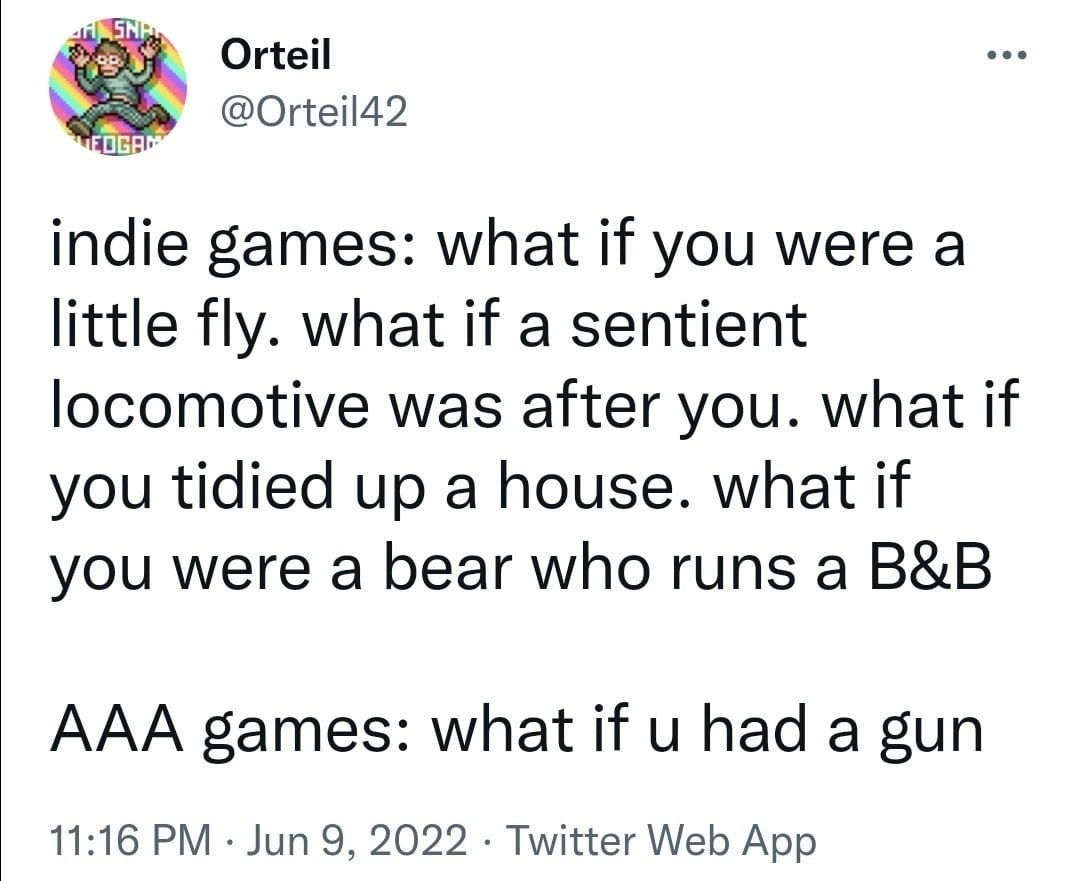
Now, why is the meme funny? Because it jokes that no matter what crazy idea indie folks come up with, AAA studios will always default to the same basic idea: “What if you had a gun?” The tweet is basically saying:

Indie game pitch: "What if you were a fly?" or "What if you ran a cozy B&B as a bear?" (something creative and unexpected)
AAA game pitch: "What if you had a gun?" (the same old idea again)

This contrast is humorous because it feels true in a lot of cases. Big mainstream games often do all start to feel the same – many of them are shooters or action games with guns, just with different paint jobs (one might be set in space, another in a jungle, another in a city, but you’re still running around shooting in each one). Meanwhile, indie games are coming out with premises that make you go, “Huh, I’ve never seen a game about that before!”

The meme is a screenshot of a tweet, but you don’t really need to know the Twitter specifics — it’s the content of the joke that matters. It highlights a real thing in the game development world: creative vs formulaic design. Indie developers often emphasize creativity and unique gameplay to stand out, whereas AAA companies, with millions of dollars on the line, tend to reuse formulas that are known to succeed (like giving the player a gun and enemies to shoot). It’s a friendly jab at the gaming industry’s clichés. People find it funny because if you’re a gamer or a developer, you can probably think of tons of AAA games that boil down to “You have a gun, you shoot bad guys,” and then you think of the oddball indie games you’ve seen, and the comparison in the tweet rings true.

So basically, the tweet is joking that:

  • Indie game idea – something innovative or quirky, where you might be doing anything from befriending animals to cleaning a house.
  • AAA game idea – the same old thing every time: here’s a weapon, go fight.

It’s poking fun at how the big-budget side of the gaming industry (AAA) can sometimes lack originality, whereas the independent side is brimming with wild, fresh concepts. For a newer developer or someone just getting into games, it’s a quick lesson in how different the approach to game design can be depending on who’s making the game. And for anyone who plays games, it’s a funny reminder of why we see so many sequel shooters each year, while also seeing weird little indie gems pop up on the sidelines.

Level 3: When in Doubt, Add a Gun

In this meme, a game developer is poking fun at the stark creative vs formulaic design difference between indie game pitches and AAA game pitches. The tweet humorously lists imaginative scenarios typical of indie games — “what if you were a little fly,” “what if a sentient locomotive was after you,” “what if you tidied up a house,” “what if you were a bear who runs a B&B” — and then contrasts them with the blunt, one-note premise that seems to dominate AAA games: “what if u had a gun.” This punchline lands because it’s a well-known gaming culture joke: big-budget studios often rely on the same tried-and-true mechanics (usually involving guns and combat), whereas indie developers float wildly original ideas that sound bizarre but fresh.

From a senior game development perspective, this meme highlights how industry economics shape game design. AAA (pronounced “triple-A”) refers to blockbuster games made by major studios with massive budgets (tens or hundreds of millions of dollars). With so much money at stake, publishers and stakeholders tend to be extremely risk-averse. They want a guaranteed return on investment, which in practice means green-lighting concepts with proven mass-market appeal. And what’s more proven in the gaming industry than a game where you have a gun and get to shoot bad guys? First-person shooters and action-adventure games with heavy combat elements dominate AAA lineups because historically, they sell. It’s the safe bet: give players a familiar power fantasy (like being a soldier or space marine with a weapon) and iterate on polished graphics and known gameplay loops. The meme exaggerates to make a point—of course not every AAA title is literally just “you have a gun” — but it’s close enough to truth to make developers smirk. Many AAA franchises (Call of Duty, Battlefield, Far Cry, Halo, Gears of War — take your pick) boil down to "here's your gun, now go shoot something." Even when the setting or story changes (be it a sci-fi world or a historical war), the core pitch often sounds similar: the player has a weapon and a license to use it liberally. The tweet distills that formula perfectly with the line “AAA games: what if u had a gun.”

On the other hand, indie games come from small independent studios or even solo developers with tiny budgets. Without corporate oversight and huge sales targets, indie devs have the freedom (and necessity) to experiment with novel ideas to stand out. They ask offbeat, whimsical "what if" questions and run with them. These questions can be delightfully unconventional: What if everyday chores were the gameplay? What if you played as an animal or even a sentient object? Because indie teams aren’t spending $50 million on development, they can afford to target niche audiences or explore gameplay that a AAA studio would consider too risky or too “weird” to sell. The result? We get wonderfully unique games with premises like running a bed-and-breakfast as a bear, or calmly organizing a messy house (no enemies, no combat — just cleaning up). Those ideas sound almost comically mundane or strange, yet games like Unpacking (a relaxing house organization game) or Bear and Breakfast (yes, a cozy management game where you’re literally a bear Airbnb host) found enthusiastic fanbases. To a big publisher executive, "tidying up a house" would initially sound like a hard sell ("Where’s the excitement? Where’s the gun?"), but for an indie developer, that same idea is a creative goldmine precisely because it’s unlike anything the AAA folks are making.

This industry dynamic leads to a lot of game design cliches. Seasoned developers have sat through meetings where any truly innovative pitch risks getting watered down into something more conventional. It’s practically an insider joke that if you propose “I want to make a game about [some quirky concept],” a big studio might respond, “Sure… as long as we add some combat or give the character a gun, right?” There’s a cynical mental image of a corporate producer hitting a big red Add Gun™ button whenever a design idea starts to drift too far from the familiar formula. The meme’s line “AAA games: what if u had a gun” nails that sentiment. It's funny because it's true: if you strip away the fancy settings or characters, the core of many AAA pitches really does reduce to "the player has a gun, and uses it a lot" — the rest is window dressing.

To illustrate the point in dev terms, it’s like the brainstorming pseudocode for game ideas diverges based on project scale:

quirky_ideas = ["tiny fly protagonist", "evil sentient locomotive chases you",
                "house-cleaning as gameplay", "bear running a B&B"]

if studio.type == "AAA":
    game.core_mechanic = "give player a gun"    # Safe, proven formula for mass appeal
else:
    game.core_mechanic = random.choice(quirky_ideas)  # Experimental, unique hook

In a large studio setting, design decisions often have to pass through many filters — marketing departments, executive approvals, focus groups — so the end result is often design by committee. And committees love formulas that worked last time. If the last big hit was a gritty shooter, the new pitch better have some shooting as well. (No one ever got fired for making yet another gun game, but if you gamble on "playing as a fly" and it flops, heads will roll.) Indie devs, conversely, answer only to their own creativity (and maybe a small fan community or Kickstarter backers). Originality becomes their competitive advantage. They can ask, "What if the player is a goose annoying villagers?" and just go build that game, no boardroom full of executives to convince. And when one of these oddball ideas does hit the jackpot (for example, Untitled Goose Game delighted a huge audience by letting players be a honking, mischievous goose), it validates the indie approach and highlights how formulaic AAA design can feel by comparison.

This meme resonates strongly as developer humor because it satirizes something game creators gripe about all the time. It’s the collective eye-roll when yet another big-budget title is announced with the same generic premise and a big arsenal of guns, while the most memorable, innovative gaming experiences of recent years have come from left-field indie projects. The humor has an edge of truth: big studios often seem stuck in a loop of sequels and clones, while indie devs are out there turning the most absurd daydreams into playable art. For an experienced developer, the tweet is both funny and a tad bittersweet – it’s a reminder that in this industry, game idea originality often takes a backseat to safe bets whenever massive budgets are involved. After all, why risk being a fly or a housekeeper when you can reliably sell millions of copies by handing the player a big gun? The AAA vs indie contrast in the meme is exaggerated for effect, but every dev who’s sat in a pitch meeting can attest: sometimes it really does feel like the only idea AAA studios pitch is, “Let’s give the hero a gun (again).” That mix of truth and exaggeration is what makes us smirk and share this meme around the studio.

Description

Screenshot of a tweet from user “Orteil” (@Orteil42) showing a small pixel-art avatar of a waving monkey on a rainbow background. The tweet text reads: “indie games: what if you were a little fly. what if a sentient locomotive was after you. what if you tidied up a house. what if you were a bear who runs a B&B AAA games: what if u had a gun”. Below the text is the timestamp “11:16 PM · Jun 9, 2022 · Twitter Web App”. The standard Twitter UI uses dark navy text on a white background. Technically, the meme contrasts the inventive mechanics often explored by indie developers with the formulaic, combat-centric focus typical of big-budget studios, satirizing how funding models and stakeholder risk tolerance constrain game design creativity
Comments

6
Anonymous ★ Top Pick Indie devs: “What if each microservice dream-walked through eventual consistency and wrote its own unit-test haikus?” Enterprise roadmap: “Love the vision - now wrap it in an 800 MB Electron shell and give the user a button that shoots JSON.”
  1. Anonymous ★ Top Pick

    Indie devs: “What if each microservice dream-walked through eventual consistency and wrote its own unit-test haikus?” Enterprise roadmap: “Love the vision - now wrap it in an 800 MB Electron shell and give the user a button that shoots JSON.”

  2. Anonymous

    Indie devs architect elaborate state machines to simulate a bear's hospitality anxiety while AAA studios spend three years optimizing the ballistics engine for bullet #47,293 that players will never notice

  3. Anonymous

    Indie devs: 'Our game explores existential themes through the lens of a sentient toaster navigating grief.' AAA studios after their $200M budget meeting: 'So we added a third gun type and made the explosions 15% bigger - ship it.' The real difference? Indie games ask 'what if?' while AAA games ask 'what if, but with more polygons and a season pass?'

  4. Anonymous

    Indie game pitch: “What if the Entity is a fly?” AAA pitch: “Attach GunComponent to every Entity and ship.”

  5. Anonymous

    AAA feels like a multi‑armed bandit with epsilon set to 0 - forever pulling the ‘gun’ lever while indies explore the rest of the state space

  6. Anonymous

    Indies architect existential fly sims on a single dev machine; AAA empires bolt ray-traced guns onto decade-old pipelines for that 'next-gen' reload jank

Use J and K for navigation