Expertly Dodging the Daily Stand-Up Inquisition
Why is this Agile meme funny?
Level 1: The Convenient Glitch
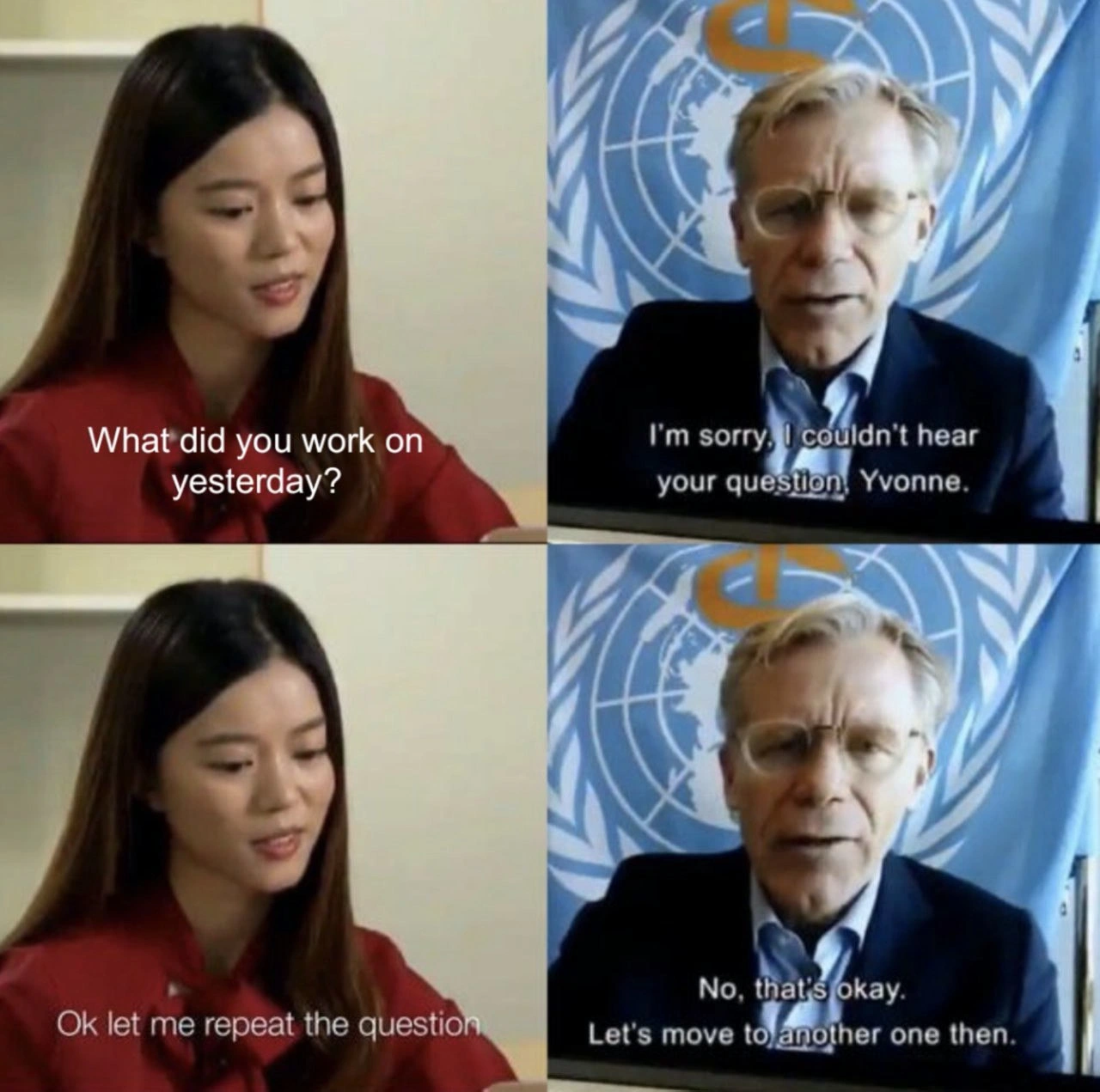
Imagine you’re in class and the teacher asks you a question about last night’s homework. You haven’t actually done it, so you suddenly pretend you didn’t hear the question. Maybe you even cup your ear and go, “Huh? Sorry, the sound is breaking up!” hoping the teacher will just ask someone else. That’s exactly what’s happening in this picture, but with grown-ups on a computer call. The lady is basically the teacher asking, “What did you work on yesterday?” and the man acts like his audio isn’t working right when he’s supposed to answer. He’s faking a technical difficulty at the perfect time so he won’t have to admit he has nothing to say. It’s funny in a sneaky way – like a kid pulling a prank to avoid trouble. Everyone laughs because we all know how it feels when you’re put on the spot and wish you could magically disappear for a moment. In this case, the “magic trick” is a pretend internet glitch, and it works like a charm. The boss just says, “No problem, let’s ask someone else,” and the man gets off the hook. The joke is a playful take on how people sometimes pretend not to hear when they don’t want to answer a question.
Level 2: Mic Check Misadventures
Let’s break down what’s happening for those new to Agile or remote meetings. A daily stand-up (also just called a stand-up meeting) is a short team meeting usually held every day in Agile/Scrum teams. The idea is each team member answers three quick questions: What did I work on yesterday?, What am I working on today?, and Do I have any blockers (problems). It’s meant to keep everyone in the loop and help with team Communication. In an office, teams often literally stand up in a circle to keep it brief (hence the name). Now, when everyone started working from home (especially around 2020), stand-ups moved to video calls using VideoConferencingTools like Zoom, Microsoft Teams, or Google Meet. Remote stand-ups serve the same purpose, but you’re talking to your webcam instead of people in a room. This shift introduced some new quirks: every call seems to start with “Can you hear me now?” or someone saying “Sorry, go ahead – no you go ahead” due to lag.
In the meme, we see a typical remote stand-up scenario. Yvonne asks her teammate what he did yesterday – a routine question in any stand-up. Normally, you’d expect him to list the tasks or user stories he completed (like “I fixed that login bug and code-reviewed Alice’s merge request”). Instead, he claims he couldn’t hear the question. On a real video call, that could happen because of a muted microphone, bad internet connection, or software glitch. It’s common courtesy to repeat the question or check audio when someone says that. Yvonne even responds with “Ok let me repeat the question,” showing she’s following good RemoteWork etiquette – assuming positive intent that it was a genuine technical issue.
However, the punchline comes when the guy quickly says, “No, that’s okay. Let’s move to another one.” That’s oddly proactive for someone who supposedly didn’t hear anything! 😅 It signals that maybe he did hear the question and is intentionally dodging it. In a real team call, this would be like a red flag: perhaps he has nothing to report or didn’t do what he was supposed to yesterday. Claiming connectivity_excuse (“I have bad signal”, “I’m breaking up”) or “Oops, my mic was off” has become a running joke in RemoteWorkCulture. It’s the digital equivalent of saying “I didn’t catch that, never mind” to avoid answering. New developers quickly learn these kinds of excuses – some people use them genuinely when tech fails, and some use them creatively when they’re unprepared. The humor here is that everyone in tech has heard lines like:
- “Sorry, you were cutting out. What was the task again?”
- “I think I have a delay… can you repeat? … Oh never mind, looks like it fixed itself.”
- “I’m going to turn off video, my connection is acting up.” (often said when someone’s about to be put on the spot)
If you’re a junior dev, all this might sound too familiar after a few months of remote meetings. You’ve probably experienced a legitimately bad Zoom call where a teammate’s audio drops. This meme plays on that familiarity, but exaggerates it into a joke: the guy is basically abusing a known technical problem as an avoidance_strategy. In plain terms, he is pretending not to hear so he doesn’t have to answer the question. It highlights a little secret of modern remote meetings: sometimes Communication isn’t blocked by technology alone – occasionally, people hide behind technology glitches on purpose! For someone new to the industry, it’s a funny peek into how human nature finds a way, even in virtual Scrum meetings. Remember, the goal of a stand-up is to be open about progress and blockers. If a teammate is constantly “having audio issues” when it’s their turn, it might be time to gently check in with them after the call. But in the moment, as this meme shows, most stand-ups will just shrug and move on to keep things on schedule. It’s a tongue-in-cheek reminder that even serious Agile routines have their lighthearted (and sometimes frustrating) moments.
Level 3: Mute Button Maneuvers
This meme hits on a scenario every seasoned developer recognizes from the era of all-day Zoom meetings and sudden RemoteWorkCulture. In an Agile team’s daily stand-up (a core AgileCeremony in Scrum methodology), each dev is supposed to quickly report yesterday’s work, today’s plan, and any blockers. Here we see that ritual play out: Yvonne, likely the Scrum Master or team lead, asks “What did you work on yesterday?” – the standard opener of a daily stand-up. The developer on the other end (with the UN-looking backdrop) immediately replies with the classic remote call line: “I’m sorry, I couldn’t hear your question.” This is the stand-up equivalent of pulling the fire alarm to skip a test. The humor lies in how perfectly timed his “audio issue” is – it’s a strategic dodge. Every senior engineer has witnessed this kind of avoidance_strategy: the one team member who always seems to have conveniently glitchy internet or a mysteriously muted mic exactly when it’s their turn to speak. It’s a sly form of remote-meeting evasion that turns the MeetingCulture on its head.
Why is this so funny (and painful) for experienced devs? Because it lampoons the ritualistic nature of Scrum ceremonies and the reality of RemoteWork communication breakdowns. In an ideal world, the daily stand-up is a focused 15-minute sync where everyone shares honest updates. In reality, stand-ups can devolve into monotonous status recitals where people half-listen while checking emails. When the whole team went remote (as many did around early 2020), these meetings moved to video calls and brought a new range of technical chaos: frozen video feeds, lagging audio, and the ubiquitous “You’re on mute!” moments. A remote_audio_issue can be genuinely frustrating – or in cases like this meme – a brilliant excuse. The developer in the meme is basically performing a well-timed mic_off_excuse. It’s developer humor gold because it satirizes how we’ve all learned to differentiate real tech issues from sprint_scrum_meme shenanigans. There’s an unwritten understanding among battle-scarred devs that if Bob’s voice only cuts out when he’s supposed to report progress, Bob might be pulling a fast one. The Scrum Master (Yvonne) even plays along, “Ok let me repeat the question,” trying to give him the benefit of doubt. But when he quickly waves it off – “No, that’s okay. Let’s move to another one then.” – it’s crystal clear that Bob had standup_fatigue or simply no progress to share and Yvonne is skipping the confrontation to keep the meeting moving. It’s a perfectly captured too-real moment of how daily stand-ups often go in practice: everyone wants to stick to the time-box, so awkward issues get swept under the rug with a nervous chuckle.
On a deeper level, this meme underscores a common developerPainPoint about remote stand-ups: the loss of direct face-to-face accountability. In person, if you tried this “I can’t hear you” act, it wouldn’t fly – your teammates would arch an eyebrow and wait you out. But behind a screen, with a bit of feigned lag or a quick mute toggle, a developer can camouflage a lack of updates as “technical difficulties.” It’s funny because it’s a high-tech twist on an old trick (think of a student faking a cough to dodge a question). The team’s Communication suffers, and the whole Agile principle of transparency is quietly subverted. Yet, as cynical as it is, it’s relatable: who hasn’t secretly wished for their internet to drop right when they’re about to admit they’re behind on a task? The meme nails that shared sentiment with deadpan accuracy. In summary, at the senior engineer level, we laugh (and cringe) because we recognize how a daily_standup_meme like this reflects real workplace dynamics – a mix of genuine tech glitches, human avoidance tactics, and the unspoken agreement to just move on and pretend everything’s fine to avoid derailing the meeting. It’s the darkly comedic underbelly of Agile teamwork in the age of endless ZoomMeetings.
Description
A four-panel meme taken from a video interview. In the first panel, a woman with long dark hair, wearing a red top, asks the question, 'What did you work on yesterday?'. The second panel shows a man with glasses on a video call, with a United Nations flag in the background, who replies, 'I'm sorry, I couldn't hear your question, Yvonne.'. In the third panel, the woman attempts to clarify, saying, 'Ok let me repeat the question'. Before she can, the man in the fourth panel quickly interjects, 'No, that's okay. Let's move to another one then.'. The humor is derived from the man's transparently false claim of hearing difficulties to avoid a simple question. In the tech world, this is highly relatable to the daily stand-up meeting in Agile, where developers have to report their progress. The meme captures the universal feeling of dread when you've had an unproductive day and will do anything - including feigning technical issues - to avoid admitting you have nothing to show for your work

Comments
7Comment deleted
The three most common developer responses to 'What did you do yesterday?' are: 'I was in meetings,' 'I was fighting a CI/CD pipeline,' and 'Sorry, you're breaking up, let's move on.'
My anti-burn-down strategy: a shell script that fakes 30% packet loss to Zoom whenever someone asks what I shipped - easily the most reliable service in our whole microservice fleet
After 20 years in this industry, I've mastered the art of making 'investigating the issue' sound like actual progress while I wait for the junior dev's PR to unblock me
Every senior engineer knows this move: when asked about yesterday's 'refactoring' that somehow took 8 hours, suddenly your microphone develops Schrödinger's audio - simultaneously working and broken until the standup moves on. It's the remote work equivalent of 'works on my machine,' except now it's 'can't hear on my connection.' Bonus points if you've perfected the concerned face while frantically typing 'sorry, audio issues' in chat, knowing full well your Bluetooth headset is at 100% and your network latency is 12ms
Remote standup trick: add 2% packet loss so “What did you ship yesterday?” becomes Schrödinger’s deliverable - shipped if unheard, rolled over if repeated
Senior dev superpower: Input validation that rejects 'yesterday' queries with a 503 Service Unavailable
Remote standup CAP theorem: during a packet loss, you trade consistency in yesterday’s Jira updates for availability of moving on to the next question - eventual consistency happens right after the call