Skip to content
DevMeme
1090 of 7435
C++ Compilation: The Unofficial Pomodoro Timer
Languages Post #1225, on Apr 2, 2020 in TG

C++ Compilation: The Unofficial Pomodoro Timer

Why is this Languages meme funny?

Level 1: Take a Breather

Imagine you’re building a really big and complicated LEGO set. You put together pieces for a while, but then, every 20 minutes, you have to ask a magic machine to glue the pieces so far (so they don’t fall apart). And that gluing machine takes 10 minutes to do its job each time. Sounds annoying, right? But you might say: “Well, at least I get a 10-minute break every time it’s gluing!” During those breaks you can rest, have a snack, or just relax your hands.

This meme is just like that, but with writing computer programs. C++ is like the big LEGO set – it’s awesome and powerful, but when you build with it, you often have to wait for the computer to “glue” everything together (that’s the compiling part). The joke is that the person is pretending to be happy about those waits because it forces them to take a break. In real life, waiting for the computer can be boring, like watching paint dry. But here they joke, “Hey, it’s actually great for my mental health – I get to chill out regularly!” It’s funny because normally we think waiting is bad, but this person is looking on the bright side and saying the forced pauses are making them feel better. It’s like saying a slow chore is good because it gives you time to daydream. So the meme is basically a programmer way of saying: “My work takes so long sometimes that I get built-in nap times, and I’m oddly okay with it!”

Level 2: Build Process Basics

Let’s break down what this joke means in simpler terms. C++ is a programming language that needs to be compiled before you can run your program. Compiled means you use a special software called a compiler to translate your C++ code (which humans can read and write) into machine code (which the computer’s hardware can execute). This compilation step is kind of like prepping and cooking a meal from raw ingredients – it takes some time. The meme is joking about how, with C++, this cooking process (the compile) can take a surprisingly long time, especially for big programs. It’s not literally every 20 minutes for all C++ projects, but the tweet exaggerates to make a point: C++ programs often take their sweet time to build.

Why does compiling take 10 minutes in the joke? Imagine you have a big C++ project with many files and lots of code. Each time you hit “build” or “run” in your development environment (or type a compile command like g++ main.cpp -o myProgram in a terminal), the computer has to: read all your code and all the libraries you included, check that everything makes sense (types match, functions exist, etc.), and then generate an executable program. For a small homework assignment, this happens in a blink of an eye. But for a large codebase (think of a complex video game or a professional application with millions of lines of code), this process can take several minutes or more. C++ in particular is known to have long compile times because it was designed in a way (with lots of small files and textual includes) that doesn’t incrementally build very easily. Often, a small change can force the compiler to re-check a lot of code.

Let’s clarify some terms from the meme and tags:

  • Compile times: This refers to how long the compiler takes to do its job (turn code into a running program). In the meme, it’s jokingly about 10 minutes per compile.
  • Build systems: These are tools (like Make, CMake, or Visual Studio’s build process) that help manage compiling many files in the right order. They can also run steps like testing or packaging. In big projects, you don’t compile files one by one manually – a build system figures out what needs to be built and runs the compiler for you. The tag BuildSystems_CICD hints at continuous integration too – that’s when every change to the code is automatically compiled and tested on a server (which can be slow if the project is large!).
  • Developer productivity: This means how much work a programmer can get done in a given time. Long build times hurt productivity because a developer might spend a lot of time just waiting. Imagine trying to write an essay, but after every paragraph you had to wait 10 minutes for your pen to start working again – it would slow you down! The joke is saying the developer uses that forced idle time as a “feature” to rest.
  • Mental health in tech: In recent years, people in software have been talking more about stress, burnout, and taking care of your mental well-being. One common suggestion is to take regular breaks – step away from the screen, stretch, maybe get some water – rather than working non-stop, which can tire you out.

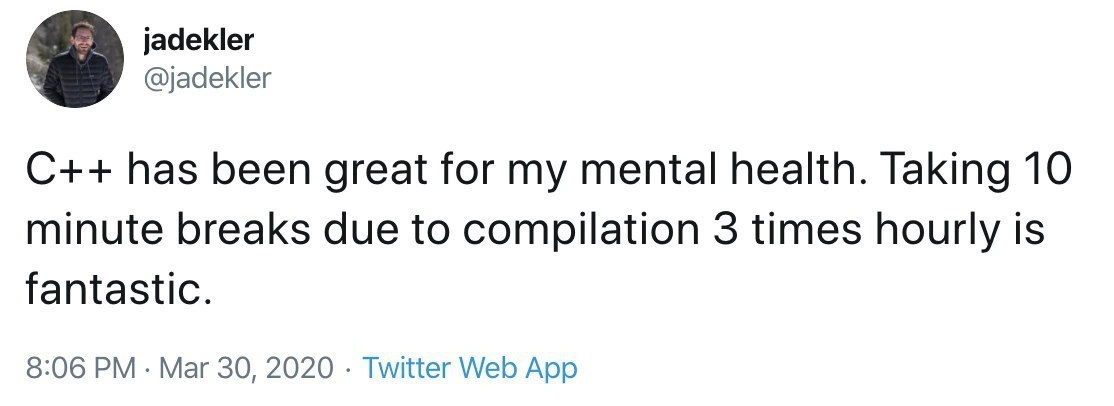
So, the tweet’s text: “C++ has been great for my mental health. Taking 10 minute breaks due to compilation 3 times hourly is fantastic.” Let’s unpack that. The person is writing C++ code and finds that every 20 minutes or so, they have to recompile their code (maybe to test what they just wrote). And each compile takes 10 minutes to finish. That means in an hour, about 30 minutes are spent just waiting for the computer to finish building the program. That sounds frustrating! But the joke here is the person is pretending to love this situation because it forces them to take breaks they might otherwise skip. It’s a very tongue-in-cheek way to say, “my builds are so slow that I’m constantly on break.” They’re definitely poking fun at C++ for being slow to compile.

For a newer developer or someone not familiar with C++: many modern languages (like Python, JavaScript, or even faster-compiling languages like Go) don’t make you wait nearly as long between making a change and running your code. With an interpreted language like Python, you can edit and instantly run again (no compile step at all, or it’s extremely quick just-in-time). With C++, you usually have to recompile after changes. On small projects, this is a few seconds or less, which is fine. But on huge projects (the kind many professional C++ developers work on), it can be several minutes each time. That’s why this scenario of “10 minute breaks, 3 times an hour” is an exaggeration many developers find relatable and funny. It’s taking a common pain point – slow compile times – and sarcastically calling it a perk.

The categories “Compilers” and “Build Process” come in because the whole joke centers on the compiler’s speed and the build routine. “MentalHealth” is mentioned because, humorously, the situation is compared to something beneficial for one’s mental well-being (regular breaks). In reality, if your build is that slow, it can actually be stressful or boring – you might start multitasking, lose focus, or get frustrated. But the meme flips it around with a laugh, implying the compiler is like a strict yoga teacher telling the developer “take a breath, relax.” It’s a bit of ironic positivity in the face of a slow computer process.

So, in simpler terms: the developer is jesting that because their C++ code takes so long to recompile, they are forced to relax and take a breather multiple times an hour, which might be inadvertently keeping them sane. It’s a lighthearted way to complain about C++’s speed by saying “hey, at least I get a coffee break out of it!” Many programmers will chuckle at this because they’ve experienced the same thing – hitting the compile button and then literally going to grab a coffee or chat with a coworker since they can’t do much else until the build finishes. It’s a shared inside joke about the quirks of working with compiled languages like C++ and managing to stay patient (and maybe even productive in a different way) during those waits.

Level 3: Coffee Break Driven Development

This meme hits home for any seasoned C++ developer who has sat staring at a progress bar or spinning CPU fan during a build. The tweet from @jadekler quips that “C++ has been great for my mental health” because it forces 10-minute breaks roughly 3 times an hour due to slow compilation. It’s a classic piece of developer humor mixing frustration with sarcasm. Why is it so funny (and a little painful)? Because experienced devs know that C++ compile times can be absurdly long, to the point where waiting for builds becomes a routine part of the day. Instead of just complaining, the author wryly reframes it as a feature: hey, at least I’m forced to step away from the screen regularly!

Anyone who’s worked on a large C++ codebase (think big game engines, complex GUI applications, or massive backend systems) has developed coping mechanisms for the inevitable wait. There’s even a running joke in offices: “the code is compiling, time for a coffee break!” – practically a ritual in some C++ shops. This tweet plays on that culture. It suggests that C++’s slower build process inadvertently enforces the kind of healthy work pattern your therapist or productivity coach might recommend: take regular breaks, stretch, clear your mind. It’s like an accidental Pomodoro technique, with the compiler acting as the timer. Instead of a 25-minute focus session and 5-minute break, it’s ~20 minutes coding and ~10 minutes waiting. In other words, “Coffee Break Driven Development” is the tongue-in-cheek methodology here. The meme conjures the image of a developer hitting “compile” and then leaning back to sip coffee, do some stretches, or chat on Slack, because there’s nothing else to do until the machine finishes crunching code.

The humor works on multiple levels for a senior dev. First, it lampoons the notorious inefficiency of C++ build times. We’ve all been there: making one small change in a header file of a large project and then watching in despair as the entire project rebuilds. That’s a classic C++ scenario – due to how headers and dependencies work, even a tiny edit can trigger a cascade of recompilations. The tweet exaggerates only slightly: some projects really do suffer ~10 minute incremental builds, especially without careful build system tuning. So the “3 times hourly” quip might make a C++ veteran chuckle and nod, recalling those painfully slow afternoons.

Second, it touches on developer productivity and its trade-offs. C++ is prized for producing high-performance executables, but the development feedback loop (write code -> compile -> run) is much slower compared to, say, an interpreted language or a language with a JIT (Just-In-Time) compilation and hot reload. An experienced engineer will recognize this as the classic speed vs. speed paradox: C++ gives you fast programs but slow development iterations, whereas something like Python gives fast iterations but slower programs. This context makes the tweet’s positivity ironic – in reality, those long compile waits are a productivity killer. You can’t quickly test changes or iterate when you’re always waiting on builds. Yet here the author jokingly spins that as a productivity booster for mental health (since they’re forced not to overwork continuously). It’s funny because it’s partially true: if you have no choice but to wait, you might indeed relax for a moment. But it’s also poking fun at the absurdity – we normally want our tools to be faster to help productivity, not so slow that we find silver linings in the slowness!

This meme also resonates with the shared camaraderie of pain in the developer community. Long compile times are an almost universal gripe in systems programming and big projects. There are legendary anecdotes, like the one about early 2000s game developers hitting “Build All” and then going for a long lunch because the engine would take an hour or more to compile. Or the famous XKCD comic where developers are shown goofing off playing ping-pong, justifying it with “Our code’s compiling.” That comic is basically the visual form of this tweet’s idea. Seasoned devs swap these stories the way war veterans share battle tales – “Remember that one project where a full rebuild took 2 hours? We set up a TV in the office lounge for build-time Mario Kart tournaments!” It’s half joke, half coping strategy.

Moreover, the mention of mental health is not accidental. By 2020, the tech community had been increasingly acknowledging mental health in tech – emphasizing that crunching 10 hours straight in front of a screen is unhealthy. Regular breaks are known to prevent burnout, eye strain, and fatigue. So the tweet humorously implies that C++’s snail-paced builds are doing developers a favor by forcing those pauses. It’s a sly commentary: in a field where burnout is common, even an annoying thing like waiting on a compiler can be seen as an opportunity to breathe. Of course, nobody truly thinks a slow build is a “fantastic” feature. But by joking about it, developers collectively vent their frustration and also remind each other to chill out a bit. It’s a subtle nod to the “take care of yourself” advice wrapped in irony. The Compilers and Build Systems that normally frustrate us are, in this light, cheeky enforcers of self-care.

In essence, an experienced developer reading this will likely smirk and think: “Yep, been there. Hah, maybe I should frame my next 10-minute compile as a positive break instead of raging at my machine.” The meme cleverly balances sarcasm and truth – acknowledging that slow compile times are a drag on developer productivity, while humorously suggesting they have an upside (enforced mindfulness!). It’s funny because it’s a coping mechanism disguised as praise. And behind the laughter, every senior dev knows the real solution isn’t to rely on compile-induced breaks, but to improve build times – whether by using a faster compiler, leveraging incremental builds, or even switching languages or employing continuous integration servers to offload the heavy lifting. Still, until those solutions come, we’ll keep making jokes like this on Twitter, finding community in shared frustration and a dash of dark humor about the tools we love and hate.

Level 4: Template Metaprogramming Marathon

At the deepest technical level, this meme highlights some C++ compiler quirks that can cause astonishingly long build times. C++ is a powerful compiled language, but that power comes with a complex compilation pipeline. When you hit “build”, the compiler (like g++ or Clang) performs a series of heavyweight steps:

  • Preprocessing & Header Inclusion: C++ uses textual #include directives to pull in declarations from header files. Each source file (translation unit) may end up parsing thousands of lines of headers (think <iostream> and other standard or third-party headers) over and over. Without modules (a modern addition in C++20), the compiler essentially re-processes the same code repeatedly across many files. This redundant work balloons compile times.
  • Parsing and Semantic Analysis: The compiler must parse your C++ code into an Abstract Syntax Tree (AST) and then perform semantic checks (type checking, name resolution, overload resolution). C++’s rich features (e.g., templates, constexpr, overloads, SFINAE*) mean the compiler is doing some heavy reasoning. C++ templates are Turing-complete, so the compiler might even be executing what amounts to programs at compile-time (like evaluating complex constexpr logic or template metaprograms). This can turn compilation into a mini computing marathon inside your compiler, eating CPU cycles and memory. In extreme cases (think heavy template metaprogramming or monstrous header files), compile times can grow non-linearly with code size – a templated function might get instantiated for many types, generating tons of code.
  • Optimization: If you compile with high optimization flags (like -O2 or -O3), the compiler’s back-end will spend extra time trying to make your code run faster – inlining functions, unrolling loops, analyzing code for vectorization, etc. The optimization phase can be computationally expensive, akin to solving complex puzzles (some optimization problems map to NP-hard problems like register allocation via graph coloring). The compiler is effectively doing intense work to save a few CPU cycles at runtime. Ironically, it’s burning a lot of CPU time at compile-time to do so.
  • Code Generation & Linking: After producing optimized machine code for each translation unit, the linker has to merge all those object files into a single program. In a large C++ project, you might have hundreds or thousands of object files. The linker resolves references between them (fixing up function calls, handling templates and inline functions that were defined in headers, etc.). If Link-Time Optimization (LTO) is enabled, this step involves another round of whole-program analysis and optimization, turning the linking stage into another mini-compilation. Linking a big C++ application can itself take minutes if not optimized.

All these stages combined explain why C++’s build process can take so long, especially for huge codebases or projects with lots of template usage. There’s a saying that “C++ compiles the world to run a snippet” – each build can feel like a marathon for your machine. This is why techniques like precompiled headers, unity builds (merging many source files into one to reduce redundant parsing), and tools like ccache (compiler cache) or distributed build systems exist: they try to shave down that wait by reusing previous results or parallelizing work. But even with those, large C++ projects often push the limits of compile infrastructure. (Fun fact: Google’s codebase historically had such massive C++ builds that they developed their own build tool, Bazel, and distributed compilation to handle it.)

The meme jokingly calls these long compile times “enforced mental-health breaks” because, from a theoretical perspective, C++ compilation inherently has these time-consuming phases. It’s almost like the language’s rich features and backwards-compatible design (from the C++98 era up to modern C++17/C++20) trade human time (waiting for compilers) for machine efficiency at runtime. We get ultra-optimized binaries, but we pay with build times. In fact, the C++ committee recognized this pain: modern C++ standards introduced modules to reduce repetitive parsing, and tools like Clang’s modules or GCC’s precompiled headers aim to cut down those redundant cycles. But adopting these is non-trivial in big legacy codebases, so many of us still endure full compilation marathons. Essentially, the meme underscores a truth: in C++ development, compile-time isn’t just a minor inconvenience – it’s a major factor that even influences how developers organize their day (or their coffee intake ☕). The humor here is rooted in that inevitability; it’s almost a law of nature in C++ projects that complex code = longer compile, something any compiler theory or advanced optimization can only mitigate so much. Thus, from a deep technical standpoint, those “10 minute breaks” are the byproduct of C++’s design and the computational complexity hidden in your code’s translation to machine instructions.

*(SFINAE: “Substitution Failure Is Not An Error,” a C++ template rule that the compiler uses extensively, which can add a lot of extra work during template instantiation and overload resolution—a very C++-specific source of compile slowdowns!)

Description

A screenshot of a tweet from the user jadekler (@jadecler). The tweet, posted on March 30, 2020, reads: 'C++ has been great for my mental health. Taking 10 minute breaks due to compilation 3 times hourly is fantastic.' The profile picture shows a man in a puffy jacket. The humor is derived from sarcasm, reframing a common frustration in software development as a positive feature. C++, particularly in large projects, is infamous for its long compilation times, which can be a significant drain on productivity. The tweet ironically suggests these mandatory waiting periods are beneficial for mental well-being. This resonates with experienced developers who have spent countless hours staring at build logs, making the shared pain a source of comedic relief


Comments

7
Anonymous ★ Top Pick The best C++ feature is the built-in coffee break scheduler, triggered by any non-trivial change. It's not a bug; it's a feature to ensure developers stay hydrated and question their life choices
  1. Anonymous ★ Top Pick

    The best C++ feature is the built-in coffee break scheduler, triggered by any non-trivial change. It's not a bug; it's a feature to ensure developers stay hydrated and question their life choices

  2. Anonymous

    My therapist said I need regular breaks, so I just #included <boost/spirit.hpp>; now clang schedules a 15-minute mindfulness session every build

  3. Anonymous

    The only language where "I'm compiling" is both a valid excuse for not working and the actual reason you're considering a career change to management

  4. Anonymous

    Ah yes, C++ compilation times - the only context where 'my code is compiling' is both a legitimate excuse and a meditation practice. Three 10-minute breaks per hour means you're essentially running a Pomodoro technique, except the timer is set by template metaprogramming instantiation depth and your build system's complete disregard for incremental compilation. At this rate, you're not just writing systems code; you're achieving enlightenment one linker invocation at a time. Who needs mindfulness apps when you have a codebase that turns every header change into a full rebuild?

  5. Anonymous

    C++ wellness program: add one more header-only library, enable LTO, and let the linker enforce your Pomodoro

  6. Anonymous

    C++: the only stack where your LTO link doubles as the team’s mindfulness program - until someone touches a header and the monorepo restarts your Pomodoro

  7. Anonymous

    C++ compilation: the original rate limiter for developer burnout, shipping with infinite backoff

Use J and K for navigation