Skip to content
DevMeme
4567 of 7435
Daily sprint meeting asks for updates before any code is written
Agile Post #5009, on Nov 19, 2022 in TG

Daily sprint meeting asks for updates before any code is written

Why is this Agile meme funny?

Level 1: Let Me Finish

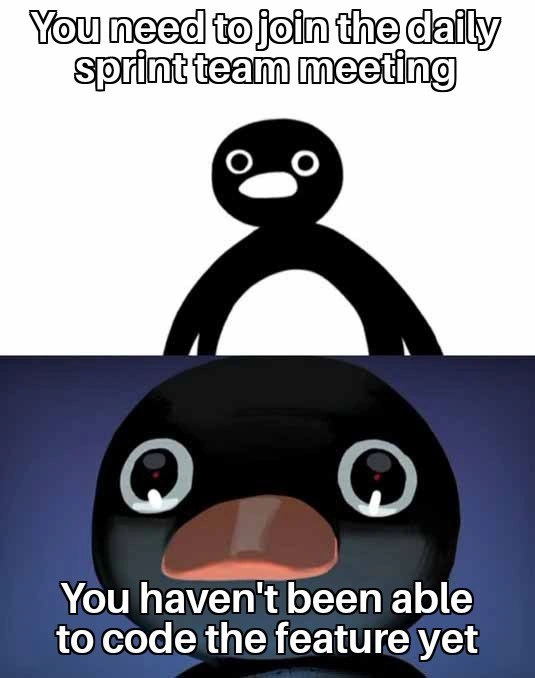
Imagine your mom asks you every morning if you’ve finished cleaning your room, even before you’ve had a chance to start cleaning. 😟 Every day, she calls you into the kitchen and says, “So, is your room all tidy now?” But you literally just woke up and haven’t touched the mess yet! You’d probably feel nervous or frustrated, right? You might be thinking, “How can I clean it if I’m here talking to you about it?” That’s exactly the feeling this meme is joking about. In the picture, a character (the penguin Pingu) is told to attend a daily team meeting and then suddenly panics because he hasn’t had time to do the work everyone expects an update on. It’s like being interrupted to talk about a chore, and then realizing you haven’t done the chore yet because of all the interruptions. The humor comes from that silly, unfair situation: someone is asking, “Are you done already?” when you barely got started. The poor penguin’s wide-eyed, open-mouthed shock is just how any of us would feel if we were put on the spot like that. In simple terms, the meme is funny because it’s a cartoon way of saying, “I can’t show you I did it, if you keep stopping me from doing it!”

Level 2: All Talk, No Code

Let’s step back and explain the scenario in simpler terms. In Agile software development (especially the Scrum flavor of Agile), teams have something called a daily stand-up meeting (also known as a daily sprint meeting). This is a short team gathering every day, usually limited to ~15 minutes. Each developer shares three things: what they did yesterday, what they plan to do today, and if they have any blockers (problems stopping their progress). The idea is to keep everyone in the loop and solve issues quickly. It’s one of the core AgileCeremonies meant to improve team communication and DeveloperProductivity. Sounds great in theory — everyone is in sync and obstacles are identified early.

Now, the meme jokes about a common problem: sometimes these constant check-ins become MeetingHumor material because they can disrupt actual work. The top text, “You need to join the daily sprint team meeting,” is basically a reminder that it’s stand-up time. The developer (represented by the penguin Pingu) hasn’t even started coding for the day yet, but they’re already being pulled into a meeting. The bottom text, “You haven’t been able to code the feature yet,” is the developer internally screaming because, well, there’s nothing new to report yet. They haven’t written any code since the last meeting! It’s like being called on in class before you’ve done your homework. The two images of Pingu (calm then panicked) dramatize this exact feeling: first the routine request to attend the meeting, then the “oh no!” realization that you have no update to give.

A few key terms and concepts here: meeting overhead means the time and energy spent in meetings (and preparing for them) that doesn’t directly contribute to writing code or completing tasks. Every meeting has a cost: even a 15-minute daily stand-up can interrupt your train of thought. This ties into context switching – a term for when you switch from one task to another. Developers often need long stretches of focused time to code effectively. If you’re deep in writing a complex algorithm or debugging, jumping into a meeting forces your brain to drop that context. After the meeting, you have to rebuild the context of what you were doing, which can take additional time. For a junior developer, it might be surprising how even a short stand-up can break your “flow.” You might think, “It’s just 15 minutes, why does it matter?” But if that meeting comes right when you were getting into the zone, it can really throw you off. That’s why developers sometimes complain that frequent meetings harm their DeveloperProductivity.

The meme also touches on the frustration or guilt developers feel in these situations. Let’s say it’s 9:00 AM and the team is huddled (or on a Zoom call) for the stand-up. They go around the room: “What did you do yesterday? What are you doing today?” If it comes to you and you haven’t made visible progress (maybe because yesterday was filled with planning meetings or debugging a gnarly issue), you might feel awkward admitting “I haven’t finished the feature yet.” This feeling is sometimes jokingly called “Agile guilt” – the internal pressure in a fast-paced sprint to always be delivering something. New developers often experience this when they first start working on real projects: tasks can take longer than expected, and saying “I’m still working on it” in front of a team every day can be nerve-wracking. The truth is, it’s completely normal for a feature to take multiple days! But in the moment, especially if you’re junior, you worry that you look unproductive. The meme’s punchline, that panicked “You haven’t been able to code the feature yet,” nails that anxiety. It’s basically Pingu shouting what the dev is thinking internally: “I have nothing to show and I feel bad about it!”

Let’s also clarify the roles and terms in Agile so the scenario is clear. A “sprint” is a short, fixed-length period (often 1 or 2 weeks) in which a Scrum team aims to complete certain work (like a set of features or bug fixes). During a sprint, aside from daily stand-ups, there are other meetings (often called Agile ceremonies or Scrum ceremonies): sprint planning (at the beginning, to plan the work), sprint review and retrospective (at the end, to demo work and discuss how things went), and sometimes backlog grooming (to prepare future work items). All these are meant to help the team work better, but they do take up time. When the meme mentions “daily sprint team meeting,” it’s specifically that daily stand-up portion of the sprint routine. By saying this meeting asks for updates before any code is written, it highlights a timing issue: if the stand-up is first thing every morning, you literally haven’t had time that day to write code yet. So you’re basically reporting on yesterday’s work. And if yesterday you were caught in other meetings or dealing with blockers, welp… you have no new code. Hence the joke that the meeting is kind of premature or even counterproductive. It’s like asking a runner for a progress report right as the race starts each day.

For a junior dev, this meme is a lighthearted introduction to a real challenge in the workplace. You might have imagined coding all day long, but soon discover a chunk of your day can be meetings and status updates. It’s an important skill to learn: how to communicate your progress (or lack thereof) honestly and get help with blockers, without feeling demoralized. A good team lead or Scrum Master will reassure the team that it’s okay if some days there isn’t a big update; tasks can span days and that’s expected. Stand-ups are meant to be a supportive tool, not a pressure cooker. Unfortunately, not all teams remember that, which is why the meme hits home for many. It exaggerates the scenario for humor: a penguin literally panicking because the feature (a piece of new functionality the dev is responsible for) isn’t done yet. DeveloperProductivity can indeed suffer if a developer is spending more time talking about work than doing work – that’s the comedic exaggeration here. The tags like #meeting_humor and #productivity_loss encapsulate this: too many meetings (or poorly timed meetings) can cause productivity loss, and developers cope by making humor out of it.

The use of Pingu (that claymation penguin from a children’s show) is just the icing on the cake. Pingu is famously expressive even without words – in the cartoon, he blathers “noot noot!” in various tones to convey emotion. In meme culture, Pingu’s neutral face followed by his alarmed face makes for a perfect before-and-after format. Even if you don’t know Pingu, you immediately get the emotional shift: calm notification vs. shocked realization. For someone new to tech, it’s basically saying: “First they tell me to come to this daily meeting, then I freak out because I’ve got nothing done yet!” You don’t need deep tech knowledge to find that scenario funny, but knowing a bit about Agile and daily stand-ups will make it even more relatable.

In summary, at this level we understand that the meme is highlighting a developer frustration: being asked for a daily update when you genuinely haven’t had the chance to make progress (often due to the very process that’s asking for the update). The terms like context switching and meeting overhead explain why this happens – meetings break up your day and consuming time that could be spent coding. And the feelings of stress or guilt are something many new developers learn to manage. The meme uses humor to share a small truth: sometimes in software teams, there’s a bit too much talking about work and not enough time for actual work. It’s a gentle poke at Agile routines, showing that even beneficial practices can become ironic if taken to an extreme or handled inflexibly. If you’ve ever been in a morning stand-up thinking “I really wish I was coding instead of talking about coding,” then this meme is speaking your language – with a silly penguin accent for good measure.

Level 3: Stand-up Standstill

The meme captures a classic Agile paradox that senior developers know all too well. In the top panel, a stoic clay penguin Pingu delivers a calm edict:

"You need to join the daily sprint team meeting"
This is the dreaded daily stand-up, a Scrum ritual meant to boost DeveloperProductivity by syncing the team each morning. But in the bottom panel, Pingu’s eyes bulge in panic as the reality hits:
"You haven't been able to code the feature yet"
In other words, the developer has no progress to report because of all the ceremony. The contrast is hilarious and painful: the very AgileCeremonies designed to help work along have, ironically, become a team_sync_blocker.

Seasoned developers recognize this as meeting overhead at its finest. You spend your morning in a daily_standup talking about what you’ll do, instead of actually doing it. By the time it’s your turn to speak, you realize yesterday’s barrage of meetings left you with zero lines of new code. The panic on Pingu’s face? That’s the agile_guilt_feelings of having to admit “no update” to the team. It’s a mix of embarrassment and frustration. You’re thinking, “If I wasn’t stuck in so many meetings, maybe I’d have something to demo by now!” This meme nails that feeling with Pingu’s exaggerated terror at being called out. It’s a form of DeveloperFrustration specific to Agile teams: when process intended to speed you up actually slows you down.

Why is this so funny to those in the know? Because it’s too real. The scenario lampoons a common DeveloperPainPoints in Scrum teams. A daily stand-up is supposed to be a 15-minute lightweight sync. Yet in many organizations it mutates into a status interrogation, happening before any code gets written for the day. It’s like being asked for your marathon time at the starting line. The humor comes from that absurd productivity paradox: being pressed for a sprint update when the sprint’s barely begun for the day. Experienced devs have lived this contradiction and often joke about it in private Slack channels and Reddit threads. The chuckle is one of commiseration: “Yep, been there, done nothing (thanks to meetings).”

From a senior perspective, this meme also hints at deeper issues with how Agile is practiced versus how it was intended. Scrum introduced the daily stand-up as a quick, focused checkpoint to remove blockers. But many teams turn it into a routine where everyone feels obligated to sound productive every single day. If you haven’t delivered a shiny new feature increment since yesterday, you end up reciting the same feature_incomplete status: “Still working on it…” Meanwhile, you know the real reason for slow progress: maybe half your day was lost to a sprint planning session or a “quick sync” meeting (ironically, to help productivity). This shared experience of ceremony-induced slowdown is fertile ground for MeetingHumor. It’s the kind of dark joke a Cynical Veteran developer would crack after the 1000th stand-up: “Yesterday I was in meetings, today I’m talking about yesterday’s meetings, blockers: meetings.”

Let’s break down the ideal vs reality of the daily stand-up that this meme is poking fun at:

Stand-up Ideal 💡 Stand-up Reality 🙃
Quickly align the team each morning Everyone scrambles to report something new
Spot blockers early to get help Each dev’s turn = public guilt if nothing new
Time-boxed to 15 min (no disruption) Interrupts deep work and flow every single day

In theory, the stand-up is a team booster. In practice, it can feel like a speed bump every morning. The table above summarizes it: what we’re told vs what often happens. The meme captures the last column’s truth: the stand-up’s good intentions (team alignment) often come with side effects (pressure and interruption). That 15-minute meeting can easily balloon with off-topic questions — suddenly it’s 30 minutes gone and your train of thought is completely derailed. The context switching is brutal. Just as you’re diving into code or formulating a solution in your head, “Ding! It’s stand-up time!” Your brain performs a harsh task switch. Any mental momentum (the cache of your brain’s CPU) gets invalidated. After the stand-up, you have to reload your entire mental state about the feature from scratch. Senior engineers often joke that frequent meetings result in a “cold cache miss” – you lose the warm-up you did on the problem, just like a processor losing cached data and having to fetch from slow memory again.

The Pingu meme wisely uses a two-panel format to illustrate this jarring context switch. Top panel: calm expectation, bottom panel: panicked reality. It’s a format meme veterans know well (often used for “expectation vs reality” jokes). Here it’s expectation: do the ritual meeting, versus reality: no actual progress to show. The humor gets amplified by Pingu’s cartoonishly panicked expression, which mirror’s a developer’s Oh no! face when called on unexpectedly. Pingu might be a cute children’s character, but in developer meme culture he’s become a vessel for our workplace horror-comedy. The wide eyes and gaping beak perfectly visualize the silent scream of “I’ve got nothing done yet!” It’s a relatable nightmare fuel for anyone who’s felt unproductive.

A senior dev reading this meme might recall countless stand-ups where they and teammates gave variations of the same update day after day. It’s almost ritualistic. In fact, there’s an inside joke template for stand-up updates:

  • Yesterday: Attended meetings, did code review, no visible progress on my task
  • Today: Hopefully implement the feature (if I can avoid meetings)
  • Blockers: The irony that stand-up itself is one (no time to code yet)

The meme strips this down to just two brutal lines: “Meeting time!” vs “No progress!” It’s funny because it’s painfully honest. Everyone in that daily meeting has probably felt this pressure to perform on cue, even when real software development doesn’t deliver neat daily bite-sized results. Writing code is a creative, problem-solving activity — some days you bang out 1000 lines, other days you’re stuck on a bug for hours. Stand-ups, however, march on every 24 hours, expecting a neat update each time. The result? A lot of developers end up context_switching between coding mode and reporting mode, with the latter sometimes cannibalizing the former.

Ultimately, this meme resonates at Level 3 because it highlights a systemic issue in modern software teams: the conflict between Agile processes and actual productive coding time. It’s poking at that awkward truth we usually only gripe about in private: meetings can kill momentum. The joke lands especially well for those who have experienced “scrum overkill,” where a well-intended process goes awry. After enough sprints and enough stand-ups, a battle-hardened developer can get a bit sardonic: “They say Agile lets us do twice the work in half the time… funny, I feel like I talk about work twice as much and code in whatever time’s left.” That cynical quip is exactly what the Pingu meme is voicing with its wide-eyed terror. It’s a comedic catharsis, letting everyone laugh at the absurdity of needing to report progress before any progress can realistically happen. In the end, daily sprint meetings and their unintended consequences are a shared insider joke — we laugh so we don’t cry, and then we impatiently say “noot noot” under our breath (like Pingu) as we finally get back to coding.

Description

The meme is split into two equal horizontal panels featuring the stylized clay-penguin character Pingu. Top panel: a plain white background with a simple, neutral-faced Pingu and the caption, "You need to join the daily sprint team meeting" in bold white text outlined in black. Bottom panel: a close-up of Pingu against a dark purple background, eyes wide and beak agape in panic, with the caption, "You haven't been able to code the feature yet" in identical bold text. The juxtaposition highlights the tension developers feel during Scrum stand-ups when they must report progress despite meeting overhead preventing actual feature work, touching on agile ceremony fatigue, context switching, and productivity loss

Comments

7
Anonymous ★ Top Pick Daily stand-up: the human version of round-robin scheduling - fair CPU time for everyone, catastrophic cache eviction for the code
  1. Anonymous ★ Top Pick

    Daily stand-up: the human version of round-robin scheduling - fair CPU time for everyone, catastrophic cache eviction for the code

  2. Anonymous

    The only thing more predictable than a P0 incident on Friday afternoon is the existential dread of explaining why that 'simple' feature refactor has turned into a distributed systems problem requiring three architectural reviews and a new Kafka cluster

  3. Anonymous

    The daily standup: where 'I'm still working on it' becomes an increasingly elaborate performance art piece, and your Jira ticket status remains stubbornly in 'In Progress' while you contemplate whether 'blocked by existential dread' is an acceptable impediment to report

  4. Anonymous

    Scrum's paradox: standups measure velocity by consuming it

  5. Anonymous

    Daily standup: a team-wide mutex that preempts every thread and then asks why throughput dropped

  6. Anonymous

    Our “daily sprint” is a blocking RPC - every thread pauses to report it’s blocked by that same call; velocity stays stable only if you measure it in status updates

  7. @s2504s 3y

    Meetings are useless shit. Sorry

Use J and K for navigation