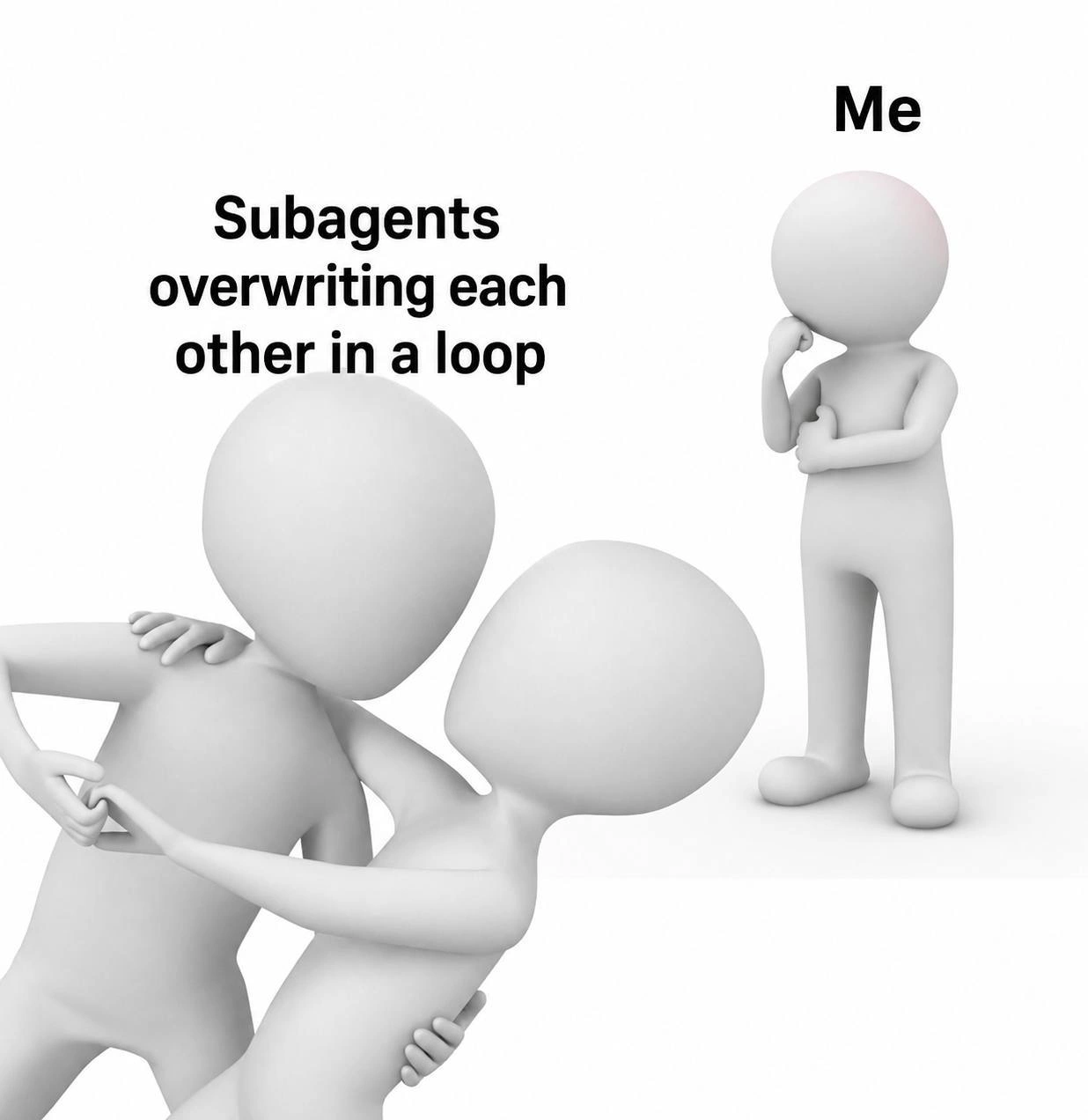
End-to-end email workflows where AIs inflate and then deflate our bullet points
Why is this AI ML meme funny?
Level 1: Inflating and Deflating a Message
Imagine you want to tell your friend a simple idea – say, you’ll be late to the game tonight. Instead of just saying that plainly, you first give your idea to a helper robot that loves fancy words. This robot takes your short message and blows it up like a balloon, turning it into a long, formal letter: “Dear Friend, I hope you are doing well. I wanted to inform you that I might unfortunately arrive a bit later than our agreed time for the game tonight, due to some unforeseen delays. Sincerely, [Your Name].” That’s the inflated version – big and fluffy! Now your friend gets this long letter, but they have their own helper robot. Their robot’s job is the opposite: it lets the air out of the balloon. It reads that long letter and says to your friend, “He’ll be late to the game tonight.” Deflated! In the end, your friend gets the same simple message you started with (you’ll be late), just with a lot of pointless blowing-up and shrinking-down in between. It’s as if you wrapped a tiny gift in layers and layers of wrapping paper, only for your friend to rip all that wrapping off immediately. All that extra effort didn’t change what was inside. That’s why it’s funny – the poor robots did a bunch of work to end up right back where things began! It shows how using a super high-tech way to say something simple can turn into a silly loop of doing and undoing the same thing.
Level 2: Automation Ping-Pong
This meme is joking about a future where writing and reading emails becomes a game of automation ping-pong between two AI helpers. Let’s break down what’s happening in simple terms:
Writing the email: Instead of typing out a full email, the person starts by writing a short list of bullet points that cover the main ideas they want to send. Bullet points are just brief, to-the-point notes (for example, “finish report, update website, schedule meeting”). Now, an AI assistant steps in. This is a piece of software (often powered by machine learning) that can generate text. It takes those bullet points and automatically expands them into a nice, well-written email. So a bullet like “finish report” might turn into a full sentence like “Please ensure the quarterly report is completed by Thursday.” The AI basically adds all the fluff and connecting words to make the email sound professional and “beautiful.” This kind of AI is using what’s called a generative AI model – it learned how to write like a human by studying tons of example texts, and now it can produce new sentences that read fluently. The result: the sender has an email that looks like they spent time composing, but really the AI did most of the writing from those short points.
Reading the email: Now the email arrives in the receiver’s inbox. It’s pretty long because the AI turned a short list into several paragraphs of text. The receiver might think, “That’s a lot to read... I just want the main points!” So they use their AI tool, which is a summarization assistant. Summarization means taking a long text and extracting the key information in a shorter form. The assistant reads the lengthy email and spits out a summary – likely as a few bullet points or a short paragraph that highlights the important facts (essentially undoing the expansion). For instance, it might condense all those detailed sentences back into something like: “– Finish quarterly report by Thu; – Update website with new content; – Schedule meeting for project team.” Now the receiver can read these bullets in a few seconds and know what the email was about, without wading through all the polite introductions and extra details.
In the end, what happened? The core message went from brief bullet points → to a long email → back to brief bullet points. Two different AI programs were used: one to inflate the message and one to deflate it. We effectively went in a circle! This is why people find it funny – nothing really changed except a lot of AI effort was used to make the message long and then short again. It’s an email summarization loop created by technology.
A new developer or anyone starting out might relate this to experiences with modern tools. Have you ever used Gmail’s Smart Compose or autocomplete feature that suggests how to finish your sentences? That’s a simple AI helping expand your writing. Or maybe you’ve seen a “TL;DR” summary at the top of a long article, or used an app that summarizes news for you – that’s AI helping compress information. This meme imagines doing both on the same email, which is pretty humorous. It highlights a concept called productivity theater: that means doing something that looks high-tech or efficient, but in reality might be unnecessary. Here, both the sender and receiver are using fancy AI automation, which looks very cutting-edge, but it results in no real improvement in communication – they could have just stuck to the bullet points in the first place!
Let’s clarify a few terms from the meme in straightforward language:
- AI assistant: This is any software agent that uses artificial intelligence to help you with a task. In software development and office work, AI assistants can do things like write text, filter emails, schedule meetings, or summarize documents. They’re called “assistants” because they assist humans, often using AI/ML (artificial intelligence/machine learning) to make smart guesses about what to do. In the meme, one assistant writes the email, another reads it. Think of them as smart robots for text.
- Bullet points: These are short, dot-pointed lines that list information succinctly. For example:
- Finish the report
- Update the website
- Schedule meeting
Bullet points skip all the small talk and go straight to the main ideas. They’re common in emails or documents when you want to make information digestible and clear.
- Summarize: To summarize means to take a longer text and boil it down to the main points. If you have a 5-paragraph email, a summary might be just 1-2 sentences or a few bullets capturing what those paragraphs said. AI can do this by identifying what content seems most important. Some summarization is extractive (copying the critical sentences) and some is abstractive (rephrasing the content more briefly).
- Generative AI expansion: This refers to the AI creating new sentences and expanding a short input into a longer output. It’s “generative” because it generates new text that wasn’t explicitly provided. In our case, the AI sees “Finish the report” and generates something like “Could you please ensure the quarterly report is finalized by Thursday? Thanks!” It’s making up the polite phrasing based on patterns it learned from many example emails.
- Communication overhead: This is the extra effort and time spent in communication that isn’t strictly necessary for understanding. For instance, super long emails, meetings that go in circles, or documentation that repeats itself – those add “overhead.” Here, the overhead is literally the expansion into a long email that someone then has to shorten again. It’s like extra steps that don’t add true value.
In a junior developer’s daily life, you might prefer when someone just tells you the 3 things you need to know, rather than sending a giant wall of text. This meme playfully warns that if we rely on AI for everything, we might ironically reintroduce walls of text that then need summarizing. It’s AI humor because it teases the idea that two fancy AI features could end up undoing each other’s work. As cool as automation is, it’s important to use it wisely. The key takeaway in simple terms: if your original message can be understood as bullet points, maybe it’s okay to just send bullet points! The whole situation is like providing a quick answer, then having a machine turn it into a long speech, and another machine turn that speech back into a quick answer. It makes us smile and think, “Wow, sometimes technology does silly things.”
Level 3: Productivity Theater
On a more practical level, this meme nails a familiar absurdity in tech and office culture: using automation and tools in a way that creates busy-work rather than true efficiency. It paints a picture of a near-future email workflow that is too real for many seasoned developers:
Sender’s perspective: You start by jotting down a few bullet points with the key ideas you need to communicate – essentially an outline. Instead of fleshing it out yourself, you rely on an AI assistant to do the bullet point expansion. With a click, your terse list is transformed into a polished, multi-paragraph AI-generated email. The assistant adds all the usual formalities: greetings like “Hello team,” elaborate explanations, transitions between points, and a courteous closing. The end result is a “beautiful long text” that looks professional and thorough. You’ve saved yourself the manual effort of writing out all that fluff.
Receiver’s perspective: Now the email lands in your colleague’s inbox. It’s a few screenfuls long (
long-ass text, as the tweet humorously puts it) because of all that added detail. But your colleague is busy – like any developer, they have code to write and prefer concise communication. So they use their AI tool to boil this verbose email back down. This second assistant performs summarization, essentially extracting the main points and perhaps presenting them as a short list. In other words, it deflates the email back into bullet points or a TL;DR. The receiver quickly reads those bullets to get the gist, effectively bypassing all the flowery prose.
By the end of this exchange, the information that was communicated is basically the same few points that existed at the start, only they took a grand tour through two AI systems. We’ve witnessed a perfect example of productivity theater: lots of activity and fancy tools in play, but no real gain in effective output. Both the sender and receiver feel like they used cutting-edge automation to be more productive (one didn’t have to manually write paragraphs, the other didn’t have to slog through paragraphs), yet collectively, the system expended extra effort for zero net change in content. It’s an oddly self-canceling setup – the AIs canceled each other out. The situation is so absurd it’s funny: the expansion and summarization are like two halves of a Rube Goldberg machine that ultimately hands you back the object you started with.
This strikes a chord with seasoned developers because it satirizes real workplace communication problems. Communication overhead in large teams is a known productivity killer – endless email threads, verbose status reports, requirement docs that read like novels. We often try to streamline it (hence bullet-point culture and TL;DR summaries at the top of emails). But here, the very tools meant to help (AI writing and AI summarizing) are creating a convoluted loop. It’s poking fun at our tendency to over-engineer solutions. Why write a simple email when you can involve a neural network to overwrite it and another to overwrite it again? It’s the same energy as using a complex microservice architecture for a “Hello World” app – overkill that tech folks recognize and chuckle at.
The meme also resonates because it’s plausible. With the rise of AI/ML in everyday tools, this exact workflow isn’t far-fetched. In fact, some people already do a manual version of this! Think about corporate scenarios: An engineer sends a brief update to their manager in bullet form; the manager expands it into a detailed report for higher-ups; those higher-ups then glance at an executive summary. It’s an age-old dance of inflating and condensing information. Now replace the humans in the middle with AI assistants, and you have the meme’s scenario. Many email platforms are adding features like “smart compose” (to help draft emails) and “smart summary” (to digest long threads). It’s easy to imagine a future where everyone has an AI writing verbose emails for them and another AI reading emails for them by summarizing – our personal automated secretary on both ends. The humor isn’t just that this could happen, but that it would be ridiculously redundant. It’s a commentary on how tech culture sometimes introduces complexity under the banner of productivity. We start automating everything, but if we’re not careful we automate ourselves into a circle.
There’s also an undercurrent of developer humor here about the nature of modern work. Engineers love efficiency and Developer Productivity is a big deal – we have stand-up meetings, agile boards, and countless tools to eliminate waste. Yet, we often see situations where formal process and tools create a new kind of waste. This meme uses AI humor to highlight that paradox. It essentially says: “Look, our fancy AI helpers might end up just talking to each other, inflating and deflating content, while we humans sit here wondering what was accomplished.” It’s a gentle roast of the tech optimism that assumes more automation is always better. Sometimes, as the experienced folks know, the simplest solution (just send a concise message and read a concise message) beats an overly complex workflow involving dueling AIs.
In short, the meme’s punchline lands with senior devs because it exaggerates a scenario they find all too familiar: using heavyweight solutions to solve a problem that maybe didn’t need solving – and even creating a new email_summarization_loop problem in the process. It’s both a funny prophecy about AI usage and a nod to the cyclical nature of communication overhead. Yes, we can have machines write our emails and other machines read our emails, but at the end of the day, wouldn’t it be simpler to just communicate in bullet points to begin with? The future depicted is both high-tech and hilariously redundant – a true productivity theater where two AIs perform an elaborate act that, from the outside, amounts to running in circles.
# Pseudo-code representation of the meme's AI email loop
bullet_points = ["Update project timeline", "Address client feedback", "Schedule review meeting"]
# AI assistant A expands the bullet points into a formal email
formal_email = ai_expand(bullet_points)
print("AI-generated email:\n", formal_email, "\n")
# (The email now contains greetings, complete sentences, and lots of added context around the points.)
# AI assistant B summarizes the formal email back into bullet points
summary_points = ai_summarize(formal_email)
print("AI-summarized key points:\n", summary_points, "\n")
# Ideally, summary_points == bullet_points (we end up where we started, content-wise)
# This demonstrates the comically redundant cycle: expand then compress => near no change in core info.
Level 4: Ouroboros of Automation
At a deep technical level, this meme highlights an ironic NLP feedback loop – essentially an AI-driven identity transformation. We have a pipeline where a concise representation (bullet points) is expanded into verbose text by one model, then compressed back into bullet points by another. In theoretical terms, if we denote the expansion function as $E$ and the summarization function as $S$, then the composition $S(E(x))$ ideally should return the original information $x$. It’s like an equation:
$$ S(E(\text{bulletPoints})) \approx \text{bulletPoints} $$
In other words, the two AI operations (expand then summarize) form a near no-op in terms of net information change. This is reminiscent of an autoencoder in machine learning, where one network encodes data into a compact form and another decodes it back; except here the order is reversed – we inflate then deflate. From an information theory perspective, the bullet list is a highly compressed form of the message (high information density). The AI expansion adds a lot of linguistic redundancy (polite greetings, filler phrases, detailed context) but no fundamentally new information. The summarization then tries to strip away redundancy to retrieve the core points. In an ideal, lossless scenario, all that extra verbosity is effectively discarded, leaving us back at the original bullet points.
However, these AI assistants are not perfectly lossless or inverse to each other. They’re likely separate Large Language Model (LLM) systems (think of a GPT-style model for generation and a BERT/T5-style model for summarization) that weren’t trained as a pair. That means $S(E(x))$ might equal $x$ only approximately. Each stage is a generative process that can introduce variation or even error. The first AI might embellish or slightly alter the meaning when expanding bullet points (e.g. adding overly flowery language or assumptions to make the email “beautiful”). The second AI, when summarizing, might miss subtle details or use different wording. There’s a potential for lossy compression – nuance could be lost or hallucinated content might slip in. Fundamentally, though, both AIs are performing sophisticated manipulations of natural language without adding net new facts. It’s a closed loop of language transformation, an AI Ouroboros where a snake is eating its own tail, or rather, where one neural network’s output is devoured by another to return to the starting state. This showcases a kind of zero-sum game in terms of information entropy: a lot of computation churns, but the mutual information between the initial bullet list and final summary remains roughly the same.
Under the hood, this humorous scenario leverages advanced techniques in NLP. The expansion step might use a fine-tuned model that excels at turning brief notes into well-structured prose (trained on countless emails and documents to sound natural and professional). The summarization step likely uses an abstractive summarization model that can generate bullet points from text or an extractive approach that plucks out key sentences. Both rely on the Transformer architecture – the powerhouse behind modern language AI – to understand context and produce fluent text. It’s a bit mind-bending that we’d hook them up in series like this. Normally, such systems are used to save human effort in isolation (either you use AI to help write or to help read), but chaining them creates what is essentially an automated round-trip translation back to the original form. It’s akin to translating English to French and back to English using two different translators: ideally nothing changes, but in practice you might end up with slightly different wording. The meme is poking fun at the idea that we’d use enormous computational power (and complex algorithms that were the subject of dozens of research papers) to perform an elaborate do-nothing operation. It’s a tongue-in-cheek commentary on technological redundancy: leveraging state-of-the-art AI to achieve the same result as if no AI was used at all – a perfect loop of inflated and deflated text.
Description
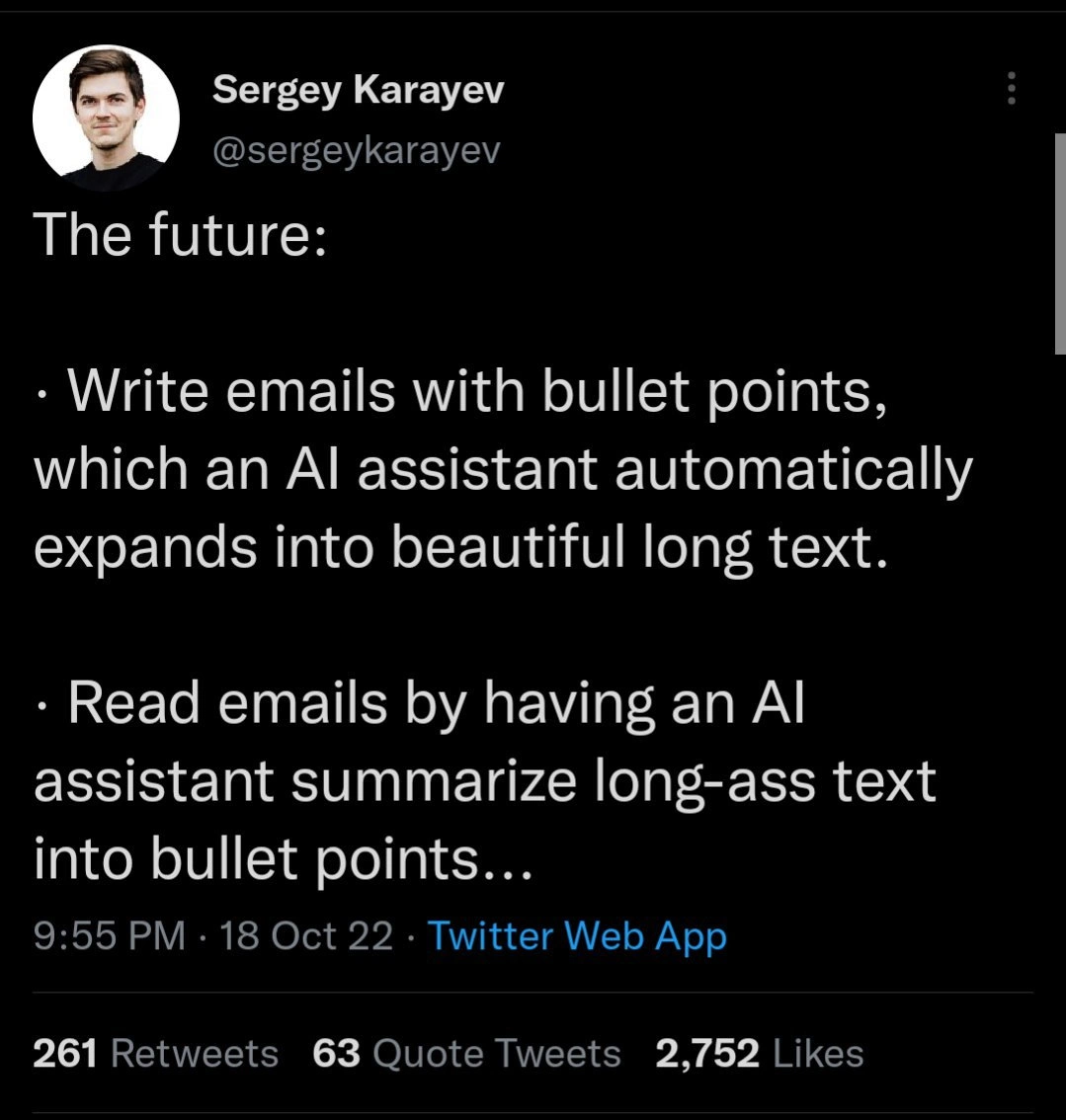
The image is a dark-mode Twitter screenshot. At the top left is a small circular avatar photo, followed by the bold white display name “Sergey Karayev” and the gray handle “@sergeykarayev”. The tweet text reads: “The future: · Write emails with bullet points, which an AI assistant automatically expands into beautiful long text. · Read emails by having an AI assistant summarize long-ass text into bullet points…”. Beneath the tweet body the timestamp shows “9:55 PM · 18 Oct 22 · Twitter Web App”, and engagement metrics display “261 Retweets 63 Quote Tweets 2,752 Likes”. Visually, the background is black with white text and light-blue hyperlinks typical of Twitter Web App. Technically, the meme satirizes generative-AI tooling loops: large-language-model assistants turn terse bullet lists into verbose prose, only for another assistant to reverse the process, highlighting potential productivity theater and communication overhead in engineering culture

Comments
14Comment deleted
Just shipped our “efficient communication” pipeline: bullets → LLM-Inflate → Kafka → LLM-Deflate → bullets. Zero net information, 100% billable compute - a distributed /dev/null with a business model
We've successfully reinvented the network packet overhead problem, but for human communication - now with venture funding and a subscription model
We've finally achieved peak enterprise efficiency: using GPT-4 to expand your bullet points into verbose corporate speak, then using GPT-4 again to TL;DR it back to bullets - because why have one API call when you can have two? It's like running your data through a compression algorithm followed immediately by decompression, except you're paying per token and pretending it's innovation. The real kicker? Both sender and recipient are now dependent on the same LLM to communicate, creating a beautiful vendor lock-in where the AI is the only one who actually read the full email
Enterprise email is basically a lossy codec - PMs call AI.expand(bullets), recipients run AI.summarize(essay), and the only bit that survives the round‑trip is “per my last.”
Bullets → LLM floridization → LLM summarization → bullets; we reinvented gzip as a managed service - now with hallucinations, latency, and a token burn rate
AI: turning dev bullets into PM novels for approval, then novels back to bullets for implementation - finally, a spec translator that works both ways
True, true Comment deleted
emails in future? Comment deleted
Fax as in Japan Comment deleted
Copilot, when I write my codes requirements with bullet point comments Comment deleted
I hope that civilization won't survive until this becomes reality. Comment deleted
I read as "bullshit points" at first. Comment deleted
Same things, different names Comment deleted
Reverse compression Comment deleted