Cursed Ways to Increment X
Why is this Languages meme funny?
Level 1: Taking The Long Way
This is funny because all the code snippets are trying to do the simple job of adding one to x, but each new version does it in a more ridiculous way. It is like walking one step forward by spinning around, crawling under a table, climbing through a window, and then saying, "See? I moved one step."
Level 2: Same Result, Worse Path
An increment means increasing a value by one. Many languages provide compact forms for that:
x++often means "increasexby one," though its return value can depend on where it is used.x = x+1assignsxto its old value plus one.x += 1is shorthand for adding one intox.x -= -1also adds one, because subtracting a negative is addition.
The bottom two examples are technically trying to use multiplication and division to reach the same result. That is why the meme fits Languages, CodeQuality, and Mathematics at the same time. The code is not merely weird-looking; it is less safe. Division introduces edge cases, especially when x is zero or when the programming language uses integer division or floating-point numbers.
For a newer developer, this is a useful lesson: code is read more often than it is written. The clearest expression usually wins. A clever expression that makes the next person re-derive algebra before approving a pull request is not clever; it is a small invoice sent to the future.
Level 3: Algebraic Crimes
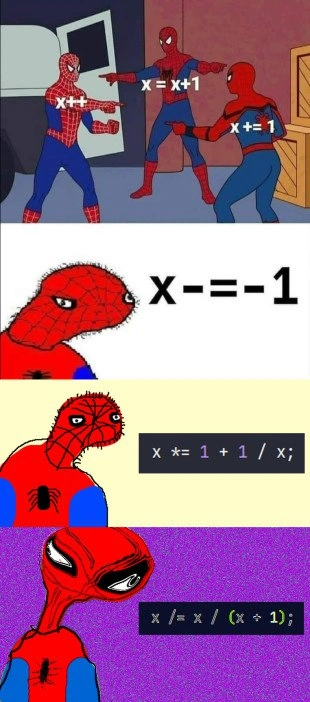
The meme starts with three Spider-Men pointing at each other, labeled x++, x = x+1, and x += 1. Those are the respectable ways to increment a variable. Then the images degrade into stranger forms: x -= -1, x *= 1 + 1 / x;, and finally x /= x / (x + 1);. The visual escalation says what every code reviewer feels: yes, these can resemble "add one," but legality and decency are not the same API.
The core joke is SyntaxAbuse disguised as mathematical cleverness. In ordinary algebra, x -= -1 is just subtracting negative one, so it increments x. The next expression relies on this identity:
x * (1 + 1/x) = x + 1
The final one is even more cursed:
x / (x / (x + 1)) = x + 1
Those identities work only under friendly assumptions: nonzero denominators, exact arithmetic, and language semantics that behave like school algebra. Production code lives elsewhere, in the swamp with integer division, floating-point rounding, overflow, NaN, Infinity, operator precedence, side effects, and the person maintaining this six months later while muttering at the monitor.
That is why the increasingly distorted Spider-Man panels fit so well. The first row shows harmless equivalence: different syntax, same intent. By the bottom, the code has crossed from CodeGolf into a readability incident. It may pass a narrow test for x = 4, but it creates questions the simple x += 1 never created. What happens at x = 0? What about x = -1? Is x an integer? A float? A decimal? A custom object with overloaded operators? Congratulations, we saved zero keystrokes and opened a committee.
Description
A tall multi-panel Spider-Man meme starts with three Spider-Men pointing at each other, labeled `x++`, `x = x+1`, and `x += 1`. Below, increasingly distorted Spider-Man drawings are paired with stranger equivalent-looking expressions: `x -= -1`, then `x *= 1 + 1 / x;`, and finally `x /= x / (x + 1);`. The technical joke is that many expressions can mathematically increment a value by one, but each rewrite gets less readable, more fragile, and more likely to break on edge cases such as zero or numeric precision.
Comments
8Comment deleted
The last one increments `x` and the probability that code review becomes a wellness intervention.
x /= x / (x - -1) Comment deleted
just because when x == "2": x + 1 = 21 Comment deleted
anx x - -1 equals to 3 Comment deleted
we can substitute -1 by some shit like cos(4atan(1)) Comment deleted
didn't work when x integer Comment deleted
3 case, i mean Comment deleted
x *= 1 + 1.0 / x Comment deleted