Your first accidental prod push takes down the site - welcome to the club
Why is this OnCall ProductionIssues meme funny?
Level 1: Welcome to the Club
Imagine you’re learning to ride a bike for the first time. You’re a bit wobbly, trying to remember all the tips, and then – crash! – you accidentally ride straight into a fence and fall over. The bike hits the ground, and you get a little scraped up. You feel terrible and scared: you think you’ve really messed up, maybe broken the bike, and you’re sure everyone will be upset with you. You even start saying “I’m sorry! I won’t do it again!” because you feel so bad. But then, to your surprise, your older brother and sister come running over, and they’re smiling. Instead of yelling, they pull you up and give you a big hug. They’re actually laughing in a kind way, not because they’re making fun of you, but because they’re happy you’re okay and… proud? Your brother claps you on the shoulder and says, “Finally! Welcome to the club!” You’re a bit confused. They point at a couple of small scars on their knees and explain that when they were learning to ride, they each had a big crash too. Just like you, they once fell and got hurt a little and felt super scared. It turns out everybody falls off the bike when they’re learning. It’s almost like a rule! Now that you’ve had your first fall, they joke that you’re officially a “real” bike rider, just like them. Suddenly, you don’t feel quite so awful anymore. You realize you’re not the only one who makes mistakes, and your family isn’t angry at you at all. In fact, they’re welcoming you as if you just joined a special club that everyone in the family goes through – the “I messed up but I learned from it” club. You grin a little through your sniffles, and they help you fix the bike and get back on. That warm, relieved feeling you get is exactly what’s happening in the meme: a newbie developer made a big mistake (knocked the site down, like crashing the bike), thought everyone would be mad, but instead the team smiled and said “welcome to the club, we’ve all been there.” It shows that making a mistake is just a normal part of learning, and it can even bring people closer together once it’s over.
Level 2: When Mistakes Go Live
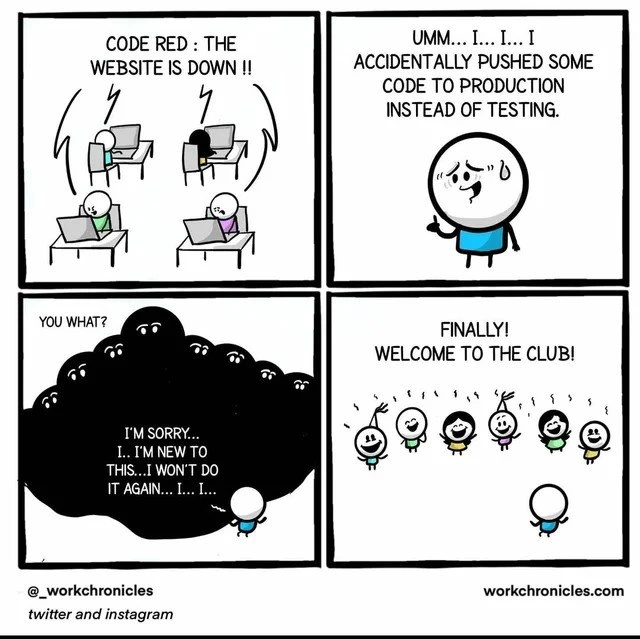
Let’s break down what’s happening in this meme in simpler terms. The comic is portraying a junior developer who made a big oops: they deployed code to the wrong place. In a software team, we usually have multiple environments – for example, a testing environment (also called “staging” or “dev”) where we try out new changes, and a production environment (“prod” for short) which is the real website or app that actual users are using. The key is that production is live and important: if it breaks, real customers are affected. Testing or staging, on the other hand, is like a safe sandbox where you can experiment without harming anything critical. What this poor junior dev did was push code (that is, send/update his changes through a deployment) directly into the production environment when he meant to put it in testing first. In plain terms, it’s like he pressed the “launch to everyone” button instead of the “try it out quietly” button. As a result, a bug or problem in his new code immediately took the website down – meaning the site crashed or became unavailable to users. That’s why in the first panel all the other developers are shown panicking at their desks with the alert “CODE RED: THE WEBSITE IS DOWN!!”. “Code red” is basically an emergency alarm in tech lingo (borrowed from emergency services) indicating a severe problem. When the website is down, it’s all hands on deck: the people who are on-call (the ones responsible for handling such emergencies) and basically the whole team drop everything to fix the issue because a downed site can cost the company money and upset users. It’s a high-pressure situation, especially for a newcomer who realizes they caused it.
In the second panel, we see a close-up of the responsible developer. He’s sweating bullets and confessing: “Umm... I... I... I accidentally pushed some code to production instead of testing.” You can almost hear his shaky voice. This is the crucial moment of truth where he admits he made a mistake. Let’s clarify some terms here: pushed some code means he sent his updated code (maybe via a git push command or a deployment tool) to an environment. The part “instead of testing” tells us he intended to send that code to the testing environment (where only internal folks would see if anything went wrong), but accidentally it went to production, the live site. This is basically the cause of the outage: untested, possibly buggy code running live. For example, maybe he meant to update the test website but clicked the wrong option and updated the real website, or maybe he merged his changes into the wrong branch in the code repository, triggering a production deploy. Such mistakes can happen if someone is new and the process is confusing or if they’re a bit careless just this once. Either way, he’s owning up to it, which is good, but you can imagine how terrified he is in that moment. Deploying code to production when it’s not ready is a big no-no because it can break things exactly like this.
Now, the third panel is mostly taken up by a huge black cloud with angry eyes yelling “YOU WHAT?!”. This cloud represents the immediate reaction he gets after confessing. It might be a senior engineer or a manager shouting in shock, or it could just symbolize the weight of the situation bearing down on him (the guilt, the horror, the collective gasp of “oh no!” from the team). In any case, from the junior dev’s perspective, it’s extremely intimidating. You see the tiny figure of him at the bottom, looking utterly small and scared in front of this looming anger. He’s saying, “I’m sorry... I... I’m new to this... I won’t do it again...” He’s basically pleading and apologizing profusely. This makes sense – if you’re a new developer and your action just took down the company’s main website, you’d likely be petrified. He probably fears he’s going to get fired or at least yelled at very harshly. The comic shows him practically shaking. This panel captures the fear and remorse a junior developer would feel in that situation: he knows he messed up big time and he’s bracing for the worst. The giant shadow shouting “YOU WHAT?” is a funny exaggeration of how scary that moment feels. In reality, someone might indeed exclaim “What happened? You did what?!” in astonishment, but the comic turns it into this almost monster-like figure to illustrate the newbie’s dread.
Finally, we get to the fourth panel, which flips the whole scenario on its head. Instead of the junior developer being scolded or fired, his teammates are actually cheering and smiling. They say, “Finally! Welcome to the club!” and they all look happy, with maybe a bit of soot or smoke still coming off them (implying the “fire” was just put out). The junior dev is drawn still standing apart, maybe a bit stunned. This outcome is very wholesome and highlights something important about good developer teams: everyone makes mistakes, and they know it. The team is basically telling the newbie, “Hey, we’ve all done something like this. Now that you’ve had your first big goof, you’re one of us!” They’re welcoming him into the fold. This idea of a “club” is a playful way of saying causing a prod incident is almost a rite of passage. It might sound strange, but in many developer circles, having a story of “that one time I took the site down” is super common. So the team isn’t actually mad at him. Once the initial shock and the outage are resolved, they find humor and camaraderie in the situation. They probably fixed the website (maybe by rolling back to the previous version of the code, which is usually the fastest way to recover), and once everything is stable, they’re able to laugh and pat him on the back.
This turn of events is a nod to what’s called a blameless culture. In a blameless culture, people aren’t punished or shamed for making honest mistakes. Instead, the team focuses on understanding what went wrong in the process and how to prevent it in the future, without making the person feel terrible. The reason the other developers say “welcome to the club” with big grins is because they likely have their own embarrassing stories of accidentally breaking something in production. Maybe one of them once deleted the wrong database table in prod, or another deployed a bug that caused a ton of errors. They all survived those incidents and learned from them, so they know this junior dev will too. Their smiling faces (some even raising their arms in celebration) show that they’re relieved more than anything, and they want to comfort the new guy by showing he’s not alone. In fact, by saying “Finally!” they imply they were almost expecting this to happen eventually. It’s a common joke in tech companies that if you haven’t broken production yet, just wait – your turn will come.
So, in simpler words: the meme is funny because it starts out looking like a disaster for the new developer (website down, everyone panicking, he’s in trouble), but ends with a positive twist: instead of being angry, his teammates basically give him a hug (figuratively) and say “Congrats, you’re now officially a developer like the rest of us!” It highlights the contrast between how scary a production mistake feels to the junior vs. how understanding the experienced devs actually are about it. This resonates with a lot of developers because those who have been around remember their first major error and how their team handled it. The best teams turn it into a learning moment and a funny story rather than a blame game. After all, nothing bonds a dev team quite like fighting a production fire together and coming out the other side. The phrase “welcome to the club” perfectly captures that sense of shared experience. The new developer is likely still embarrassed, but also probably incredibly relieved that he’s not getting harshly punished – instead, he’s practically getting high-fives. In real life, once the dust settles, the team would probably do a retrospective meeting to figure out how to improve the deployment process (maybe add an extra check so “accidentally pushing to prod” is less likely). They’ll make sure the newbie learns what the proper steps are. But they’ll also reassure him that it’s okay and he’s still a valued team member.
In summary, this comic is about a new dev’s first big mistake – deploying untested code and causing a site outage – and the supportive, humorous reaction of the team. Every part of it, from “THE WEBSITE IS DOWN!!” panic to the apologetic newbie and the final “Welcome to the club!”, is a scenario packed with developer humor and real lessons. For a junior developer reading this, the takeaway is: mistakes happen to everyone, even big ones. What matters is owning up to it, fixing it as a team, and learning not to do it again. And if you’re lucky, you have colleagues who will pat you on the back afterward rather than point fingers. It’s a rite of passage in tech, and it doesn’t mean you’re a bad developer – on the contrary, it means you’re gaining experience. As scary as it feels, one day you might even chuckle about “that time I accidentally brought down the website” and welcome the next newbie into the club with the same kind of grin.
Level 3: Baptism by Prod Fire
At the highest level, this meme lampoons a production outage triggered by a botched deployment, something seasoned engineers know all too well. In the first panel, multiple devs at their computers are freaking out as alarms blare. "CODE RED: THE WEBSITE IS DOWN!!" is basically every on-call engineer’s worst nightmare: a critical ProductionIncident where the live site has crashed. The immediate reaction is pure ProductionFirefighting mode – slack notifications exploding, monitoring alerts screaming, and experienced devs rushing in to triage the damage. It’s an “all hands on deck” moment that veterans recognize with a mix of dread and adrenaline. This particular outage has a twist though: the cause is quickly identified and confessed. In panel two, a nervous junior developer admits, "Umm... I accidentally pushed some code to production instead of testing." In other words, the new dev deployed untested changes directly to production (the live environment serving real users) rather than to a safe testing environment. Oof. That’s a classic DeploymentFailure scenario – essentially releasing something unproven straight into the wild, bypassing all the usual safety nets. It’s a mistake that can bring any website to its knees in seconds, as depicted by the downed site.
What makes this funny (and painfully relatable) to senior developers is how common and inevitable this “rookie mistake” really is. The humor comes from a shared understanding: nearly every developer, at some point, has accidentally caused a ProductionOutage or broken something critical. The meme exaggerates the situation to a “code red” meltdown, but honestly, that’s exactly how it feels when it happens for real. The combination of a panicky confession and the looming angry black cloud yelling "YOU WHAT?" is played for laughs, but it satirizes a genuine industry pattern: the junior vs senior dynamic where a newbie expects to be utterly doomed after a prod mistake, while seasoned teammates are more like, “Been there, done that.” The giant shadow with hostile eyes in panel three illustrates that gut-dropping moment every dev dreads – the instant you realize you took the site down and imagine the wrath coming your way. The junior’s sweating, stammering apology ("I'm sorry... I'm new... I won't do it again...") captures that sheer terror and impostor syndrome-fueling panic of messing up in production. It’s a nightmare scenario turned into a cartoon, which makes us laugh because we all remember our first time in those shoes.
From an experienced perspective, a lot of intriguing technical and cultural context underlies this simple four-panel story. Let’s unpack how something like “pushing code to production instead of testing” can even happen, and why it’s more common than one might think:
Branch Mix-ups: Modern teams use version control (like Git) with separate branches for features or testing versus the main branch for production releases. A newbie might accidentally merge or push to the
mainbranch (which triggers a live deployment) instead of adevorstagingbranch. One typo or wrong click, and suddenly the code meant for a sandbox is running on the live site. For example:# Developer accidentally pushes changes directly to main (production branch): git push origin main # What they intended (pushing to a safe feature/testing branch first): git push origin feature/testing-branchIn the above snippet, the first command deploys the code to the production branch by mistake. This is precisely the kind of minor oversight that can lead to big trouble.
Tool/Environment Misconfiguration: Many teams use automated deployment scripts or CI/CD pipelines (Continuous Integration/Continuous Deployment) that deploy code as soon as it’s pushed to certain branches. If those tools aren’t configured with strict checks, a new engineer might run a deploy command without specifying the environment, and the system defaults to production. For instance, a deployment script might default to
--env=produnless told otherwise. One wrong default or a missing flag, and poof – your code is live without passing Go. Automation can ironically make these mistakes happen faster: the moment you push to the wrong place, the pipeline cheerfully promotes your half-baked code straight to users. Speedy, but unforgiving.Human Error Under Pressure: Let’s face it, sometimes it’s just a case of a tired or rushed developer clicking the wrong option in a deployment dashboard or copying the wrong config file. Maybe the test and prod buttons in some UI looked too similar, or someone skipped a deployment checklist step. We’re humans working with complex systems – mistakes happen, especially when you’re new and still learning all the ropes. In a culture of “move fast and ship things,” the occasional mis-deploy is almost inevitable.
Now, once an accidental prod push like this occurs, it kicks off a well-known real-life drama: detecting the problem, rolling back the bad change, and firefighting to get the site up again. In the comic, that drama is condensed. By panel three, the cause of the outage is already identified (thanks to the junior bravely shouting out their mistake). In reality, that quick confession is golden: half the battle in incident response is figuring out why the site went down. Here, the team can immediately stop hunting for obscure bugs or blaming the usual suspects (“It’s always DNS!”) because the newbie piped up “I pushed bad code!” With root cause known, the seniors can jump straight into recovery mode: likely backing out the change or redeploying the last good version to bring the site back. The Code Red alarm might last minutes instead of hours thanks to that honesty. This highlights a positive aspect of the team’s culture: the new dev felt safe enough to admit their error promptly (despite fear), which is exactly what you want in a high-trust engineering culture.
Speaking of culture, panel four is where the meme delivers its punchline and message. We see the supposedly “angry mob” of coworkers in the previous panel was just momentary shock. In the final frame, those teammates are literally cheering, some still a bit singed with smoke from the ordeal, shouting "Finally! Welcome to the club!". This is a comedic way to show a blameless culture in action. Instead of chewing out the junior developer or making them feel horrible, the team does the opposite – they celebrate his rite of passage. The dark cloud has cleared, turning into smiling faces. That exaggeration of going from doom to party is poking fun at how dev teams often react once the crisis is over: after the site is back up, the initial anger fades and everyone collectively sighs, maybe even laughs, “Well, that happened.” There’s huge relief (nobody lost their job, customers are back online) and there’s a bonding moment. The phrase “welcome to the club” says we’ve all been there. It’s both comforting and a little tongue-in-cheek hazing: Finally! – as if they were waiting for his inevitable first big screw-up because now he’s a real member of the team. In many engineering circles, causing a production incident is jokingly seen as earning your stripes. It’s like an initiation that every developer will go through eventually, no matter how careful. The teammates’ happy expressions and the fact they’re slightly charred (with soot or smoke rising from them in the drawing) is a brilliant visual gag: it’s as if each of them has had their own “fires” in the past. Those are the battle scars from nights of ProductionFirefighting. The new guy now has a matching scar (metaphorically), so he’s part of the club of burned-but-wiser developers.
This leads to the deeper industry insight the meme is conveying: blameless post-mortems and learning from failure are considered best practices in modern DevOps and SRE (Site Reliability Engineering) cultures. The meme hints at this with humor. Instead of management angrily firing the junior developer or the team ostracizing him, they do the healthy thing: treat it as a shared learning experience. After a real incident like this, a good team would hold a post-incident review (often called a post-mortem). In that meeting, they’d dissect not “who screwed up” but why the process allowed the mistake and how to prevent it in the future. Maybe they’ll realize, “We should add a confirmation step when deploying to production,” or “Let’s restrict direct pushes to main for new devs until they get more comfortable,” or even “Our documentation for deployments wasn’t clear about how to target the test environment.” In a blameless culture, the focus is on fixing systems and processes, not punishing individuals for human errors. The comic’s lighthearted ending – everyone literally welcoming the mistake-maker – is an extreme portrayal of that ethos. It assures the newbie: you’re not the first to do this, and you won’t be the last. This approach actually makes systems safer in the long run, because people are more likely to report issues immediately and honestly if they’re not afraid of being blamed or fired. We see exactly that: the junior immediately fesses up (“I accidentally pushed…”), which allows for a fast fix. A fear-based culture could have led to delay or cover-up, worsening the outage.
There’s also a nice commentary here on the Junior vs Senior developer dynamic. The junior is terrified because from their perspective, taking down the production site is the worst thing imaginable – a fireable offense, career-ending in their mind. The seniors, however, respond almost with pride and humor, because they remember being in his shoes and know that one mistake (even a big one) is just part of growing as an engineer. It’s a moment of empathy: the senior developers likely recall their own first big mistake, maybe grinning because they did something just as bad once. By saying "welcome to the club," they implicitly tell him, “You’re one of us. We trust you. Now you’ve seen that even when things go wrong, we’ve got your back.” This kind of support can transform a junior developer’s confidence. Instead of spiraling into imposter syndrome or fear, they realize that every expert has screwed up too. It demystifies the senior engineers – they’re not perfect coding machines; they’re humans who have unplugged the wrong server or deployed the wrong branch at 2 AM and learned from it. In an odd way, the newbie gets a boost of belonging and confidence after making a huge mistake, which is pretty counter-intuitive but very real in good teams.
Anecdotally, many tech companies actually share this “club initiation” mentality. You’ll hear jokes like, “We don’t really consider you a senior dev until you’ve brought production down at least once.” Some teams even have fun traditions around it. For example, a developer who causes an outage might have to buy donuts or bagels for the team the next day – not as punishment, but as a playful way of saying “oops, my bad” and turning it into team breakfast. I’ve seen cases where the offending code is jokingly framed on the wall or the incident is given a funny nickname. All of this turns a stressful event into DevHumor and collective memory, which exactly what this meme is doing. It’s taking an incident that in the moment is horrifying and reframing it as a badge of honor once it’s resolved.
On a more sobering note, the meme also implicitly critiques the systems that allow an accidental prod push to happen. Ideally, modern deployment pipelines have safeguards: protected branches, required code reviews, separate credentials for production, etc. The fact that a new hire could single-handedly push untested code live means the DevOps guardrails might have been insufficient here (or perhaps intentionally lax to move fast). Many of us have worked at places where a simple slip like running deploy-prod.sh instead of deploy-test.sh could set off a disaster. This is why robust processes matter. But the reality is, no matter how much automation or process you put in place, the human element will always find a new way to trigger chaos. As long as software is built by humans, there’s no such thing as a completely mistake-proof system. And that’s why this “club” of having caused an outage has so many members. It might happen with a different tool or in a different way to each person, but it happens. The meme resonates because it’s essentially saying: welcome to the reality of software engineering.
In summary, the cartoon humorously captures a scenario that mixes deployment horror with camaraderie. It’s highlighting the importance of not crucifying people for errors, especially beginners, and instead learning as a team. The response "Finally! Welcome to the club!" is both funny and heartwarming – it acknowledges the screw-up but immediately puts it in perspective: this is normal; we’ve all done it; you’re still one of us. As the old tongue-in-cheek saying goes:
“There are two types of developers: those who have taken down production, and those who will.”
This meme is essentially an illustrated version of that quote. The “club” is not exclusive at all — eventually everyone in this field earns their membership. The real punchline is that what feels like a personal disaster actually turns into a shared rite of passage. In the end, the newbie engineer gains not only a valuable lesson in deployments, but also a sense of belonging. And the rest of the team gets a fresh war story to chuckle about at the next retrospective. Welcome to the club, indeed.
Description
Four-panel cartoon in minimalist stick-figure style. Panel 1 shows an office scene with panicked devs at laptops and the caption: “CODE RED : THE WEBSITE IS DOWN !!”. Panel 2 zooms on a sweating figure saying, “UMM… I… I… I ACCIDENTALLY PUSHED SOME CODE TO PRODUCTION INSTEAD OF TESTING.” Panel 3 is mostly a looming black cloud with hostile eyes shouting “YOU WHAT?”, while the tiny dev replies inside the darkness: “I’M SORRY… I… I’M NEW TO THIS… I WON’T DO IT AGAIN… I… I…”. Panel 4 reveals a row of happy, slightly singed teammates cheering “FINALLY! WELCOME TO THE CLUB!” as smoke rises, implying shared battle scars from prod incidents. Footer text includes “@_workchronicles twitter and instagram” and “workchronicles.com”. Technically, the meme riffs on the classic rookie mistake of skipping environments, causing a production outage, and the blameless, inclusive culture that follows

Comments
17Comment deleted
In our blameless culture, an accidental prod push isn’t a failure - it’s the CI/CD handshake: Commit, Incident, Career Development
The real initiation isn't learning Git - it's discovering that the senior who wrote the deployment pipeline has been manually SSH'ing into prod for "quick fixes" since 2019
The real production environment is the one where you discover your staging environment was actually just your laptop all along. Every senior engineer has that one story about their 'welcome to the club' moment - usually involving a Friday afternoon, a missing WHERE clause, or in this case, a git push that went to the wrong remote. The universal truth: we've all been that sweating stick figure, and the hazing ritual is realizing everyone else has too
Accidentally pushed to prod? Welcome to the club - where “staging” is a YAML comment, change control is a Slack emoji, and salvation is one terrifying feature flag
Prod Club membership: Earned not by years of service, but by that one fat-fingered 'git push origin/main' no blue-green could save
Welcome to production‑driven development - where staging is folklore and branch protections are optional reading
And he will always ignore dev branch Comment deleted
literally the case with my repo, people just make PRs for the master branch, ignoring the develop one. Comment deleted
For me, a broken master is broken production...why even care about other branches. Comment deleted
Hey, master !== production. Production is a TAG, not just a branch Comment deleted
+ Comment deleted
Hmm, okay...but tags are build numbers, so 1.20.4 for example, and that gets deployed to production in a pipeline, so master == production although which version of master is in production differs Comment deleted
to avoid such situations you can stick to master-release style instead of dev-master Comment deleted
yea, I thought about that Comment deleted
But... You can protect your repo from this in most part of vcs Comment deleted
How about unit tests?) Comment deleted
agreed Comment deleted