Skip to content
DevMeme
2282 of 7435
Lambda outsmarts genie API, chaining wishes to gain infinite freedoms
FunctionalProgramming Post #2539, on Dec 27, 2020 in TG

Lambda outsmarts genie API, chaining wishes to gain infinite freedoms

Why is this FunctionalProgramming meme funny?

Level 1: Bending the Rules

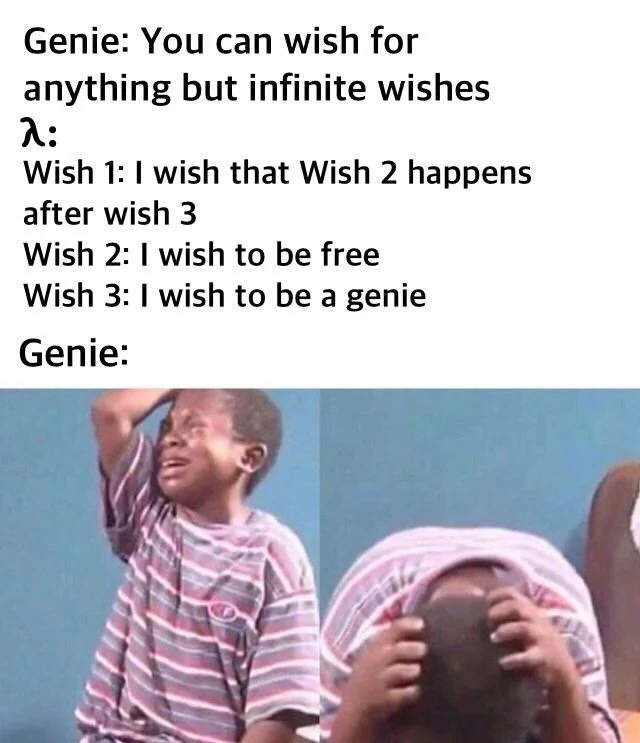
Imagine a magical genie friend says, “Okay, you can ask for a few things, but you’re not allowed to ask for endless wishes.” Seems strict, right? But the person in this meme found a sneaky way around the rule! It’s like if a kid was told, “You can’t have infinite candy,” so first they wish to become a candy-making wizard, and then they wish to be free to make candy forever. In the story on the meme, the person uses the first wish to rearrange the order of the next two wishes (pretty tricky!). Then, with one wish they ask to turn into a genie themselves (gaining all the magic powers), and with the final wish they ask to be free. In the end, that person becomes a free genie – which means they can now do anything they want without even needing wishes! The original genie is shown utterly shocked, holding his head like “What just happened?!” The reason it’s funny is that the person followed the genie’s rule (they never said “give me infinite wishes” directly), but they still got unlimited power in a roundabout way. It’s a bit like outsmarting a teacher with a clever answer to a trick question. The genie didn’t see that coming at all, and that surprise is both clever and comical. In simple terms: the rule said no cheating, but the person found a smart loophole, and even the all-powerful genie couldn’t help but feel stunned by how clever that wish was!

Level 2: Out-of-Order Wishes

For a newer developer or someone learning the ropes, let’s break down what’s happening. In programming, lambda (λ) often means an anonymous function or a short block of code. The meme uses “λ” to label the person making wishes, hinting that this person thinks like a programmer using FunctionalProgrammingConcepts. The genie in the story has a rule (like a line in an API documentation): “You can ask for anything except infinite wishes.” This is similar to a game or system saying “you can call our service as much as you want, but you can’t directly request unlimited usage.” Now, our cunning “lambda” character doesn’t ask for unlimited wishes outright. Instead, they use their 3 wishes in a very specific order to get essentially the same result.

Here’s how the wishes are structured:

  • Wish 1: “I wish that Wish 2 happens after Wish 3.” This is a bit mind-bending – it’s like using one wish to change the order in which the genie will do the other wishes. Think of it as telling the genie, “Before you do my second wish, you must do my third wish.” It’s a scheduling trick!
  • Wish 3: “I wish to be a genie.” This was originally the third wish, but because of Wish 1’s instruction, the genie will actually perform this one before Wish 2. So effectively, this happens second. When this wish is granted, the person making the wish is turned into a genie themselves – gaining a genie’s magical powers.
  • Wish 2: “I wish to be free.” According to Wish 1, this wish will be executed last (after Wish 3). Now here’s the key: at this point, the wisher has become a genie (from Wish 3) and then uses Wish 2 to free themselves. In genie lore (think of Disney’s Aladdin or common fairy tales), a genie can be bound to a lamp or master, and a wish can set them free. So the wisher basically says, “I want to be a genie, and then I want that genie (me!) to be free.”

By the end of Wish 3 and Wish 2, the once-normal person has genie powers and is not bound to anyone – effectively a free genie. That means they now can presumably do anything, without needing more wishes! They have achieved the equivalent of infinite wishes by becoming the one who grants wishes, with no chains on them. Meanwhile, the original genie is standing there slack-jawed (as shown in the reaction images) because it just got totally outplayed. The genie’s rule wasn’t technically broken – the wisher never said “I wish for infinite wishes” – yet the result is even more advantageous: infinite power and freedom.

In coding terms, the wisher treated the wishes like functions or tasks they could rearrange. This is similar to writing a program where you decide that step 3 should run before step 2. Many programming languages and systems allow asynchronous execution or scheduling. For example, in JavaScript you might use promises or callbacks to say “do this task later, after that other task.” Here, Wish 1 is like a special callback: it makes sure the genie calls Wish 3 before completing Wish 2. It’s a constraint bypass in the genie's algorithm – the genie expected to do Wish1 → Wish2 → Wish3 in order, but Wish1 rewrote that expectation.

Some terms from the tags that relate to this:

  • AmbiguityInRequirements: The genie’s rule (“no infinite wishes”) left some wiggle room. It didn’t cover all loopholes. In development, if requirements are vague or incomplete, people or code can do unexpected things. Here the requirement was ambiguous enough to allow a creative solution.
  • SpecificationByExample: Sometimes, instead of describing rules generally, you give examples of how something should work. The wisher sort of did this by explicitly stating an example sequence of wishes to get the desired outcome. They basically wrote a mini-spec for the genie to follow (do Wish3 then Wish2).
  • Monkey paw programming: This is a fun term referencing the “Monkey’s Paw” story where wishes are granted in twisted ways. In programming, it means code will do exactly what you ask, which might not be what you really wanted. Here, the wisher turned that on its head – he gave the genie a wish that exactly follows the wording but twists the genie's intention. It’s like the CodingHumor version of a genie story: the developer’s literal interpretation wins.

Overall, for a junior dev, the humor comes from the wisher using a developer-like hack to solve a problem. Instead of breaking the rule “no infinite wishes” directly (which is not allowed), they wrote a clever sequence of allowed steps to achieve the same effect. It’s as if you told a programmer “you can’t use a loop in your code,” so they write a recursive function or use a clever trick with gotos or conditional calls to still loop – not technically using a loop keyword, but the effect is a loop. The genie meme makes this idea visual and funny. That kid clutching his head in shock is the genie realizing, “This person just beat me at my own game!” Developers find it funny because it’s a spot-on example of thinking outside the box with a bit of cheeky programming logic applied to a fairy-tale rule.

Level 3: Clause and Effect

This meme cleverly mocks the way senior developers and hackers find loopholes in rules. The genie’s one clause “You can wish for anything except infinite wishes” is the kind of half-thought-out requirement that experienced devs love to exploit. In the meme’s text, the λ (lambda) character – representing a crafty functional programmer – effectively says: “Challenge accepted.” They use Wish 1 to reorder the sequence of the next two wishes, which is an outrageous but technically allowed move. It’s the ultimate spec loophole exploitation: the genie’s spec didn’t forbid meta-wishes about wish ordering or becoming a genie. So our developer-minded wisher squeezes through that gap. This is hilarious to developers because it’s exactly what happens with ambiguous specs in real projects: give an overly literal or clever coder a rule, and they’ll find a way to fulfill it to the letter while completely undermining its spirit. Here the wisher essentially performs a privilege escalation attack on the genie’s system: using three normal wishes to gain god-like permissions (becoming a genie) and then liberating themselves. It’s like a user finding an API vulnerability to become an admin on a service – the genie’s face (the shocked child holding his head) says it all: “I can’t believe you just did that.” Seasoned devs recognize this pattern from monkey-paw programming tales: if a requirement is even slightly ambiguous (AmbiguityInRequirements alert!), someone will write code that technically satisfies it but produces a wild side effect. The meme’s humor also lies in mixing a fairy-tale scenario with coding concepts: wishes turning into scheduled function calls, and a genie effectively being outsmarted by a coder’s logic puzzle. We’ve all seen junior requirements or naive business rules get torn apart by edge cases; this genie’s rule was begging for an exploit. The reaction image – the genie utterly floored by the outcome – is every tech lead when a developer or user does something so unexpected that it breaks the system. It’s a laugh of recognition: DeveloperHumor where the all-powerful genie (like a production system or spec-maker) is left speechless by a simple, ingenious hack. The takeaway for the experienced? Always account for clever users, because if you don’t, you’ll end up like that genie, groaning “Why didn’t I forbid that?!” in stunned frustration.

// Pseudo-code representation of the wishes:
const wish3 = () => { me.become('genie'); };   // Wish 3: I wish to be a genie
const wish2 = () => { me.free(); };           // Wish 2: I wish to be free
const wish1 = () => { 
  wish3(); 
  wish2(); 
}; // Wish 1: I wish that Wish 2 happens after Wish 3

// Genie executes the wishes in order:
wish1(); // Triggers wish3() then wish2() due to Wish1's definition

// Outcome: 'me' is now a free genie, outsmarting the no-infinite-wishes rule.

Above: The wisher essentially monkey-patches the genie’s wish order. This code-style sketch shows how Wish1 acts like a tiny program: it calls Wish3 first, then Wish2. The genie had no defense against this reordering hack – much like a system with a sneaky scheduling bug. In real developer life, this is the kind of CodingHumor that makes us smirk: it’s absurd yet illuminating. The genie (like a rigid program) didn’t expect the user to inject control flow logic as a wish! It’s specification by example: the wisher specified the desired outcome (infinite freedom) by giving the genie a step-by-step example (those 3 wishes) that the genie had to execute. In summary, the senior-perspective laugh comes from recognizing both the clever AlgorithmHumor at play (turning a forbidden infinite loop into a accepted finite sequence) and the cautionary tale: always tighten your specs, or someone will break your genie_api_spec in a way you never saw coming.

Level 4: Side-Effect Sorcery

At the deepest level, this meme illustrates a functional programming brain teaser using a genie as the computation model. The Greek letter λ (lambda) hints at lambda calculus, the theoretical foundation of functional programming. In lambda calculus (and pure functional languages), you normally can’t have side-effects (like magical wishes) without controlling their order explicitly. Here the wisher treats each wish like a function and even makes one wish about the order of other wishes – a bit of deferred execution wizardry. This is essentially side-effect reordering: Wish1 doesn’t directly ask for an outcome, it specifies when Wish2 should run relative to Wish3. It’s like writing a higher-order function or a continuation that says, “execute Wish3, then execute Wish2.” This trick is reminiscent of how a monad in Haskell sequences actions or how continuation-passing style (CPS) passes future steps as arguments. The genie’s rule “no infinite wishes” is analogous to a restricted API or a formal system constraint. Yet, just as theoretical computer science shows us you can encode a seemingly forbidden capability via allowed operations (think of how a fixed-point combinator (Y combinator) smuggles in recursion or how Gödel encoded self-referential statements), the lambda here encodes an infinite wish loophole using only the permitted three wishes. The result is a specification loophole in action: by manipulating temporal logic – essentially creating a causal loop where wish #3 is invoked before wish #2 – the wisher gains infinite freedom without ever uttering “infinite wishes.” It’s a brilliant exploit of the genie’s API specification (and perhaps a nightmare scenario for any formal spec writer)! The physics of the genie’s world just got a hack: an out-of-order execution of magical commands that leaves the poor genie in a logical paradox and the λ-wielding programmer cackling with nerdy glee.

Description

The meme is split into a text block on white and a two-panel reaction image. Text reads: "Genie: You can wish for anything but infinite wishes λ: Wish 1: I wish that Wish 2 happens after wish 3 Wish 2: I wish to be free Wish 3: I wish to be a genie Genie:". Under the text, two side-by-side photos show a child in a striped shirt, face blurred, clutching his head in stunned frustration against a plain blue wall. The joke is a functional-programming twist: a lambda function reorders side-effects so that wish sequencing defeats the stated constraint, effectively achieving both freedom and genie status - an elegant specification loophole reminiscent of currying, deferred execution, and contract exploitation

Comments

11
Anonymous ★ Top Pick Yet another reminder that if you don’t model wishes as pure functions, someone will commute the side-effects, promote themselves to genie, and file the PR as a “minor refactor.”
  1. Anonymous ★ Top Pick

    Yet another reminder that if you don’t model wishes as pure functions, someone will commute the side-effects, promote themselves to genie, and file the PR as a “minor refactor.”

  2. Anonymous

    This is basically what happens when you let junior devs write async code without proper dependency resolution - suddenly your wish fulfillment service has a circular reference and the genie process is stuck in an unhandled promise rejection loop

  3. Anonymous

    This is essentially a distributed systems consensus problem disguised as a genie joke - λ just discovered that if you can control the happens-before relationship in your wish transaction log, you can exploit temporal dependencies to achieve Byzantine fault tolerance against wish limitations. The genie's face-palm reaction is justified: they forgot to implement ACID properties in their wish-granting system, and now they're dealing with a causal consistency violation that creates an infinite loop. Classic CAP theorem failure - you can't have Consistency, Availability, AND Partition tolerance when your partition is between 'being a genie' and 'being free.'

  4. Anonymous

    Spec says “no infinite wishes,” but without a defined happens-before, λ reorders the side effects, becomes the genie, calls free(), and you’ve accidentally shipped an unbounded Wish<T> monad to prod

  5. Anonymous

    Genie's log: ERROR: Cyclic dependency in wish graph - topological sort failed, wishes deadlocked eternally

  6. Anonymous

    Spec: “no infinite wishes.” Missing: execution order. λ uses lazy eval and CPS to become the genie then free himself - congrats, your Wish API is now re-entrant with privilege escalation

  7. @unknown24907 5y

    не понял

  8. @dr_schmurge 5y

    genie = джинн Не благодарите

  9. @onetrackmindman 5y

    There is no delay between 3rd and 2nd so all wishes are wasted

  10. @yuriiq 4y

    What's about "I wish to be a free genie"?

    1. @RiedleroD 4y

      *sells you for free*

Use J and K for navigation