Skip to content
DevMeme
2575 of 7435
Blind Trust: The 'curl | sh' Method of Installation
Security Post #2851, on Mar 23, 2021 in TG

Blind Trust: The 'curl | sh' Method of Installation

Why is this Security meme funny?

Level 1: Candy from Strangers

Imagine you have a friend who eats candy that strangers give them without asking any questions. Every day, they’re like, “Ooh, candy!” and just gobble it up, not knowing if it could be bad for them. They don’t check who the stranger is or what’s in the candy – they just eat it because it’s easy and tasty. Now one day, this same friend is offered a piece of candy from a well-known candy store, with a clear label on the wrapper showing all the ingredients. Suddenly your friend says, “Hmm, I’m not sure… what if there’s something weird in this candy? I’m worried about what’s inside.” You’d probably laugh and say, “Buddy, you’ve been eating mystery candies from random people all the time, and THAT never bothered you. This one is from a trusted store – if anything, it’s the safest candy you’ve had!”

The meme is making just this point, but with developers and computers. Developers sometimes run mysterious computer commands from the internet without knowing what they really do (that’s like eating candy from strangers). It’s risky, but they do it because it makes installing programs quick and simple. If someone like that then turns around and says, “I’m worried about what’s inside this vaccine shot,” it sounds silly – kind of like our candy-eating friend suddenly getting picky. The joke is funny because it shows how illogical it is to be carefree in one risky situation and fearful in a much safer one. It uses a real-world comparison everyone can understand: trusting unknown things versus things that are known to be safe. So in simple terms: if you’re the type of person to trust a random thing (code or candy) from an unknown place, you probably shouldn’t be scared of something given to you by reliable experts. The contrast is what makes us laugh, because it’s a bit absurd when you spell it out like that.

Level 2: Blindfolded Installs

Let’s break down the scenario for a newer developer or someone not as familiar with the command line. The tweet references installing a program with curl XYZ | sh, which is a shorthand many of us have seen in README files or install guides. Here’s what that means:

  • curl is a command-line tool (stands for “Client URL”) used to download data from the internet. It’s like a web browser but without the graphics – you give it a URL, and it fetches the content.
  • The | symbol is called a pipe in shell language. It takes the output of the command on the left (in this case, whatever curl downloaded) and feeds it as input to the command on the right.
  • sh is the Unix shell, a program that reads and executes shell commands (scripts). sh (or bash, zsh, etc.) is basically the interpreter that runs a list of given commands on your system.

So when you put it together: curl XYZ | sh means “Download whatever is at address XYZ and immediately execute it as a shell script.” It’s a one-liner that says: fetch code from the internet and run it blindly.

Why would anyone do this? Mainly for convenience. Many software projects offer an easy installation script. For example, a tool might say: “To install our program, just run:

$ curl -sS https://install.example.com/mytool.sh | sh  

and you’re done!”
This single command could download an installer script (let’s call it mytool.sh) and pipe it to sh to execute it on the fly. The -sS flags on curl in this example just make curl silent and show errors (common for these snippets). Under the hood, that script might do a bunch of setup: download the actual program, move files to the right places, set environment variables, etc. It’s basically an automated install wizard running in your terminal.

The reason this is considered a “blindfolded install” is because you typically don’t see or review the content of mytool.sh before it runs. You’re taking the authors (or maintainers) at their word that it’s safe and does what it claims. This is where the security risk comes in. With a package manager like apt or npm, there’s usually some trust: the packages come from known repositories and maintainers, and often there are backup checks (like checksums or code reviews by the community). With curl | sh, you’re bypassing some of those safety nets. You’re effectively saying, “I trust whatever is at this URL completely.” If that URL served malicious code (whether because the server was hacked, DNS was spoofed, or maybe the project itself is doing something sneaky), your computer would run that malicious code immediately.

For instance, imagine the script at install.example.com/mytool.sh had a line rm -rf / in it (the dreaded command to wipe your hard drive). If you ran the above curl | sh command, your system would start deleting files before you even realized what happened. Less dramatically, the script could silently send your usernames, or environment variables (which might include secrets like API keys) to a remote server. This kind of unseen action is often how malware or supply chain attacks operate. You might not notice anything at first – the program you wanted gets installed – but in the background, something fishy also ran.

Now, the meme is comparing this behavior to worrying about vaccine ingredients. Vaccines (like the COVID-19 vaccines being discussed around March 2021) list their ingredients publicly and are vetted through clinical trials and scientific review. Yet, some people without a biology background might say, “I don’t understand these chemical names, that sounds scary, what am I really getting?” They’re hesitant because they can’t personally verify what each ingredient does, even though experts have done it for them. The funny parallel here is that developers often show a similar kind of trust (or even greater trust) in code: when you run a random script from the internet, you likely haven’t verified what’s inside it either! Most of us aren’t reading through hundreds of lines of a bash installer script before running it, especially if we’re eager to get the tool working. So if you’re a developer who has ever done a curl | sh install, the tweet jokes that you’ve already proven you’re willing to trust something uncertain. In other words, “you’ve consumed mystery code, so why be scared of a little mystery juice in a syringe?” It’s poking fun at that inconsistency.

To a junior dev or any cautious newcomer, the take-home lesson is also hidden in the humor: maybe think twice before running curl | sh. It’s usually better to download the script, open it in a text editor, and skim through it first, or use official package channels. But the reality is, many of us have done it because 99% of the time the script is from a reputable source and we just want things done quickly. This tweet just reminds developers of that bold leap of faith they routinely take. It ties into DeveloperHumor because it’s an inside joke about our own habits, and into SecurityBestPractices because, well, running code blindfolded is not a best practice. And seeing it contrasted with something non-tech (vaccines) makes it accessible and extra amusing. Even if you’re not a hardcore security person, you get the idea: one shouldn’t be hypocritical about trust.

Level 3: Caution to /dev/null

For seasoned developers, the sight of curl XYZ | sh in documentation triggers a mix of amusement and anxiety. It’s a prime example of what one might call “YOLO-driven development” – throwing caution to the wind (or rather, redirecting caution to /dev/null). The humor here comes from pointing out a shared dirty secret in the developer community: we’ve all copied and pasted commands from the internet into our terminals without fully reading them. Whether it was setting up oh-my-zsh, installing nvm (Node Version Manager), or grabbing some quick Docker install script, many of us have run a one-liner that essentially says, “I trust this random script to set up my system. Let’s hope it doesn’t rm -rf /.”

By pipelining curl to sh, a developer is implicitly saying, “I’m okay running whatever this remote author or website gives me, no questions asked.” It’s incredibly convenient – one command and you’ve got a program installed – but it’s also the stuff of SecurityBestPractices nightmares. The script could do anything: add users, change permissions, exfiltrate data, or install a rootkit. The meme’s author, Daniel Feldman, is poking fun at the idea that a person who’s this cavalier about software security would get cold feet over the contents of a vaccine vial. It’s a classic case of developer irony. We programmers pride ourselves on being logical and evidence-driven, yet here we are executing unvetted code from the wild because it’s easier than reading the documentation.

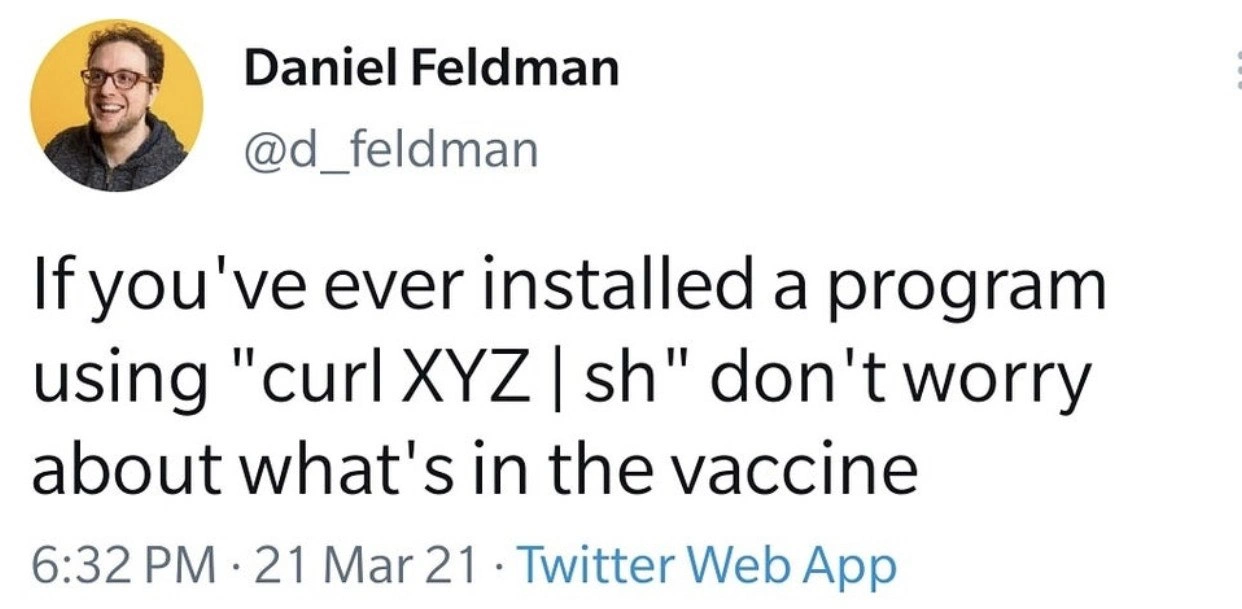
The tweet format itself reads like a deadpan observation: “If you’ve ever installed a program using curl XYZ | sh don’t worry about what’s in the vaccine.” It’s funny because it calls out a contradiction: worrying about vaccine ingredients (which are publicly known but maybe chemically complex like mRNA, lipids, etc.) versus not worrying about the “ingredients” of a shell script (which could literally contain sudo rm -rf /* or a crypto-miner and you’d be none the wiser if you didn’t open it). Any senior engineer can relate to the uneasy feeling of running a command from Stack Overflow or some GitHub README and thinking, “This could end badly, but I really need this tool now.” The collective experience is that usually it doesn’t end badly – because most maintainers aren’t malicious – but we know we’re testing fate. It’s a bit like crossing your fingers every time you run such a command.

In practice, teams try to avoid this. Enterprises have policies: “No blind curl | sh executions!” Instead, they’ll tell you to download the script, inspect it, maybe verify a hash, then run it. But in the real world? At 6:32 PM on a Sunday (like the tweet timestamp hints), some developer is setting up a new dev environment or deploying a quick fix and just runs the quick installer. The shared laugh here is that developers have already demonstrated trust in far sketchier situations than getting a vaccinated shot. If you confronted a dev about this habit, they might sheepishly grin, recalling how they pipe-installed some package manager in a hurry. It’s a “we’ve been there” chuckle among veteran coders. And the vaccine angle gives it an extra twist — it extends the tech humor into real life. Given the timeline (March 2021), everyone was talking about COVID-19 vaccines and some folks were anxious about them. By contrasting that fear with the reckless abandon of curl|sh, the meme effectively says: “Friend, you run unattended scripts from the internet on your machine – you’re clearly comfortable with risk!”

There’s also an undercurrent of supply chain security commentary. In 2021, high-profile software supply-chain attacks (like malicious updates or compromised packages) were front-of-mind. Piping in a shell script from a third party is the simplest form of a supply-chain vulnerability: you’re trusting an external supply of code with zero validation. It’s analogous to installing a package from an unverified source. For instance, a nightmare scenario: a popular install script on a project’s website gets hacked and modified to steal API keys or install malware. Anyone who curls and pipes that script would unknowingly execute the malicious payload. This isn’t hypothetical – such things have happened (typosquatted packages, hacked npm libraries, the infamous Codecov bash uploader incident where a script was tampered with to leak secrets). So the tweet is doubly humorous to a senior dev: it’s both a jest about personal risk tolerance and a nod to real security gaps that we tend to gloss over in day-to-day work.

In summary, at the senior engineer level, this meme lands because it highlights a “do as I say, not as I do” moment in tech culture. We lecture juniors about not pasting random commands, about practicing good security hygiene, about carefully vetting what we execute. Yet plenty of hardened professionals have done exactly this curl|sh trick when convenience trumped caution. The vaccine crack just drives the point home by comparing it to something outside of software. It’s a bit of self-deprecating humor for developers: we can laugh at our own paradoxical behavior. After all, we operate complex systems and worry about edge cases at work, but then might neglect basic caution when installing our beloved CLI tools. The next time someone frets about a microchip in a syringe, a dev who’s guilty of blind shell piping might just smirk remembering this tweet.

Level 4: Reflections on Trusting Scripts

At the most fundamental level, this joke exposes a breakdown in the chain-of-trust in software delivery. Ordinarily, installing software involves verification steps: package managers (like apt, yum, or brew) validate signatures or checksums, ensuring the code you're running is exactly what the authors intended. This cryptographic trust chain (signing releases with GPG keys, hosting on HTTPS, etc.) upholds a trust boundary – a barrier that unverified code is not allowed to cross. When a developer uses curl | sh, they essentially short-circuit all those safeguards. They download a shell script over the internet and execute it immediately, with no verification of authenticity or integrity. It's the ultimate act of blind trust in the remote source. The meme is highlighting that if a person is willing to do this, they're already accepting a level of supply-chain risk far greater than what any regulated vaccine presents.

From a security theory perspective, this is akin to Ken Thompson’s classic lesson “Reflections on Trusting Trust.” Thompson pointed out that you can’t just trust code at face value – compilers or binaries might be backdoored without your knowledge. Here, the situation is even more stark: developers aren’t even reading the source before running it. They’re foregoing formal verification and even informal inspection. The curl | sh pattern dumps whatever the server sends straight into a command interpreter. It’s a bit like accepting an unsigned kernel module and loading it directly into the OS – you’re completely at the mercy of that code’s benevolence. The lower-level protocols might be secure (e.g. HTTPS prevents man-in-the-middle tampering during transit), but that doesn’t guarantee the code itself is safe. If the hosting server is compromised or the script author has malicious intent, your machine could be running anything – from a harmless installer to a one-liner that exfiltrates your SSH keys. In other words, the typical safeguards of distributed software systems (digital signatures, sandboxing, verified publishers) are all bypassed.

The meme’s punchline deftly compares this computing scenario to the biological one of vaccines. Modern vaccines (like those for COVID-19 in early 2021) undergo rigorous testing, peer review, and public disclosure of ingredients – a biological chain-of-trust maintained by scientific institutions and regulatory bodies. Yet some folks worry obsessively about “what’s in the vaccine,” despite that oversight. The tweet implies that developers, of all people, shouldn’t be swayed by that fear if they’ve been nonchalantly executing opaque installation scripts. After all, a shell script piped directly from the internet is a black box of content – there’s no peer-reviewed guarantee on what it's injecting into your system. In effect, the joke operates on a deep truth: both code and vaccines require trust in unseen components, but developers routinely trust code from random servers with far less evidence than what we have for vaccine safety. It’s security hypocrisy laid bare – delivered with a heavy dose of irony.

Description

A screenshot of a tweet from user Daniel Feldman (@d_feldman). The tweet, posted on March 21, 2021, reads: 'If you've ever installed a program using "curl XYZ | sh" don't worry about what's in the vaccine'. This is a highly technical joke that draws a parallel between a risky software installation practice and skepticism about vaccines. The command 'curl XYZ | sh' downloads a script from a URL and immediately executes it with shell permissions, without any opportunity for the user to inspect the code. This is considered a major security vulnerability, as the script could be malicious. The tweet humorously suggests that anyone who would take such a risk with their computer's security, blindly trusting an unknown script, is being hypocritical if they express concern about the contents of a scientifically vetted vaccine. It's a sharp commentary on misplaced priorities and risk assessment within the tech community
Comments

9
Anonymous ★ Top Pick The most dangerous command in tech isn't 'rm -rf /' - it's the 'curl | sh' you just copied from a five-year-old Stack Overflow answer without reading the script first
  1. Anonymous ★ Top Pick

    The most dangerous command in tech isn't 'rm -rf /' - it's the 'curl | sh' you just copied from a five-year-old Stack Overflow answer without reading the script first

  2. Anonymous

    If your threat model accepts ‘curl | sudo bash’ on the prod bastion at 4 PM Friday, you’re already running in Schrödinger’s supply chain - worrying about vaccine ingredients is just bikeshedding

  3. Anonymous

    The same developers who audit every line of a 10-line PR will happily pipe arbitrary internet scripts directly to bash with sudo privileges, yet somehow manage to maintain a healthy skepticism about FDA-approved vaccines that went through years of clinical trials

  4. Anonymous

    The real irony is that 'curl | sh' is basically dependency injection without the dependency inversion principle - you're just hoping that remote server isn't serving you a malicious payload instead of the installer you expected. At least vaccines go through FDA approval; that random install script from a GitHub gist? Not so much. Senior engineers know the proper pattern is: curl, inspect, verify checksum, review source, then maybe - just maybe - execute. But let's be honest, we've all done it at 2 AM when fighting with build dependencies

  5. Anonymous

    If 'curl | sh' is in your runbook, your SBOM is a pastebin

  6. Anonymous

    Devs grant root to GitHub randos via curl | sh, but mRNA is the real supply-chain attack

  7. Anonymous

    curl https://installer | sudo bash - the enterprise standard for RCE procurement; zero trust in policy, absolute trust in the pipe

  8. @mainfme 5y

    says soy-cuckold from twitter

  9. Kademlia 5y

    Brain backups and full-organ restarts exist, duh

Use J and K for navigation