The Developer Ecosystem Party
Why is this IDEs Editors meme funny?
Level 1: The Odd One Out
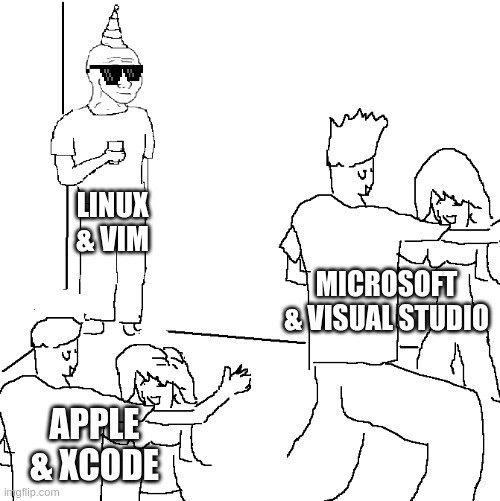
Imagine you’re at a school party where everyone has formed little groups based on what they like to play with. In one corner, there’s a pair of kids playing a big, fancy dance video game together, jumping around and having a blast. In another corner, two friends are totally engrossed in a cool new board game that only they have. And then, off by himself, there’s one kid sitting quietly, happily playing with his favorite puzzle. This kid in the corner isn’t dancing or high-fiving like the others; he’s doing his own thing. He might feel a bit left out because nobody else is playing puzzles with him, but he also really loves that puzzle and is proud of how he can solve it on his own. Meanwhile, the others are laughing and cheering over the video game and the board game, not really paying attention to the puzzle kid.
This scene is a lot like the meme. The kid with the puzzle is like the programmer using Linux & Vim – doing something a bit old-fashioned or unique by himself. The dancing video game kids and board game friends are like the programmers using the big popular tools (Visual Studio and Xcode) – they’re having fun together with something more common and flashy. It’s funny because we can all recognize that feeling: being the odd one out who likes something different than everyone else. The meme makes us smile because even though all the kids (and all the programmers) are just playing games or writing code in their own way, it looks like they’re at completely different “parties.” In simple terms, it’s saying: people can do the same kind of thing (like coding or playing) but still stick to their own style so strongly that it’s almost as if they’re not part of the same group. And that little bit of silliness – everyone separated just by what they’re using – is what makes it humorous and relatable.
Level 2: Text Editors vs IDEs 101
This meme shows a developer party where each “group” is basically a different coding setup. On one side, we have Microsoft & Visual Studio dancing together. On another, Apple & Xcode are sitting together happily. And then alone in the corner is Linux & Vim with a drink, just watching. The joke here is about how programmers often split into groups based on the tools and environments they use, almost like cliques in a school. Each label is an operating system paired with a coding tool that’s popular on that system. Let’s break them down:
Linux is an operating system (like Windows or macOS) that many programmers use, especially those who like open-source software or work on servers. It’s known for giving users a lot of control and is widely used in back-end systems.
Vim is a text editor that runs in a terminal (a text-only interface). Instead of clicking menus and buttons, you use the keyboard to give Vim commands. It’s very powerful and efficient once you learn it, and many experienced developers adore Vim because it can greatly speed up editing tasks. However, Vim is also famously hard for beginners – there’s a running joke that people open Vim and can’t figure out how to exit (to quit Vim you actually have to type a command like
:q!and hit Enter). So Vim has this reputation of being for “hardcore” programmers who invest time to master it. In the meme, the Linux & Vim person is by himself, which suggests he might be the odd one out, using a tool that isn’t as mainstream or easy for others to jump into.Microsoft is the company behind Windows, and here it’s paired with Visual Studio. Visual Studio is what we call an IDE – Integrated Development Environment. An IDE is a big application that provides a graphical editor to write code, along with lots of helpful features like autocompletion (where the tool suggests or fills in code as you type), a debugger (to run the code and help find errors), and designers for things like user interfaces. Visual Studio is one of the most well-known IDEs, especially for developing on Windows. People use it to create all sorts of applications, from desktop programs to video games, often using languages like C# or C++. It’s made by Microsoft, so it’s really tuned for Windows development. Visual Studio has tons of features (toolbars, graphics, forms designers – you name it). Because of that, it’s heavyweight (it can be a big, slow program on older computers) but very user-friendly in many ways. In the picture, Microsoft & Visual Studio are dancing enthusiastically, which humorously represents that Windows developers using Visual Studio are having a grand, easy time – as if their tool makes development a celebration. (Just a note: Visual Studio is not the same as Visual Studio Code, which is a lighter code editor that came later. Here we’re talking about the full Visual Studio IDE that’s more common for large projects on Windows.)
Apple (the company that makes Mac computers and iPhones) is shown with Xcode. Xcode is Apple’s main IDE, used for creating apps for macOS (Mac computers) and iOS (iPhones/iPads). If you want to build an iPhone app, you pretty much have to use Xcode on a Mac. Like Visual Studio, Xcode provides an all-in-one environment: you write Swift or Objective-C code in it, you can design the app’s interface by dragging buttons and labels in its Interface Builder, and you can run your app in a simulator to test it. It’s also pretty large and only runs on MacOS. In the meme, Apple & Xcode appear as a close couple sitting together, which implies that Mac developers are really closely tied to their official tool (Xcode). It’s almost an exclusive relationship because Xcode only dances with Apple – you can’t use it on any other operating system. Apple developers often accept this because Xcode is the gate to the whole Apple ecosystem (you can’t easily develop for iPhone without it).
Now, what’s funny about putting these at a party? It’s showing how each of these pairs (Linux+Vim, Microsoft+VS, Apple+Xcode) stick together with their kind, and they don’t really mix. The Linux & Vim user is like a person who came to the party but doesn’t fit in with the others. In real life, this reflects how developers can sometimes be passionate about their tools to the point that it becomes a bit tribal. For example, someone who uses Vim on Linux might always talk about how Vim is the best and make jokes that people using fancy IDEs are “spoiled” or relying on crutches. On the flip side, a person who uses an IDE might joke that the Vim user is being unnecessarily old-fashioned or masochistic (since Vim can be tough to learn). It’s a friendly rivalry in the tech world, often called the editor war or IDE vs editor debate.
If you’re a newer programmer, you might have noticed discussions or light-hearted arguments like:
- “VS Code (or Visual Studio) is the best, it has everything built-in!”
- “No way, Vim (or Emacs) is better, I can do everything with just my keyboard and it works on any machine.”
It’s very much like two different clubs. People end up hanging out (figuratively) with those who use similar tools because they share experiences. For instance, Windows/Visual Studio developers share tips about NuGet packages or Visual Studio shortcuts, and Mac/Xcode developers swap stories about provisioning profiles or the latest Swift features. Meanwhile, the Linux/Vim folks exchange Vim plugin configurations or shell scripts. Each group has its own “party” going on in real life (like their forums, chat groups, or sections of a company). So in the meme, the Visual Studio users dancing and Xcode users hugging show those groups enjoying their common bond, and the poor Linux/Vim guy is left standing alone with his drink, maybe feeling a little left out or just different.
The humor comes from recognizing this scenario. It exaggerates it – in reality, developers of different stripes do talk to each other – but it’s not far-fetched to see a lone Linux user at a company mixer where most others use Windows or Mac. That person might not get as excited about a new Visual Studio feature or the latest Xcode update, just like the others might not appreciate a cool Vim trick he discovered. So it can feel socially like being the odd one out at a party. The meme pokes fun at tooling_preferences in a light way: it’s saying “look, we developers sometimes act like we’re at separate parties (or separate corners of the same party) just because of the tools we use.” And truth be told, all these tools – whether a simple text editor like Vim or big IDEs like Visual Studio/Xcode – are just different ways to do the same thing (write code). Each has its advantages: Vim is super fast and works on any machine (great for quickly editing files or coding on a remote server), whereas Visual Studio and Xcode provide a lot of guidance and visual help (great for complex projects where you want that all-in-one convenience).
For a new developer, the takeaway is that this meme is showing an inside joke about developer culture. It emphasizes how people sometimes identify strongly with their development environment. But it’s all in good fun. Just like some people prefer a fancy all-inclusive kitchen appliance and others like a simple reliable tool, in programming some prefer a fancy IDE and others a simple editor. And like any group of friends, folks will tease each other about “your way vs my way.” In the end, the Linux+Vim guy in the corner isn’t actually wrong or worse – he’s just doing things differently. The meme gets a laugh by showing how silly it is in a social setting when everyone clings to their favorite tools as if they’re dance partners at a party. It’s a reminder that, hey, maybe we should all dance together once in a while – or at least acknowledge that each approach can be respected (and maybe even learned from). After all, the party’s more fun when everyone’s included, right?
Level 3: Terminal Wallflower
In this meme’s little cartoon party, each developer faction is personified as an operating system paired with its favorite coding tool. In the center, Microsoft & Visual Studio are joyfully dancing; on the side, Apple & Xcode are cuddled up together; and off in the back stands Linux & Vim, our lone party-goer in the corner. This amusing setup immediately evokes the long-running editor wars and tooling tribalism in programming. Seasoned developers recognize these cliques: the Windows folks reveling in their feature-packed IDE, the Mac/iPhone crowd entwined with Apple’s official tools, and the hardcore Linux user quietly bonding with a minimalist text editor. It’s a snapshot of dev culture: different tech communities celebrating in their own ways, with the classic loner_dev stereotype for the Linux/Vim user.
Why is the Linux & Vim guy alone? It’s hinting at the cultural gulf between lightweight Unix-style development and the heavyweight IDE-centric worlds of Apple and Microsoft. Historically, developers have gravitated into camps around their tools. This dates back to the earliest Editor Wars: think vi vs Emacs in the Unix world – a nearly religious debate over which text editor is superior. Vim (an improved vi) became a beloved tool on Unix/Linux systems, while Emacs had its own loyal following. These editors weren’t just tools; they symbolized an entire philosophy of software craftsmanship. Meanwhile, on the commercial side in the 90s and 2000s, Microsoft Visual Studio emerged as the one-stop IDE for Windows development, and later Apple’s Xcode became the default for macOS/iOS development. Over time, these preferences solidified into distinct DevCommunities. If you walked into a company’s engineering wing, you could almost tell who’s who: the guy scripting in a terminal with Vim on a Linux laptop, versus the team clicking through Visual Studio dialogs on their Windows workstations, versus the MacBook-toting iOS dev testing an app in Xcode’s iPhone simulator. Each group speaks a slightly different “dialect” of development.
From a technical perspective, the differences are significant. Visual Studio and Xcode are full-fledged IDEs (Integrated Development Environments). An IDE combines a source code editor with debuggers, designers, and build tools – a whole suite of features under one roof. Visual Studio, for instance, offers rich GUI forms designers, IntelliSense auto-completion, integrated debugging, and a plethora of plugins. It’s the epitome of a MicrosoftProducts flagship: robust, feature-rich, but also monolithic and traditionally tied to Windows. Xcode, similarly, is Apple’s all-in-one IDE for building Mac and iOS applications. It includes Interface Builder for designing app UIs with drag-and-drop, graphical debuggers, and deep integration with Apple’s SDKs. However, both of these IDEs are platform-dependent: Visual Studio (in its classic form) historically ran only on Windows, and Xcode only runs on MacOS. This makes their user bases pretty insular – you won’t find Xcode users on Windows or Visual Studio users on Linux. They’re like two dancing couples who each only dance on their own turf.
Vim, on the other hand, is the polar opposite kind of tool – a text-based editor living in the terminal. Vim eschews graphical interface entirely: you interact using keyboard commands in modes (pressing i to enter insert mode for typing, Esc to go back to command mode, etc.). There are no panes full of buttons or wizards; everything is done through text commands and custom shortcuts. This makes Vim extremely lightweight and ubiquitous (it’s present on almost every Linux/Unix system, ready in a pinch to edit a config file or code over SSH). Advanced users become astonishingly fast with Vim, chaining together commands and macros to manipulate text at speeds a GUI user might envy. But there’s a catch: Vim has a steep learning curve – it’s notoriously hard for newcomers (so much so that a running joke is being stuck in Vim because you don’t know how to exit it). In the party meme, that steep learning curve and eccentric style is represented by our Linux & Vim character hanging off by himself, too “cool” (or too stubborn) to join the others. He’s the archetype of the programmer who prides himself on using bare-bones tools, even if it means being isolated from the mainstream. He might be thinking something like:
“They have no idea I can write and compile code faster with Vim and a terminal than they can with all those fancy GUIs.”
That thought bubble captures the mix of superiority and outsider status. It’s half true and half tongue-in-cheek – experienced Vim users really can be incredibly efficient, but the scene is exaggerated for humor. The Visual Studio dancers and Xcode couple, by contrast, represent developers enjoying the high-level comfort of modern IDEs. They love the conveniences: point-and-click interfaces, auto-generated project files, visual debugging – it’s like partying with a full band playing. The meme humorously suggests that Visual Studio and Xcode users are having a grand time in a DeveloperExperience_DX paradise, while the Vim user stands apart by choice, smug with his spartan setup (or possibly just feeling awkward and wishing someone else at the party also used Linux so he’d have a friend!).
This resonates with developers because it’s TechHumor drawn from real life. In many workplaces or online forums, you’ll notice this exact dynamic. The Windows/.NET crew bonds over Visual Studio’s latest features (“Did you try the new IntelliCode in VS 2019? It’s magic!”), the Apple devs geek out over the new SwiftUI updates in Xcode, and then there’s that one colleague who configures everything in Vim, living in the terminal and bragging about how he doesn’t need all those “bloated GUI” tools. It’s a friendly rivalry. In fact, the IDE vs Editor culture has led to endless playful banter: “Real programmers use Vim/Emacs and write Makefiles by hand,” versus “Real professionals use an IDE to be more productive.” Each side pokes fun at the other, much like the dancing couples versus the loner in the meme. And each environment has its merits: the IDE folks genuinely get a smoother on-ramp (especially for complex projects or when debugging), while the Vim user gains unmatched control and consistency (same editing experience locally, on servers, or even in emergencies when only a terminal is available).
Another layer to this meme is the cross-platform divide. Notice how it pairs Microsoft with Visual Studio and Apple with Xcode – these are proprietary ecosystems. Linux (which is open-source and community-driven) doesn’t have an official “IDE partner” made by a big company. Instead, Vim (also open-source, born from the Unix tradition) fills that role. So it’s also a joke about how open-source vs proprietary worlds socialize. The proprietary groups (Apple, Microsoft) are off enjoying within their walled gardens (their exclusive dance circles), while the open-source guy is sort of doing his own thing. There’s even a hint of “grassroots vs corporate” culture: Vim and Linux represent the hacker ethos of customizing your own environment piece by piece, whereas Xcode and Visual Studio represent the corporate-provided, batteries-included experience. Neither is inherently superior, but the cultures around them differ starkly.
Ultimately, this meme is funny to developers because it exaggerates a truth: we often identify strongly with our tools and platforms, sometimes to the point of good-natured tribalism. It’s the same energy as sports-team rivalries or DevCommunities rallying around a favorite framework. Seeing those personified at a party – with one guy literally in the corner – is an absurd, comical visualization of the “Editor Wars” and tooling_preferences we’ve all seen. It reminds us not to take these preferences too seriously. After all, whether you’re grooving with an IDE on the dance floor or chilling with Vim by the snack table, we’re all just coding in the end. And who knows – maybe the Terminal Wallflower is perfectly content; as the saying goes, “Works on my machine,” and that’s what matters to him!
Description
A popular meme format known as 'Wojak at a party' or 'They Don't Know', rendered in a simple black-and-white line drawing style. The scene depicts a party where two couples are happily dancing in the foreground. One couple is labeled 'APPLE & XCODE', and the other is 'MICROSOFT & VISUAL STUDIO'. In the corner, a lone figure wearing a party hat and sunglasses stands stoically, holding a drink. This character is labeled 'LINUX & VIM'. The meme humorously personifies different software development ecosystems and their associated stereotypes. Apple/Xcode and Microsoft/Visual Studio are portrayed as the popular, mainstream choices, engaged and sociable. In contrast, the Linux/Vim user is depicted as the aloof, perhaps more 'hardcore' or individualistic developer who stands apart from the crowd, embodying a subculture that prides itself on minimalism, efficiency, and command-line mastery
Comments
36Comment deleted
He's not being antisocial. He's just in normal mode and hasn't hit 'i' to insert himself into the conversation yet
Let them dance - by the time VS and Xcode finish re-indexing 40 GB of symbols, my 100-line .vimrc has already deployed, rolled back, and annotated the blame
The real joke is that the Linux/Vim user spent 3 hours configuring their .vimrc just to look cool at this party, while the VS Code users already installed the 'Party Mode' extension and are actually having fun
The Linux/Vim developer stands alone at the pool party, not because they're antisocial, but because they're still configuring their .vimrc to enable 'social_interaction' mode - a plugin that requires compiling from source, naturally. Meanwhile, the Visual Studio and Xcode users are already swimming, having simply clicked 'Install Extension' three years ago
Vim: Esc :wq to nirvana. VS: Ctrl+everything till it loads. Xcode: Infinite beachballs, zero commits
Visual Studio’s leading the conga, Xcode’s still reindexing the playlist, and the Linux+Vim guy in the corner quietly SSH’d into the DJ booth and kept prod up - he’s the only one with root
While .sln and .xcodeproj debate schema upgrades, the Vim guy ships a fix over SSH with tmux and :make - project files change, text pipes forever
4real, vim is good. Comment deleted
That's like comparing apples to oranges, quite different application areas there: vim and VSCode are more editors, while Xcode is an actual IDE, also very Apple-platforms centric. Myself using VSCode for development and vim whenever applicable for quick console editing. Comment deleted
Visual Studio is an IDE and Visual Studio Code is an editor Comment deleted
Alright good correction 👍 Comment deleted
Any OS has an IDE it deserves Comment deleted
What you refer to as "Linux" is in fact "GNU/Linux"... Comment deleted
Oh stfu it's just Linux Comment deleted
Or as I like to call it, apt-get hell -f Comment deleted
I think Emacs would fit better. It's not just text editor. It is an IDE, window manager, browser, coffee machine, dildo controller... VIM is more like an editor than anything else. Comment deleted
Apple should be on some kind of wheelchair Comment deleted
for all i know, vs is the single worst ide in the world Comment deleted
i don't think you even can make worse if you try Comment deleted
I also have some troubles with VS, but currently at work I'm using xcode and it just crashes, everytime i try bind some .xib properties file or sometime it just lagging as epileptic Comment deleted
you can't even swap out the compiler for it, like how the fuck Comment deleted
and it's slooow Comment deleted
Funny thing, same project in VS builds 2 or 3 times faster than in xcode(not m1) Comment deleted
nah, it's slow to edit stuff in, it's slow to load, it's slow to open files, every single thing is slow Comment deleted
I can not feel same, maybe for me it's not that big difference Comment deleted
and the cross-compilation is non-existent Comment deleted
even bloody eclipse can do that Comment deleted
Cmake is for you) VS does support it) Comment deleted
never got around to actualy learing it, moved to linux and forgot windows like a nightmare Comment deleted
using gnu makefiles to this day Comment deleted
I wish I could do something similiar at work) Comment deleted
Linux & pycharm is good tho Comment deleted
IntelliJ IDEA on each platform 😎 Comment deleted
Where's NixOS/Emacs gang at? Comment deleted
What about jet brains? Comment deleted
vim top! do you agree with me Comment deleted