Skip to content
DevMeme
2574 of 7435
The Ultimate Gatekeeping: Are You Qualified for Imposter Syndrome?
MentalHealth Post #2850, on Mar 23, 2021 in TG

The Ultimate Gatekeeping: Are You Qualified for Imposter Syndrome?

Why is this MentalHealth meme funny?

Level 1: Doubting Your Doubts

Imagine you’re a kid building a LEGO tower. You make it pretty tall, and everyone says, “Wow, good job!” But you start thinking, “Hmm, my tower isn’t as good as my friend’s tower. I’m not a good builder at all.” That’s already a sad thought, right? Now you go even further and wonder, “Actually, am I even good enough to feel like I’m bad at this? Maybe I shouldn’t even worry because I’m just bad, period.” Sounds confusing and silly, doesn’t it? It’s like you’re going in circles in your own head. This meme is joking about that exact over-the-top worrying. It’s funny because nobody would seriously say you need to be “qualified” to feel unsure — that idea is crazy! But sometimes we do get so insecure that our thoughts don’t make sense. The meme makes us laugh at how ridiculous that feeling can be, kind of like laughing at a cartoon version of our own worries. It’s saying: “See how silly it is when you doubt yourself too much? Everyone feels this sometimes, so you’re not alone.”

Level 2: First Year Fears

Let’s break down what this meme is talking about in simpler terms. Imposter Syndrome is the name for a very common feeling among developers (and other professionals too): it’s when you constantly think you’re not as good or as smart as everyone believes you are. Imagine getting a job as a programmer or acing a coding class, but deep down you feel like you just “got lucky” or that you don’t actually deserve any praise. You worry that one day people will discover you’re not a “real” developer – as if you’ve been faking it this whole time. That anxious feeling of “I’m not good enough, I have no idea what I’m doing”that is imposter syndrome. It’s basically developer anxiety about not measuring up. The twist is that usually, people who feel this way are actually doing fine or even exceptionally well; they just think they are frauds. Meanwhile, someone who truly isn’t doing well often doesn’t feel like an imposter at all! This is why imposter syndrome is considered a mental quirk – your brain is lying to you about your own abilities. In the tech world, which moves fast and is full of very smart folks, it’s easy for even a good coder to feel “behind” or “not worthy.” It’s such a common part of MentalHealthInTech discussions that most developers will nod in understanding when the topic comes up.

Now, the meme itself makes a joke out of that feeling by using sarcasm. The question at the top — “Are you even good enough to have imposter syndrome?” — isn’t a real question at all. It’s a sarcastic way of saying “I feel like I’m not even worthy of calling myself unworthy!” That’s obviously an exaggerated, silly thought, and that’s why it’s funny. The meme presents it like a quiz, as if you could score yourself on being an imposter. Of course, there’s no real quiz; it’s just poking fun at the absurdity of how we think when we’re insecure. The humor here is very self-deprecating, meaning the person is making fun of themselves. Essentially, it’s a developer joking: “I’m such a mess that I doubt whether I’m allowed to doubt myself.” It’s a bit like saying “I’m failing at even feeling like a failure!” Obviously that’s not literally true, but it captures that extreme loop of worry in a comedic way.

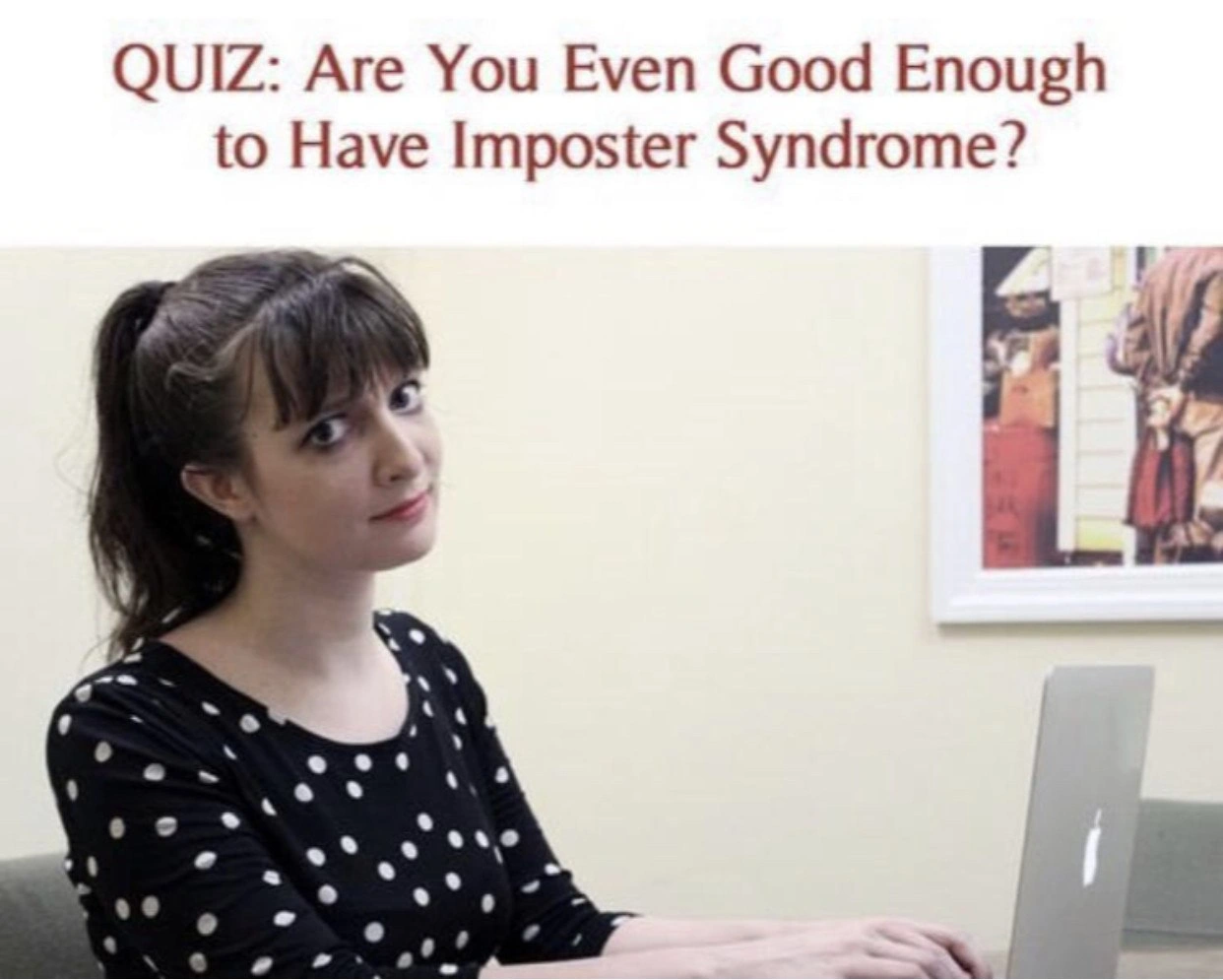
In the image, we see a woman sitting at a desk working on a laptop (specifically a MacBook, with the little glowing Apple logo on the back). In tech, seeing that silver MacBook is a pretty familiar sight — a lot of programmers use Mac laptops for writing code. That detail makes it clear she represents a software developer at work. She’s dressed normally (a black polka-dot top) and is in a simple office setting, so there’s nothing out of the ordinary in the scene. In fact, that’s the point: she looks like any regular developer concentrating on her code. There’s no obvious reason from the outside to think she isn’t qualified. Yet, the big red-text banner above her head suggests that inside, she might be having doubts about herself. The contrast is important: everything looks fine — she’s sitting there coding away — but in her mind she might be thinking, “Oh man, I have no idea what I’m doing… everyone else is so much better… I bet I’m not even good enough to feel imposter syndrome.” That’s why her slight, hesitant expression (even though her face is blurred, we can imagine it) fits the joke. It’s the face of someone who just had an absurd anxious thought cross their mind.

For newer developers or students, this meme is both humorous and reassuring. It tells you that feeling unsure of yourself doesn’t mean you’re truly incompetent; in fact, almost every developer feels this way at some point. You might remember the first time you joined a stand-up meeting or code review and felt completely out of your depth. Maybe you struggled with a bug for hours that a senior engineer solved in five minutes, and you thought, “I must be the worst coder ever.” That’s imposter syndrome talking. Or perhaps you read fancy articles or see awesome open-source projects on GitHub and suddenly feel, “I could never do something like that, I’m not a real programmer.” That too is imposter syndrome creeping in. The meme takes that voice in our head and makes it ask a ridiculously pessimistic question. It’s like shining a spotlight on how silly that inner voice can be. After all, if you truly weren’t good at anything, you probably wouldn’t even be reflecting on it or comparing yourself — you wouldn’t care. The fact that you worry about your skill means you do care and are likely improving.

So, when the meme asks “Are you even good enough to have imposter syndrome?”, it’s highlighting a truth in a jokey way: feeling like an imposter actually means you’re already part of the club (the developer community) doing real work. The humor might be a bit dark, but it serves to say, “Don’t be so hard on yourself, we all have these wild doubts that don’t make sense.” It’s a form of solidarity. In a strange way, it’s comforting for a junior programmer to realize that even that super talented senior developer who writes clean, brilliant code might secretly be up at night thinking, “Why do people think I’m good at this? I have no clue what I’m doing.” The meme uses relatable humor to communicate: You’re not alone in feeling like you’re not good enough — even the people you admire feel that way sometimes. And if even they feel it, maybe you can forgive yourself for feeling it too, and just have a little laugh about how weird our brains can be.

Level 3: Recursion of Doubt

QUIZ: Are You Even Good Enough to Have Imposter Syndrome?
This meme greets seasoned developers with a tongue-in-cheek paradox. The bold, quiz-style question above the image hits us with layered irony: it’s essentially asking, “Are you such a fraud that you don’t even deserve to feel like a fraud?” This creates a recursion of self-doubt – a loop where the developer questions their right to even question themselves. In coding terms, it’s like an infinite function call that checks AmIGoodEnough() inside itself, over and over, until it crashes. In fact, the humor comes from this exact infinite loop of insecurity: doubting one’s own doubt. It’s a nerdy form of self-deprecating humor that flips imposter syndrome on its head by implying you need to be qualified to feel unqualified. The result is absurd and painfully relatable to anyone in tech who's tangled with their own thoughts.

For experienced engineers, there’s a known pattern at play here. It recalls the Dunning–Kruger effect (a cognitive bias where the least skilled are often the most confident, and the highly skilled undervalue themselves). In our world, the true beginners sometimes boast about “mastering” a language after a weekend, while the veterans with 10 years of experience silently worry they know nothing at all. So when the meme asks if you’re “good enough to have imposter syndrome,” it’s riffing on that phenomenon. It’s basically saying: if you’re worrying about your competence, you’re probably competent enough to worry. Seasoned devs smirk at this because we’ve learned the ironic truth: the more you learn, the more you realize there is to learn, and thus the more you might doubt your own knowledge. The meme exaggerates this into a darkly comic gatekeeping of self-doubt — as if only the truly capable earn the right to feel incapable. It’s sarcastic, of course, making light of an almost universal developer insecurity.

The image itself reinforces the joke in a subtle way. We see a woman at her desk wearing a normal work outfit (a black polka-dot blouse) with an open MacBook front and center. The shiny Apple logo on that laptop is practically an unofficial badge of the trade — many software engineers swear by their MacBooks for coding. She’s effectively the picture of an everyday developer at work. Yet her blurred, subtly bemused expression seems to say, “Seriously? I’m even doubting whether I should doubt myself now.” This contrast — a person who looks the part of a capable developer externally, while internally feeling like a fraud — is exactly what imposter syndrome is about. The meme’s question in dark red serif font feels like a mock online quiz or clickbait article, which adds another layer of tech inside-joke: developers often encounter these “Are you a real programmer?” quizzes or absurd skill checklists on the internet. Here it’s turned into a satirical mental health quiz, where obviously no one would want to “pass” – it highlights how irrational our developer anxiety can get.

The punchline lands because it resonates with shared experiences in tech. Many of us have compared ourselves to peers or open-source rock stars and felt totally outclassed. We scroll through GitHub seeing genius-level open-source projects, or hear a colleague casually reference five frameworks we’ve never even heard of, and that familiar wave of “I’m not keeping up” washes over us. The meme captures that exact wave and pushes it to comedic extreme. It’s effectively saying “I feel so inadequate that I’m questioning my right to feel inadequate” – an obvious logical madness that we can recognize in ourselves. Bouncing between “I know nothing” and “I’m not even sure I know enough to say I know nothing” can feel like a mental StackOverflowError. (No, not Stack Overflow the website — though spending too long reading brilliant answers there can also trigger this feeling!) The joke gives a name to that spiral of thoughts and makes us laugh at the sheer ridiculousness of it.

Beyond the humor, there’s a comforting subtext: Imposter Syndrome is incredibly common in engineering circles, to the point that joking about it has become a coping mechanism. Teams, conferences, and online communities frequently bring up imposter feelings as a way to reassure developers that they’re not alone. By framing it as a satirical quiz, the meme indirectly says, “Hey, we’ve all unlocked this ‘achievement’ of feeling like frauds together.” It’s a bit of collective therapy hiding in a joke. In tech culture, where everyone secretly worries they’re underqualified, a sarcastic question like this both pokes fun at our irrational self-criticism and acknowledges it. Seasoned devs will chuckle, remembering all the times they nervously awaited a code review thinking “This is it, they’ll realize I have no clue what I’m doing,” only to find out the code was fine. The humor works because it’s truthful: even the best programmers sometimes feel like the worst, and we’ve developed a sarcastic, recursive joke to laugh at that fact. In short, the meme weaponizes our own inner voice of self-doubt and turns it into a shared laugh, reminding every overthinking engineer: if you’re worried about not being good enough, that in itself might mean you are.

Description

A meme featuring a headline in a serif font that reads, 'QUIZ: Are You Even Good Enough to Have Imposter Syndrome?'. Below the text is a stock-style photo of a woman with dark hair in a ponytail, wearing a black and white polka-dot shirt. She is sitting in front of a laptop, looking over her shoulder at the camera with a skeptical, slightly judgmental expression. The humor is deeply satirical and resonates with the tech community where imposter syndrome - the persistent feeling of being a fraud despite evidence of competence - is a widely discussed phenomenon. The meme creates a paradoxical layer of anxiety by suggesting that one must meet a certain standard of skill even to qualify for feeling like an imposter. It's a meta-joke about the pervasive self-doubt and gatekeeping attitudes that can sometimes surface in competitive professional environments
Comments

12
Anonymous ★ Top Pick I tried to take the quiz, but I got a 403 Forbidden. Apparently, my self-doubt permissions aren't configured correctly
  1. Anonymous ★ Top Pick

    I tried to take the quiz, but I got a 403 Forbidden. Apparently, my self-doubt permissions aren't configured correctly

  2. Anonymous

    Took the quiz; by question three - “Have you migrated the same service from bare-metal to VMs to containers to serverless and still feel obsolete?” - I unlocked Recursive Imposter Syndrome and a bonus badge for ‘Temporal Architectural Whiplash’

  3. Anonymous

    After 20 years, I've finally achieved the perfect balance: competent enough to architect distributed systems, incompetent enough to still believe I can estimate them accurately

  4. Anonymous

    This meme perfectly captures the recursive nature of imposter syndrome in tech: you're so convinced you're not good enough that you start questioning whether you're even qualified to feel like a fraud. It's the software equivalent of a stack overflow in your self-assessment function - each layer of doubt calls another layer of doubt until you hit a StackOverflowError in your confidence. Senior engineers know this feeling well: after 15+ years, you've seen enough production disasters and architectural decisions to know how much you don't know, which paradoxically makes you more qualified than those who think they know everything after their first bootcamp

  5. Anonymous

    We productized it: imposter syndrome is now a feature flag - enabled only after you pass three design reviews and the Dunning‑Kruger smoke test

  6. Anonymous

    Imposter syndrome: the CAP theorem of self-doubt where you sacrifice confidence for consistency in competence checks

  7. Anonymous

    Leveling rubric: L5 has imposter syndrome, L6 wonders if they’ve earned the right to it, L7 writes the rubric

  8. Deleted Account 5y

  9. @nuntikov 5y

    it's good to be not sus

  10. @NiKryukov 5y

    I have a friend named Sussus Amogus

  11. @ANTICHRISTUS_REX 5y

    Cattus magnus magnificus est

    1. @SuperiorProgramming 5y

      😂

Use J and K for navigation