Skip to content
DevMeme
171 of 7435
CSS Specificity's Final Boss: !important
Frontend Post #209, on Mar 8, 2019 in TG

CSS Specificity's Final Boss: !important

Why is this Frontend meme funny?

Level 1: The Word That Means Its Opposite

Imagine a sign that says "NOT a big deal!" — but in this town's strange language, that exact phrase officially means "THE biggest deal of all, drop everything." The pirate in the picture is doing the joke where you expect him to say "well yes, but actually no," except here the answer really is just yes: the thing that looks like it says "not important" is secretly the most important command there is. It's funny the way any word meaning its own opposite is funny — like learning that "literally" sometimes means "figuratively," but for people who build websites.

Level 2: What That Red Word Actually Does

Quick decoder ring for the concepts in play:

  • CSS (Cascading Style Sheets) — the language that styles web pages. The "cascading" part means multiple rules can target the same element, and an algorithm decides which wins.
  • Specificity — the scoring system for that contest. Roughly: inline style="" beats #id selectors, which beat .class selectors, which beat plain div/p tags. When two rules tie, the one written later wins.
  • !important — the override switch. Append it to a declaration:
.button {
  color: red !important; /* beats nearly everything targeting this property */
}

Now this rule defeats higher-specificity selectors that lack !important. It's the nuclear option for "why won't my style apply?!"

  • ! in other languages — in JavaScript, !true means false. That's why the meme works: your JS-trained brain reads !important as "unimportant," and CSS smiles like a clay pirate and says actually, yes.

The classic junior experience: hour two of fighting a stubborn style, you discover !important, it works instantly, and you sprinkle it everywhere like seasoning. Three months later you can't override your own styles, because everything is maximally important — which means nothing is. The real fix is usually understanding why your selector was losing (use DevTools' computed-styles panel; it shows exactly which rule won and why). The post's caption — "Just to be sure, right?" — is precisely the mindset that produces those codebases.

Level 3: Winning the Cascade by Flipping the Table

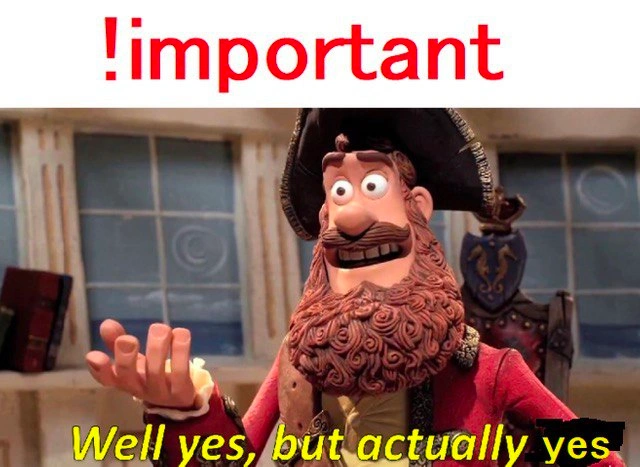
Two layers of joke are stacked here, and both reward CSS scar tissue. The image is the "Well Yes, But Actually No" template — Aardman's claymation Pirate Captain mid-gesture — except the final word has been visibly blacked out and overwritten:

!important "Well yes, but actually yes"

Layer one is the cross-language pun. In nearly every C-family language, ! is the logical negation operator: !important parses, to a polyglot's eye, as "NOT important." CSS, with characteristic chaos, chose the same glyph to mean the exact opposite — a declaration suffixed !important doesn't get negated, it gets promoted above almost everything else in the cascade. So the template's usual bait-and-switch ("yes, but actually no") collapses into deadpan agreement: it says not-important, but actually it is important. The crude black censor bar over the original "no" is part of the humor — the correction is as blunt as the keyword itself.

Layer two is what !important means culturally. The cascade resolves conflicting rules through a specificity algorithm — inline styles beat IDs, IDs beat classes, classes beat element selectors. !important is the table-flip that overrides the entire computation. Veterans recognize it as a confession: somewhere upstream there's a third-party stylesheet, a CMS theme, or a #header .nav ul li a selector from 2014 that nobody dares refactor, and !important was the only escape hatch that shipped before the deadline. Then comes the arms race — the only thing that beats !important is another !important with higher specificity, so codebases accrete escalating layers of them like sediment, each one a fossilized argument someone lost with the cascade. Stylelint rules ban it; design systems forbid it; and yet grep -r '!important' styles/ returns three digits in every mature frontend. It's the sudo of CSS: technically a tool, practically an apology.

The deepest irony: the syntax even lies grammatically. It's not a "bang operator" at all — the CSS spec treats ! as a delimiter token before the keyword important. The pun that powers this meme exists only because a 1990s syntax decision didn't anticipate twenty years of developers who'd learn ! from JavaScript first.

Description

This meme uses the 'Well yes, but actually no' format, featuring the claymation Pirate Captain from the movie 'The Pirates! Band of Misfits.' Above the image, the text '!important' is displayed in a large, bold red font. The original subtitle of the meme format has been cleverly altered from 'Well yes, but actually no' to 'Well yes, but actually yes' in yellow text. This meme humorously explains the function and common misuse of the `!important` rule in CSS. In CSS, `!important` is used to override all other styling rules, effectively breaking the natural cascade and specificity hierarchy. The joke is that while using `!important` is often considered bad practice ('Well yes, [this is bad],'), it is also an absolute and final command that forces the style to be applied ('but actually yes [it will be applied regardless]'). The caption 'Just to be sure, right?' highlights the developer's mindset of using it as a heavy-handed guarantee to fix a stubborn styling issue

Comments

8
Anonymous ★ Top Pick The CSS cascade is a delicate dance of specificity and inheritance. `!important` is the developer who walks onto the dance floor, throws the DJ out the window, and plays their own music at full volume
  1. Anonymous ★ Top Pick

    The CSS cascade is a delicate dance of specificity and inheritance. `!important` is the developer who walks onto the dance floor, throws the DJ out the window, and plays their own music at full volume

  2. Anonymous

    !important is the CSS equivalent of git push --force: instant gratification now, guaranteed post-mortem later, and no one can remember who typed it

  3. Anonymous

    The same developer who wrote a 47-page CSS methodology document is now adding !important to override the Bootstrap modal z-index because the client demo is in 20 minutes

  4. Anonymous

    !important is CSS's admission that its own cascade lost the argument - the specificity equivalent of settling a design review by sudo

  5. Anonymous

    The !important flag is like sudo in CSS - it works every time, your future self will curse you for using it, and there's always that one legacy stylesheet where someone already used it 47 times, forcing you into an !important arms race where specificity goes to die and maintainability becomes a distant memory

  6. Anonymous

    !important: the senior dev's 'ship it now, refactor never' override

  7. Anonymous

    CSS CAP theorem: consistency, themeability, maintainability - pick two; or add !important and pick none

  8. Anonymous

    !important is sudo for CSS - it silences the pager in 5 minutes and funds a multi-quarter initiative called “Specificity Debt” with stylelint ignores, broken theming in microfrontends, and a design-system postmortem

Use J and K for navigation