Skip to content
DevMeme
172 of 7435
Python's Guardrails vs. C++'s 'Hold My Beer'
Languages Post #210, on Mar 9, 2019 in TG

Python's Guardrails vs. C++'s 'Hold My Beer'

Why is this Languages meme funny?

Level 1: Two Babysitters

Imagine a kid announcing, "I'm going to ride my bike off the roof!" One babysitter (Python) grabs the bike and says, "Absolutely not — that's against the rules." The other babysitter (C++) grins, hands the kid a helmet-shaped object that is actually just confidence, and yells "GO FOR IT, DUDE!" The joke is that both pictures show the same kid with the same bad idea — the only difference is which adult is on duty. Programmers love it because choosing a programming language really does feel like choosing between the strict babysitter who keeps you safe and the fun one who lets you find out.

Level 2: Guardrails vs. Power Tools

  • Python is a high-level, interpreted language. It checks your work as it runs: index past the end of a list and you get an IndexError — a polite crash with a stack trace pointing at the exact line. You essentially cannot corrupt memory from normal Python code.
  • C++ is a compiled systems language that hands you direct memory access. This:
int arr[3] = {1, 2, 3};
arr[7] = 42;        // compiles fine. Writes... somewhere. Cowabunga.

compiles without complaint and scribbles on memory you don't own.

  • Segfault (segmentation fault) — the operating system catching your program touching memory it has no right to, and killing it. When C++ devs say "it segfaulted," that's the good failure mode — the bad one is when it doesn't.
  • Exception — Python's structured way of saying "no": the program stops at the offense, with an explanation. Compare debugging an IndexError (30 seconds, read the traceback) with debugging memory corruption (three days, a tool called valgrind, and a personal crisis).

The first-year rite of passage in each language tells the story: in Python it's reading your first traceback; in C++ it's staring at Segmentation fault (core dumped) with no line number, no message, and no mercy.

Level 3: Two Philosophies, One Stupid Idea

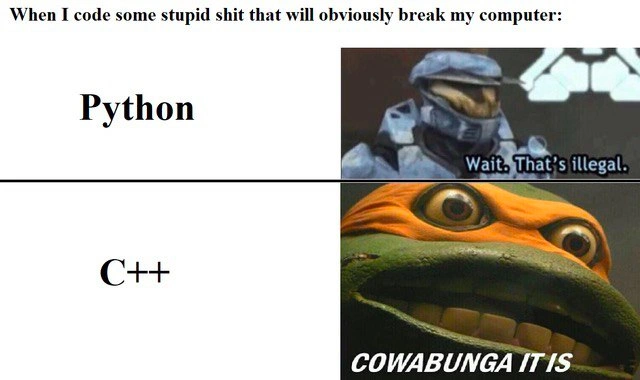
The caption — "When I code some stupid shit that will obviously break my computer:" — frames a language-design Rorschach test. Python, played by a Halo Spartan from Red vs. Blue, delivers the meme-canonical "Wait. That's illegal." C++, played by a feverishly wide-eyed live-action Michelangelo, answers "COWABUNGA IT IS." The casting is impeccable: Python as the armored rules-enforcer, C++ as a mutant party reptile with visibly dilated pupils.

The senior insight is that both responses are features. Python's guardrails — exceptions, garbage collection, no raw pointers — exist because its niche is developer velocity: scientists, scripters, and web backends where a clear TypeError traceback at runtime beats a corrupted result. C++'s permissiveness exists because its niche is the layer under all of that: game engines, kernels, HFT systems, and the CPython interpreter itself — domains where you genuinely need to reinterpret bytes, place objects at specific addresses, and refuse to pay for checks you've proven unnecessary. The meme's "stupid shit" is illegal in one jurisdiction and load-bearing infrastructure technique in the other.

The cultural layer: every C++ programmer has chosen the cowabunga at least once — reinterpret_cast to "just make it work," const_cast to silence an API, pointer arithmetic that would make a code reviewer file a restraining order. The compiler says nothing. It compiles, it ships, and the segfault arrives later like a postcard from your past self. Python developers, meanwhile, experience the opposite frustration: the language stopping them from things that would be fine, thanks. Hence the eternal flame war, compressed into two reaction images.

Level 4: Undefined Behavior as a Contract Clause

The deep reason this meme is technically accurate lives in the C++ standard's most infamous phrase: undefined behavior (UB). The standard defines a contract between programmer and implementation — and for certain operations (out-of-bounds access, dereferencing dangling pointers, signed integer overflow, data races), the contract simply says: all bets are off. Not "an error occurs," not "the program crashes" — the implementation is permitted to do anything, including appearing to work. This is the legendary "nasal demons" clause of comp.std.c folklore.

Why would a language do this? Performance, by design. UB is what lets the optimizer assume your code is correct and reason from that assumption. If arr[i] were required to bounds-check, every array access would pay a comparison-and-branch tax; because out-of-bounds access is UB instead, the compiler may assume i is in range and vectorize the loop, hoist the load, or delete the check you thought you wrote (the classic: if (ptr + len < ptr) overflow tests optimized away, because pointer overflow "cannot happen"). UB isn't sloppiness — it's a deliberate trade of safety for the assumption space that makes C++ fast. Python makes the opposite trade: every bytecode op in the CPython interpreter validates types, bounds, and reference counts before acting, which is precisely why a list overrun raises IndexError instead of reading your TLS keys.

The kicker veterans know: modern UB rarely "breaks your computer" directly — virtual memory and the MMU mean a wild write usually hits an unmapped page and the OS delivers SIGSEGV, the merciful outcome. The terrifying outcome is the write that lands somewhere valid: silent heap corruption that detonates three function calls later in unrelated code, the bug class behind decades of CVEs and roughly the entire motivation for Rust's borrow checker, ASan, and the industry's slow memory-safety reckoning.

Description

This is a two-panel comparison meme that contrasts the safety features of Python with the permissive, low-level nature of C++. The top of the image has text that reads, 'When I code some stupid shit that will obviously break my computer:'. The first panel, labeled 'Python', shows a screenshot of a character from the video game Halo in blue armor with the subtitle 'Wait. That's illegal.' This reaction represents how a high-level language like Python often has built-in protections that prevent a developer from performing obviously dangerous operations. The second panel, labeled 'C++', features a menacing, close-up image of the Teenage Mutant Ninja Turtle, Michelangelo, with a wide, toothy grin and the caption 'COWABUNGA IT IS'. This captures the essence of C++, a language that gives developers the power to perform low-level memory manipulation and other risky tasks, essentially allowing them to proceed with reckless abandon


Comments

8
Anonymous ★ Top Pick In Python, you might get a `PermissionError`. In C++, you might get a BSOD and a faint smell of ozone from the motherboard. The language just assumes you know what you're doing, even when you're casting a struct to a function pointer
  1. Anonymous ★ Top Pick

    In Python, you might get a `PermissionError`. In C++, you might get a BSOD and a faint smell of ozone from the motherboard. The language just assumes you know what you're doing, even when you're casting a struct to a function pointer

  2. Anonymous

    Python: “Hold my traceback, that’s illegal.” C++ with -O3: “I optimized the legality check away, mapped 0x0 as a feature flag, and now we’re 3 ns faster - cowabunga!”

  3. Anonymous

    Python treats you like a junior dev who needs protection from themselves, while C++ assumes you're either a genius or have excellent liability insurance

  4. Anonymous

    Python throws an exception; C++ throws a party in memory you don't own - and the standard's only RSVP is 'undefined behavior'

  5. Anonymous

    The real difference: Python throws an exception and writes a helpful stack trace to your log aggregator, while C++ silently corrupts your heap, crashes three microservices downstream, and the only clue in your distributed tracing is a cryptic 'signal 11' that happened 47 milliseconds after the actual bug. But hey, at least C++ gave you those 3 nanoseconds of performance before summoning undefined behavior from the void

  6. Anonymous

    Python stops you with an Exception; C++ ships it, and the optimizer turns your undefined behavior into a high-performance segfault

  7. Anonymous

    Python's the seatbelt reminding you it's illegal; C++ is flooring it into the guardrail with UB demons cheering

  8. Anonymous

    Python throws; C++ compiles - then -O3 optimizes your footgun into UB that appears only after you disable ASan for performance

Use J and K for navigation