A Cautionary Tale About Befriending Computer Science Majors
Why is this CS Fundamentals meme funny?
Level 1: Project Before Play
Imagine your friend has homework to do every single week, and it’s a really big kind of homework where they have to make something work, like a little machine or a big puzzle. Every time you ask them to come out and play, they say, “Sure, I just need to finish this one thing first!” But that “one thing” ends up taking all day long. It’s like if your friend said they’ll join the game after cleaning their room, and then they spend eight hours trying to fix a toy that keeps falling apart. By the time they’re done (and sometimes the toy still isn’t fixed!), it’s too late to hang out. The joke is showing that computer science students have so much tough homework (writing programs on the computer) that they hardly have any time for fun. They always think the task won’t take too long, but it often becomes a big challenge. It’s funny in a friendly way because we all know that one friend who’s always busy with work, and this says, “Yep, that’s the life of a coding student – their project comes before play!”
Level 2: Hello World, Goodbye Party
Let’s break down what’s happening in simpler terms. Computer Science majors are college students who study how to write software, and that means doing a lot of coding projects for their classes. In many CS programs, every week there’s a new project deadline – for example, one week you might need to code a small game, next week a sorting program, and so on. These assignments are meant to teach different concepts, but they often pile up, leaving students with constant homework that involves programming.
Now, programming isn’t like some homework where you just write an essay and you’re done. Here, you have to write code and then run it to see if it works. Inevitably, at first it doesn’t work. Things go wrong – the program might not even start (run) because of a mistake in the code, or it runs but gives the wrong answers. The process of finding and fixing these mistakes is called debugging. It’s a huge part of coding. When the meme says the student spends 8 hours coding a program that doesn’t run, it means they were debugging for eight hours straight trying to figure out why their code was broken. Eight hours is basically an entire day’s work (often done at night for students). That’s a long time to struggle with one program!
Imagine you wrote an essay but whenever you tried to open it, Word gave you an error – you’d have to figure out why before you can even turn it in. That’s like a program not running: something’s broken at a technical level. Common reasons a beginner’s program “doesn’t run” include:
- Syntax errors – These are like grammar mistakes in code. For example, in C++ or Java, forgetting a semicolon
;at the end of a line will prevent the code from running at all. The compiler (the tool that turns code into an executable program) will throw an error, and you can’t run the program until it’s fixed. It’s akin to forgetting a period in a sentence – the computer gets confused reading your code. - Runtime errors – These occur when the code starts running but hits a problem and crashes. A classic newbie mistake: dividing by zero in a calculation, or messing up an array index. For instance, if you have a list of 4 items and try to access the 5th item, the program will throw an error (since that index doesn’t exist). Here’s a quick illustration:
numbers = [1, 2, 3, 4]
print("The last number is " + str(numbers[4]))
# Error: IndexError because there is no index 4 (last index is 3).
In this snippet, the list numbers has indices 0,1,2,3. Asking for numbers[4] causes an IndexError: list index out of range. A student might spend hours figuring out why their code crashes only to realize they accidentally went one index too far!
- Logical errors – The code runs without crashing, but it doesn’t do the right thing. Maybe your sorting algorithm sorts the numbers incorrectly, or your game character moves in the wrong direction. These can be even more time-consuming because the program runs, but the output is wrong, so you have to trace through your logic to find the mistake.
Debugging often involves using tools or methods to troubleshoot. Beginners usually start with simple methods like adding print statements in the code to check if variables have the values they expect at different steps. For example, if a student’s program isn’t doing what it should, they might insert lines to print intermediate results to see where it goes off-track. It’s not the most efficient method, but it’s an entry point (many of us have done plenty of printf debugging or print debugging at first). More advanced methods include using a debugger tool that lets you run the code step-by-step, but learning that can itself take time. Early on, many students just repeatedly run the program, see it fail, tweak something, and try again — which can indeed take eight hours or more before the program finally works (if it ever does before the deadline!). This explains why your CS major friend said “it isn’t that bad” initially — they thought the coding part was straightforward — but they didn’t account for the bug-hunting safari that came after.
Now, about the social angle: when the meme says “Do NOT become friends with computer science majors!!!!”, it’s obviously joking, but it highlights that CS students are so busy that they often seem unavailable. If you ask a CS major to hang out, you’ll probably hear something like, “Sure, I just have to finish this project first.” They’re not trying to blow you off; they really do have work to finish. But what happens next is the funny/tragic part: that “quick” finishing touch on the project turns into an all-day affair. Because, as we just discussed, coding projects love to hide surprise bugs that trap the student for hours. Before they know it, the day (or night) is gone. So the friend who said “I’ll come after I’m done” ends up never showing up to the hangout because they literally spent the whole time debugging. It’s like a running gag in college: “Where’s Alice?” – “Oh, her code isn’t working so she’s stuck in the computer lab again.”
For junior developers or students, this meme is super relatable. It reminds them of their own late-night coding sessions – those times when you start an assignment after dinner and suddenly it’s 3 AM and you’re still staring at an error message. It’s also a bit of a warning: ComputerScienceHumor like this often serves to say “You are not alone.” Everyone learning to code goes through a phase where debugging feels endless and you have to sacrifice some social events to finish homework. Of course, it’s important to learn balance (even CS majors need sleep and fun!), but during crunch time for project deadlines, balance often goes out the window.
The tags like LearningToCodeJourney and DebuggingFrustration are exactly what’s depicted: the journey of learning to code is full of frustrating moments when nothing works and you doubt your abilities. The good news is, each time you solve a tough bug, you learn a ton and get a little faster for next time. But the meme opts to laugh at the situation, because honestly, when you’re in that moment, sometimes all you can do is laugh (or cry, then laugh later). And when it’s over, these become almost fond memories—war stories you and your classmates bond over: “Remember that one project that took us all night to debug? We thought we’d never get it done!”
In summary, this meme is explaining (in a joking way) that CS majors are always busy coding, often under deadline pressure, and their code often breaks at first, leading them to spend hours fixing it. That’s why if you have a friend studying CS, you might find it hard to hang out with them – not because they don’t want to, but because their workload is truly heavy and unpredictable. The phrase “program that doesn’t run” is practically a rite of passage in coding: every newcomer experiences the dreaded moment when nothing works and you have no idea why. But hey, after enough all-nighters and debugging nightmares, those CS majors emerge as software engineers who can eventually make programs run in far less than 8 hours... most of the time 😉. It’s all part of the learning process!
Level 3: Major Project, Minor Social Life
The meme hits on a painfully relatable pattern in computer science education: every week brings a new programming project, each supposedly "isn't that bad" until reality hits. The humor here comes from the stark truth that CS majors live in an infinite loop of deadlines. A friend asks, "Wanna hang out?" and the CS student replies, "Sure, I just gotta finish a project first," not realizing that this “quick” coding task will snowball into an 8-hour debugging session. It’s an ironic cycle of optimism and despair: they downplay the project’s difficulty, then spend the entire day (and night) wrestling with code that stubbornly won’t run, all while their social plans irretrievably null-out.
This scenario satirizes the deadline pressure cooker of a CS curriculum. Many computer science programs assign major projects every week (implementing data structures, building mini-apps, writing algorithms, etc.) to solidify learning. On paper, each assignment seems manageable – professors might say, “This should only take a few hours if you understand the material.” 😅 In practice, these projects often hide tricky edge cases and unforeseen complexities that turn into all-night coding marathons. A student might start a simple web app for class, only to discover a mysterious bug that breaks everything. Suddenly those few hours explode into a full-blown late-night debugging session, complete with frantic Googling of error messages and pleas for help on Stack Overflow. The meme exaggerates, but any seasoned dev can recall a night where a missing semicolon felt like a boss-level bug keeping them from victory (and from sleep).
Why is this so funny (or tragic) to insiders? Because it pokes at a universal truth: coding always takes longer than expected. There’s even Hofstadter’s Law in CS – “It always takes longer than you expect, even when you take into account Hofstadter’s Law.” Seasoned programmers laugh (perhaps a bit cynically) because they’ve been there: telling family or friends “I’ll be done in an hour” and emerging from a debugging bunker at dawn. The meme’s hyperbole (“DO NOT become friends with CS majors!!!”) playfully warns that CS students have no free time, as if cursed by their major. Indeed, CS majors often become ghosts in their social circles during the school year, forever saying “can’t tonight, I have to code.” The line about contemplating dropping out over each “not that bad” project is an extra punch – it captures that dark night of the soul many students face around 3 AM when the code still won’t compile. In those moments, even the most enthusiastic student wonders, “Why did I sign up for this? Maybe I should have majored in something with less...computer...and less science.” It’s funny because it’s true: the struggle is real, and almost every CS student has dramatically considered quitting at least once per semester, only to soldier on the next morning.
On a deeper level, the meme highlights how learning to code often means learning to debug. New developers quickly discover that writing the initial solution is just half the battle – the other half is fixing everything that’s broken. This trial by fire is essentially a crash course in problem-solving and resilience. While the meme is about college, seasoned engineers in the industry are nodding knowingly because, surprise, the habit of “just one more tweak before I join you” can follow you into your career. Production bugs and last-minute feature fixes have led many a professional to cancel dinner plans. That feeling when a program doesn’t run after hours of effort is universally agonizing, whether you’re a first-year student or a staff engineer. The difference is, professionals have (hopefully) learned more systematic debugging techniques – and they’re getting paid for the pain. But the shared trauma? That never quite goes away.
Crucially, this meme resonates as a form of coding humor therapy. It’s a way for students and developers to laugh at the absurdity of devoting an entire day to chase down a tiny error. Consider a typical scenario a CS major might face: a weekly project to implement, say, a sorting algorithm or a small game. They think, “I understand the theory, it shouldn’t be too bad.” Hours later, the code is almost working, except it crashes on certain inputs. The student then spends the rest of the night in a debugging trance – adding print statements, stepping through logic, maybe even performing a ritual rubber-duck debugging session (explaining the code line-by-line to an inanimate duck or a confused roommate). Meanwhile, their friends are out relaxing or sleeping. By the time the bug is found – perhaps an off-by-one error or a forgotten edge case – the sun is rising, the student’s eyes are bloodshot, and their social life...well, that wasn’t saved to git.
This endless cycle of project deadlines is something of a rite of passage in the LearningToCodeJourney. It can foster great camaraderie among CS majors (“Did you get the code to run? No? Me neither, let’s grab coffee.”). It’s darkly funny because it’s exaggerated truth: no, being friends with a CS major isn’t truly forbidden, but you will become intimately familiar with the glow of their laptop screen as your plans get postponed yet again. The meme encapsulates that dual identity of a CS student – part college kid, part nocturnal code gremlin. In summary, the humor is a mix of schadenfreude and solidarity: if you’ve lived through those late nights of debugging despair, you can’t help but laugh (and maybe cry a little) at how accurately this meme nails the experience.
Description
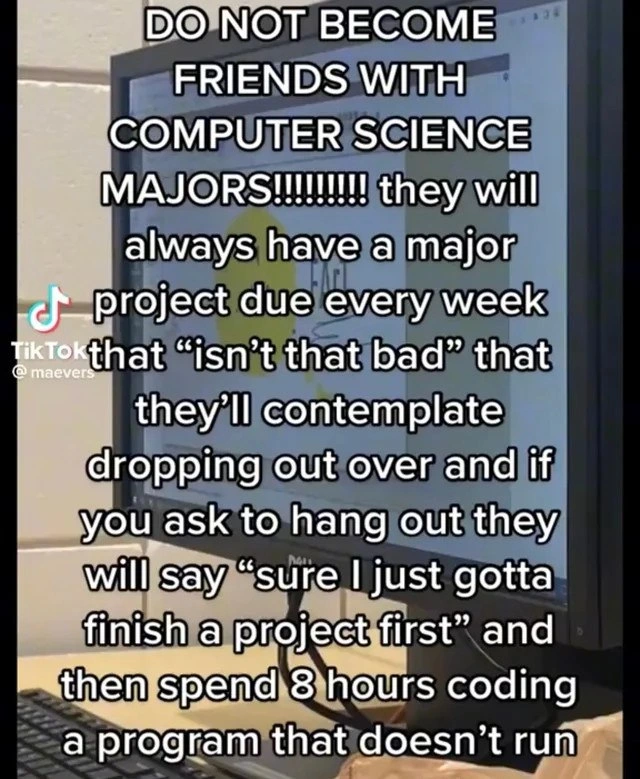
This image is a screenshot of a TikTok video that presents a humorous public service announcement about the social lives of computer science students. The image displays a large block of white, bold text overlaid on a blurry background showing a computer monitor and keyboard. The text reads: 'DO NOT BECOME FRIENDS WITH COMPUTER SCIENCE MAJORS!!!!!!!! they will always have a major project due every week that “isn’t that bad” that they’ll contemplate dropping out over and if you ask to hang out they will say “sure I just gotta finish a project first” and then spend 8 hours coding a program that doesn’t run'. This meme perfectly encapsulates the stereotypical high-stress, high-workload life of a CS major. It highlights the cycle of underestimating project difficulty, the resulting all-consuming coding sessions, and the frequent frustration of ending up with non-functional code, making social plans nearly impossible

Comments
8Comment deleted
CS students are just junior developers in their larval stage, trading a salary for student debt and a production outage for a failing grade. The core feedback loop of 'it doesn't run' remains identical
CS majors burn eight hours trying to make it compile; 20-year vets burn eight hours deciphering why it only deadlocks when the feature flag is OFF, the leader pod migrates, and Jupiter is in retrograde
Twenty years later, they're still saying "just gotta finish this one thing first" except now it's a distributed system with 47 microservices, and the thing that doesn't run costs $80,000 a month in AWS bills
The classic CS major time dilation phenomenon: where 'I just need to finish this project first' exists in a quantum superposition of both 20 minutes and 8 hours until observed by a frustrated friend. The real O(n!) complexity isn't in the algorithm - it's in the relationship between estimated completion time and actual debugging sessions required to achieve exit code 0
CS majors call it homework; seniors call it pre‑on‑call training - estimate “not that bad,” then burn eight hours chasing a cold-start bug before the 23:59 cutoff
College: eight hours on a program that doesn’t run. Enterprise: eight teams on a microservice that only runs in staging. Same vibe, better acronyms
That 'quick project' always scales from O(1) optimism to O(n²) social regret
You just insulted my entire race. But yes Comment deleted