Great Product vs. Great Marketing: The Startup Dilemma
Why is this Marketing meme funny?
Level 1: Lemonade Stand Lesson
Imagine two kids on the same street decide to sell lemonade on a hot day.
Kid A spends a lot of time squeezing real lemons and mixing the tastiest lemonade in town. It’s honestly delicious! But Kid A is a bit shy. He sets up a plain table in his yard with a small sign that just says “Lemonade.” He doesn’t tell many people; he just hopes someone notices. All day, only a couple of people walk by, and most don’t even realize there’s amazing lemonade right there. He’s left sitting sadly with his jug still full.
Kid B isn’t as good at making lemonade – in fact, his lemonade is kinda watery and just from powder mix. But he’s super good at getting attention. He puts up big bright posters that read “World’s Best Lemonade – Free Sample!” and he’s out by the road yelling, “Ice-cold lemonade, get your lemonade!” He even has balloons and maybe some music playing. People walking by can’t help but notice Kid B’s stand. A big crowd comes over out of curiosity and excitement. They’re smiling, trying samples, and buying cups. They don’t really know (or initially mind) that his lemonade isn’t that great, because they’re caught up in the fun and the hype.
In the end, Kid B sells a lot more lemonade simply because he got everyone’s attention, while Kid A – who actually had the better drink – barely sold any because nobody really noticed him. It feels a bit unfair, right? The lesson is that just having a great thing isn’t enough if no one knows about it. Sometimes the kid who makes the most noise wins initially, even if what they’re offering isn’t the best. That’s exactly what the meme is joking about: in life (and business), being good at showing and telling can matter as much as being good at making.
Level 2: Hype vs Substance
Let’s break this down in simpler terms. We have two founders (people who start new companies) and two very different outcomes:
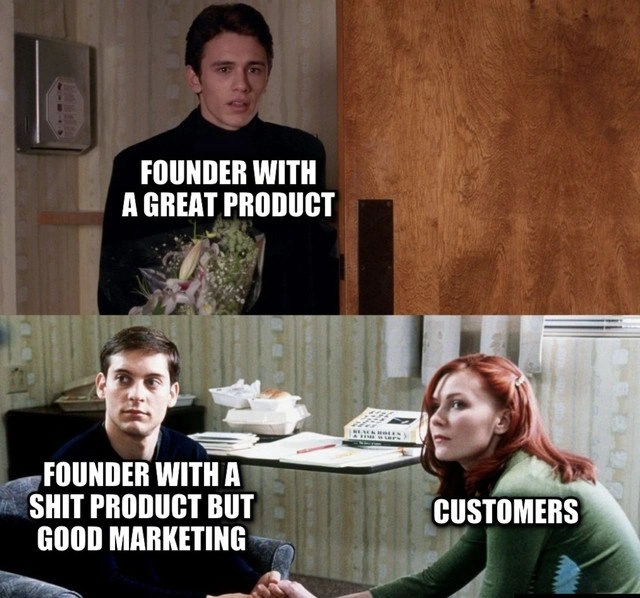
The first founder has a great product – meaning he built something high-quality that probably works really well or has awesome features. Picture an app or gadget he crafted with excellent engineering. However, he’s standing outside a door and nobody is letting him in. Why? Because no one knows about his product. He hasn’t done much marketing (promoting or telling people about it). So even though his product is excellent, customers (the people who would use or buy it) aren’t aware of it. They’re not opening the door for him, literally in the meme and figuratively in real life. This is the classic case of a founder thinking “If I build something amazing, people will automatically find out and come flocking,” but unfortunately, that’s not how it usually works.
The second founder has a "shit product but good marketing" (using the meme’s blunt wording). In plain language, his product isn’t very good – it might be unfinished, low quality, or just not a great solution. But he’s excellent at marketing: he knows how to get people excited and interested. In the meme, he’s shown holding hands with a woman labeled "Customers" – meaning he’s already gotten customers to like him and his idea. How did he manage that? Through hype, storytelling, and outreach. He probably talked about the product in a really appealing way, maybe made a flashy demo or a cool website, and generally created a buzz. The customers are essentially dating him in the picture – a funny way to show they’re interested and engaged – despite his product’s poor quality.
So the meme humorously compares product quality with marketing quality. At an early-stage startup (a new company just starting out), it’s common to see this contrast. A founder who is very engineering-focused might pour all their time into coding and perfecting the product (lots of engineering_effort). But if that founder doesn’t also spend time on customer_acquisition_tactics – things like running ads, posting on forums, doing email campaigns, hyping it on Twitter or at events – then potential users might never hear about the great product. It’s like shouting into a void.
On the other hand, a founder who focuses on marketing will make sure everyone hears about their product. They’ll network, craft a compelling story for why their product is exciting, maybe use some StartupLife hacks like referral programs or viral marketing. They might even exaggerate a bit (that’s the “hype” part of hype_over_substance). The result? They gain initial traction (sign-ups, user interest, maybe even investors) quickly, even if the product itself is just okay or even problematic. This is often called “fake it ’til you make it” in startup culture – where you promise big, get people on board, and then scramble to actually make the product as good as you claimed.
Let’s define a few key terms to make sure everything’s clear:
- Marketing: In this context, marketing means all the ways a founder can promote their product and convince people to try it. It includes advertising, social media buzz, a persuasive pitch, good branding, and engaging storytelling about the product. Good marketing makes people feel like they need this product or that it’s the next big thing.
- Product quality: How good the product actually is in terms of functionality, reliability, and solving the problem it’s meant to solve. A great product does what it promises, doesn’t break, and users typically love its performance. A "shit product" (crass language aside) means a poor-quality product – it might be buggy, lacking features, or not really solving the problem effectively.
- Customers: The people who would buy or use the product. Early-stage startups often have to fight hard to get these people’s attention because nobody knows the startup yet.
- Early-stage startup: A new company in its first phase, usually still figuring things out like who their customers are and what exactly the product should be. Early-stage startups often have limited resources, so the founders have to choose where to put their effort (building the product vs. marketing it, or ideally some balance of both).
- Product–market fit: This is a term in entrepreneurship meaning the product has found a good market – i.e. the solution matches what customers really want/need, and it practically “sells itself” because people value it so much. However, getting to product-market fit often requires marketing in the beginning because you need to reach those customers and maybe adjust the product based on their feedback. The meme’s first founder might actually have built something with potential for product-market fit, but without customers to try it, he can’t prove that. The second founder might not have product-market fit at all (since the product is “bad”), but his marketing creates an illusion of fit for a while by drawing interest.
Think of it this way in simpler cause-and-effect:
- If you don’t promote your great product, no one knows about it. No users, no feedback, no revenue – the startup struggles.
- If you do promote even a not-so-great product heavily, people at least give it a look. You might get users to sign up out of curiosity or excitement. Some will leave once they see issues, but some might stick around or give feedback that helps you improve.
For someone new to the startup world, the meme is pointing out a common beginner’s mistake: assuming that just building something awesome is enough. In reality, having a plan to get customers is just as important. The founder with the bouquet (great product) forgot to send out invitations to the party, so no one came. The other founder basically threw a noisy parade for a not-great product, and people showed up for the spectacle.
It might seem unfair, but early on, perception can matter as much as reality. Good marketing can create opportunities – it opens the door. Of course, once the door is open, the product needs to eventually deliver value. But the meme’s joke is about that initial door-opening moment. It’s a lesson to new developers or founders that building something is only step one; step two is selling the idea – getting people excited enough to try it. In short, Hype vs Substance is the duel here, and hype is shown winning round one. The takeaway for a junior developer or budding entrepreneur: don’t ignore the power of marketing and presentation, even if you’re focused on engineering. The best product in the world won’t make an impact if it remains a well-kept secret.
Level 3: Sell the Sizzle, Not the Steak
This meme hits on a painful truth in StartupCulture: having the best tech solution means nothing if nobody’s paying attention. In the top panel, a founder with a meticulously crafted product is standing at a closed door with a bouquet (representing his beautiful codebase or carefully built app). The door stays shut – customers aren’t even aware he’s there. Meanwhile, the bottom panel shows another founder (with a far less polished product) happily holding hands with Customers across a table. His secret? Slick marketing and a compelling story. The humor (tinged with despair) comes from this stark contrast: the superior product is lonely, while the inferior one is winning hearts and wallets thanks to hype. It’s essentially showing us hype_over_substance in action.
In the real startup scene, this scenario is almost a rite of passage. Founders often learn the hard way that you can’t just code in a vacuum and expect users to magically appear. The meme’s caption “FOUNDER WITH A GREAT PRODUCT” paired with an unanswered door illustrates the classic Field of Dreams fallacy: If you build it, they won’t necessarily come. The second caption “FOUNDER WITH A SHIT PRODUCT BUT GOOD MARKETING” depicts the flip side – a mediocre (even bug-ridden half-baked) product can gain early traction if it’s promoted with enough sizzle. It’s funny because it’s true: we've all seen a startup with a slick website, viral launch video, and buzzword-packed pitch deck steal the spotlight from a more deserving, engineer-approved solution that nobody’s heard of.
Why does this happen? In early-stage startups, go-to-market execution often matters more than technical perfection. Real talk: a brilliant product that solves a problem will fail if no one knows about it. On the other hand, a product with known flaws can still attract users (and even investors) if it captures imagination or FOMO through savvy marketing. It’s a case of ProductManagementHumor meeting cold reality: the founder who spent months obsessing over clean architecture and flawless features might get outshined by the founder who spent that time crafting a persuasive story and building hype on social media. One built the steak, the other sold the sizzle.
This meme resonates with experienced developers and entrepreneurs because it satirizes founder_struggles we’ve either lived or witnessed. It hints at those startup pitch competitions where the flashy presenter with an iffy prototype wins, while the quiet coder with an actually working product gets a polite nod. It’s the marketing_vs_reality gap: real value vs. perceived value. The engineering_effort_ignored vibe in the top panel is something many devs fear – “What if all my hard work gets ignored because we didn’t tweet about it enough?” Meanwhile, the bottom panel exudes hype_over_substance, reminding us of that one startup in our space that kept getting clients and press mentions even though their app crashes every other click.
From a Stakeholders_Clients angle, it also underscores how stakeholderExpectations are set early. Strong marketing builds high expectations and emotional connection with customers or investors. By the time they discover the actual product is subpar, those customers might already be invested (emotionally or financially) – or the startup has a window to improve. Conversely, the great product founder never got a foot in the door, so stakeholders never gave the product a chance at all. It’s a cynical joke that in a pitch meeting or on Product Hunt, storytelling can beat engineering – at least initially.
To put it in pseudo-technical terms (we are devs, after all):
# Pseudo-code for startup traction
for startup in startups:
if startup.product_quality > 9 and startup.marketing_effort < 1:
print("😔 No one notices the great product.")
elif startup.product_quality < 5 and startup.marketing_effort > 8:
print("🔥 Customers line up for the hype.")
The code above tongue-in-cheek illustrates the meme’s premise: a top-tier product with near-zero marketing results in crickets, while a low-quality product with top-tier marketing sets the world on fire (at least initially). It’s obviously an exaggeration – product quality does matter in the long run (an actually terrible product will face churn or bad reviews eventually). But the meme’s humor lives in that short-term absurdity where slick marketing can paper over a product’s flaws long enough to gain traction. It’s poking fun at the sometimes absurd priority of customer_acquisition_tactics over robust engineering in early startup life.
In summary, the top founder is every engineer who’s whispered, “Our tech is so good it will sell itself” – and then felt heartbreak when reality said otherwise. The bottom founder is the hustler who lives by “fake it ’til you make it,” stirring up excitement (and maybe a bit of smoke and mirrors) to get those first users through the door. The meme cleverly captures this core tension of startup life: you need both a great product and great marketing, but early on, if you can only pick one, marketing often wins the first round. And as bitter as that truth can be (especially to the idealistic builder inside us), we can’t help but laugh at how accurately this meme portrays it. It’s funny because it’s true – and it hurts a tiny bit, too.
Description
This two-panel meme uses a scene from the Sam Raimi 'Spider-Man' films to illustrate a common business frustration. In the top panel, Harry Osborn (played by James Franco) looks hopeful while holding a bouquet of flowers, labeled 'FOUNDER WITH A GREAT PRODUCT'. In the bottom panel, Peter Parker (Tobey Maguire) sits intimately with Mary Jane Watson (Kirsten Dunst). Peter is labeled 'FOUNDER WITH A SHIT PRODUCT BUT GOOD MARKETING', and Mary Jane is labeled 'CUSTOMERS'. The meme humorously and cynically points out that in the marketplace, superior marketing often triumphs over a superior product, capturing customer attention and loyalty even when the underlying technology or service is lacking. This is a particularly resonant pain point for engineers and product-focused founders who believe in meritocracy and can be frustrated when technically inferior competitors win due to better sales and marketing execution
Comments
7Comment deleted
We spent a year perfecting a sub-50ms API response time just to lose the market to a company that wrapped a Google Sheet in an API and spent their entire seed round on LinkedIn ads
Six months refining an idempotent event-driven architecture; competitor ships a Figma mock labeled “AI-powered” and closes Series A - apparently eventual consistency applies to revenue too
The engineering team spent three years perfecting the distributed consensus algorithm while the competitor shipped a CRUD app with a landing page that says "AI-powered" and got to Series B
The eternal startup paradox: you can architect a beautifully scalable, fault-tolerant system with 99.999% uptime, but if your competitor has a flashy landing page and a charismatic founder who can spin a good story at TechCrunch Disrupt, guess who's getting the Series A? It's the enterprise software equivalent of watching someone choose a relationship based on the Instagram aesthetic rather than compatibility - except in this case, the customers are willingly signing multi-year contracts with the marketing wizard while your technically superior solution collects dust in a private GitHub repo
Reminder: the most performant serialization for revenue is still PPTX; without distribution, your beautifully engineered service is just running on localhost
Great product sans marketing: a perfectly indexed database where every query returns zero rows
We tuned the SLOs; they tuned the CAC. Guess which dashboard the customers looked at